
Contents
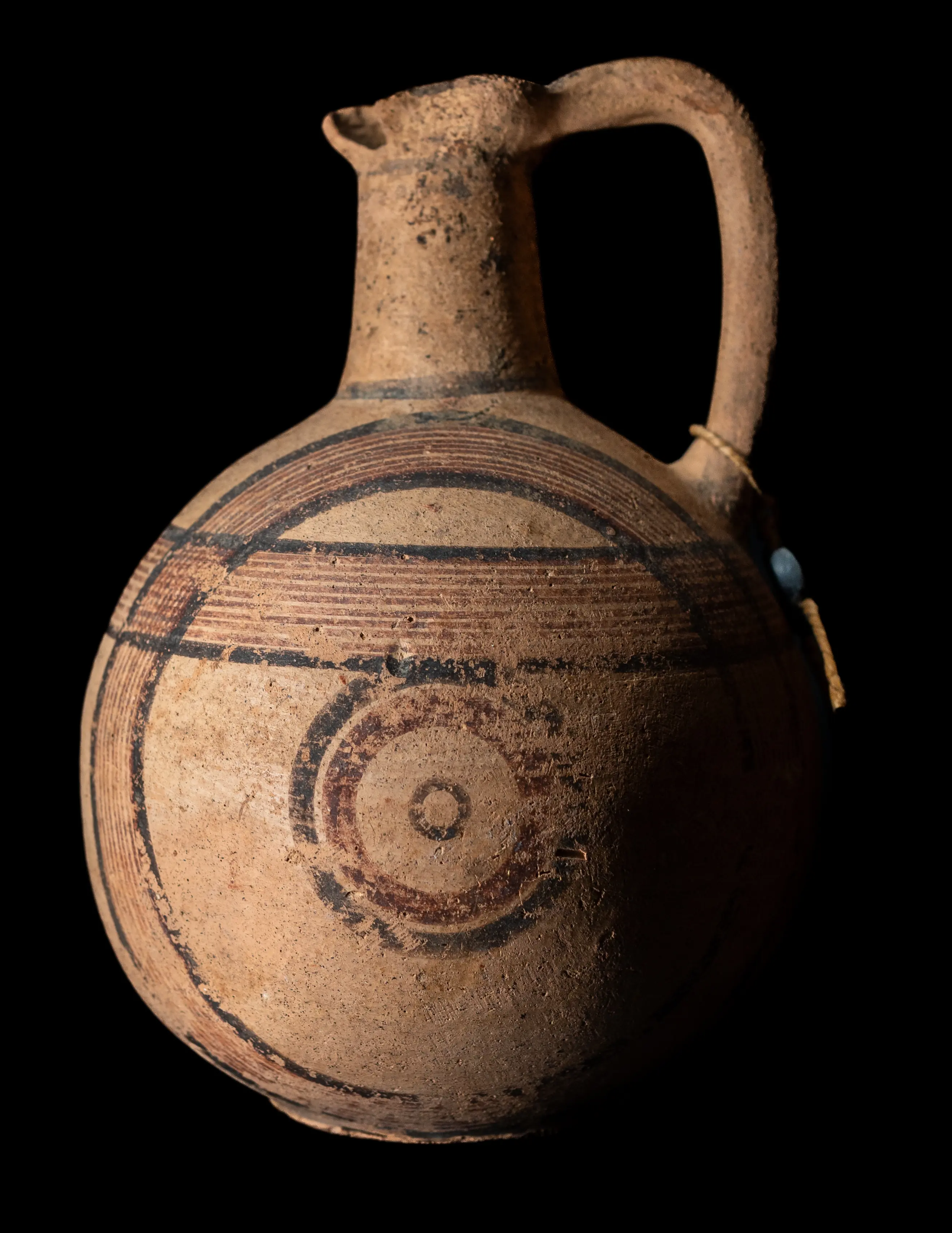
When a Cypriot pot comes up for sale today, the first question asked of it is whether its history can be shown to reach back before 1974. If it can, the pot is treated as an ordinary antiquity with an owner. If it cannot, it is treated as a possible product of the looting that followed the Turkish invasion of July 1974, and the burden of showing otherwise falls on whoever holds it. That presumption is now the working rule of the Department of Antiquities, of the larger auction houses and of most buyers, and it has good reasons behind it: the occupied north was looted, churches above all, and much of what Cypriot collectors bought in the decade before the invasion had been dug illicitly. But the presumption runs against the larger part of the documented record. For about 120 years before 1996, Cypriot antiquities left the island through lawful channels and in very large numbers, and most of the objects that reach the market today are the descendants of that traffic, many of them with their paper long since lost. The jug whose lead seal heads this page, a Bichrome oinochoe in this site's collection, is one of the objects the question is asked of.
How 1974 became the date-line
Three dates now govern the paperwork of a Cypriot antiquity, and they were set for different reasons. The first is 1970, the year of the UNESCO Convention on the illicit import, export and transfer of ownership of cultural property. The Convention binds states, not private owners, and it is not retroactive; Cyprus ratified it in 1979 [1], and Karageorghis, then Director of Antiquities, welcomed American ratification when he was interviewed in 1983 [2]. Museums and the larger salerooms have adopted it as an ethical benchmark, asking for a history documented to before 1970 or to a lawful export after it. The ethics of that benchmark are argued in the article on UNESCO 1970.
For Cypriot material, 1970 falls four years before an event that changed what an undocumented object was assumed to be. After the invasion the Republic lost access to the northern third of the island, its churches, its cemeteries and the registered collections kept there. From then on, any Cypriot antiquity without a recorded history could have come from the occupied areas, and the date that buyers and officials began to ask about was 1974. The entry on collecting today puts it plainly: the 1970 date-line is a professional standard, "and for Cypriot material 1974 is the date that matters". The Republic's own export rule pointed the same way. In the 1983 interview Karageorghis set out the policy: objects "legally acquired and duly registered by December 31, 1973", and not needed by the Cyprus Museum, could be exported with a permit, and the Department kept a Sales Register of items at nominal prices for universities and museums [2]. Lawful export therefore went on after the invasion, but it rested on registration completed before it.
The third date is American. On 16 July 2002 the United States and Cyprus entered into a bilateral agreement under the Convention on Cultural Property Implementation Act, and import restrictions were imposed on designated Cypriot archaeological material three days later [3]. The agreement has been extended at five-year intervals; the current restrictions, as amended in July 2022, run through 13 July 2027, and the designated list now covers archaeological material "ranging in date from approximately the 11th millennium B.C. to A.D. 1770", with ecclesiastical and ethnological categories alongside [3]. A designated object exported from Cyprus after its designation cannot enter the United States without a certificate from the Republic that its export was lawful, or satisfactory evidence that it left Cyprus on or before the designation date or more than ten years before entry [4]. The question of when an object left Cyprus thereby became a customs question as well as an ethical one.
Dealers and auction houses have folded these dates into one working habit. The accurate description of the larger houses' practice is that they want a checkable history. Christie's has sold Cypriot pieces whose recorded history begins in 1977 and in 1989, so the rule is not a strict pre-1970 bar, but an object with no history at all does not reach those rooms. The smaller regional and online houses, where most Cypriot lots are now sold, apply the rule less consistently, and it is there that the Department of Antiquities applies it for them.
What the presumption does in practice: the withdrawals of 2025 and 2026
The Department of Antiquities has staff who watch online sale catalogues for Cypriot material. When they find a lot they object to, the Department writes to the auction house, the house withdraws the lot, and the holder hands the object to a Cypriot embassy or high commission. The announcements of 2025 and 2026 show what the presumption catches; the monitoring as a whole is described in policing and monitoring.
| Auction house | Object(s) | Handed over | Source |
|---|---|---|---|
| Brunk Auctions and Nadeau's Auction Gallery (USA) | Two Bichrome vessels, a jug and a juglet | November 2025, embassy in Washington | [8] |
| The Cotswold Auction Company, Cirencester (UK) | A Black-on-Red juglet, about 7 cm tall, Cypro-Archaic | November 2025, at the auction house | [9] |
| Sloans & Kenyon (USA) | Two Early and eleven Middle Bronze Age vessels, four Cypro-Archaic vessels, a 4th-century BCE limestone head | 23 February 2026, embassy in Washington | [10] |
| Watsons Auctioneers (UK) | A Black-on-Red III (IV) jug, Cypro-Archaic I, rim missing | 7 March 2026, High Commission in London | [11] |
| Kleinfelter's Auction (USA) | A White Painted V juglet, Cypro-Archaic II | 27 March 2026, embassy in Washington | [12] |
| Halls Fine Art Auctioneers (UK) | A Base Ring juglet, Late Cypriot I–II, about 1450 BCE | 23 June 2026, High Commission in London | [13] |
Three things stand out from the list. Every house is a regional or online saleroom; none is Christie's, Sotheby's or Bonhams. Almost every object is an ordinary pot of a class that survives in thousands, the Bichrome, Black-on-Red, White Painted and Base Ring jugs and juglets that the licensed trade and the Cyprus Museum's own sales counter sold in quantity for decades; the one piece of sculpture is a single limestone head in the Sloans & Kenyon group. And no announcement names a trafficker, alleges a theft or gives a findspot. The Department thanks the auction houses and "the donors for voluntarily returning the artefact" [11]; the Halls juglet was returned by its unnamed "holder" [13]. None of the reports says when or how a particular object left Cyprus.
Returns made directly by families have the same character. In July 2024 the heir of a German citizen who had worked at the German embassy in Nicosia handed over 37 pieces, Bronze Age to medieval pottery and lamps, which he had taken from Cyprus in the 1960s [14]. It was a household holding of the kind foreign residents of the island formed before 1974, returned because its owner chose to return it.
What the withdrawals record, then, is the presumption at work on the old, undocumented stock that heirs and house-clearers consign to small salerooms. They are not evidence of a present flow of loot, and the Department's announcements do not present them as such. The economics are consistent with that reading: in our own unpublished research on 2,168 Cypriot vessels sold at auction, the median price was about 820 dollars, and about nine sales in ten take place at the cheaper venues where all of these lots were found.
Why the presumption reverses the documented history
The presumption treats the absence of a pre-1974 record as a sign of post-1974 removal. The documented history points the other way, because the lawful channels out of Cyprus were older, longer-lived and far larger than the illicit ones. The entry on legal export sets them out in sequence: Ottoman firmans and consular digging before 1869, the partage of the 1874 regulation, which gave a third of a licensed excavation's finds to the excavator, the permissive British years to 1905, the Antiquities Laws of 1905 and 1935, the Swedish partage of 1930, the Cyprus Museum's own saleroom, the licensed dealers of Nicosia and Famagusta from 1935, and licensed export from the Republic until the amendment of 1996. Luigi Palma di Cesnola alone removed tens of thousands of objects in the 1870s; the Metropolitan Museum later sold thousands of his "duplicates", and the Lawrence-Cesnola sales at Sotheby's dispersed many more. The saleroom in the Cyprus Museum's courtyard, which ran until 1991, is described in How the Cyprus Museum Sold Antiquities, and the wider story of dealers and buyers in How Cyprus's Past Was Sold.
Licensed export did not stop at the invasion. Karageorghis's 1983 statement of policy describes permits still being issued for registered objects and a Department Sales Register still encouraging exports [2], and Fehlmann notes that until 1996 export from the Republic was permitted "as long as the Department of Antiquities had provided a licence" [7, p. 156]. So an object can have left Cyprus lawfully after 1974, under a licence issued in Nicosia, and still have no paper before 1974 in the hands of its present owner.
The auction record shows how much of the old lawful stock still circulates, and how little paper travels with it. Martin Fehlmann, writing from Eastern Mediterranean University in occupied Famagusta and openly polemical on this subject, had every antiquity offered at Christie's and Sotheby's between 1988 and 2008 counted: 52,482 lots, of which 1,842 were identifiably Cypriot. Of those, 377 had a history documented before 1970, and fifteen could be traced to the Metropolitan Museum's Cesnola sales of the 1920s [7, p. 161]. Read under the presumption, the other 1,465 are suspect. Read against the export record, most of them are more plausibly objects whose earlier owners never wrote anything down. Fehlmann draws a market argument from the same figures: had the 60,000 objects that the Republic's authorities say left the north after 1974 passed through the international market, "this volume would have caused the collapse of prices for Cypriot antiquities", and he puts the true number at "a few thousand" [7, p. 161]. His estimate is his own inference, and it should be read as his.
The distinction that keeps this argument honest is between how an object left the island and how it came out of the ground. "Left lawfully" concerns title and export: the object went abroad under the rules of the day, with a permit, a partage share, a Museum sale or a dealer's licence. It says nothing about who dug it up. A great deal of what the licensed trade and the Museum's counter sold had been found by farmers, builders and tomb-robbers rather than by archaeologists, and the law of the day made it saleable after the fact. The case this section makes is about the first question, and on the first question the record is strong.
What the presumption gets right
The strongest evidence against the argument of this page is real, and it comes from the Department of Antiquities itself, from scholars who have studied the trade closely, and from the courts.
The occupied north was looted. The best-known case is church art rather than archaeology: the sixth-century apse mosaic of the Panagia Kanakaria at Lythrankomi was cut from the wall "some time between August 1976 and October 1979", four of its fragments were bought in the duty-free zone of Geneva airport in July 1988 by an Indianapolis dealer "making only the most cursory of investigations", and the Republic and the Church of Cyprus recovered them in an Indiana court, under a law by which "a thief can never acquire good title" [15]. Icons, frescoes and mosaics are a different class of object and a different market from ancient pottery, and the sibling entry on looting in the occupied north keeps the two apart. But antiquities were taken too. Interviewed in 1983, Karageorghis reported "widespread looting of moveable objects from tombs and collections" in the occupied areas, and gave the registered Hadjiprodromou collection of Famagusta as his example: "only 40 or 50 of approximately 2,000 items have been recovered" [2]. Fehlmann, the sharpest critic of the official numbers, accepts that "apparently well-informed gangs regularly plunder archaeological remains in the North of the island" [7, p. 161].
The decade before the invasion is harder ground for the lawful-trade argument than the north. Between 1963 and 1973 Greek Cypriot collectors bought antiquities on a large scale, much of it looted from Turkish Cypriot enclaves outside the government's control. Karageorghis described the policy in a letter to Antiquity printed in 1976: the collections were formed "with the silent accord of the Department of Antiquities, which considered this to be the best policy to follow in view of the anomalous political conditions prevailing in Cyprus"; every item was registered, with "a card with a description and photograph", and "this gigantic work ended in December 1973" [5]. The accord was public, and the collections formed under it, among them the Severis and Pierides holdings, are now mostly in public institutions. But a later Director, Sophocles Hadjisavvas, was direct about where the objects came from. As Samuel Hardy quotes him, the collected antiquities were "illegal in the sense that they all came from illicit excavations", at least one collector had organised teams of illicit diggers, and "more than 1250 people had become collectors" in those years [6, p. 462]. Registration made such objects lawful to hold. It did not make their digging lawful, and in Hadjisavvas's terms a legally exported object is not thereby a legally excavated one.
Hardy's own analysis, published in 2014, goes further, and it has to be stated precisely because it is often cited loosely. He describes his categorical method as "crude" [6, p. 459]. For the peacetime sample, 319 objects in a public museum collection acquired before the conflict, he counts 214 (67%) as "neither scientifically excavated nor found through survey or by accident" and concludes that "the majority of the public collection had probably illicit origins" [6, p. 466]. That is the strongest single figure against the idea that old Cypriot collections are clean: on his reading much of what left lawfully had first been dug illicitly. For the conflict years he finds that Greek Cypriots dug as well as Turkish Cypriots. His headline that "almost half" of the objects in the salvage collections were looted by Greek Cypriots inside state control [6, p. 460] rests on the objects with a findspot only: in the Severis collection, 35 of the 77 findspotted pieces, out of 288 catalogued, and 31 of those 35 come from one cemetery, Alaas [6, p. 470]. His data also show that Turkish Cypriot participation in looting "increased significantly, and possibly constituted the majority of the looting, during the civil war" [6, p. 471], and that before the conflict there was no correlation between community and looting [6, p. 459].
This evidence justifies caution over three kinds of object: church art of any date, anything whose type or story points to the occupied north after 1974, and fine pieces of the classes the 1963 to 1973 market favoured. It does not show that an ordinary Bichrome jug in an English saleroom left Cyprus illicitly. Hardy's 67% and Hadjisavvas's sentence both concern how objects were found, not how they left, and both describe material that was in the end registered, published or lawfully exported. The presumption is right about the north and right to keep the two questions apart. Where it overreaches is in treating every missing document as evidence of the north.
What counts as proof of a lawful history
A lawful history is a set of documents and marks that tie an object to one of the lawful channels. The guide to export licences, lead seals and labels explains how to read each kind; in summary, they fall into six groups.
The first is the export licence itself, a printed Department form filled in by hand, numbered and signed for the Director, listing the objects in a consignment. The second is the lead seal: a small disc stamped C.M., for Cyprus Museum, pressed onto a cord or wire through the handle when a consignment was inspected and passed for export. The third is the Museum's own sales paper, the dated tickets of the courtyard saleroom and the S.R. numbers of the Sales Register. The fourth is the dealer's paper: the receipts and stock numbers of the licensed dealers, such as Petros Kolokasides of Nicosia, whose receipts can sometimes be matched to a licence issued a few days later. The fifth is the registration card of the 1963 to 1973 collections, with its description and photograph [5], and the published catalogues of those collections, which are themselves provenance documents for anything that later left them. The sixth is the old sale catalogue and the old publication: the Lawrence-Cesnola sales at Sotheby's, the Metropolitan Museum's duplicate sales of 1928, museum distribution labels and loan files, and the volumes in which Vassos Karageorghis and others published private collections.
None of these is proof of where an object was found, and the distinction between provenance and provenience matters here. A seal records an export inspection. A licence records a consignment. They answer the question the presumption asks, which is when and how the object left Cyprus, and they answer it from the state's own system.
The oinochoe at the head of this page shows both the strength and the limit of this evidence. It was bought at Harrington's Auctioneers in 2024, and its recorded ownership before that sale is unknown. It carries, on a twisted cord round its neck, a lead seal stamped C.M. On the presumption alone it would be an undocumented Cypriot jug. With the seal it is an object that passed a Cyprus Museum export inspection. The seal does not say in which year, and a seal on a cord can in principle be moved from one pot to another, which is why the guide advises photographing the cord, the groove it has worn and both faces of the disc. But the seal points to the licensed channel, and nothing about the jug points anywhere else.
Why missing paper is the norm
The presumption assumes that a lawful object will have kept its documents. Most did not, and the reasons are mundane. Export licences were issued to the exporter, a tourist, a soldier, a teacher or a dealer abroad, and they stayed with whoever held the family papers. The provenance research behind the Malios collection in Leipzig, which reconstructs the history of each object, found that export permits "were often lost, leading to objects bearing an increasing number of lead seals and numbers" [16, p. 7]: the permit went, and the mark on the object was sometimes all that remained. A pot bought at the Museum's counter in 1950 and given to a niece in 1980 might reach a provincial saleroom in 2026 with no history but "from a deceased estate", and nothing about that is suspicious in itself.
The numbers make the point. The 1,465 Cypriot lots without a pre-1970 history in Fehlmann's two decades of major-house sales [7, p. 161] are the visible top of a much larger body of household holdings: the material taken home by residents of the island in the colonial and early Republican years, of which the German embassy employee's 37 pieces are a typical example [14], and the many thousands of objects released through the saleroom, the licensed dealers and the partage shares. Most of it was never photographed or published, and most of it changed hands within families. A looted object that reaches a major house has to arrive with some kind of history; an object that left lawfully in 1935 or 1965 and stayed in a family was never given anything, and may now be harder to document.
The absence of paper is therefore weak evidence on its own. It is consistent with looting, and it is consistent, more often, with three or four generations of ordinary ownership. It is a reason to look harder at an object's type, marks and story, which is the work the next two sections describe.
An object on the market today
The position for an owner or buyer in 2026 follows from the law and the record set out above and in the entry on collecting today. An object that left Cyprus before the Republic's export controls closed, and that nobody has stolen since, may lawfully be owned, bought and sold in the United Kingdom, the European Union and the United States, subject to the import rules of each. For a designated Cypriot object entering the United States, the evidence required is an export certificate from the Republic or proof that it left Cyprus before its designation [4]. In the European Union, archaeological objects entering from outside now need an import licence based on evidence of lawful export.
On the market itself, the presumption decides where an object can be sold and what it fetches. An undocumented Cypriot pot is consigned to a regional or online house, is likely to be noticed by the Department's monitors, and may be withdrawn at the Department's request; all six of the cases tabled above ended that way, with the holder returning the object voluntarily [8–13]. A documented pot can be offered at a major house, can be published, and can be imported into the United States, and it sells for more: much of the gap in price between the cheap venues and the major houses is a gap in documentation.
The evidence that rebuts the presumption is specific: a licence number, a C.M. seal, a Museum ticket or S.R. number, a dealer's receipt, a registration card, a catalogue entry, or a named owner whose residence in Cyprus or whose purchase can be dated. The Department of Antiquities will check licence numbers, seals and its registers against its own archive, and a family story can be tested against the dates of residence and the kind of object. Objects of the classes the presumption rightly targets, church art and anything pointing to the occupied north after 1974, are the cases to report rather than sell, and the guide on returning or donating Cypriot antiquities describes how a return is made. For the rest, which is most of the Cypriot material outside the island, the useful course is the one the documented private collections have taken: photograph the object and any mark on it, keep every scrap of paper, and record what is known and what is not, so that the next owner does not have to start the question again.
References
- 1.UNESCO Cyprus National Commission. Convention on the Means of Prohibiting and Preventing the Illicit Import, Export and Transfer of Ownership of Cultural Property (1970). https://www.unesco.org.cy/Programmes-Convention_on_the_Means_of_Prohibiting_and_Preventing_the_Illicit_Import_Export_and_Transfer_of_Ownership_of_Cultural_Property_1970,EN-PROGRAMMES-04-06-01,EN
- 2.Herscher, E. (1983). The antiquities market: Interview with Dr. Vassos Karageorghis, Director of the Department of Antiquities of Cyprus. Journal of Field Archaeology, 10(3). https://doi.org/10.1179/009346983791504327
- 3.U.S. Customs and Border Protection. (2022). Extension and amendment of import restrictions on archaeological and ethnological material from Cyprus (CBP Dec. 22-14). Federal Register, 18 July 2022, document 2022-15398. https://www.govinfo.gov/content/pkg/FR-2022-07-18/html/2022-15398.htm
- 4.Convention on Cultural Property Implementation Act, 19 U.S.C. § 2606 (Import restrictions: documentation of lawful exportation). https://www.law.cornell.edu/uscode/text/19/2606
- 5.Karageorghis, V. (1976). The illicit sale of Cypriot antiquities [Letter]. Antiquity, 50(199-200), 233-234. https://doi.org/10.1017/S0003598X00108336
- 6.Hardy, S. A. (2014). Using open-source data to identify participation in the illicit antiquities trade: A case study on the Cypriot civil war. European Journal on Criminal Policy and Research, 20(4), 459–474. https://doi.org/10.1007/s10610-014-9250-x
- 7.Fehlmann, M. (2014). Looting and losing the archaeological heritage of Cyprus. In Ö. Çaykent & L. Zavagno (Eds.), Islands of the Eastern Mediterranean: A history of cross-cultural encounters (pp. 144–170). I.B. Tauris. https://doi.org/10.5040/9780755608331
- 8.Two Cypriot antiquities repatriated from the USA. Cyprus Mail, 9 December 2025. https://cyprus-mail.com/2025/12/09/two-cypriot-antiquities-repatriated-from-the-usa
- 9.Cyprus repatriates Cypro-Archaic juglet from UK auction. Politis English, 25 November 2025. https://www.en.politis.com.cy/culture/970665/cyprus-repatriates-cypro-archaic-juglet-from-uk-auction
- 10.Repatriation of 18 Cypriot antiquities from the U.S. after online auction discovery. Fast Forward (Cyprus), February 2026. https://fastforward.com.cy/breakthrough/repatriation-18-cy-antiquities-us-online-auction
- 11.Cypriot antiquity repatriated from UK. Cyprus Mail, 17 March 2026. https://cyprus-mail.com/2026/03/17/cypriot-antiquity-repatriated-from-uk
- 12.Ancient Cypriot jug repatriated from United States. Cyprus Mail, 31 March 2026. https://cyprus-mail.com/2026/03/31/ancient-cypriot-jug-repatriated-from-united-states
- 13.Cypriot antiquity repatriated from the UK after online auction discovery. Politis English, 1 July 2026. https://en.politis.com.cy/culture/arts/1016069/cypriot-antiquity-repatriated-from-the-uk-after-online-auction-discovery
- 14.Antiquities repatriated from Germany after 60 years. Cyprus Mail, 2 August 2024. https://cyprus-mail.com/2024/08/02/antiquities-repatriated-from-germany-after-60-years
- 15.Gerstenblith, P. (2015). For better and for worse: Evolving United States policy on cultural property litigation and restitution. International Journal of Cultural Property, 22. https://doi.org/10.1017/S094073911500017X
- 16.Gatzsche, A. (2023). From Cyprus to Leipzig: Provenance research. In E. Poyiadji-Richter (Ed.), Alexander Malios Collection, Vol. 1: Cypriot Antiquities (pp. 6–11). Alexander Malios Research Institute for Cypriot Heritage and Archaeology.