
Fieldwork·Roundup
This Week in Cypriot Archaeology: 2–8 February 2026
A stone-knapping floor at Drouseia-Skloinikia in the Akamas, a wall at Nea Paphos dated by a Rhodian amphora stamp, and a Bichrome kylix handed back in London.



Two excavation reports from the autumn of 2025 came out this week: a prehistoric knapping floor on the Akamas coast and late Hellenistic building remains at Nea Paphos. A Bichrome bowl was handed back to Cyprus in London, the Cyprus Museum showed its refreshed galleries, and the Deputy Minister of Culture toured the newly upgraded site of Kourion.
Map of Cyprus
This week's stories
- Fieldwork
- Museums and sites
- Ground above 200, 500, 1,000 m
Sites on this map
- 1Drouseia-Skloinikia (approx.)
- 2Nea Paphos
- 3Kourion
Fieldwork
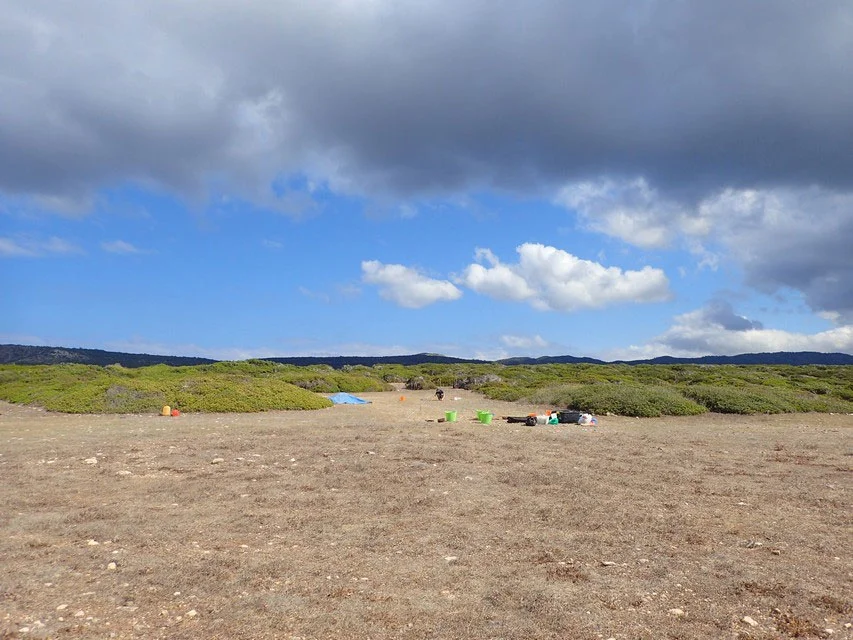
On 5 February the Department of Antiquities reported on the October 2025 season at Drouseia-Skloinikia, a newly identified site in the northwest of the Akamas peninsula. Dr Theodora Moutsiou of the University of Cyprus directed it with Dr Christian Reepmeyer of the German Archaeological Institute, as part of Project TOPOS, funded by the A.G. Leventis Foundation Overseas. A geophysical survey under Professor Apostolos Sarris had guided five trenches in 2024.
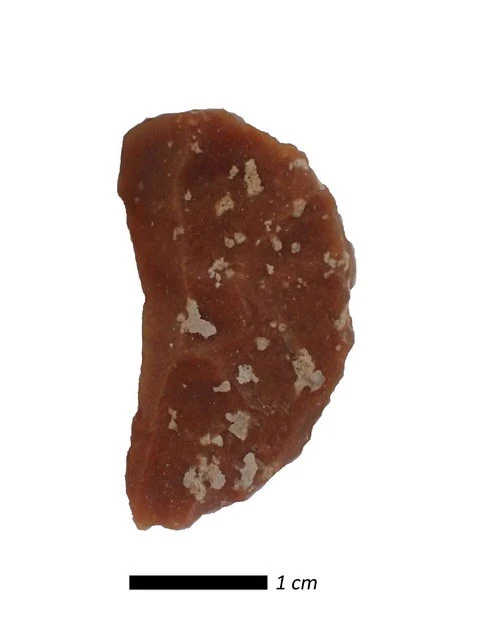
Of nine new trenches, one went down to bedrock for geomorphological samples; the other eight, only about 20cm deep, tested an odd magnetic anomaly and found an in situ knapping floor, the spot where stone was worked into tools, with raw blocks, cores, hammerstones and flakes still lying together. Hundreds of stone artefacts, among them a lunette (a small crescent-shaped tool), point provisionally, by their type and technique, to the Terminal Pleistocene and Early Holocene, 12,000 to 8,000 years ago; the first radiocarbon dates put the occupation before about 8000 cal BP. Beads and bead blanks, ground stone, bone and shell artefacts and a very large haul of shells came up as well. Divers made a brief survey of the reef offshore, which lay above water when the sea was about 15m lower. A third season is expected in September 2026. The project began in 2020 as a search for Pleistocene deposits on the peninsula, and the Department counts the site among the excavations now filling in the island's early Neolithic.
The same day the Department announced the end of the 2025 season of the University of Warsaw and Jagiellonian University expedition at Nea Paphos, led by Professor Ewdoksia Papuci-Władyka and dug from 7 September to 7 October. In a trench west of Fanari Hill, in the Maloutena quarter, crucibles cut from the bases of storage amphorae suggest metalworking nearby, and a Rhodian amphora handle stamped with the eponym Aristombrotidas, dated around 117 BCE, came from the foundation trench of a wall. The team takes it as confirmation of late Hellenistic architecture that it calls unique for Paphos. In the Agora, dug by the Paphos Agora Project, a shallow settling basin fed by a ceramic pipe was linked to a well of the first half of the 2nd century BCE, and a previously unknown stylobate with two fluted column drums appear to belong to a phase of the eastern portico earlier than its last, of the first half of the 2nd century CE. Dr Aleksandra Brzozowska-Jawornicka recorded 350 architectural pieces in the Maloutena houses, and 71 coins were conserved at the Paphos museum. The Polish Centre of Mediterranean Archaeology marked 60 years at Maloutena in 2025.
Returns
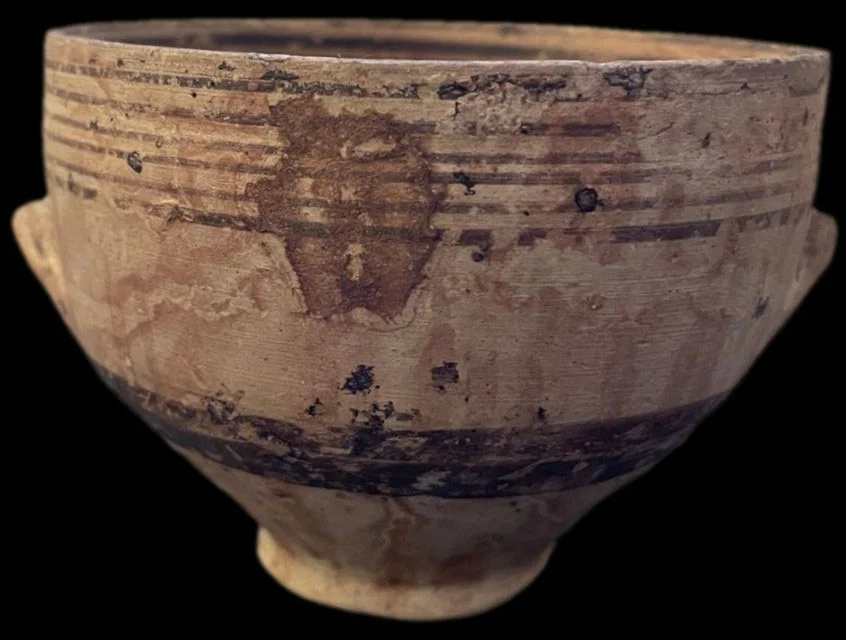
A stemmed bowl (kylix) of Bichrome ware, with two opposed loop handles and bands of black lines inside and out, was handed to the High Commission of Cyprus in the United Kingdom on 4 February, the Department said. Its archaeological officers, who watch the internet for illegal trafficking in Cypriot antiquities, had spotted it in an online auction (one of eight such returns between December 2025 and June 2026); it was withdrawn after talks with the auction house, and the house and the possessor returned it voluntarily. The Department dates it to Cypro-Geometric III or Cypro-Archaic I, between 900 and 600 BCE. It was the second kylix returned this way in seven weeks, after one handed to the Cypriot embassy in Paris on 19 December 2025.
Museums and sites
The Cyprus Museum in Nicosia presented its upgraded permanent exhibition at a public event with guided tours that weekend, the Deputy Ministry announced on 8 February. It was held under Cyprus's presidency of the Council of the EU and as part of the Department's 90th anniversary. The galleries gained recent excavation finds, repatriated antiquities, new lighting and refitted cases. Dr Vasiliki Kassianidou, Deputy Minister of Culture, pointed to the copper oxhide ingot exported in 1936 and back since 2024, when Harvey Mudd College gave its collection to the University of Cyprus, and said the collection would move to the new archaeological museum in two years. On 30 September MPs were told that building will not be delivered before 2028 (our brief).
On 5 February the Deputy Minister toured Kourion, which she called the second most visited site in Cyprus after Paphos, the Deputy Ministry said. In 2025 the shelters over the mosaics got new membranes and the theatre new lighting and refurbished dressing rooms. The largest job, a full renovation of the visitor centre with a new shop, a lecture hall, covered rest areas and toilets, cost about €3.5 million, she said; further work on the shelters is due to finish in the coming months. More site guards, she said, are the priority for security.
Original sources
- Department of Antiquities: Completion of the archaeological excavation at the site of Drouseia-Skloinikia in the Akamas Peninsula
Official release·
- Department of Antiquities: Completion of the joint expedition of the Warsaw and Jagiellonian Universities in Nea Pafos
Official release·
- Department of Antiquities: Repatriation of a Cypriot antiquity from the United Kingdom
Official release·
- Deputy Ministry of Culture: The upgraded permanent exhibition of the Cyprus Museum presented
Official release·
- Deputy Ministry of Culture: The Deputy Minister of Culture visited the archaeological site of Kourion
Official release·
- Department of Antiquities: Repatriation of a Cypriot antiquity from France
Official release·
- Archaeology Wiki: Excavation at the site of Drouseia-Skloinikia
Press·
- Archaeology Wiki: Repatriation of a Cypriot antiquity from the UK
Press·
- Cyprus Mail: Akamas excavations reveal prehistoric coastal life
Press·
- Cyprus Mail: Ancient Cypriot bowl returned from UK
Press·
On ancientcyprus.com
- Sites
- Nea Paphos, Kourion
- Excavations
- Akamas: the PLEICY survey and the Drouseia-Skloinikia excavation (University of Cyprus), Nea Paphos: the Polish Archaeological Mission (Maloutena)
- People
- Theodora Moutsiou, Christian Reepmeyer, Apostolos Sarris, Ewdoksia Papuci-Władyka, Aleksandra Brzozowska-Jawornicka, Vassiliki Kassianidou
- Institutions
- University of Cyprus, Deutsches Archäologisches Institut, A. G. Leventis Foundation, Department of Antiquities of Cyprus, Polish Centre of Mediterranean Archaeology, Paphos Agora Project (Jagiellonian University, Kraków), Cyprus Museum, Harvey Mudd College
- Periods
- Neolithic, Hellenistic, Roman, Cypro-Geometric, Cypro-Archaic
More in Fieldwork
- Hellenistic quarry under Paphos's Fabrika hill became an unused tomb, then a church
- This Week in Cypriot Archaeology: 31 August–6 September 2026
- Hollows cut into a Bronze Age threshold at Erimi match a senet game board
- This Week in Cypriot Archaeology: 27 July–2 August 2026
- Grape seeds and unfired loom weights found in Bronze Age work complex at Erimi-Pitharka