
Fieldwork·Brief
Crucibles made from amphora bases point to metalworking in Hellenistic Nea Paphos
A Rhodian amphora handle of about 117 BCE dates the rooms at Maloutena; in the agora the Polish team found a settling basin and part of an older colonnade.



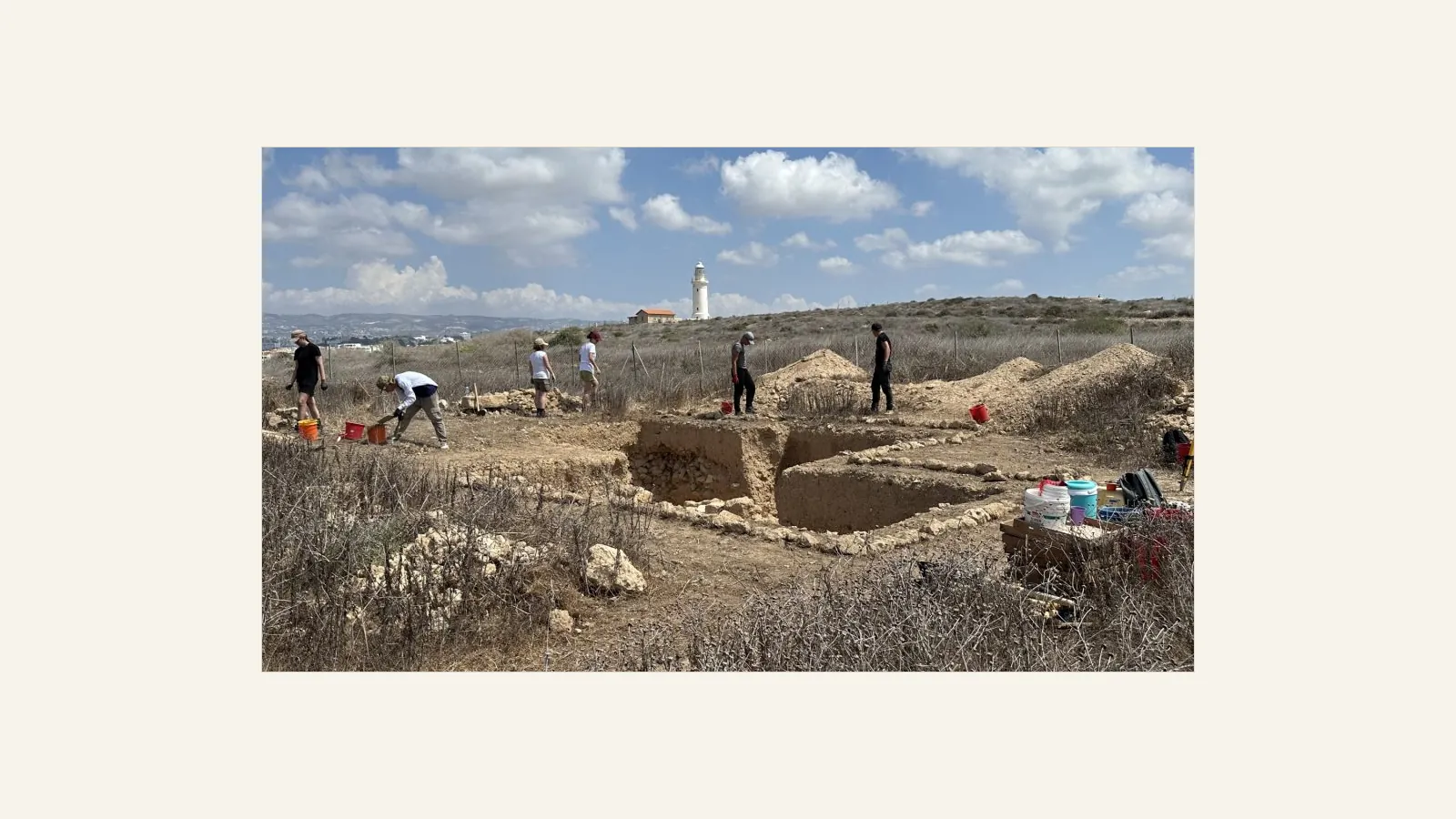
A small trench in the western part of Nea Paphos has produced numerous crucibles for melting metal, each made from the base of a storage amphora, on a stone-paved surface of the late Hellenistic town. The Department of Antiquities announced on 5 February 2026 that the University of Warsaw and the Kraków-based Jagiellonian University had closed the 2025 season of their joint expedition. About 30 staff, students and volunteers dug from 7 September to 7 October under Professor Ewdoksia Papuci-Władyka.
A production area at Maloutena
Trial Trench MAL TT.X, begun in 2022, lies west of Fanari Hill where north–south street 11 meets east–west street K. In a new 3.0 by 3.0 m extension in the corner where Wall 1 meets Wall 2, the team reached stone paving level with the street and canal exposed to the east in 2024. The crucibles came from here; the Department reads them as evidence of some kind of production site, and the University of Warsaw report of 24 March as a small production area.
The date comes from Room 1, south of Wall 1. In the trench dug for the wall's foundation lay a stamped handle from a Rhodian amphora naming the eponym Aristombrotidas, dated to around 117 BCE. For the Department this bears out the team's reading of 2024 that the trench holds fairly well-preserved late Hellenistic buildings, which it calls unique for Paphos. The Warsaw team takes them to be most likely houses, less than a metre below the surface. Dr Paweł Lech leads the project on the western city.
A basin and an earlier colonnade in the agora
In the agora, Łukasz Miszk supervised Trench T.II in the northern part of the East Portico. Only the south-east corner has been dug to bedrock. There the team found a shallow settling basin with a ceramic pipe entering from the north. It worked together with Well S.233, which earlier seasons had dated to between 200 and 150 BCE.
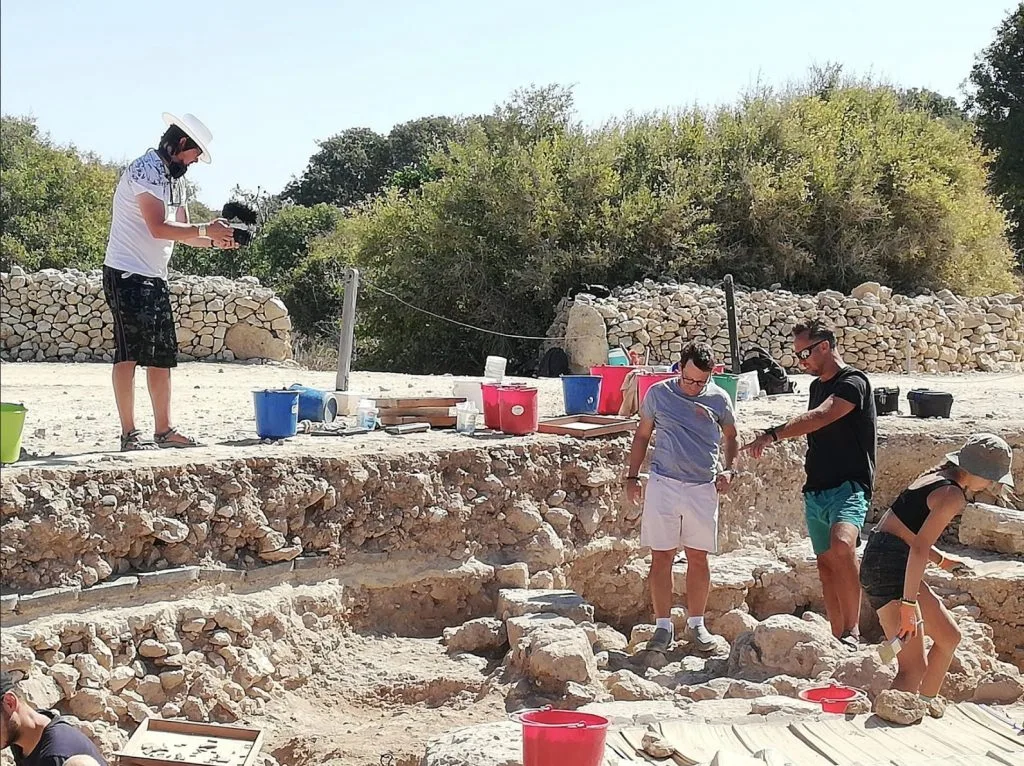
In the western part of the trench, north of the basin, lay a stretch of stylobate, the course on which a row of columns stands, unknown until now, with the lower drums of two fluted columns still in place and no bases. Its date is still open; for now the team links it to an earlier phase of the portico, before the final one of the first half of the 2nd century CE, and plans to return to it next season.
Sixty years of Polish work
A Warsaw mission under Kazimierz Michałowski began at Maloutena in 1965, and the Jagiellonian Paphos Agora Project started on the square in 2011. Excavation since 2011 has traced the agora back to the early Hellenistic city, and in 2016 the Jagiellonian team found a probable furnace, crucibles and production waste in Room 31 of Trench IV, which it read as a bronze-casting workshop.
Away from the trenches, Aleksandra Brzozowska-Jawornicka of Wrocław University of Science and Technology recorded 350 pieces of architectural decoration in five Maloutena houses, among them the Villa of Theseus. At the Paphos museum, Jarosław Bodzek studied the coins and Barbara Zając of the National Museum in Kraków conserved 71 of them, one silver and the rest bronze, together with the handle of a bronze situla (bucket) and a small piece of gold foil.
Original sources
On ancientcyprus.com
- Sites
- Nea Paphos
- Excavations
- Nea Paphos: MA-P, Maloutena and Agora in the Paphos Urban Plan (Warsaw and Kraków), Nea Paphos: the Polish Archaeological Mission (Maloutena), Nea Paphos: the Paphos Agora Project (Jagiellonian University), Geronisos (Yeronisos): the New York University excavations
- People
- Ewdoksia Papuci-Władyka, Dr Paweł Lech, Łukasz Miszk, Aleksandra Brzozowska-Jawornicka, Jarosław Bodzek, Barbara Zając, Kazimierz Michałowski, Joan Connelly, John Lund
- Institutions
- Department of Antiquities of Cyprus, University of Warsaw, Jagiellonian University, Wrocław University of Science and Technology, Paphos District Museum
- Periods
- Hellenistic, Roman
References
- 1.Lund, J. (2015). A Study of the Circulation of Ceramics in Cyprus from the 3rd Century BC to the 3rd Century AD. Gösta Enbom Monographs 5. Aarhus: Aarhus University Press.
- 2.Connelly, J. B. (2002). Excavations on Geronisos (1990–1997): First Report. Report of the Department of Antiquities, Cyprus 2002.
More in Fieldwork
- Hellenistic quarry under Paphos's Fabrika hill became an unused tomb, then a church
- This Week in Cypriot Archaeology: 31 August–6 September 2026
- Hollows cut into a Bronze Age threshold at Erimi match a senet game board
- This Week in Cypriot Archaeology: 27 July–2 August 2026
- Grape seeds and unfired loom weights found in Bronze Age work complex at Erimi-Pitharka