
Fieldwork·Roundup
This Week in Cypriot Archaeology: 27 July–2 August 2026
Grape seeds, raw clay and a bull figurine at Late Bronze Age Erimi-Pitharka, a chapter on the war harbour of Kition, and the Kourion museum at Episkopi closes for an upgrade.



The Department of Antiquities reported on this year's dig at Erimi-Pitharka, a Late Bronze Age production centre in the Kouris valley, where the excavated complex grew to the north and east and yielded a clay deposit, loom weights and many grape seeds. Sabine Fourrier published a chapter on the fourth-century BCE war harbour of Kition, Deborah Ruscillo reviewed a book on purple dye in Cyprus and the Aegean, and the museum at Episkopi that holds the finds from Kourion closed for an upgrade.
Map of Cyprus
This week's stories
- Fieldwork
- Its Kouris valley contemporaries
- Research
- Ground above 200, 500, 1,000 m
Sites on this map
- 1Erimi-Pitharka
- 2Alassa
- 3Episkopi-Bamboula
- 4Kition-Bamboula
- 5Hala Sultan Tekke
- 6Palaepaphos (Kouklia)
- 7Kourion
Fieldwork
On 28 July the Department of Antiquities announced the close of the 2026 season at Erimi-Pitharka, in the Limassol District, where an international team of students and specialists led by Dr Laerke Recht of Moesgaard Museum, Denmark, worked from 20 April to 22 May. The excavations, running since 2022, date the site mainly to Late Cypriot IIC–IIIA, the same time as Alassa and Episkopi-Bamboula in the same valley, according to the Department. Earlier seasons in Area I/1A found a large building that the team reads as a place of administration and production, with evidence for processing cereals, olive oil and wine. Trenches opened north and east of it this year showed the complex extends beyond its known limits, with more rooms and open spaces; some walls are of big, carefully dressed blocks, others of dry stone carrying mudbrick.
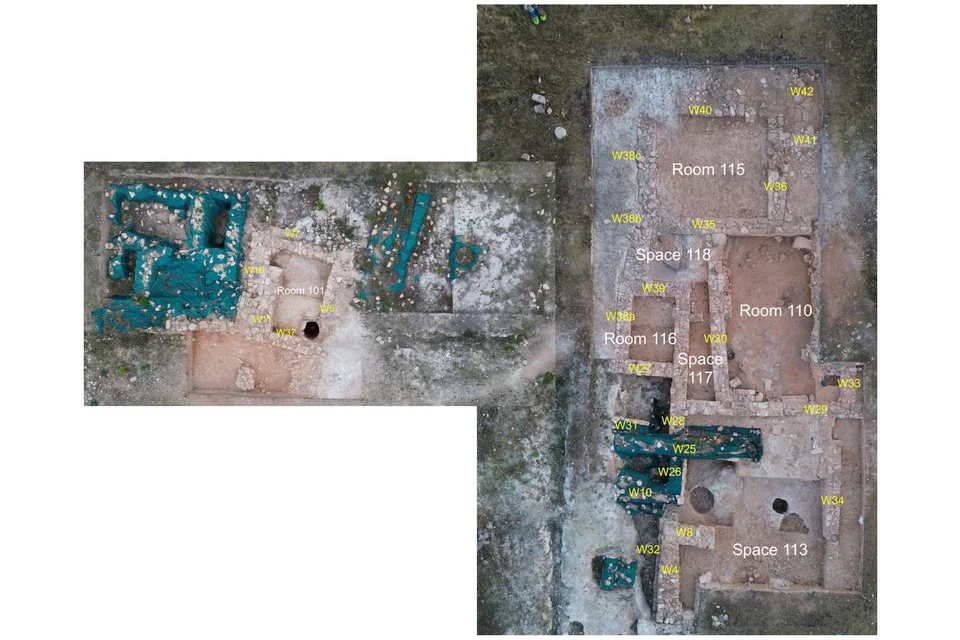
The largest room so far, Room 110, measures at least 7×4.30 m. It has benches, marked thresholds, a stone-lined storage unit and a large stone weight from a press, and in it lay a deposit of raw clay with loom weights, some unfired and some low-fired, which the team takes as a sign that ceramic objects were made on the spot and perhaps that cloth was made there. In the south of the area, by Courtyard 113, layers full of pottery, with a few animal bones, pits of discarded material and a large quantity of grape seeds, point to grapes being processed, possibly for wine.
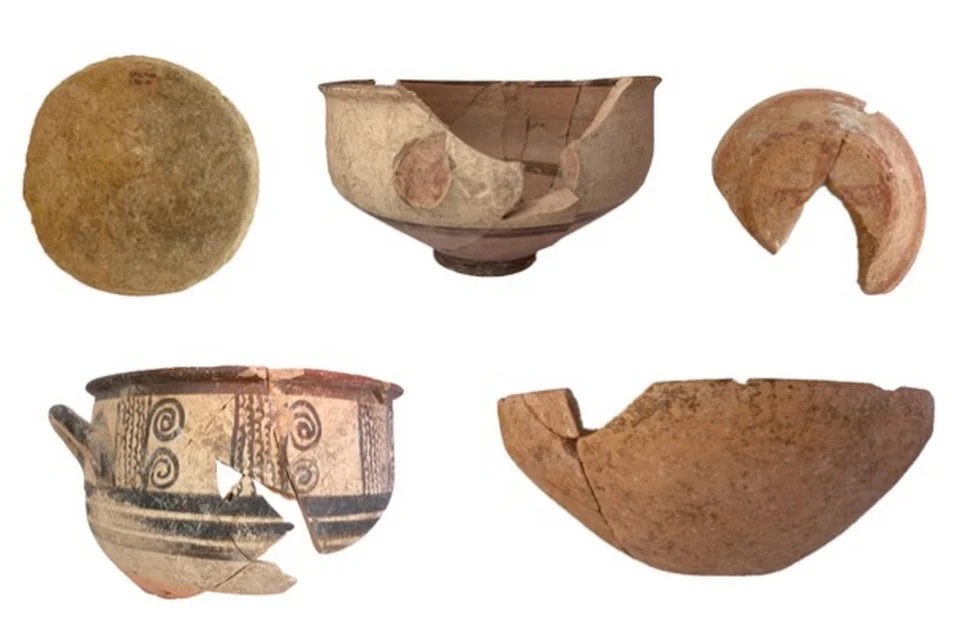
The dig finished Room 101, which has a smooth, well-kept plaster floor. A deep pit in its south-east corner held near-complete vessels: decorated Aegean-type pottery alongside pots put to new uses, among them a bowl with a perforated base, while the bottom of a Plain White ware pot had been trimmed into a lid. South of the room a second deposit held a clay bull in Plain White ware, nearly whole, together with part of a jug and a bronze pin, which the excavators connect with the last phase of occupation. Other finds include spindle whorls, more pins and the head of a boar figurine in Base Ring ware. A handful of Ceramic Neolithic sherds from the deepest levels point to activity at or near the spot much earlier, though every building found so far belongs to the Late Bronze Age. The season was funded by the A.G. Leventis Foundation, the Curtiss T. and Mary G. Brennan Foundation and Moesgaard Museum, and the Department says digging will go on to fix the limits of the complex.
Research
In a chapter published on 29 July in the Brill volume Managing Warships and Fleets in the Ancient Greek World (pp. 274–296), Sabine Fourrier studies how the kings of Kition ran their war fleet, through the fourth-century BCE military harbour at Bamboula (DOI). The French mission on the Bamboula hill, led by Marguerite Yon from 1976 and then by Fourrier, finished digging the sanctuary of Astarte and Melqart-Herakles there and explored the Classical war harbour with its sheds for triremes, the néoria [1]. The sheds were published in full as Kition-Bamboula VIII, Les néoria du port de guerre (Yon and Fourrier, 2022).
Books
Deborah Ruscillo of the University of Toronto Scarborough reviews PORPHYRA, a volume on how purple dye was made and used in the Aegean and Cyprus between prehistory and Late Roman times, in the Journal of Eastern Mediterranean Archaeology and Heritage Studies, volume 14, issue 3, out on 30 July (DOI). The book, edited by Dimitra Mylona, Thomas M. Brogan, Melissa Eaby and Maria Iacovou, came out in 2025 as Aegis 30 from the Presses universitaires de Louvain and grew from a workshop held in Nicosia in 2019. Three of its chapters are on Cyprus. At Late Bronze Age Hala Sultan Tekke, crushed shells of two murex species, the sea snails that yield the dye, lie beside installations for working liquids; at Kition-Bamboula some 60 fragments of a large pithoid jar with purple residue inside are read as a dye vat. At Hadjiabdullah West in Palaepaphos, a 4th-century BCE deposit held 430 kg of crushed Hexaplex trunculus shells, about 50,000 animals, which Mylona and Iacovou take for waste from dye workshops on the Paphos coast.
Museums
The Local Archaeological Museum of Kourion at Episkopi closed on 1 August for work on its galleries and service areas, as the Department had announced in July (roundup of 6–12 July); a reopening date will be given later.
Original sources
- Deputy Ministry of Culture: Completion of the 2026 fieldwork season at the Late Bronze Age site of Erimi–Pitharka
Official release·
- Υφυπουργείο Πολιτισμού: Λήξη της ανασκαφικής περιόδου 2026 στην Υστεροκυπριακή θέση Ερήμη-Πιθάρκα
Official release·
- Royal Management of the War Fleet of Kition: The Fourth-Century BC Military Harbour at Bamboula (Cyprus), in Managing Warships and Fleets in the Ancient Greek World (Brill)
Book·
- Ruscillo, D.: review of PORPHYRA: The Materiality of Purple Dye Production and Use in Cyprus and the Aegean from Prehistory to the Late Roman Period (Journal of Eastern Mediterranean Archaeology and Heritage Studies 14.3)
Paper·
- Muti, G.: review of PORPHYRA (Cahiers du Centre d'Études Chypriotes 56)
Paper
- Department of Antiquities: Temporary closure of the Local Archaeological Museum of Kourion (Episkopi) for upgrade works
Official release·
- Famagusta Gazette: Ancient wine and weaving complex uncovered at Late Bronze Age site in Cyprus
Press·
On ancientcyprus.com
- Periods
- Neolithic, Late Bronze Age, Cypro-Classical
References
- 1.Yon, M., Caubet, A. and Hermary, A. (2012). La France et l'archéologie chypriote. Introduction. Cahiers du Centre d'Études Chypriotes 42.
More in Fieldwork
- Hellenistic quarry under Paphos's Fabrika hill became an unused tomb, then a church
- This Week in Cypriot Archaeology: 31 August–6 September 2026
- Hollows cut into a Bronze Age threshold at Erimi match a senet game board
- Grape seeds and unfired loom weights found in Bronze Age work complex at Erimi-Pitharka
- 2026 dig at Kissonerga-Skalia adds to the case for Bronze Age beer, Akamas municipality says