
Fieldwork·Brief
Hellenistic quarry under Paphos's Fabrika hill became an unused tomb, then a church
Chamber 5, one of 15 rock-cut spaces on the hill, was probably abandoned before any burial once the new city wall took Fabrika into the town.



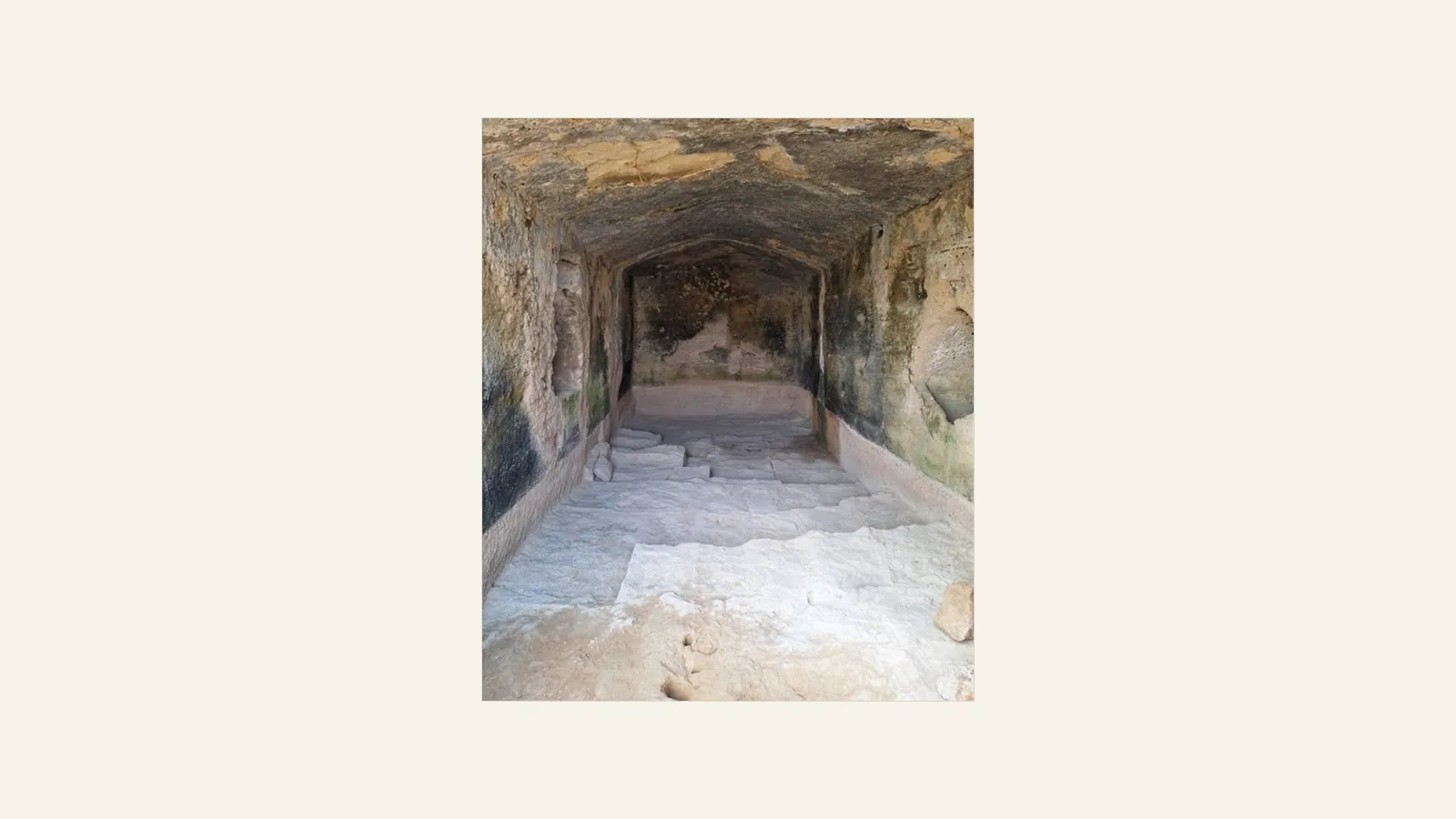
A rock-cut room in Fabrika hill in Kato Paphos was dug out for building stone in the early Hellenistic period, trimmed to become a tomb that apparently never received a burial, and turned into a church in Early Byzantine times. The sequence comes from the French Archaeological Mission of Avignon University, which works with the French School at Athens under Professor Claire Balandier. The Department of Antiquities announced the end of the season on 24 June 2026.
Chamber 5, from quarry to church
The room is chamber 5 of the 15 underground spaces the mission has listed on the hill, which the Department describes as the north-eastern acropolis of ancient Nea Paphos. After the quarrying stopped, its ceiling and walls were dressed smooth and niches were cut into the rock, so the team reads it as an unfinished tomb. The Department dates the abandonment of the tomb project, probably, to the second half of the 2nd century BCE, when the new city wall brought Fabrika inside the inhabited town. In the Roman period the chamber was partly filled; in the Early Byzantine period it was used as a church.
The rest of the season
The same campaign identified a large square feature cut in the bedrock at the foot of the rock-cut church of Agios Agapitikos as the north-eastern tower of the Hellenistic city wall; blocks from it were later reused under a church. Two trenches on the wall were opened with Sophocles Hadjisavvas, and in the south tower of the north-west gate the team reached the tower's last floor, partly preserved.
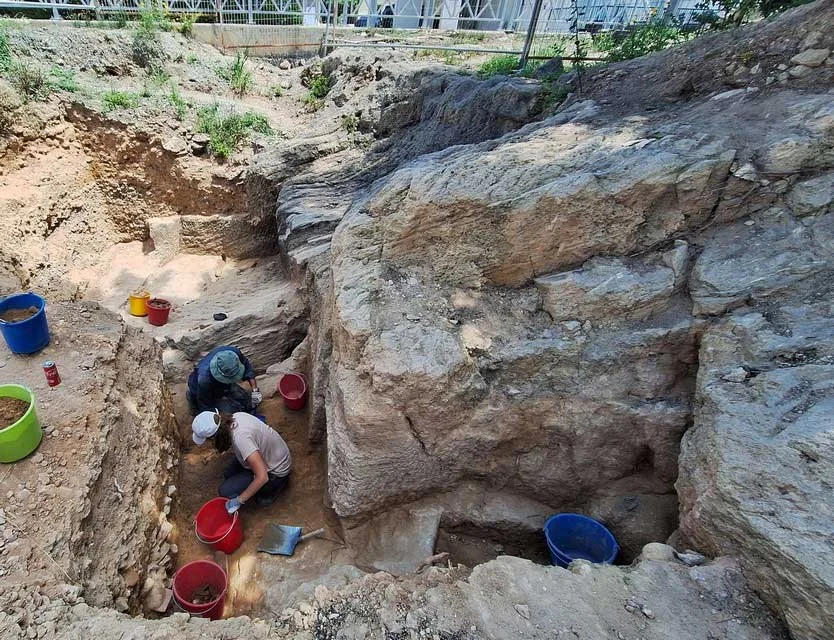
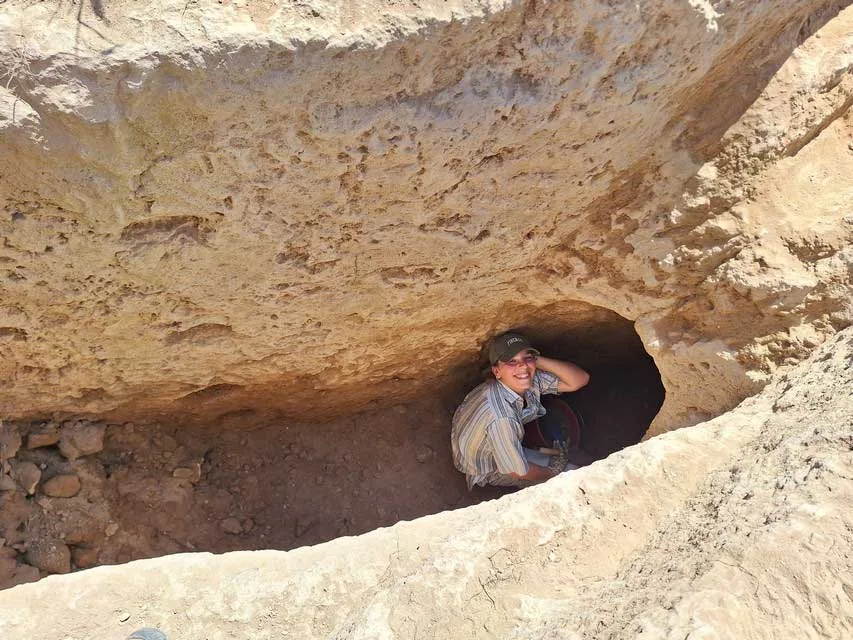
North of the theatre, a well and an underground gallery belong to a water system that changed between the Hellenistic and Roman periods. A channel cut in the rock, first found in 2025, was followed further south-east, and fragments of a large terracotta pipe lay on the gallery floor. A crack in the gallery's western wall, probably caused by an earthquake, let the water escape and may explain why the gallery went out of use. At right angles to that wall the trench met another, about 3 m high and possibly Roman or even Hellenistic, whose foundation has yet to be reached; the Department takes it as proof that the ancient ground level lay far below the modern one. In the Roman house the team cleared room 9, at its south-east corner. Jolanta Młynarczyk of the University of Warsaw studied the Hellenistic and Roman pottery that Demetrios Michaelides found at the harbour of Paphos in the 1980s.
A hill of quarries and rock-cut rooms
Fabrika is an outcrop of calcarenite rising to 26 m, and it was first used as a quarry for the building of the town and its walls [1, p. 120]. Chamber tombs had been cut into its sides in the Late Classical period, and quarrying in its western part probably went on after a theatre was built on the south-eastern slope in the 3rd century BCE [2, p. 289]. In 2015 Balandier described several of the hill's underground rooms as cult places fitted out inside old quarries, and noted that the so-called tombs of Agios Lambrianos, Agia Solomoni and Agios Lepros, like the Agapitikos chapel, became places of Christian worship [3, p. 179].
Balandier first dug at Nea Paphos in 1997, on the western rampart, and in 2008 founded the Fabrika mission with Éric Morvillez. The French foreign ministry, the CNRS, the Municipality of Paphos and the two French institutions paid for the season. Work on the hill is due to resume next year.
Original sources
- Department of Antiquities, Cyprus: Completion of the excavation by the French Archaeological Mission of Avignon University on Fabrika Hill in Kato Pafos
Official release·
- Archaeology Wiki (the announcement republished)
Press·
- Politis
Press·
- Medievalists.net
Press·
- Avignon University: the Paphos mission receives the Académie des Inscriptions et Belles-Lettres archaeology label
Official release·
On ancientcyprus.com
References
- 1.Młynarczyk, J. (2022). Fanari Hill in the Urban Plan of Hellenistic and Early Roman Nea Paphos and the Question of the 'Two Akropoleis' of Nea Paphos. Études et Travaux 35, 119–134. https://doi.org/10.12775/EtudTrav.35.006
- 2.Młynarczyk, J. (1985). Remarks on the Temple of Aphrodite Paphia in Nea Paphos in the Hellenistic Period. Report of the Department of Antiquities, Cyprus 1985, 286–292.
- 3.Balandier, C. (2015). Les lieux de culte sur et sous la colline de Fabrika. Soubassement de temple et autres sanctuaires rupestres ptolémaïques et romains de Néa Paphos. Cahiers du Centre d'Études Chypriotes 45, 161–180. https://doi.org/10.3406/cchyp.2015.1632
More in Fieldwork
- This Week in Cypriot Archaeology: 31 August–6 September 2026
- Hollows cut into a Bronze Age threshold at Erimi match a senet game board
- This Week in Cypriot Archaeology: 27 July–2 August 2026
- Grape seeds and unfired loom weights found in Bronze Age work complex at Erimi-Pitharka
- 2026 dig at Kissonerga-Skalia adds to the case for Bronze Age beer, Akamas municipality says