
Workshop·Archaeological Research Unit - University of Cyprus·2019
PORPHYRA Workshop: Purple Dye on Rhodes, at Palaepaphos and at Eretria
Sophia Sotiropoulou, Maria Iacovou, Dimitra Mylona and Sophie Horacek
Chapters
About the video
This fourth recording from the PORPHYRA Workshop on the materiality of purple dye production and use in Cyprus and the Aegean contains three papers examining evidence from Rhodes, Cyprus, and Euboea.
In the first paper, co-authored with Toula Marketou of the Ephorate of Antiquities of the Dodecanese, Sophia Sotiropoulou examines purple pigment and dyeing evidence on Rhodes. At the Late Bronze Age IA settlement of Trianda (Ialysos), excavations in earthquake debris of c. 1630 to 1610 BC recovered a dry mass of purple pigment alongside wall painting fragments, a copper-melting crucible, and a lead weight. Micro-Raman, FTIR, and HPLC analyses identified 6,6'-dibromoindigotin adsorbed onto an aragonite and calcite substrate derived from crushed shells, matching pigment lumps from Akrotiri on Thera and indicating vat-dyeing technology. Sotiropoulou also notes Middle Bronze Age murex shell deposits and loom weights at Trianda, as well as a late Hellenistic and early Roman purple-dyeing workshop outside the fortification walls of the town of Rhodes equipped with cisterns, drains, and three ovens.
Maria Iacovou and Dimitra Mylona then present the discovery that prompted the workshop: a deposit of crushed purple shells on the Hadjiabdullah plateau at Palaepaphos (Kouklia). Iacovou outlines the archaeological and political context established by the Palaepaphos Urban Landscape Project since 2006. Built around 500 BC and abandoned in the early 3rd century BC after the takeover by Ptolemy I and the death of the royal family of Nicocles in 306 BC, the western complex on the citadel was a royal industrial and storage facility of the Cypro-Classical city-state, where a sherd bearing a Greek syllabic accounting inscription in black ink was also found. Mylona presents the preliminary study of the shells recovered by water flotation from Unit 2, a small basement room with a mudbrick-tile floor. Weighing 430 kilograms and comprising roughly 50,000 heavily pounded shells, the deposit consists almost exclusively of Hexaplex trunculus harvested with baited baskets. Because no purple shells were found outside Unit 2, Mylona and Iacovou argue that the foul-smelling dye extraction took place on the ancient coast and that the clean crushed shells were brought up in sacks or baskets and stored in Unit 2 as raw material for lime plaster.
In the final paper, Sophie Horacek reads a study by Stefan Schmid on excavations by the Swiss School of Archaeology in Greece in Area E/600 NW at Eretria on Euboea. After the destruction of 4th-century BC houses in the Chremonidean War (267 to 261 BC), Hellenistic buildings erected on the plot were destroyed during Sulla's conquest in 88 to 86 BC. Layers of crushed Murex brandaris and Murex trunculus shells on a Hellenistic floor, whole shells built into a later Roman wall, household loom weights, and two hydraulic-mortar basins built into the Hellenistic walls suggest possible purple dyeing, which Schmid compares with Philostratus's account of Eretrian purple dyers deported to Persia. A closing discussion returns to why the Palaepaphos shells represent secondary storage rather than on-spot dye production.
From our collection
Pieces in the Drakopoulos collection of the kinds and periods this talk covers: Textile tool, Cypro-Archaic, Hellenistic.
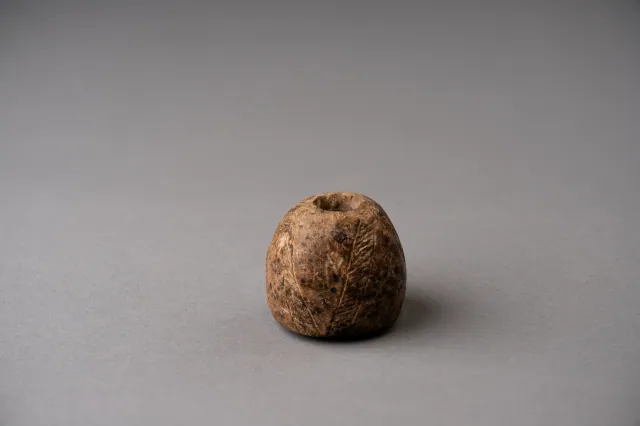
Spindle Whorl with Incised Herringbone Bands
Textile tool
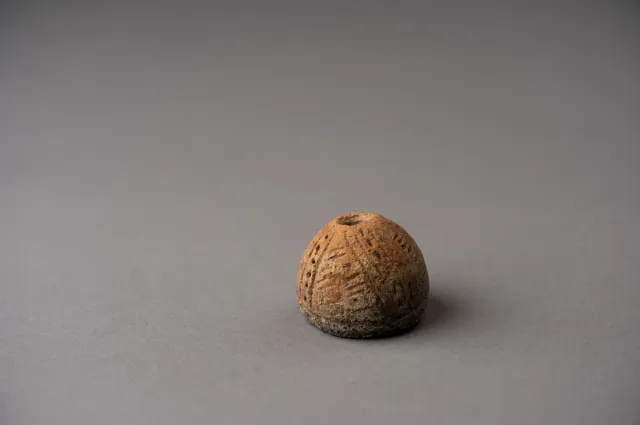
Red Polished Spindle Whorl with Incised Lattice and Dotted Bands
Textile tool
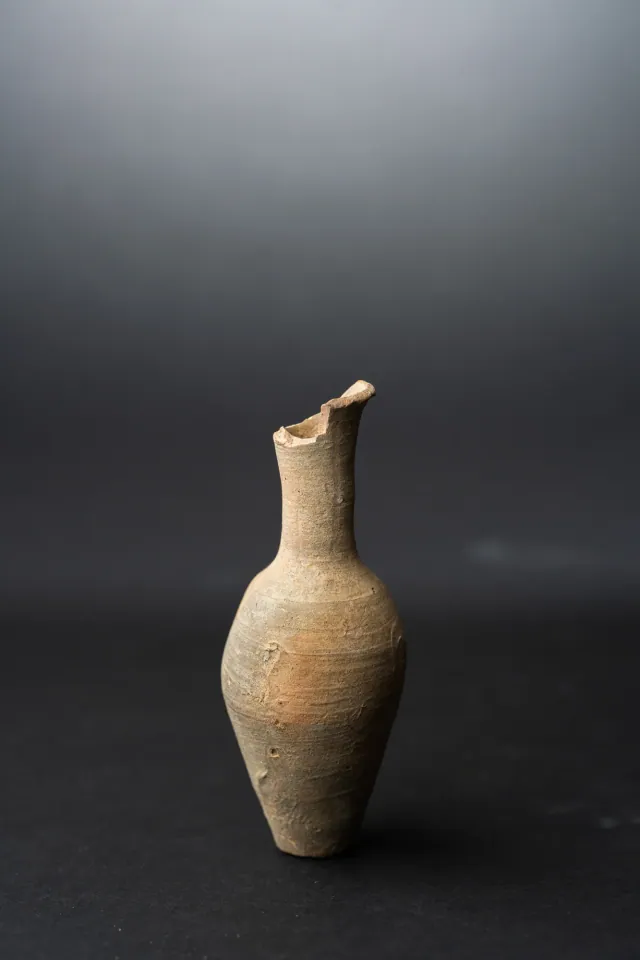
Fusiform Unguentarium
Hellenistic
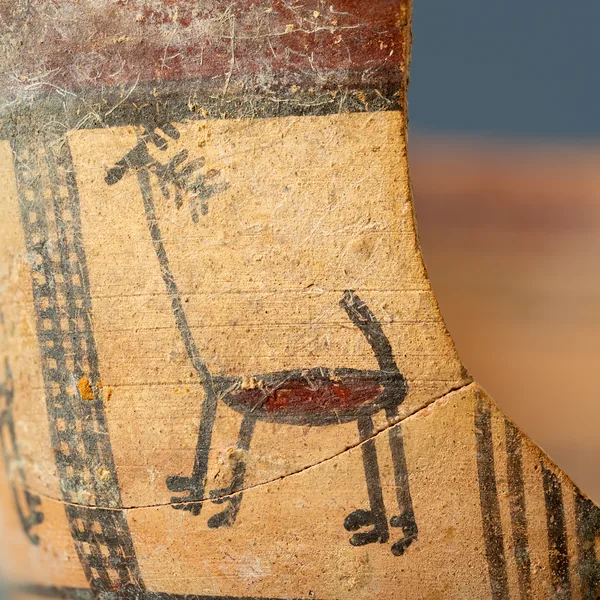
Bichrome Skyphos with Stags in Metopes
Cypro-Archaic
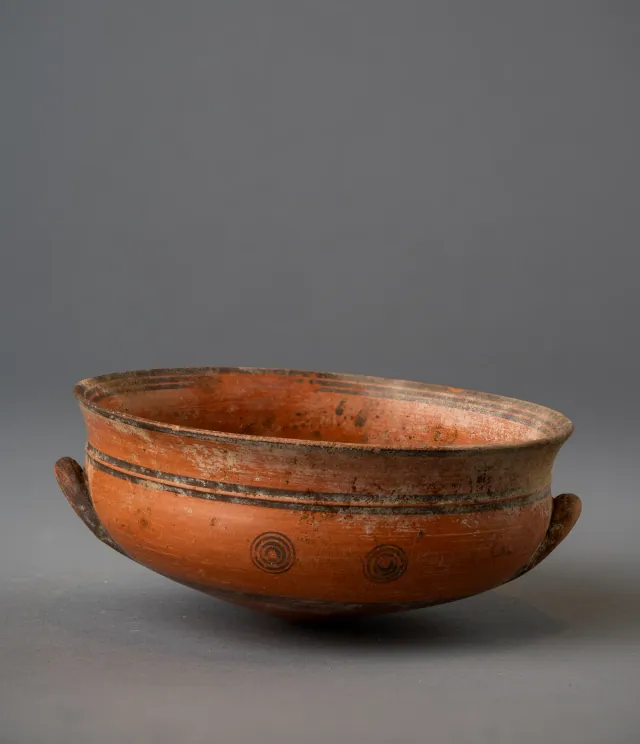
Black-on-Red Two-Handled Bowl with Raised Flaring Rim
Cypro-Archaic
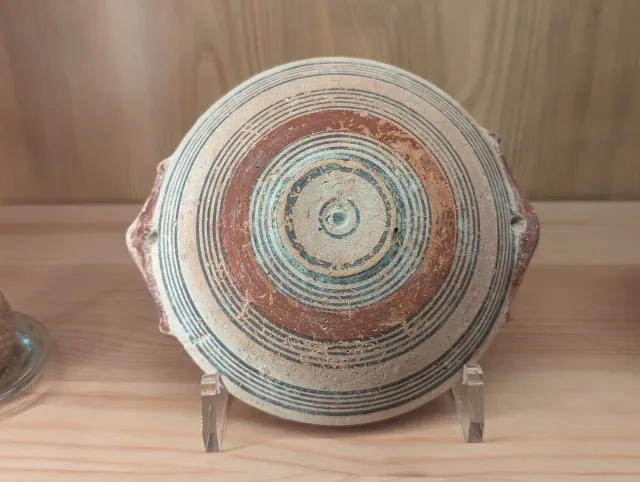
Bichrome IV Bowl with Red-Painted Pierced Lug Handles
Cypro-Archaic
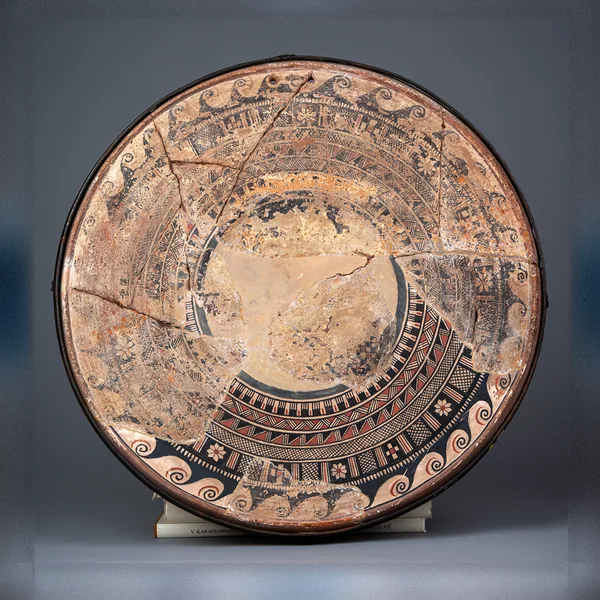
Large Bichrome Plate from Salamis with a Wave Band and Rosette Metopes
Cypro-Archaic
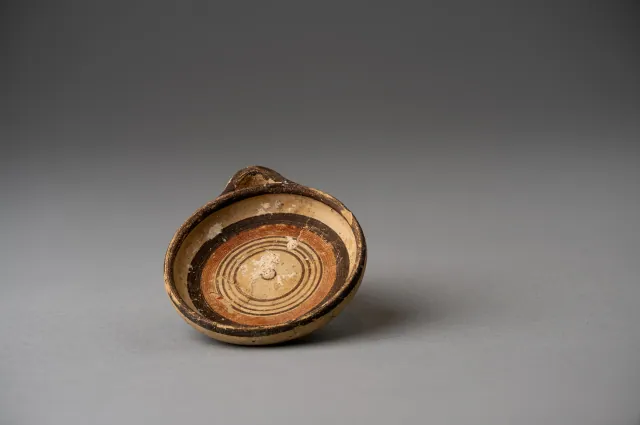
Miniature Bichrome Plate with Concentric Circles
Cypro-Archaic
Found at the places discussed
Objects in our catalogue, in museum collections, recorded as found at these sites.


Background
Where to read more on this site before or after watching.
The site
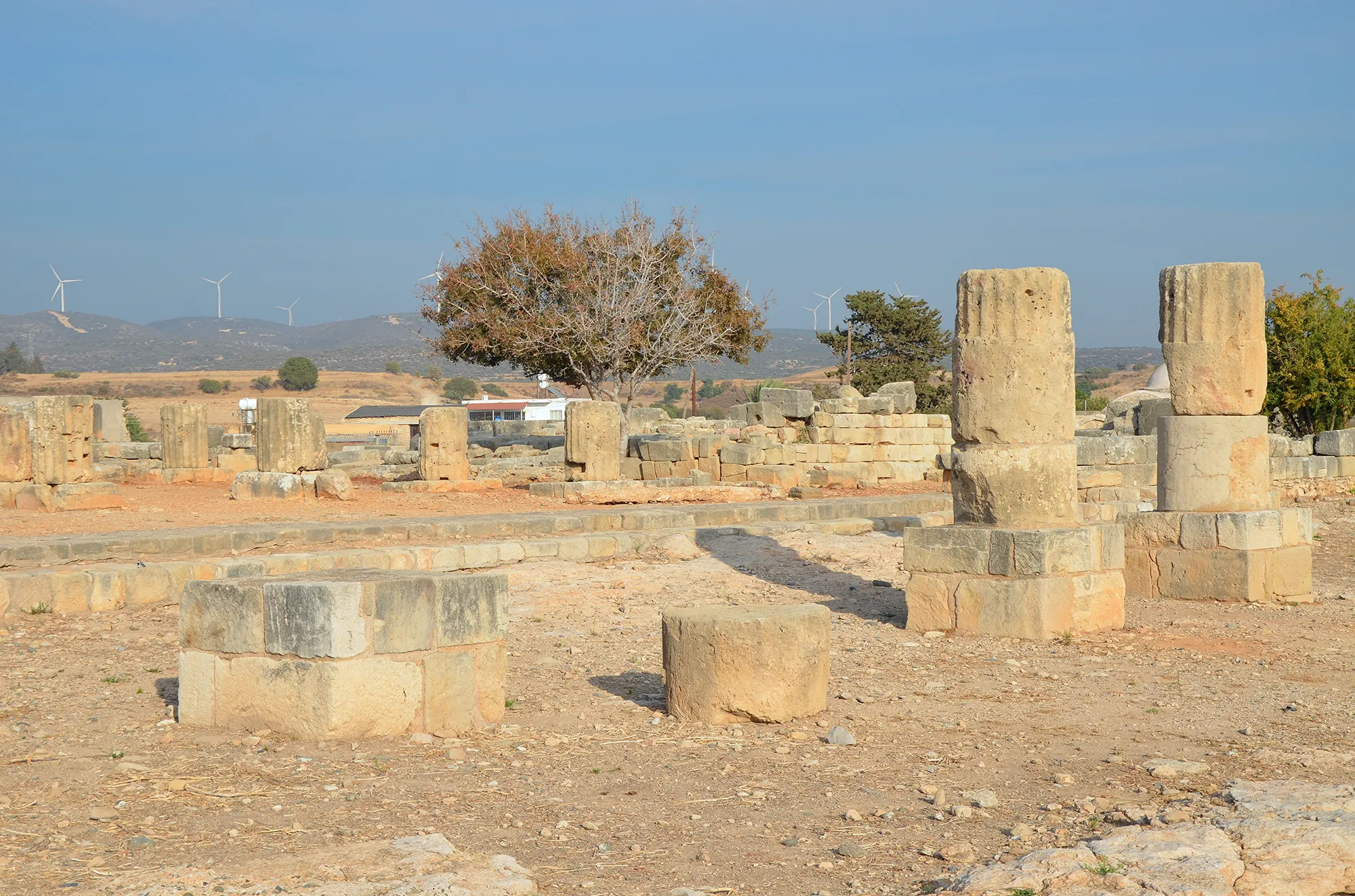
Palaepaphos (Kouklia)
Palaepaphos, Old Paphos, lies under and around the village of Kouklia in western Cyprus. Founded in the Middle Bronze Age, it was the only large town of the south-west until the early Hellenistic period, the seat of the kings of Paphos and the site of the sanctuary of the Paphian goddess, Aphrodite, worshipped here from about 1200 BC to the end of the 4th century AD.
In the compendium
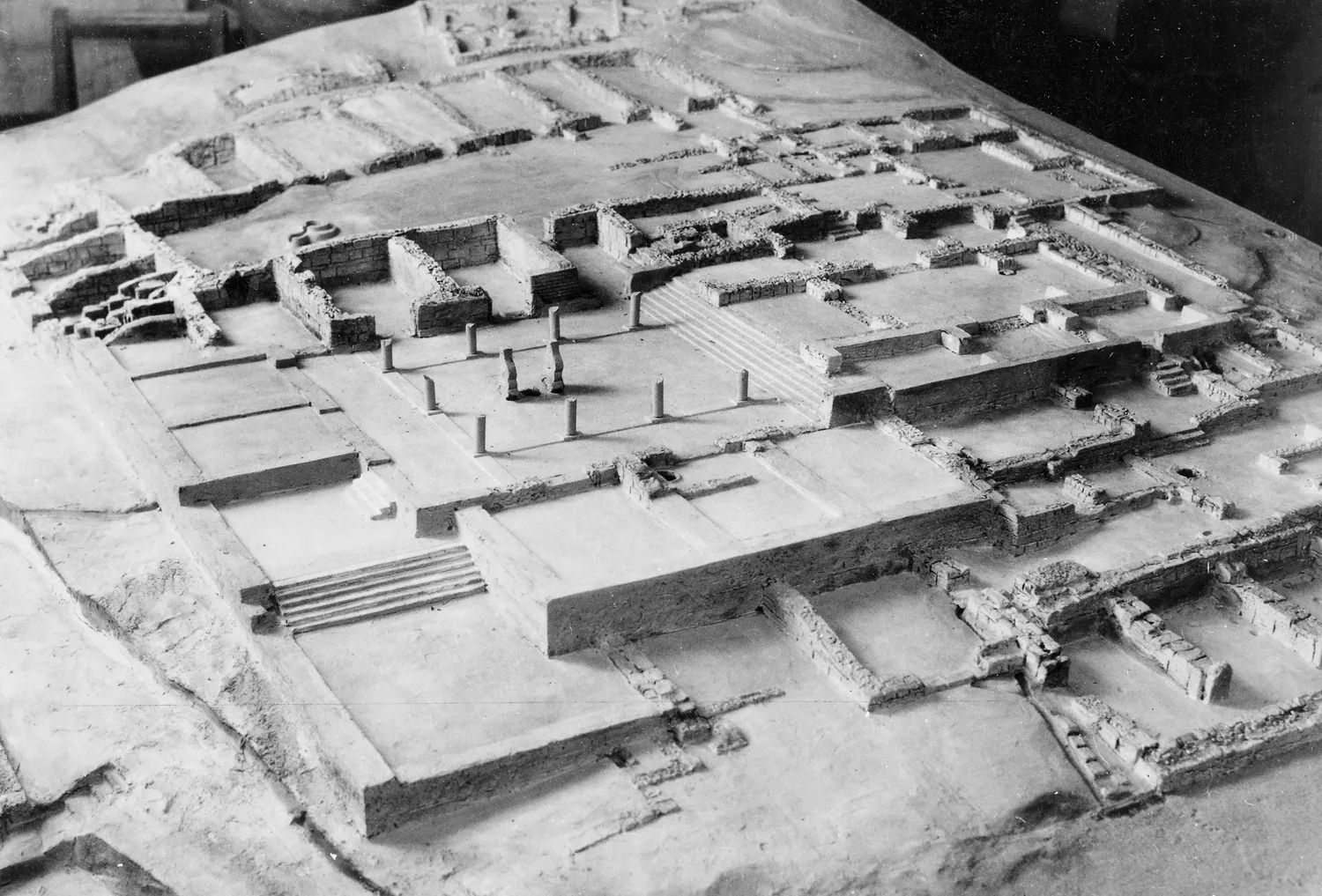
Iron Age Cities and Palaces
The capitals of the Iron Age kingdoms of Cyprus, their palaces at Vouni, Amathus, Idalion and Palaepaphos, their houses, and the volute and Hathor capitals of the period.
In the compendium
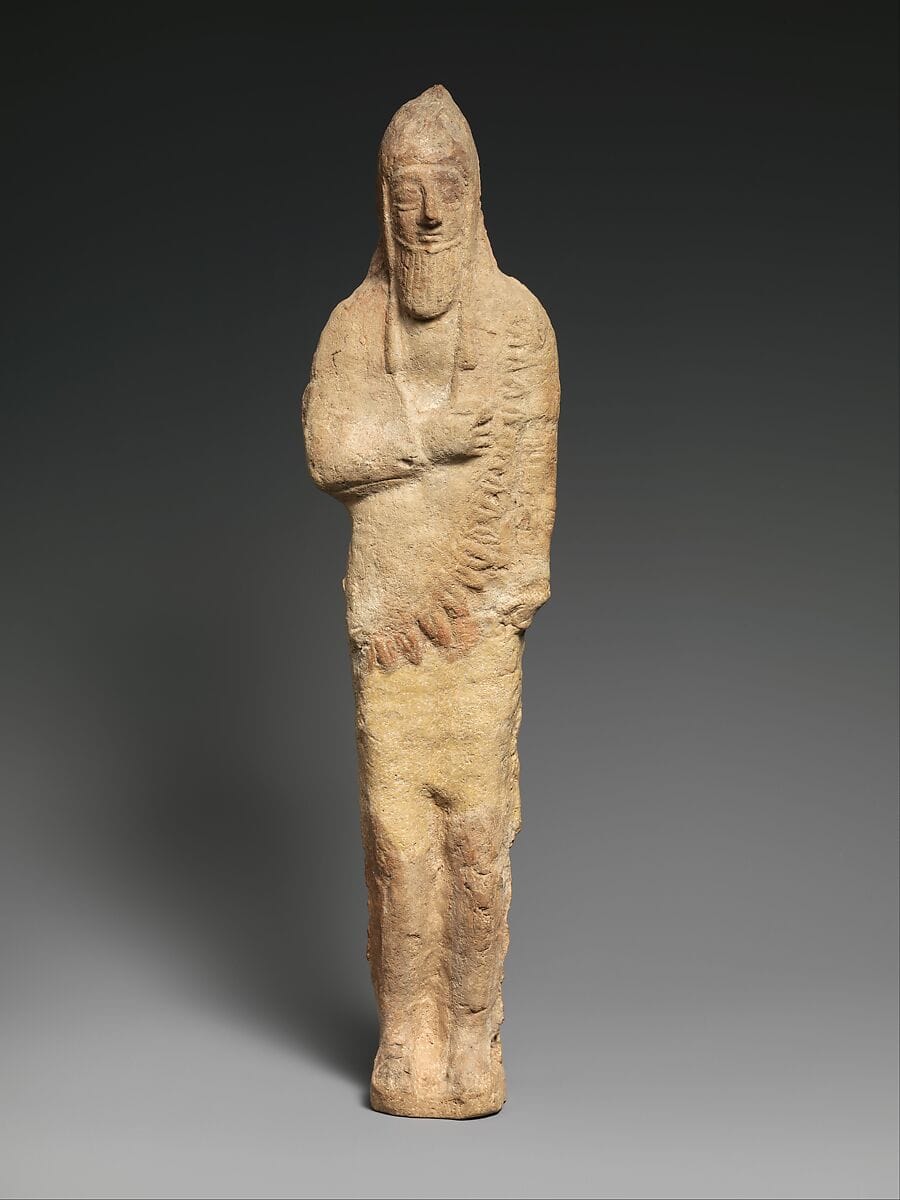
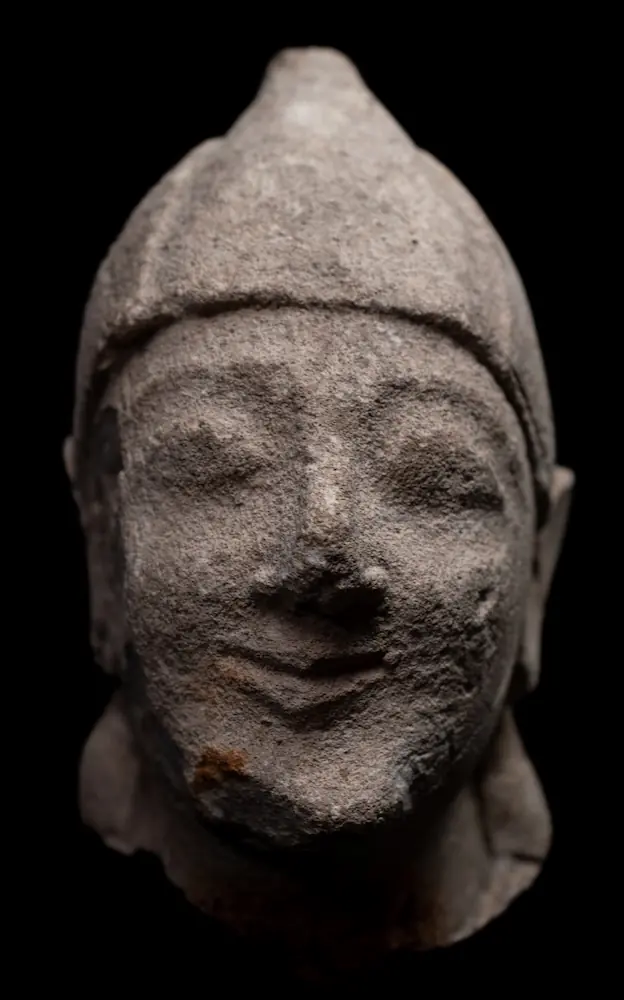
Clothing and Dress in Ancient Cyprus
What Cypriots wore from the Neolithic to the Cypro-Classical period, reconstructed from figurines, statues, textile tools and metal fasteners.
In the compendium
Writing and Literacy in Ancient Cyprus
The scripts of ancient Cyprus, from undeciphered Cypro-Minoan to the Cypriot Syllabary, Eteocypriot, Phoenician and the Greek alphabet, and who used them.