
Contents
Red-on-Black is the painted pottery of the Middle Bronze Age in north-eastern Cyprus. The potters coated handmade jugs, bowls and jars with a black, grey or brown slip and then covered almost the whole surface with matt red lines, laid on several at a time with a multiple brush. The ware was a speciality of the north-east and was largely confined to the Karpas peninsula [1, p. 27], while the rest of the island used White Painted ware for the same jobs. The catalogue holds seventeen Red-on-Black objects, mostly jugs and bowls in the Ashmolean Museum and the British Museum; you can see all Red-on-Black ware in the catalogue.
.](https://cdn.ancientcyprus.com/ashmolean/AN1953.221.webp)
Identification
The ware belongs to the moment when the long Red Polished tradition of the Early Bronze Age gave way to painted pottery. Dorothy Morris put it plainly: in the Middle Cypriot period the slip became uniform and usually matt, decoration was applied as painted lines, and there were two main wares of this kind, Red-on-Black and White Painted [1, p. 27].
A typical piece is easy to recognise. The slip is dark, from black to grey or brown. The paint is a matt red that tends to be fugitive, and the slip often flakes off in patches [1, p. 27]. The lines run in parallel bands, and the number of lines in each band is nearly always the same on a single vessel, which shows that one multiple brush was used throughout. Paul Åström remarked on the horror vacui of the decoration, which leaves very little of the surface empty [1, p. 27].
Vassos Karageorghis once called Red-on-Black "the debased, matt version of Red Polished". Morris disagreed: brush-painted linear decoration puts it in a separate category and links it to White Painted rather than to Red Polished [1, p. 27]. She also pointed to the threads that tie it to late Red Polished: the multi-pointed tool already appears on late Incised Red Polished, Black Slip and Drab Polished, the red-on-dark effect recalls the white-filled incisions of the older ware, and some Red-on-Black slips are still polished [1, p. 27].
Variants
Morris divided the family into four wares by surface and paint [1, p. 27]. The common one is what most museum labels simply call Red-on-Black.
| Variant | Surface | Paint | Frequency |
|---|---|---|---|
| Red-on-Black Slip (Proto-Red-on-Black) | Slightly shiny, polished; black, grey or brown slip, sometimes orange-red | Matt red lines | Rare; transitional from Black Slip |
| Red-on-Black Painted | Dark slip, usually matt | Matt red, multiple brush, near-total cover | The common, typical ware |
| Red-on-Red | Polished red-brown or pink slip | Matt red-brown or purple lines | Rare |
| Light-on-Dark | Lustrous red, brown or black slip | Matt white lines | Rare |
Morris treated the Red-on-Black Slip group as intermediate between the end of Black Slip and Red-on-Black proper, which is why the name Proto-Red-on-Black was suggested for it [1, p. 27]. Lindy Crewe treats all of these colour schemes as a single unit, following Robert Merrillees's observation that colour differences across one vessel probably come from firing rather than from any intention to make a different ware [2, p. 49].
Date
Red-on-Black was made from Middle Cypriot II into Late Cypriot I. Åström placed it predominantly in Middle Cypriot III, but Crewe notes that it may have been just as common in Late Cypriot I, given the quantity found at Phlamoudhi-Vounari, and Åström himself listed some shapes as exclusively Late Cypriot [2, p. 49]. Late pieces can be spotted by flat bases on closed vessels and by fugitive paint [2, p. 49]. The Phlamoudhi team put the life of the fashion at about three hundred years: the settlement at Phlamoudhi-Melissa was occupied from the end of the Middle Cypriot period into the 13th century BCE, and Vounari into the 15th [3, p. 123].
In calendar terms this is roughly 1900 to 1600 BCE, the span the catalogue uses, overlapping the end of the Middle Bronze Age and the start of the Late Bronze Age. The Ashmolean dates its Galinoporni jugs to Middle Cypriot II to III, about 1850 to 1650 BCE (AN1953.220). Buchholz and Karageorghis set the arrival of Red-on-Black painting, alongside Black Slip, at the point where Red Polished was being abandoned and white-painted pottery came to dominate [4, p. 141].
Distribution in the Karpas
Red-on-Black was made in the Karpas. It travelled across the island, but significant numbers occur only in the Karpas and the bordering region [2, p. 49]. Merrillees defined a Karpas "cultural zone" on this basis, running from Phlamoudhi, north of the Kyrenia Range, down to Enkomi as its south-western limit [2, p. 49]. The ware is commonest at Paleoskoutella, Galinoporni, Nitovikla, Phlamoudhi-Vounari and Phlamoudhi-Melissa [2, p. 49].
Joanna Smith and her colleagues describe this as a regional culture area. Elsewhere on the island Red-on-Black turns up only as an import, in assemblages dominated by White Painted, White Slip, Base Ring and Monochrome; shared deposits and the stratigraphy at Melissa show that these wares were in use at the same time, so the pattern is regional and not chronological [3, p. 123]. Their summary is that there was "no island-wide uniformity in pottery production" [3, p. 123].
Most of what survives whole comes from tombs. Phlamoudhi was a settlement and produced no intact Red-on-Black vessel; the complete jugs, bowls and animal-shaped containers in museums come from cemeteries [3, p. 123]. The Ashmolean tankard jug and globular jug in the catalogue were both found at Galinoporni-Trachonas, in the Karpas heartland.
Decoration and the multiple brush
The multiple brush is the signature of the Karpas wares. In the volume edited by Irmgard Hein, it is described as the hallmark of Red-on-Black and Red-on-Red, though it also appears on the White Painted III to IV Wavy Line Style at Ayios Iakovos and Nitovikla [5, p. 47]. Brushes with between three and sixteen elements were used at Phlamoudhi-Vounari and Deneia, and many Red-on-Black vessels from Paleoskoutella Tomb 6 and Nitovikla Tomb 2 carry wavy lines [5, p. 48].
The same habits run through Karpas White Painted and Red-on-Black alike: strokes painted from right to left, a framework of parallel lines filled with chequers and ladders, and multiple brushes. Together they set the north-east apart from the long White Painted tradition of the north, centre and south-east [5, p. 49]. The same chapter goes further and argues that Karpas and eastern Mesaoria potters, working in White Painted V and Red-on-Black, stand behind the multiple-brush, right-to-left painting of Proto White Slip and White Slip [5, p. 46]. The case is argued from shared painting habits and remains open; if it holds, the Karpas potters lie behind the best-known painted pottery of the Late Bronze Age.
Shapes
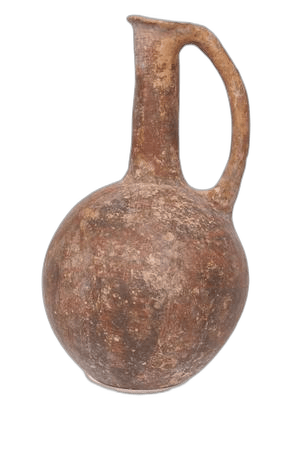
Jugs dominate the catalogue. The tankard jug from Galinoporni-Trachonas (Ashmolean AN1953.220, 20.7 cm high) is shown at the top of this page; the globular jug comes from the same site. Other jugs include a jug with a long neck, a round-bodied jug with a trumpet mouth and a British Museum jug. Open and storage shapes include a carinated bowl, a carinated jar and the British Museum bowl, with a small globular juglet at the other end of the scale. Another Ashmolean jug, 18.7 cm high, was presented by Hector Catling in 1970 (AN1970.832). For the forms in general, see jug, bowl and jar.
Red-on-Red ware
Red-on-Red is the rare sister of Red-on-Black: a polished red-brown or pink slip with matt lines in red-brown or purple [1, p. 27]. It is painted with the same multiple brush and in the same Karpas manner [5, p. 47], and it shares the same date range, roughly 1900 to 1600 BCE in the catalogue. Crewe, following Merrillees, treats Red-on-Red and Red-on-Black as one ware, since colour can change across a single pot with the firing; Red-on-Black is simply the commoner result [2, p. 49]. The light-on-dark variants, with white lines on a red or black ground, or red and white on black, belong to the same family [2, p. 49].
The catalogue has one example, the British Museum Red-on-Red bowl. The Ashmolean holds Red-on-Red bowl rim sherds from Enkomi (AN1953.1175.b and .c), Kalopsida (AN1953.1073.b) and Leontari Vouno (AN1953.1029.h), all Middle Cypriot. You can see all Red-on-Red ware in the catalogue.
.](https://cdn.ancientcyprus.com/britishmuseum/3625-red-on-red-bowl.png)
Exports and later echoes
Red-on-Black also left the island. A Red-on-Black jug was found at Tell Fara in southern Palestine, and such exports matter for reconstructing the transition from the Middle to the Late Cypriot period [3, p. 123]. Phlamoudhi-Vounari's own overseas links point the same way, towards the Asiatic mainland, with a Tell el-Yahudiyeh sherd [3, p. 124].
The ware's influence may also run into the Late Bronze Age. Chemical analysis of Monochrome pottery from Kalopsidha and Tell Mevorakh places it closest to Red-on-Black and to the Paleoskoutella variant of Black Slip, which suggests that the Monochrome found at Enkomi may well have come from the Karpas [2, p. 49]. If that reading is right, a north-eastern regional pottery with its own painting habits also supplied fabrics and techniques to the island-wide wares of the Late Bronze Age.
For the wider picture of how these pots were made and how to tell the wares apart, see the making of ancient Cypriot pottery and how to identify ancient Cypriot pottery.
Objects on this page
- Red on black ware globular jugMiddle Bronze Age II · 1850–1650 BC
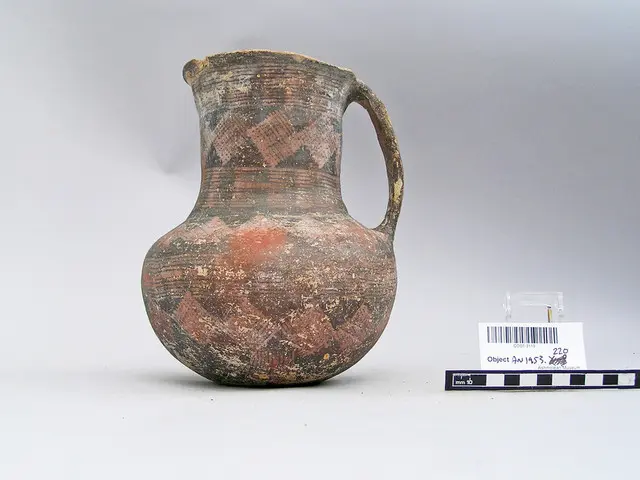 Red on Black ware tankard jugMiddle Bronze Age II · 1850–1650 BC
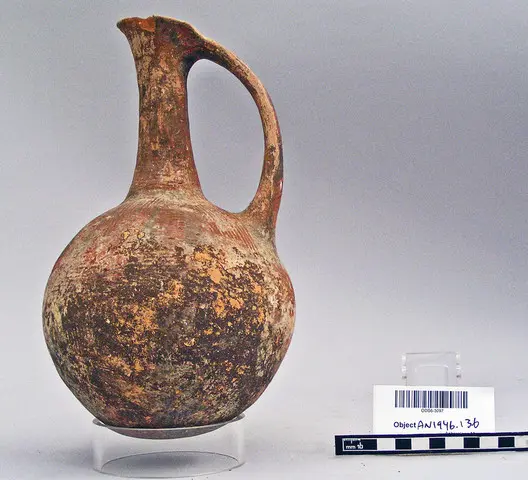 Red on Black ware jug with long neckMiddle Bronze Age II · 1850–1650 BC
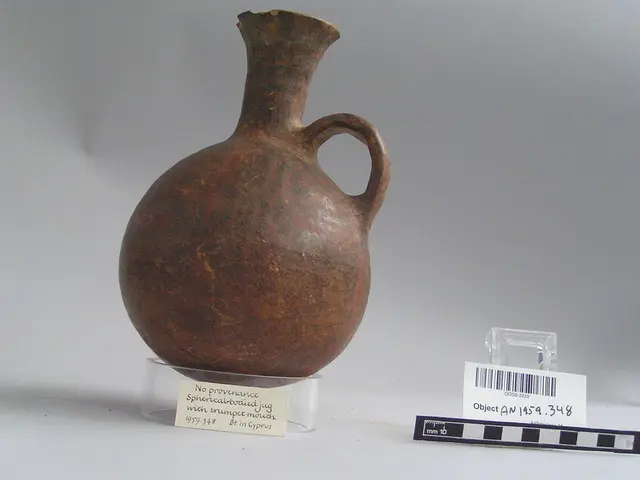 Red on Black round-bodied jug with trumpet mouthMiddle Bronze Age II · 1850–1650 BC
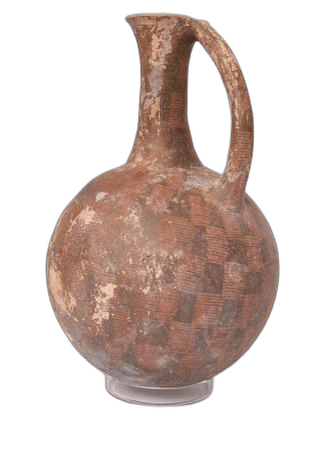 Red-on-black Ware JugMiddle Bronze Age II · 1850–1550 BC
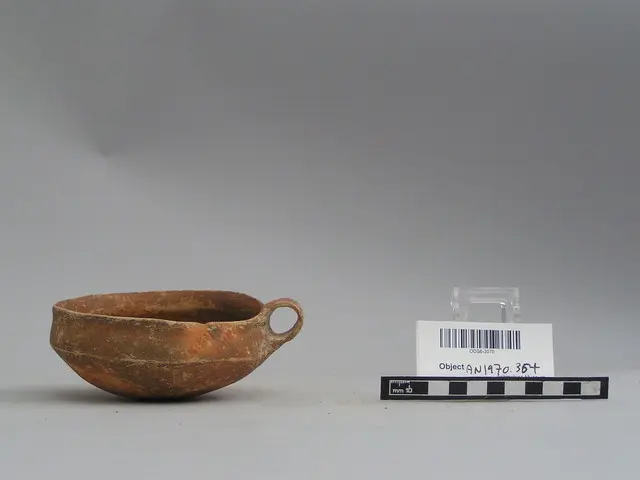 Red-on-Black carinated BowlMiddle Bronze Age II · 1850–1650 BC
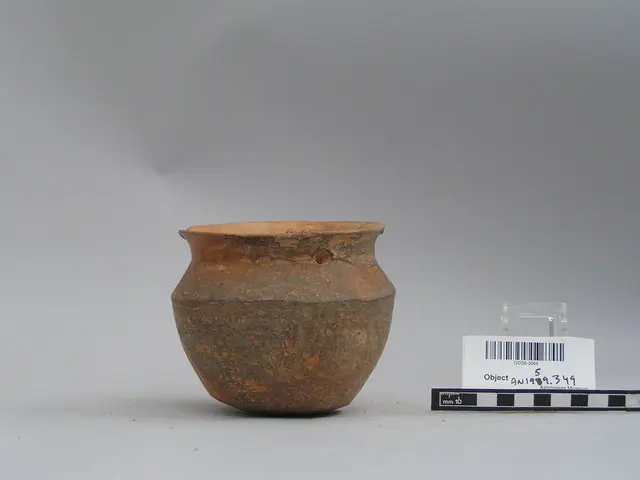 Red on Black carinated jarMiddle Bronze Age II · 1850–1650 BC
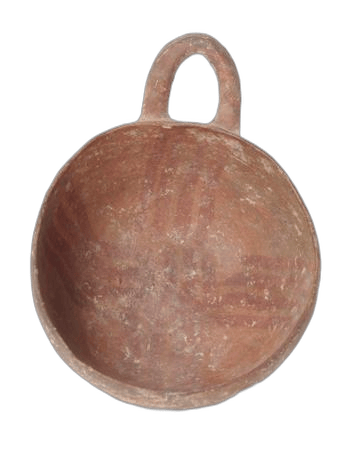 Red-on-Black BowlMiddle Bronze Age II · 1850–1550 BC
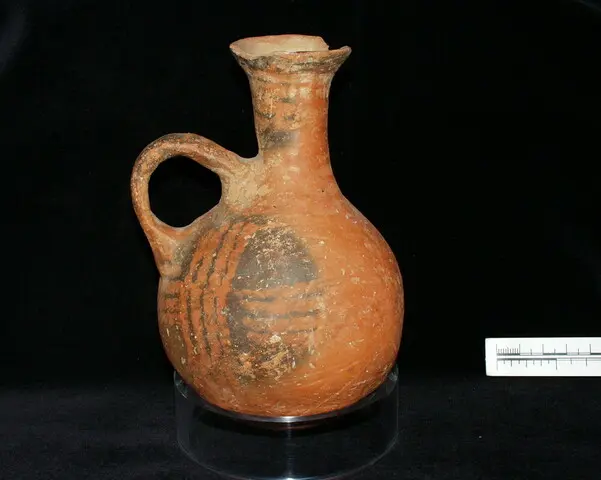 Red-on-Black globular jugletMiddle Bronze Age III · 1750–1650 BC
- Red-on-Red BowlMiddle Bronze Age III · 1750–1550 BC
In the catalogue
References
- 1.Morris, D. (1985). The art of ancient Cyprus.
- 2.Crewe, L. (2007). Early Enkomi: Regionalism, trade and society at the beginning of the Late Bronze Age on Cyprus (BAR International Series 1706).
- 3.Smith, J. S. (Ed.). (2008). Views from Phlamoudhi, Cyprus (Annual of the American Schools of Oriental Research 63). American Schools of Oriental Research.
- 4.Buchholz, H.-G., & Karageorghis, V. (1973). Prehistoric Greece and Cyprus.
- 5.Hein, I. (Ed.). (2009). The formation of Cyprus in the 2nd millennium BC.