
Contents
Every Cypriot antiquity outside the island has a history between the ground and its present owner, and part of that history is written on paper, card and lead. The hero image of this page is one such paper: export licence No. 2655 of the Department of Antiquities, dated 6 November 1953 and issued under the Antiquities Law, 1935, for objects bought from the licensed Nicosia dealer P. Kolokasides, several of them listed with his stock numbers. Documents of this kind are the evidence for the lawful side of the trade, which ran for more than a century until licensed export ended in 1996 (see the legal export of Cypriot antiquities). The illicit side leaves documents too, but of a different kind: they are made by police, courts, parliaments, journalists and the dealers themselves, usually after the object has gone. This entry sets the two records side by side and says, for each kind of document, what it proves and what it does not.
The documents of a lawful history
The oldest lawful papers concern excavation rather than sale. Under the Ottoman regulation of 1874, finds from a licensed dig were divided between the government, the excavator and the landowner, and the division and the permission to export are the earliest official acts an object can carry. The British laws of 1905 and later kept a division of finds for foreign missions, amended in 1927 so that the Swedish Cyprus Expedition could take a share [4, p. 23]. The expedition's objects are the best documented lawful export of the twentieth century: they carry site, tomb and find numbers that correspond to the published volumes and to the registers of the Medelhavsmuseet in Stockholm, so an object can be followed from its tomb to its shelf. The 1935 law cut the excavator's share to half of what remained after the Museum's choice, and the amendment of 1964 ended it (see the 1905 and 1935 laws).
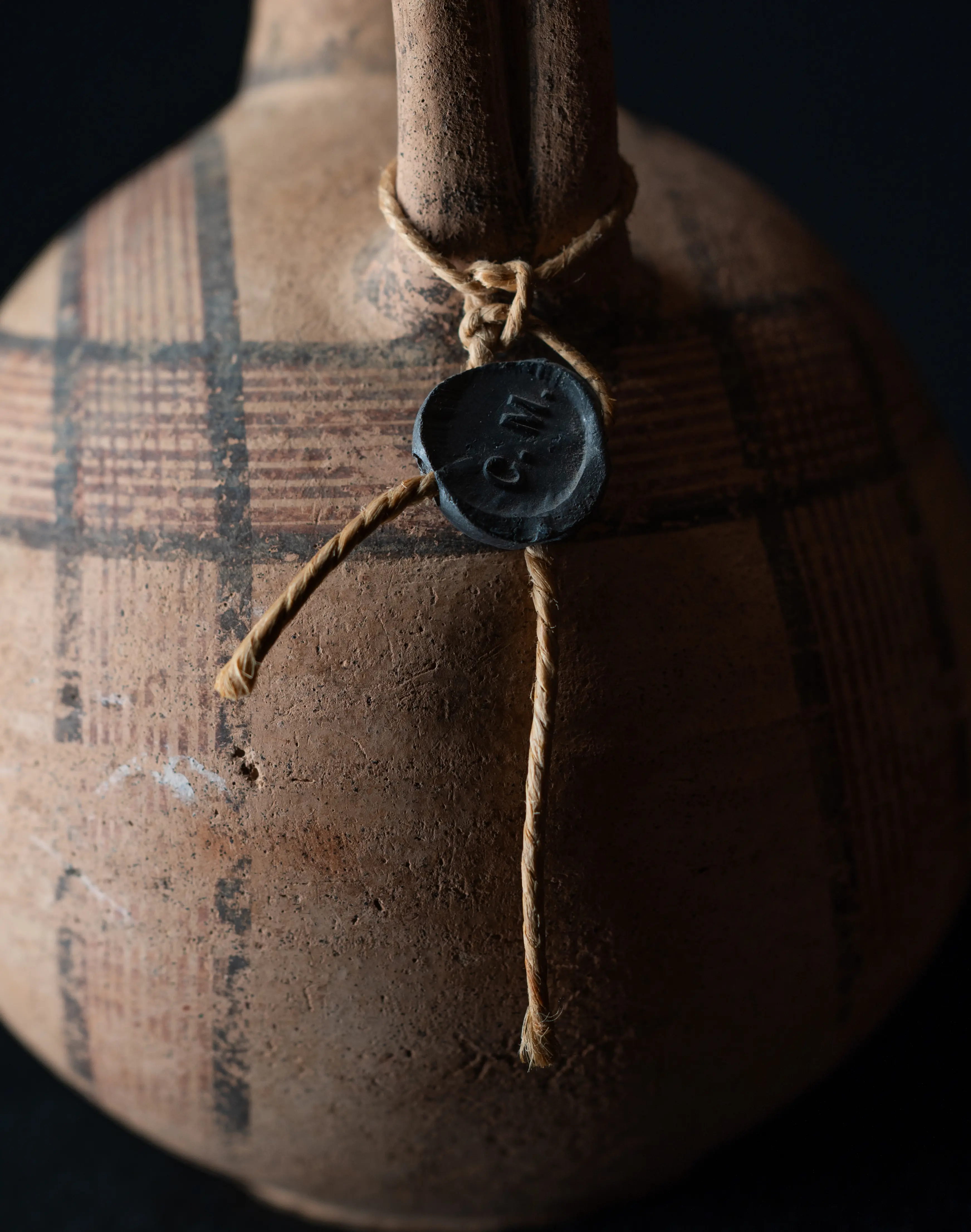
The second group of papers belongs to the Cyprus Museum's own sales. The Museum sold "duplicate" antiquities from the 1920s; under Rupert Gunnis the stock was labelled, using spare Government House invitation cards, and the practice "continued in the Museum until finally being abolished in 1991" [2]. A Museum sale might leave a receipt, a sales register number of the form "S.R. 3477/65" (register number and year), a label, and the small lead seal, stamped C.M. for Cyprus Museum, that inspectors squeezed onto a cord through the handle when they passed an object for export. The site's guide to export licences, seals and labels describes each of these marks, and how the Cyprus Museum sold antiquities gives the history of the saleroom.
The third group comes from the licensed dealers. After 1935 dealing was a licensed trade, and the export licence was the document that closed a sale. The printed form, in use from the colonial period into the 1960s, gave permission to export "antiquities bearing the above number, examined and passed for export by me and sealed in my presence", so licence, number and seal were three parts of one act. Dealers added their own paper. Kolokasides gave receipts and lists with his stock numbers, and in his case the stock numbers on the 1953 licence are the link between the paper and particular pieces. The Department keeps copies of the old licences in its archives, so a licence that turns up with an object "can be confirmed" [3]. Alphas gives two examples: a Red Polished jug offered at Bonhams in October 2014 with a copy of a licence dated 20 October 1964, which the Department matched to a jug "bought for the price of eight Cyprus pounds by an American national from an authorised antiquities' dealer" on 28 September 1964; and a Bichrome bowl at a London gallery, "acquired during the 1950s–1960s from P. Kolokasides", with a "Cyprus Museum lead export tag attached to the handle" and a typed card with a photograph, which the Department also verified [3].
The fourth group is the registration of private collections. Declared collecting was lawful from 1935, and in 1963–73 the Department followed what its Director, Vassos Karageorghis, called a policy of "silent accord". He described the result in a letter printed in Antiquity: "All these collections have been registered (there is a card with a description and photograph of every single item). This gigantic work ended in December 1973" [1, p. 233]. Owners were asked to declare their collections in the last six months of 1973 [5]. This was a declaration window under the 1935 law, not a separate amnesty statute. The cards are the reason the Republic could later write: "We have complete records of all antiquities which have been left in the occupied part of Cyprus" [1, p. 234].
The last group is published. Museum registers, collection catalogues, sale catalogues and deaccession records fix an object at a date and place. The Metropolitan Museum's 1928 sales of Cesnola "duplicates", the British Museum's distributions of finds to British museums and colleges, and the catalogues of the registered collections (Pierides, Severis, Phylactou) are all documents of this kind, discussed in collecting Cypriot antiquities today. When a museum later sells, its deaccession record and its old number on the object carry the history forward.
The documents of an illicit history
The illicit record is made by other people, and usually after the event. The first kind is the police and court file. The four mosaics from the apse of the Panagia Kanakaria at Lythrankomi in the occupied north were removed some time between August 1976 and October 1979; the Indianapolis dealer Peg Goldberg bought them in the free zone of Geneva airport in July 1988 from Aydın Dikmen, a Turkish dealer living in Munich [8]. When she offered them to the Getty, its curator Marion True told Karageorghis, and the Republic and the Church of Cyprus sued in Indianapolis [8]. The judgment of 1989, affirmed in 1990, awarded the mosaics to the Church [7]. The court record is evidence of a precise kind. It proves that the objects were stolen and who held title, and it names the people in the sale. It is not a criminal finding against any of them: Dikmen was never convicted of an offence concerning Cypriot antiquities, and Goldberg lost a civil action for possession, nothing more.
The second kind is the parliamentary and press account. Ymenus van der Werff, reporting to the Parliamentary Assembly of the Council of Europe in July 1989, wrote that "after early opportunist raids during the unsettled period following 1974, more organised looting of selected targets seems to have taken place between 1977 and 1982" [9, p. 131]. His "targets" were mainly churches. From inside the occupied north, the Turkish Cypriot weekly Olay printed Mehmet Yaşın's series "Perishing Cyprus" from 26 April 1982, later entered in a United States congressional record [10]. It reports that 217 antiquities confiscated in 1975 from a shop of the mayor of Morphou carried the initials "OHL" and numbers which suggested that they belonged to the Morphou collector Christakis Hadjiloizides, and that the "list of stolen antiques submitted to UNESCO" by the Department of Antiquities confirmed it [10]. In 1989 a motion in the assembly of the occupied north called for an inquiry into antiquities smuggling, and the resulting debate put on record a structure of the network that the Turkish journalist Özgen Acar had published that year [11]. These accounts are evidence of what officials and journalists knew and said at the time. They are not inventories, and they rarely identify an object that can be traced today.
The third kind is the dealer's own archive. The photographs seized from the Italian dealer Giacomo Medici in Geneva in 1995, and later from Gianfranco Becchina, are the standard examples: pictures of objects fresh from the ground, often broken and encrusted, taken before restoration and sale. An object that appears in such an archive has an illicit history whatever its later papers say. For Cyprus the type of evidence matters more than the archives themselves, because Cyprus had a lawful export channel until 1996 and most Cypriot objects abroad carry the paper of that channel instead.
The fourth kind is the list of stolen objects. The Department's records of registered collections allowed it to issue lists of what was lost after the Turkish invasion of 1974, as the Olay account of the "OHL" pieces shows, and it now identifies objects on the market against those records [3]. The Department and the Church also report stolen pieces to INTERPOL's database of stolen works of art. The International Council of Museums publishes Red Lists of the categories of object most at risk for many countries, including Greece and Türkiye, but it has published none for Cyprus [12]. A Red List would in any case describe categories, not individual stolen objects.
What each document proves
| Document | Issued by | Years | What it proves | What it does not prove |
|---|---|---|---|---|
| Division of finds and export permission | Ottoman and British authorities, Cyprus Museum | 1874–1935 | A licensed excavation and a lawful share for the excavator | Which object in a consignment is which, unless numbers match |
| Expedition and excavation numbers | Excavators (for example the Swedish Cyprus Expedition) | 1890s–1930s and later | Findspot, tomb and lawful division, when matched to the publication | Ownership after the object left the excavator's museum |
| Saleroom label, sales register number, lead seal stamped C.M. | Cyprus Museum | 1920s–1991 | An inspection and sale by the Museum | That the seal or label belongs to this object; that the Museum's stock was lawfully dug |
| Export licence | Director of Antiquities | 1935–1996 | A lawful export on a date, confirmable against the Department's copies | Who bought the object; which object, if the description is brief |
| Dealer's receipt and stock number | Licensed dealers (for example Kolokasides) | 1935–1996 | A sale by a licensed dealer and, with numbers, a link to the licence | Where and how the object was found |
| Registration card with photograph | Department of Antiquities | Declared to December 1973 | That an object was in a registered collection in Cyprus | That it was lawfully excavated |
| Museum, collection and sale catalogues; deaccession records | Museums, collectors, auction houses | 1870s–present | Where an object was on a date | That the earlier history was lawful |
| Seizure list and court record | Police, prosecutors, courts | 1975–present | Theft and title, as found by the court | Guilt of anyone not convicted; the price (police figures are valuations) |
| Parliamentary and press accounts | Council of Europe, assemblies, newspapers | 1982–present | What was known and alleged at the time | The identity of individual objects |
| Dealer's photograph archive | Dealers; seized by police | 1970s–1990s | That an object was handled fresh from the ground | Anything about an object the dealer did not photograph |
| Stolen-object list | Department of Antiquities, Church, INTERPOL | 1974–present | That a listed object was stolen from a known owner | Anything about unlisted objects |
The limits of the paper record
Most objects that left Cyprus lawfully have lost their paper. A licence travelled in a desk drawer, not with the pot; it was thrown out with a house clearance, or kept by one heir while the object went to another. Seals and labels were cut off because owners thought them unsightly. The lack of paper is therefore common among lawful exports and does not by itself show that an object was looted.
A seal or a label can be moved. A lead seal on a cord can be untied and tied to another pot of the same kind, and loose ancient lead seals are cheap. A seal is strongest when its cord is as old as the object's other marks and when the seal can be matched to a licence that the Department can confirm. No Cypriot case of a transferred seal has been published, but the possibility is why a seal alone is weaker evidence than a seal with a licence.
A licence can name the dealer, not the buyer. Kolokasides sometimes signed licences himself as the exporter for pieces sold to clients, and licences often describe objects as briefly as "one base ring juglet", of which hundreds left the island. The buyer may be named only on the dealer's receipt. A search of the Department's files under the buyer's name will then find nothing, and a search under the dealer's name may find a licence that fits several objects.
Registration records possession, not lawful excavation. A card from 1963–73 shows that an object was in a declared collection on the island by December 1973. It says nothing about who dug it. The official archive also has gaps: Stanley-Price reports that in 1926–32 Gunnis was able to approve his own export requests "while omitting to keep a carbon copy of them on file" [2], so the absence of a permit for those years proves nothing either way.
The Drakopoulos Bichrome oinochoe with a lead export seal, 18 cm high, bought at Harrington's Auctioneers in 2024, shows these limits on a single object. The seal records that the jug was inspected and passed for export by the Cyprus Museum. No licence or receipt came with it, so its history between the export and its sale at auction is not known. This is the usual state of a lawful Cypriot export abroad: a mark that records the export, and no paper that names the owners.
Evidence that paper does not always mean a lawful history
The strongest case against reading paper as proof of innocence comes from the Department's own records. A Cypro-Geometric ring-vase (kernos) from the Hadjiprodromou collection in Famagusta, stolen after the Turkish invasion, was photographed in Turkey on its way to the European market, "surfaced in Sotheby's July 1982 auction under 'Various Properties'" and reappeared at Sotheby's in 2014 in the collection of Stanley J. Seeger, before the Department identified it in July 2016 and it was returned that November [3]. Two catalogued sales at a major house gave it a published history of more than thirty years, and that history was a stolen one.
The registration cards raise a second objection. Karageorghis wrote in the Severis catalogue that the "silent accord" allowed Cypriots with access to the Turkish Cypriot enclaves "to buy the 'spoils' of looting so that these should remain in the country and not be exported abroad", and that "there were others who were then buying from the looters" [5]. Sophocles Hadjisavvas, a later Director, has made the same point more bluntly: legally exported is not the same as legally excavated. Samuel Hardy, citing Hadjisavvas, writes that "more than 1250 people had become collectors" in these years and that at least one collector organised teams of diggers; he calls the closing declaration of 1973 an amnesty [6]. On the record, the 1973 measure was a declaration window under the 1935 law, the policy was published by its author in Antiquity [1], and Hardy's figure counts people, not registered collections.
The answer is to keep two questions apart. Whether an object left the island lawfully is a question about title and export, and the licences, seals, saleroom numbers and cards answer it for a very large number of objects. Whether it came out of the ground lawfully is a different question, and for much of the material dug in 1963–74, as for the Cesnola and saleroom material of earlier decades, the honest answer is often no or unknown. The registration cards also worked in the other direction: they are how the Hadjiloizides pieces in Morphou in 1975 and the Hadjiprodromou kernos in 2016 were identified as stolen [10] [3].
What a buyer or owner should look for today
For an object on the market today, the paper record answers specific questions. A licence number, a seal stamped C.M., a saleroom register number or a dealer's stock number can each be checked: the Department of Antiquities holds copies of the old licences and the records of registered collections, and will say whether a number or a well-photographed seal matches its files [3]. A history that reaches back before 1974 through named collections, published catalogues or museum deaccessions is the strongest evidence a seller can give, and an object listed by the Department, the Church or INTERPOL as stolen cannot be lawfully sold. A history that begins with a sale in the 1980s or later, with no earlier name, leaves the years before that sale unaccounted for, and the kernos shows that even a major-house sale can conceal a theft.
Owners should keep every paper with the object and leave seals and labels in place. How to assemble a file, including what to record when nothing survives, is set out in documenting a lawful history. The site's guide to export licences, seals and labels explains how to read and photograph each mark, provenance and provenience explains the difference between an object's ownership history and its findspot, and collecting Cypriot antiquities today sets out what the law now allows.
References
- 1.Karageorghis, V. (1976). The illicit sale of Cypriot antiquities [Letter]. Antiquity, 50(199–200), 233–234. https://doi.org/10.1017/S0003598X00108336
- 2.Stanley-Price, N. (2025). Illicit excavation and the sale of 'duplicate' antiquities: Rupert Gunnis and the Cyprus Museum, 1926–1932. Cahiers du Centre d'Études Chypriotes, 55, 269–301. https://doi.org/10.4000/151c2
- 3.Alphas, E. (2017). From a Bronze Age tomb in Cyprus to the estate of a gentleman in Sussex: Measures taken and problems faced in the investigations on the illicit trade of antiquities. In D. Pilides & M. Mina (Eds.), Four decades of hiatus in archaeological research in Cyprus: Towards restoring the balance (pp. 30–43). Verlag Holzhausen.
- 4.Pilides, D., & Papadimitriou, N. (Eds.). (2012). Ancient Cyprus: Cultures in dialogue. Department of Antiquities, Cyprus.
- 5.Karageorghis, V. (2010). Ancient Cypriote art in the Severis Collection (2nd ed.). Nicosia.
- 6.Hardy, S. A. (2014). Using open-source data to identify participation in the illicit antiquities trade: A case study on the Cypriot civil war. European Journal on Criminal Policy and Research, 20(4), 459–474. https://doi.org/10.1007/s10610-014-9250-x
- 7.Autocephalous Greek-Orthodox Church of Cyprus v. Goldberg & Feldman Fine Arts, Inc., 717 F. Supp. 1374 (S.D. Ind. 1989), affirmed 917 F.2d 278 (7th Cir. 1990).
- 8.Gerstenblith, P. (2015). For better and for worse: Evolving United States policy on cultural property litigation and restitution. International Journal of Cultural Property, 22. https://doi.org/10.1017/S094073911500017X
- 9.Hadjisavvas, S. (2015). Perishing heritage: The case of the occupied part of Cyprus. Journal of Eastern Mediterranean Archaeology & Heritage Studies, 3(2), 128–140. https://doi.org/10.5325/jeasmedarcherstu.3.2.0128
- 10.Yaşın, M. (1982). 'Perishing Cyprus'. Olay (Nicosia), from 26 April 1982. Printed as Appendix 9 in Commission on Security and Cooperation in Europe, Implementation of the Helsinki Accords: Hearing on human rights abuses in Cyprus, July 20, 1985. U.S. Government Printing Office, 1986. https://archive.org/details/micro_IA41152841_0156
- 11.Hardy, S. A. (2021). Organised crime in trafficking of cultural goods in Turkey and interconnections between antiquities trafficking and narcotics trafficking, arms trafficking and political violence. In A. Traviglia, L. Milano, C. Tonghini & R. Giovanelli (Eds.), Stolen heritage (pp. 113–154). Edizioni Ca' Foscari. https://doi.org/10.30687/978-88-6969-517-9/006
- 12.International Council of Museums. Red Lists. https://icom.museum/en/resources/red-lists/ (consulted October 2026).