
Fieldwork·Roundup
This Week in Cypriot Archaeology: 25–31 May 2026
A Late Roman wall 2 m thick on the Amathus acropolis, the first volume of the final report on the Tombs of the Kings at Paphos, and a tour of the new Cyprus Museum site.



The French mission at Amathus traced a thick Late Roman wall along the west terrace of the acropolis, and the excavation report on the Tombs of the Kings at Paphos began to appear in print with its first volume. In Nicosia, the builders of the new Cyprus Museum showed journalists round the site.
Map of Cyprus
This week's stories
- Fieldwork
- Books
- Museums
- Ground above 200, 500, 1,000 m
Sites on this map
Fieldwork
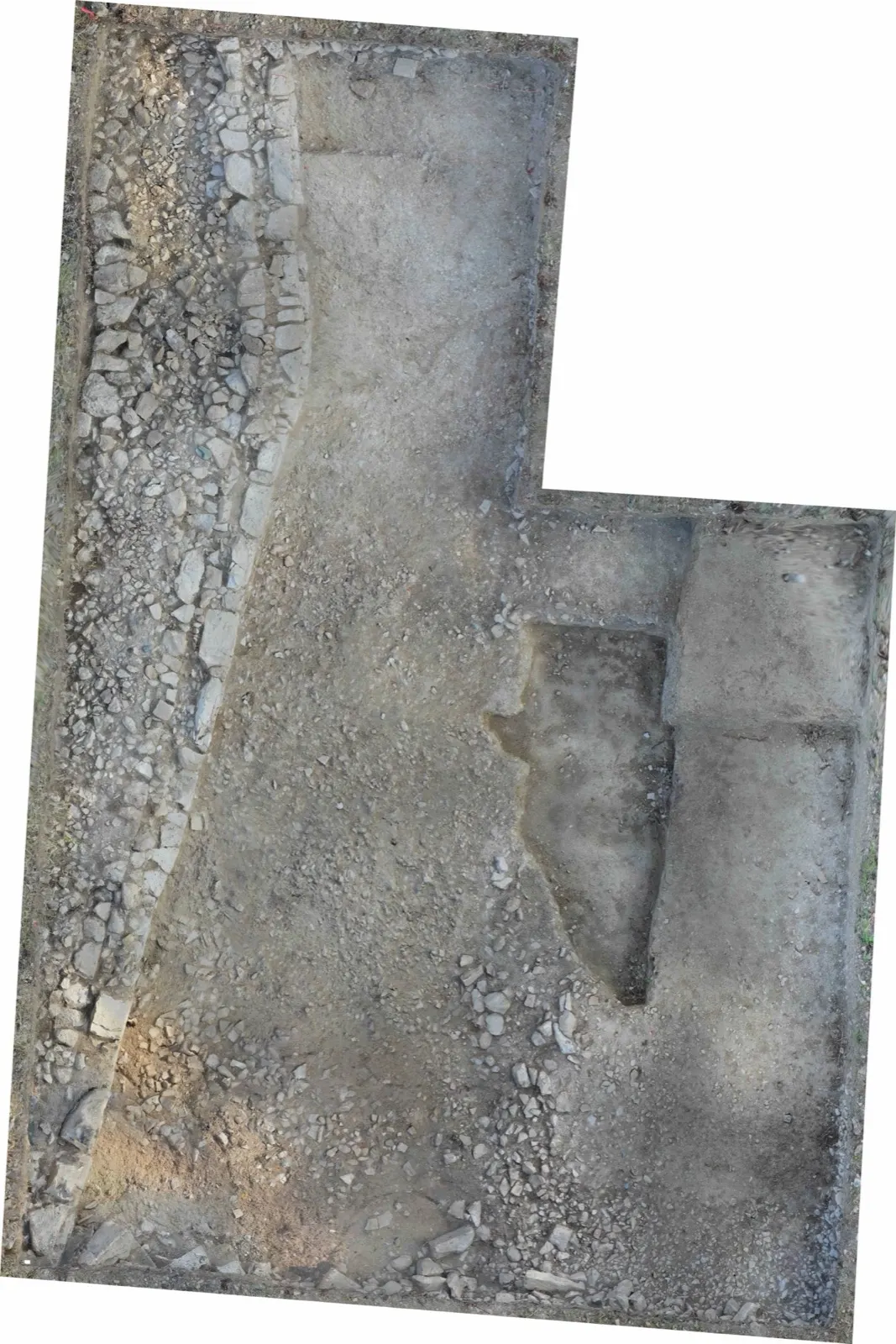
From 30 March to 24 April the French archaeological mission at Amathus dug a second season on the west terrace of the acropolis, the Department of Antiquities announced on 29 May. The work, directed by Dr Anna Cannavò of HiSoMA in Lyon for the French School at Athens, followed a geophysical survey in 2024 and a first season in 2025, which had found a short stretch of north–south wall and well-preserved Late Roman roof tiles.
This year Trench 1 was enlarged to 12 by 8 m. The wall runs along the natural edge of the terrace and turns slightly west at its southern end; it reaches 2 m in thickness and survives to about 50 cm on average. The team sees two probable phases, a first wall 135 cm thick later strengthened on its east face by a second row of large limestone blocks. To the east lay a floor partly paved with roof tiles, buried under fallen blocks, roof tiles and mudbrick from the wall's upper part. Transport amphorae and tiles date the wall and floor to the Late Roman period.
The Department reads the wall as probably defensive, protecting the upper acropolis and the basilica that took the place of the sanctuary of Aphrodite on the summit. A second trench, 5 by 5 m, on the northern edge of the terrace above an Archaic fortification wall the French mission excavated in 1976–1977, found no buildings but a deep fill rich in Iron Age material, including terracotta figurines and pottery in the Amathus style. Lower down, the stretch of city wall halfway up the acropolis, explored in 1975–1976 and again from 1988, has its main phase in the 6th century CE.
Books
On 27 May the Department released Volume I of the final publication of the Tombs of the Kings, the Ptolemaic cemetery north of Nea Paphos: Tombs of the Kings: The Ptolemaic Necropolis of Pafos, Volume I. Excavation Seasons 1977–1981 (ISBN 978-9963-36483-1), by Sophocles Hadjisavvas, who directed the Department's excavations there. Two of its chapters deal with Tomb 8, which, according to the Ministry, has been attributed on strong arguments to the burial of Ptolemy of Cyprus (80–58 BCE), who ruled the island until Rome annexed it. The book was to be presented at the A. G. Leventis Gallery in Nicosia on 3 June.
Museums
Cyfield, which is building the new home of the Cyprus Museum in Nicosia in a joint venture with Iacovou, took journalists round the site on 28 May. The building has a built area of 30,000 m² on five levels, two of them underground, and rests on 77 seismic isolators; the contractor had asked for 500 days beyond the completion date of 9 June 2026 (our brief on the later delay to 2028).
Original sources
- Deputy Ministry of Culture: Completion of the second excavation season of the west terrace of the Acropolis of Amathous
Official release·
- Deputy Ministry of Culture: Release of the Volume I Tombs of the Kings: The Ptolemaic Necropolis of Pafos Excavation Seasons 1977–1981
Official release·
- Politis: Inside the construction site of Cyprus's new archaeological museum
Press·
On ancientcyprus.com
- Sites
- Amathus, Nea Paphos
- Excavations
- Amathus: the French School at Athens mission, Nea Paphos: the Tombs of the Kings excavation (Hadjisavvas)
- Institutions
- Department of Antiquities of Cyprus, École française d'Athènes, HiSoMA (Histoire et Sources des Mondes Antiques), A. G. Leventis Gallery, Cyprus Museum
- Periods
- Hellenistic, Roman
More in Fieldwork
- Hellenistic quarry under Paphos's Fabrika hill became an unused tomb, then a church
- This Week in Cypriot Archaeology: 31 August–6 September 2026
- Hollows cut into a Bronze Age threshold at Erimi match a senet game board
- This Week in Cypriot Archaeology: 27 July–2 August 2026
- Grape seeds and unfired loom weights found in Bronze Age work complex at Erimi-Pitharka