
Research·News
At least 40 roof tiles lay in rows under fallen stone on the Amathus acropolis, report shows
Anna Cannavò's report on the 2025 season on the west terrace dates the collapse over them to Late Antiquity, probably the same 6th–7th century CE phase as the nearby basilica.



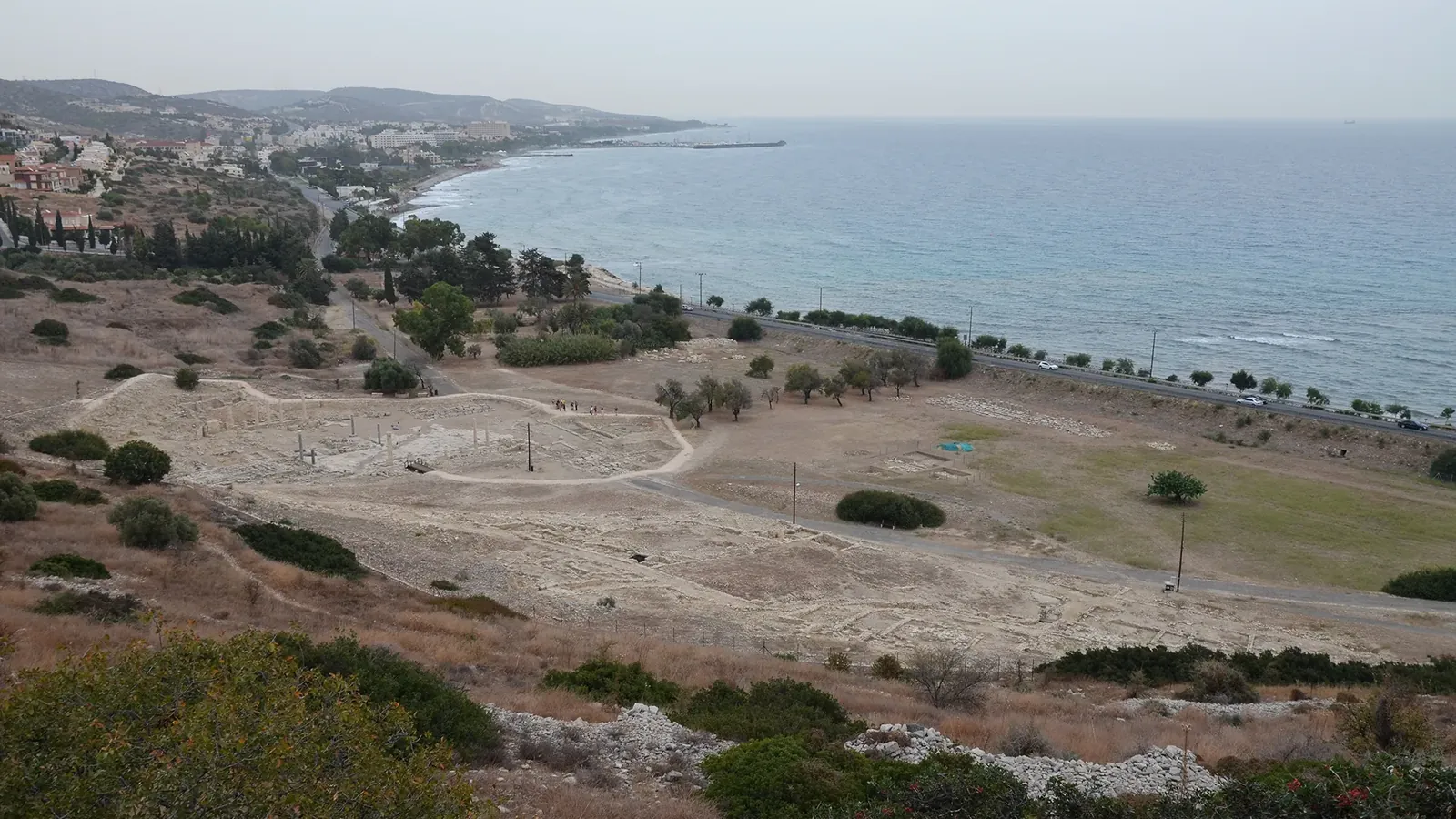
Under a layer of fallen stone on the west terrace of the Amathus acropolis, the French mission found at least 40 roof tiles still lying in rows, beside the face of a wall of squared blocks. Dr Anna Cannavò of HiSoMA in Lyon, who directs the work, describes the find in her report on the 2025 season, the first excavation on the terrace, published online on 2 February 2026 in the Bulletin archéologique des Écoles françaises à l'étranger. The team excavated from 31 March to 25 April 2025. Our piece on the second season, announced by the Department of Antiquities in May, followed the same wall north.
The terrace and the old dig below it
The terrace is a long, narrow strip on the western slope of the acropolis, running north to south at about 60 m above sea level and 63 m in its flat central part. That puts it level with the royal palace, which lies at 56–59 m. A narrow passage at its north end gives access to the sanctuary on the summit. Steep slopes bound it on both sides, propped in places by dry-stone walls.
No one had excavated the terrace itself. The earlier work lay below its western edge, where the Department of Antiquities collected sherds, limestone and terracotta figurines and inscribed fragments near a well-built wall in 1960, 1961 and 1963. In 1976 and 1977 J.-P. Thalmann of the French mission dug into that wall to work out its phases. He found two deposits of Archaic and Early Classical material at its base, and so many figurines and sherds of imported Greek and local "Amathus style" pottery that the excavation was halted and never resumed.
Thalmann later published the imported pottery the Department had collected, and Antoine Hermary the terracotta figurines. The local and imported pottery from the 1976–1977 seasons is still unpublished; the finds from the French dig are stored in the Limassol Archaeological Museum as AM 2890–2923.
The other aim is the wall. It is read as a terrace wall holding back the slope, perhaps part of the Archaic fortifications of the acropolis, but what it was has not been settled. The project combines three approaches: geophysics over the whole terrace, a new study of the 1976–1977 pottery, with Anna Georgiadou as the team's ceramologist, and test trenches.
Survey, then two trenches
In October 2024 Christophe Benech and Khaldoun Rajab of Archéorient in Lyon surveyed the terrace with magnetometry. The stony surface blurred the signal, yet anomalies on a shared alignment came through, clearest in the north. Radar was used only at chosen points, since its antennas could not sit flat on the stones. The Director of the Department, Dr Georgios Georgiou, issued the excavation licence on 2 January 2025.
The two trenches, sited on the survey results, covered 74 m². The northern one, 7 by 7 m, is the Trench 1 that the 2026 season enlarged. Below a surface layer holding material from the Iron Age to Late Antiquity, with nothing later, the team reached a layer of collapse. Its western part was made of larger blocks, some of them worked and, in Cannavò's judgement, certainly taken from nearby buildings; a cluster of tiles lay in the middle. Lifting the western blocks exposed the tiles, set in north–south rows, and to their west the east face of a north–south wall of large squared blocks bedded in earth and small stones. The tiles were numbered, lifted and stored on the last day.
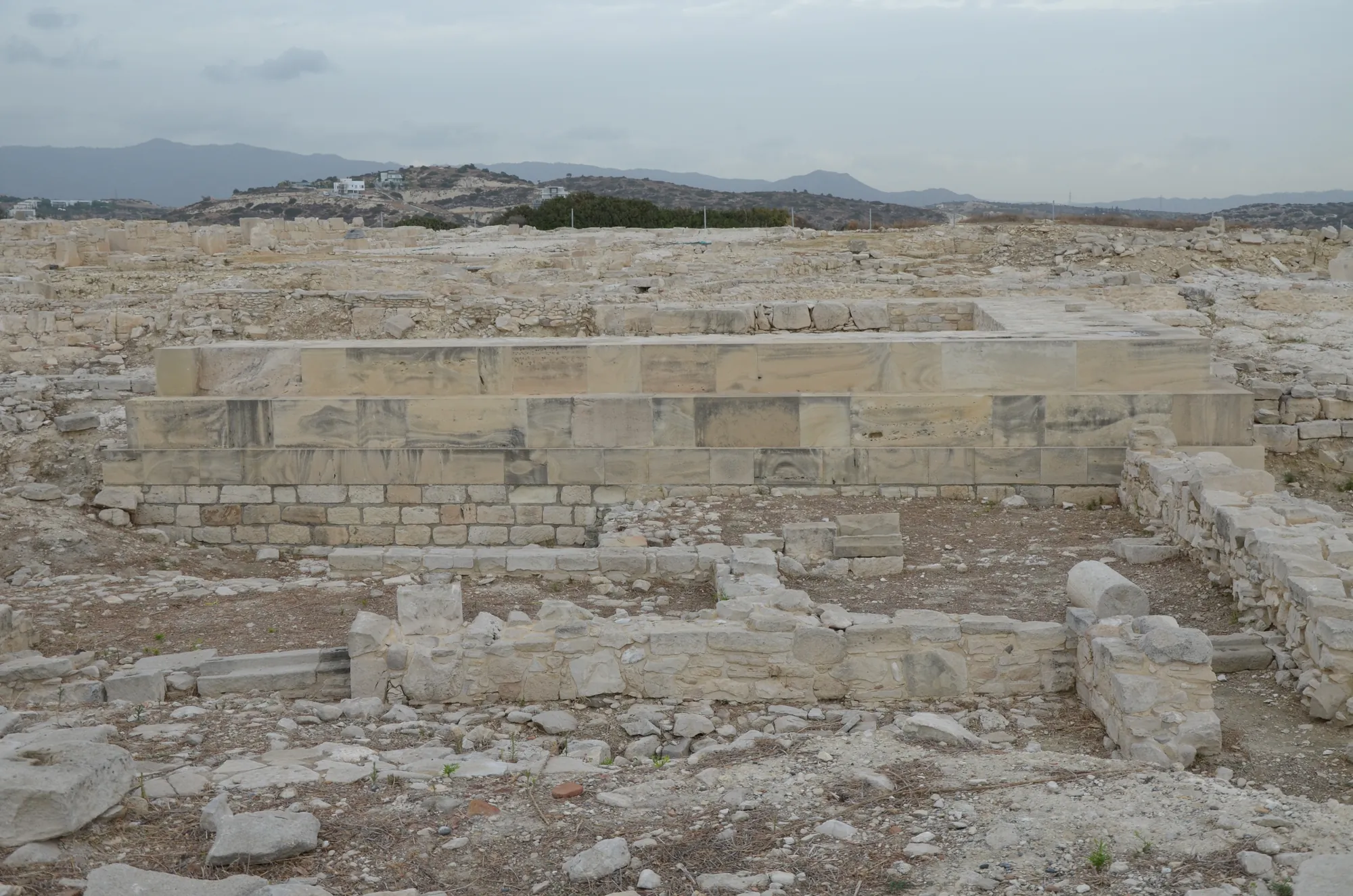
The finds from the collapse and the layers around it point to the Late Antique period. Roman and Late Roman amphorae, everyday pottery and tiles were mixed with Iron Age and Hellenistic pieces. The surface layers held several Iron Age terracotta figurines, among them a male figure wearing a mitra headdress (AM 4036), and a small limestone head.
The southern trench, 5 by 5 m, met a north–south band of stones packed with Late Roman amphora sherds. The report reads it as the collapse of a small structure, possibly a xerolithia, a dry-stone wall, that fell from the east side of the terrace. The team then cut down in stages to a pit 1.5 m square, stopping at 61.66 m above sea level without reaching bedrock. This trench gave a coin (AM 4037), a bronze ring (AM 4035) and a moulded female figurine in terracotta from the upper layers, and, from the lowest, a glass vessel base (AM 4034) and a terracotta head of Hellenistic type. The four numbered finds went to the Limassol museum on the closing day.
Late Antique occupation, earlier levels below
The report draws two preliminary conclusions. The terrace was left untouched after the city was abandoned at the end of Late Antiquity: the dry-stone walls suggest farming and herding, but neither left a trace in the excavated layers. People did use it in antiquity, in the Late Antique period at least, while the earlier material scattered through the fill suggests older levels further down.
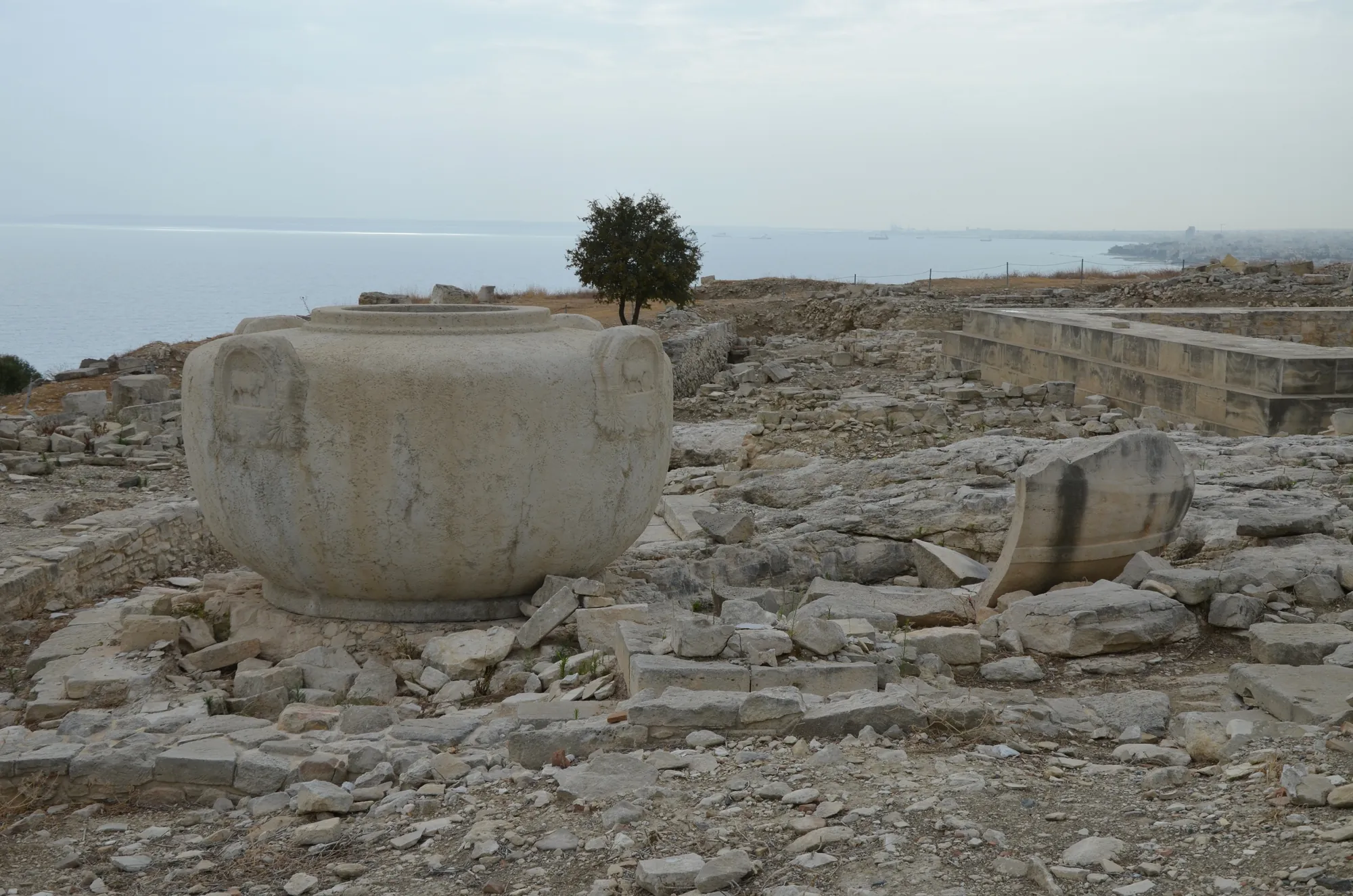
What the remains in the northern trench were needs more excavation. Cannavò thinks they can probably be linked to two other parts of the acropolis that have produced 6th–7th century CE evidence: the basilica and early Christian complex in the sanctuary, and the middle fortification wall. Whether the north–south wall in that trench is related to the wall Thalmann excavated below the terrace remains to be investigated.
Funding came from the French School at Athens, HiSoMA and France's foreign ministry, with support from universities that sent students, among them the École normale supérieure in Paris and Paris 1 Panthéon-Sorbonne. Besides the director, the ceramologist and two topographers, 11 participants came from France, Cyprus, Germany, Spain and Italy.
Original sources
On ancientcyprus.com
References
More in Research
- Wine jars from Gaul and fish-sauce jars from Sicily reached ancient Cyprus, five free papers report
- Wreck off Cape Apostolos Andreas is the Città di Alessandria, lost in 1972, diver concludes
- Giovanni Mariti watched ancient Kition being dismantled for 1760s Larnaca, a 2013 study recounts
- Cyprus's endemic mouse and the house mouse differ in jaw and molar shape, 3D study finds
- Villagers' tip about a medieval cistern explained disturbed layers at Palloures, co-director writes