
Lecture·CAARI Cyprus·2022
Disaster and Debris: Remaking Society in Post-Earthquake Kourion
Chapters
About the lecture
Ian Randall, postdoctoral fellow at the University of British Columbia and pottery analyst for the Kourion Urban Space Project (KUSP), examines how the inhabitants of Kourion responded to the devastating late fourth-century earthquake and compares this recovery with changes across Cyprus after the Arab raids of the seventh century.
Randall frames the lecture through Shannon Dawdy's concept of a "taphonomy of disaster", which uses post-catastrophe rebuilding and rubbish disposal to observe how a community is structured, who directs recovery, and which areas are left behind. In the Late Roman and early Byzantine empires, central imperial relief after earthquakes was usually limited to tax remission, as at Salamis Constantia after the earthquake of 342. Physical rebuilding fell largely to local secular elites of the curial class and, increasingly from the fourth century onwards, to bishops and church authorities.
At Kourion, a series of fourth-century earthquakes culminated in a destructive event in the late fourth century, identified by Soren at the Earthquake House with the quake of 365 CE or shortly thereafter. While the traditional narrative posits decades of near-total abandonment before the three-aisled Christian basilica (dated by Megaw between the 410s and 430s) was erected, Randall brings together earlier excavation records from Daniel, McFadden, Stillwell, and Christou to show continuous, smaller-scale habitation. The late fourth-century House of Eustolios provided baths and a guesthouse, while humbler dwellings built of spolia occupied the ruined theatre, the agora, and the House of the Gladiators.
Drawing on KUSP excavations of a second-century elite building on the southern bluff next to the Earthquake House, directed by Tom Davis and Laura Swantek, Randall shows that this sector had already been subdivided by the fourth century. After the earthquake, neither building was cleared of human remains or collapse; instead, the KUSP area was used for four distinct episodes of dumping debris cleared from wealthier parts of town, containing coins, an Egyptian glass millefiori plate, and large, unrepaired sherds of red slip fine ware. Re-examining McFadden and Daniel's unpublished pottery in the Episkopi Museum, Randall contrasts fill-like assemblages from the theatre with the higher concentration of fine wares and fewer pithoi at the House of Eustolios.
The final section places fourth-century Kourion alongside seventh-century Cyprus, when Arab raids in 649 and 653 and the 688 treaty between Byzantium and the Umayyad Caliphate disrupted state-subsidized shipping and the import of red-slipped fine wares. As dining pottery became localized across the island, the appearance of imported Constantinopolitan glazed whiteware signals new class and administrative differentiation tied to the imperial capital.
Found at the places discussed
Objects in our catalogue, in museum collections, recorded as found at these sites.

Background
Where to read more on this site before or after watching.
The site
Kourion
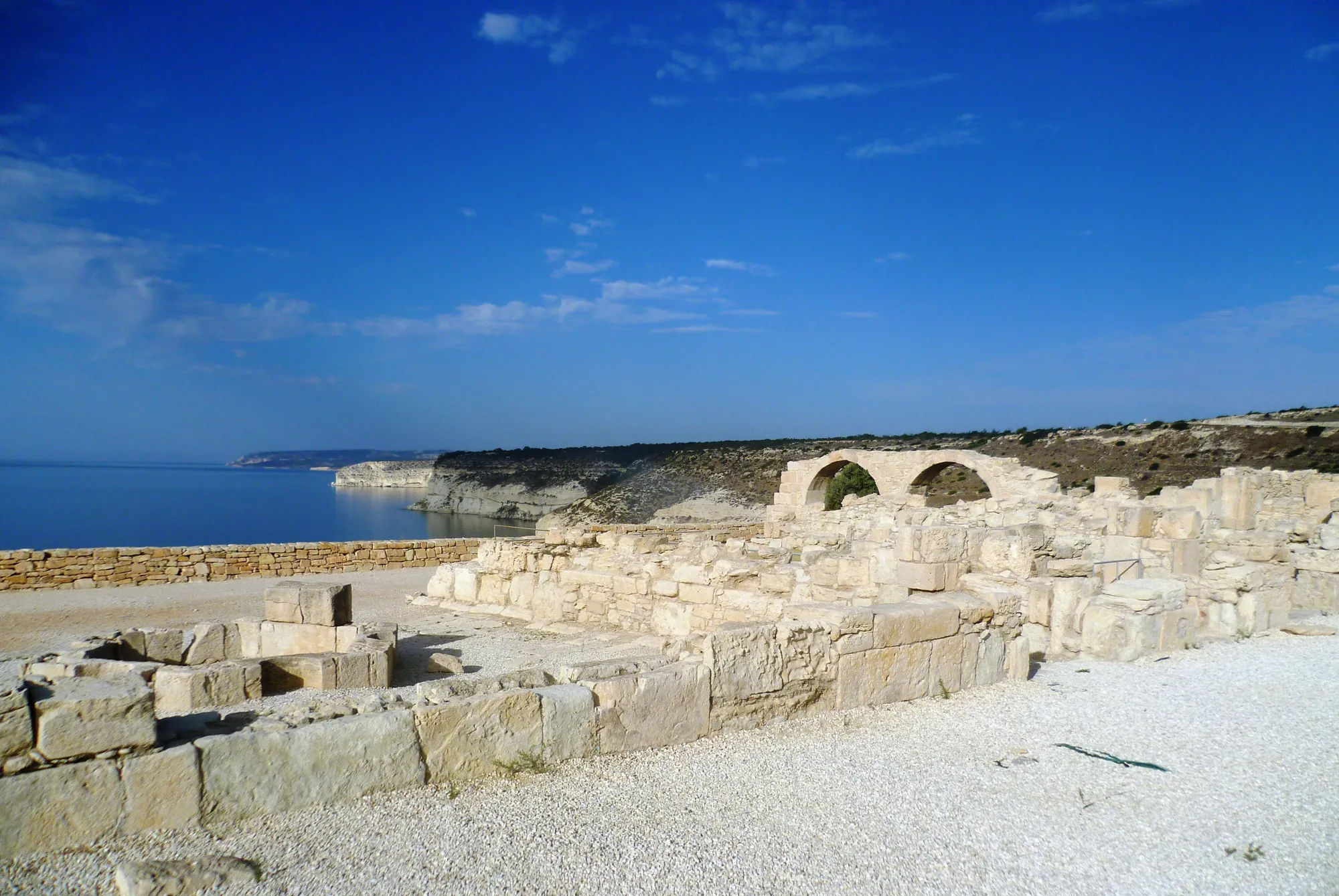
Kourion stands on a limestone bluff above Episkopi Bay, west of Limassol. It was the seat of one of the Iron Age kingdoms of Cyprus, then a Hellenistic and Roman city with a theatre, baths and houses with mosaic floors, and a great sanctuary of Apollo Hylates to the west. An earthquake in the later 4th century AD destroyed the city; a Christian town with a bishop's church grew up over the ruins and was abandoned in the later 7th century.
In the compendium
Hellenistic and Roman Houses
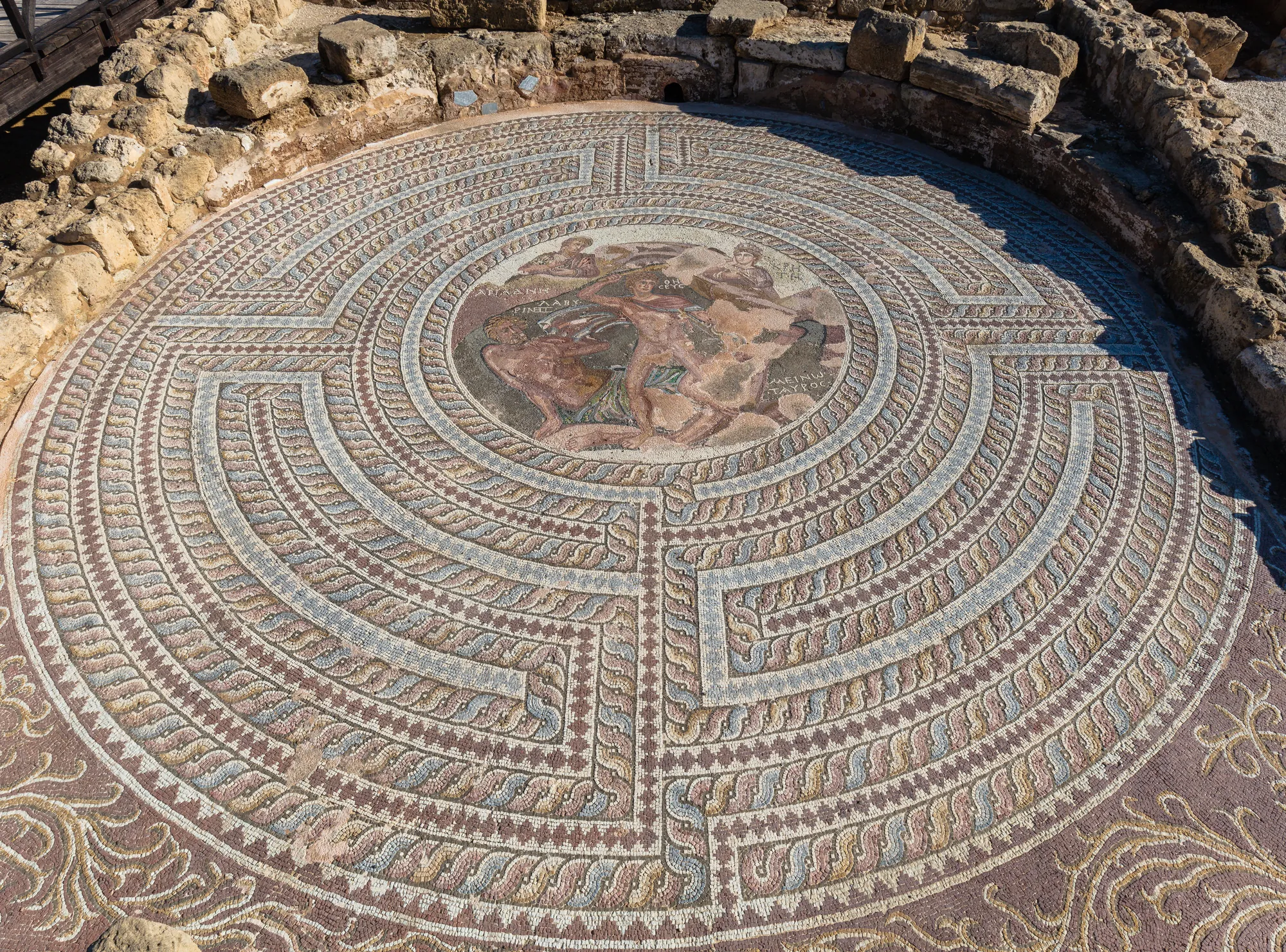
Town houses on Cyprus from the founding of Nea Paphos in the late 4th century BC to the earthquakes of the 4th century AD, from mosaic-floored peristyle houses to a mudbrick house at Kourion.
In the compendium
Theatres, Baths and Public Buildings
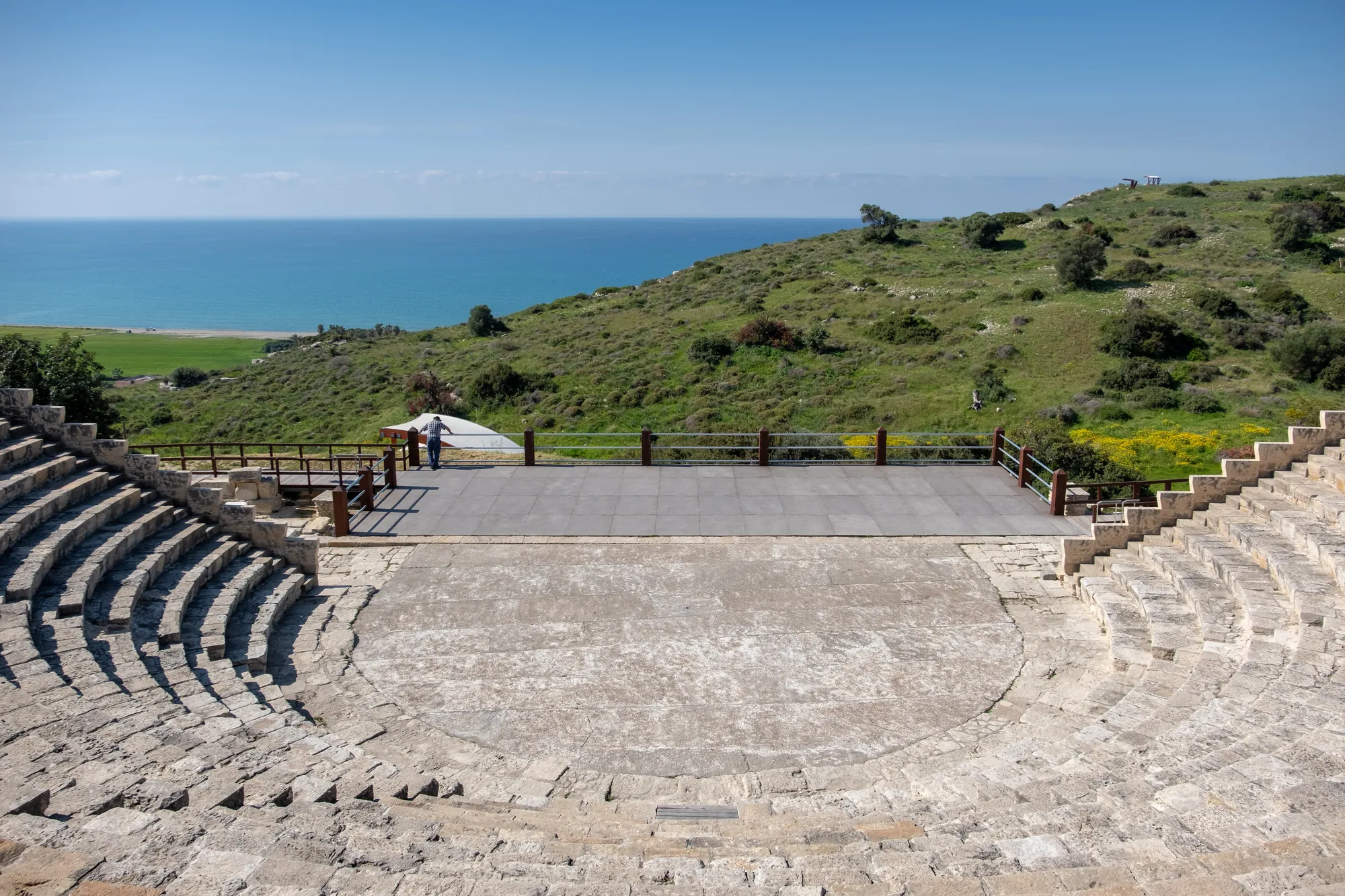
The public buildings of Hellenistic and Roman Cyprus: theatres, an odeion, agoras, the Salamis gymnasium, the Kourion stadium and heated baths, mostly rebuilt after AD 76/77.
In the compendium
Earthquakes in Ancient Cyprus
The earthquakes proposed for ancient Cyprus, from disputed Bronze Age destructions to the 4th-century CE shocks that left Kourion in ruins.