Archaeologist · Excavator · Expedition member · Scholar
Virginia Randolph Grace
1901–1994 · United States
American archaeologist (1901-1994) who dug tombs at Lapithos in 1931, published its Minoan jar in 1940, worked at Kourion in 1939-42 and built the study of stamped amphora handles.
Key factsBorn 1901, New York City; died 22 May 1994, AthensShowHide
Virginia Randolph Grace (1901–1994) was an American archaeologist who, in Ellen Herscher's words, was "best known for her definitive studies of Greek amphorae" but "active in Cyprus early in her career"1. Sara Immerwahr records that she was born in New York City on 9 January 1901, the second of five daughters and one son of Lee Ashley and Virginia Fitz-Randolph Grace12. She studied five years of Latin and three of Greek at the Brearley School before entering Bryn Mawr College12. She took her A.B. there in 1922, cum laude in Greek and English13,14. She then taught English at a New York public high school and mathematics at Brearley, and tutored a pupil on a California ranch12.
She first went to Greece as a member of the American School of Classical Studies at Athens in 1927–192813. There, Immerwahr writes, she met her future fiancé, a fellow student who was considerably younger12. The sources differ on the year of her Bryn Mawr M.A.: the AIA citation and the Bryn Mawr Alumnae Bulletin of 1938 give 1929, and a Bryn Mawr College Library exhibit gives 19309,13,14. In spring 1931 she went with Lucy Shoe to Pergamon, her first excavation14.
Lapithos and the Minoan jar
In 1931 a University Museum of Pennsylvania team under the general direction of Bert Hodge Hill opened tombs at Lapithos, Vrysi tou Barba; the staff were Lucy Talcott, Virginia Grace and the architect Dorothy H. Cox15. Herscher writes that Grace supervised the excavations, and that thanks to her "meticulous notes and reports" the data from these still unpublished excavations were not lost1. A tomb chamber opened on 6 October 1931 held Early Cypriote III offerings and the pieces of a vase made in Crete8.
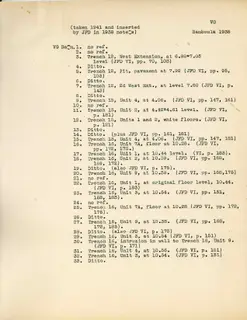
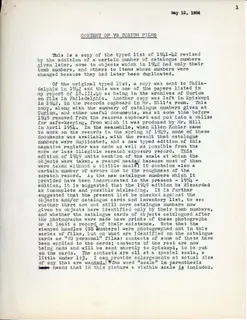
Her application to the Philosophical Society for $1,700 to prepare the material for publication had been considered twice without favourable action by 193516. On 31 July 1935 Hill wrote that the Museum had made her a small grant to photograph and study that autumn the 1931 Lapithos finds still in Cyprus; the Museum's Lapithos pottery now lay in 40 packing-cases at Episkopi16. She held a special research fellowship under Bryn Mawr in 1937-38 for the study8. On 8 December 1938 J. R. Stewart gave her his full permission to use the confidential lists of his finds16.
Her paper "A Cypriote Tomb and Minoan Evidence for its Date" appeared in 19408. Hector Catling and J. A. MacGillivray write that she attributed the "now famous" vase to the earliest burial and dated the context EC IIIA; Stewart later dated the tomb, renumbered 806A, to EC IIIB17. They set Miss Kehrberg's view against "Miss Grace's original view of the tomb's sequence", noting that "at least the excavator saw the material in the ground"17. A 1947 article in the American Journal of Archaeology credits the lowering of the dates of the Cypriote Early Bronze Age to the independent studies of Grace at Lapithos and Claude Schaeffer at Vounous18. Schaeffer judged her right to consider significant the horse remains she reported from another Lapithos tomb, though he noted that she did not cite the earliest Near Eastern finds of the horse19. Herscher calls her study "one of the cornerstones of Cypriot chronology", and Immerwahr says she issued an Addendum in 1973 with a full index and inventory1,12. Giampaolo Graziadio calls the jar the earliest Minoan vase imported to Cyprus20.
Kourion and the war
Immerwahr says Grace had been at the Penn excavations at Kourion in 1939, and in spring 1940 the two women lived in the excavation house at Episkopi awaiting Hill and George H. McFadden12. Grace was the last member of the American School to leave Athens in 194013. Immerwahr writes that she left in October via Istanbul and Alexandretta and spent two years at Kourion putting the finds in safe storage in case the island was invaded, and trained as a Nurses' Aid with the British12. McFadden says she supervised Tombs 1 and 9 of the Ayios Ermoyenis necropolis and would publish them, and he thanked her for a provisional catalogue of Rhodian and other large amphoras3. On 4 June 1941 her mother wrote to the University of Pennsylvania asking for news of her16. Immerwahr has her leaving Cyprus in mid-April, with the year marked "(1942?)"12. Despina Pilides writes that in 1944 she served with the OSS in Smyrna and Constantinople21. She returned to America in 194512.
Amphoras
Her Agora stamped handles, published in Hesperia by 1934, became her Bryn Mawr Ph.D. dissertation13. From 1945 to 1949 she was a Visiting Member of the Institute for Advanced Study at Princeton, then returned to Greece as Edward Capps Fellow13. On trips to Cyprus she studied the Swedish Expedition's amphora finds, and a manuscript on a Marion tomb group is dated 24 October 195522. Graziadio records soundings at Episkopi Bamboula by Grace and Saul S. Weinberg in the 1940s and 1950s20. In 1967 she tentatively identified the commonest amphora of the Kyrenia wreck as Rhodian, of the last third of the fourth century BC23. On 28 December 1989 the Archaeological Institute of America gave her its Gold Medal, citing her lifelong study of stamped amphora handles13.
She died in Athens on 22 May 199412. Her ashes were interred at Cold Spring Harbor, New York, where her fiancé had been buried almost sixty years earlier12.
Life and work
92 events, 1931–2023
1931
Member of the University Museum (Pennsylvania) team that opened 38 tombs at Lapithos, Vrysi tou Barba, under the general direction of Bert Hodge Hill; staff Lucy Talcott, Virginia Grace, architect Dorothy H. Cox. Herscher says Grace supervised the Lapithos excavations and that her notes preserve the data of the still unpublished dig.
In the Kourion expedition papers of 1935: «conversation with Virginia Grace that the Museum has been able to make a small grant to her for work this autumn photographing and studying those of our finds of 1931 at Lapithos»
In the Kourion expedition papers of 1935: «The Museum has made arrangement with Virg. Grace to prepare the an excavation & 321 of Lap. for publication»
In the Kourion expedition papers of 1935: «Miss Grace has handed me the key you had from me of the trunk kept in the storeroom at Episkopi, from which she extracted our Lapithos notebooks»
In the Kourion expedition papers of 1935: «learned from Virginia Grace, now in Athens, herself more in detail of her plans for work on the pottery and bronzes … She tells me that for the part of the work to be done in Cyprus she has an allowance of $400 from the Museum»
Wrote to J. R. B. Stewart (cited in Powell's notes as a letter of 10 August 1937, CAARI archive); she visited the Stewarts at Karmi, admiring their complete find catalogues kept during digging.
Held a special scholarship to continue research in Cyprus, working for the University Museum of Pennsylvania on amphora handles (A.B. 1922, M.A. 1929, Ph.D. 1934, Bryn Mawr).
Gave Dikaios permission to refer to gold ear-rings found at Lapithos (Vrysi tou Barba) by the Pennsylvania excavations of 1931, for comparison with Vounous finds.
Supervised the excavation of Tombs 1 and 9 of the Ayios Ermoyenis necropolis, Kourion, for the University Museum expedition; was to publish them; supplied McFadden with a provisional catalogue of Rhodian and other large amphoras and some of the photographs.
In the Kourion expedition papers of 1941: «Virginia's letters with the films and plans, sent air-mail, made very good time, the plans taking only 23 days.»
In the Kourion expedition papers of 1946: «On February 7, 1946, George MacFadden and Virginia Grace examined the contents of about 35 manila envelopes»
In the Kourion expedition papers of 1946: «Miss Grace has sent me a list of the contents of packages sent by us before the war to the University Museum»
In the Kourion expedition papers of 1948: «Start opening a section by the circuit wall in the area of my old trenches 5 and 7 and V.Grace's wartime sounding.»
In the Kourion expedition papers of 1953: «Also that Mr. Hill be asked to find out if Virginia Grace would be willing to take on the theatre-palace publication»
In the Kourion expedition papers of 1953: «Virginia, I suppose, we can approach only in a tentative way at this point. Have heard she was asking for a Fulbright in Egypt.»
Wrote a letter of condolence to Eve Stewart after J. R. B. Stewart's death (letter dated 19 Feb 1962, DES archive); had visited him in Kyrenia during the Karmi season.
Tried to identify the commonest amphora type of the Kyrenia shipwreck as Rhodian and dated it to the last third of the 4th century BC; her identification is cited in Karageorghis's 1968 Chronique.
The University of Pennsylvania Museum began underwater excavation of an ancient Greek merchant-ship wreck off the Kyrenia coast in May 1968, working with a diving team from 14 June to 18 August 1968.
About 307 whole or broken amphorae were recorded and raised, mostly of Type A, identified by Dr. Virginia Grace as of Rhodian origin and dated to the late 4th century BC, along with millstones, lead sheathing, bronze coin and pottery.
307 whole or fragmentary amphorae were raised from the Greek merchant ship off Kyrenia; the most common type (type I) was tentatively identified by Miss Virginia Grace as Rhodian, dated to the last third of the fourth century B.C.
Said in the recorded talk «Law and archaeology in British-period Cyprus: the case of Lapithos» (CAARI Cyprus, 2020-11-17): Member of the American School of Classical Studies at Athens who assisted the Lapithos excavation; later received a grant to study the Lapithos material.
Said in the recorded talk «Middle and Late Bronze Age Levantine amphorae and maritime trade in the Eastern Mediterranean and Cyprus» (Archaeological Research Unit - University of Cyprus, 2023-11-16): Was the first scholar to use the designation 'Canaanite jars' in a study on the origin of these containers.
Said in the recorded talk «Hidden in the shadow of the stamps. Discovering the variety and the economic importance of Hellenistic transport amphorae in Nea Paphos» (Archaeological Research Unit - University of Cyprus, 2017-05-08): In 1979 first described and identified Kourion amphorae among amphorae excavated at Kourion by the University of Pennsylvania.
In the Kourion expedition papers: «Virginia Grace has investigated a section at the extreme Eastern end of the excavated part since my departure from Cyprus»
Virginia Randolph Grace is described as 'from the American School' in Powell's account of the Stewarts' Karmi work (letter to J. R. B. Stewart, 10 Aug 1937).
Bryn Mawr graduate Virginia Randolph Grace (A.B. 1922, M.A. 1929, Ph.D. 1934) held a special scholarship to continue research in Cyprus for the University…
9.Bryn Mawr College (1938). Bryn Mawr Alumnae Bulletin.
10. (1935). “Bryn Mawr Alumnae Bulletin, 1935”.
11.Irene Bald Romano (2006). Classical Sculpture: Catalogue of the Cypriot, Greek, and Roman Stone Sculpture in the University of Pennsylvania Museum.
12.Sara A. Immerwahr. “Biography of Virginia Grace”. Breaking Ground: Women in Old World Archaeology (Brown University). Online
13.Archaeological Institute of America (1990). “The 91st General Meeting of the Archaeological Institute of America”. American Journal of Archaeology 94, 293-344. Online
14.Bryn Mawr College Library. Virginia Grace [Breaking Ground: Women in Old World Archaeology exhibit]. Online
15.E. Herscher (1975). “New Light from Lapithos”. The Archaeology of Cyprus: Recent Developments, 39-60. Park Ridge, N.J., Noyes Press.
16.University of Pennsylvania Museum Archives. “Kourion Expedition records (PU-Mu 1050)”. Penn Museum Archives.
17.H. W. Catling and J. A. MacGillivray (1983). “An Early Cypriot III Vase from the Palace at Knossos”. Annual of the British School at Athens 78, 1-8. Online
18. (1947). “[Article in American Journal of Archaeology 51 (1947) citing Grace on Lapithos chronology]”. American Journal of Archaeology 51.
19.Claude F. A. Schaeffer (1948). Stratigraphie comparée et chronologie de l'Asie occidentale.
21.Despina Pilides (2008). “"Welcome, Sir, to Cyprus": The Local Reaction to American Archaeological Research”. Near Eastern Archaeology 71, 6-15.
22.Mark L. Lawall and John Lund (eds.) (2013). The Transport Amphorae and Trade of Cyprus.
23.Public Information Office, Cyprus (1968). “[Press release on the results of the Kyrenia underwater excavation, 30 September 1968]”. PIO press releases.
28.Press and Information Office, Republic of Cyprus, press release No. 3 of 30 September 1968, «Τα αποτελέσματα των υποβρυχίων ανασκαφών εις τας ακτάς Κυρηνείας».
29.Press and Information Office, Republic of Cyprus, press release No. 3 of 30 September 1968, «Kyrenia underwater excavation results».
30.McFadden 1946, AJA 50, 'A Tomb of the Necropolis of Ayios Ermoyenis', p. 449 n. 1; Dikaios 1940, 'The Excavations at Vounous-Bellapais in Cyprus, 1931-2', Archaeologia 88n. 1.
32.Stella Diakou, «Law and archaeology in British-period Cyprus: the case of Lapithos», recorded conference paper, Empire and Excavation: Critical Perspectives on Archaeology in British-Period Cyprus, 1878-1960, CAARI Cyprus, published on YouTube 2020-11-17, at 0:18:00. Online
33.Cydrisse Cateloy, «Middle and Late Bronze Age Levantine amphorae and maritime trade in the Eastern Mediterranean and Cyprus», recorded lecture, ComPAS Afternoon Seminar Series, Archaeological Research Unit - University of Cyprus, published on YouTube 2023-11-16, at 0:10:01. Online
34.Agata Dobosz, «Hidden in the shadow of the stamps. Discovering the variety and the economic importance of Hellenistic transport amphorae in Nea Paphos», recorded lecture, Archaeological Research Unit - University of Cyprus, published on YouTube 2017-05-08, at 0:15:07. Online
35.Anon. (1990). The 91st General Meeting of the Archaeological Institute of America. In American Journal of Archaeology. pp. 293-344. Archaeological Institute of America. p. 293.. Online
36.George H. McFadden (1948). A TOMB OF THE NECROPOLIS OF AYIOS ERMOYENIS A T KOURION. <i>By</i> George H. McFadden. <i>American Journal of Archaeology</i>, vol. 50. Online
37.Penn Museum Archives, Kourion Expedition records (PU-Mu 1050), Box 1, folder 12.
38.Penn Museum Archives, Kourion Expedition records (PU-Mu 1050), Box 2, folder 12.
39.Penn Museum Archives, Kourion Expedition records (PU-Mu 1050), Box 24, folder 13.
40.Penn Museum Archives, Kourion Expedition records (PU-Mu 1050), Box 3, folder 1.
41.Penn Museum Archives, Kourion Expedition records (PU-Mu 1050), Box 4, folder 11.
42.Penn Museum Archives, Kourion Expedition records (PU-Mu 1050), Box 4, folder 15.
43.Penn Museum Archives, Kourion Expedition records (PU-Mu 1050), Box 1, folder 2.
44.Penn Museum Archives, Kourion Expedition records (PU-Mu 1050), Box 1, folder 4.
45.Penn Museum Archives, Kourion Expedition records (PU-Mu 1050), Box 1, folder 5.
46.Penn Museum Archives, Kourion Expedition records (PU-Mu 1050), Box 1, folder 8.
47.Penn Museum Archives, Kourion Expedition records (PU-Mu 1050), Box 1, folder 9.
48.Penn Museum Archives, Kourion Expedition records (PU-Mu 1050), Box 6, folder 7.
49.Penn Museum Archives, Kourion Expedition records (PU-Mu 1050), Box 1, folder 10.
50.Penn Museum Archives, Kourion Expedition records (PU-Mu 1050), Box 6, folder 9.
51.Penn Museum Archives, Kourion Expedition records (PU-Mu 1050), Box 1, folder 11.
52.Penn Museum Archives, Kourion Expedition records (PU-Mu 1050), Box 25, folder 10.
53.Penn Museum Archives, Kourion Expedition records (PU-Mu 1050), Box 8, folder 3.
54.Penn Museum Archives, Kourion Expedition records (PU-Mu 1050), Box 9, folder 13.
55.Penn Museum Archives, Kourion Expedition records (PU-Mu 1050), Box 9, folder 14.
56.Penn Museum Archives, Kourion Expedition records (PU-Mu 1050), Box 2, folder 10.
57.Penn Museum Archives, Kourion Expedition records (PU-Mu 1050), Box 1, folder 13.
58.Penn Museum Archives, Kourion Expedition records (PU-Mu 1050), Box 1, folder 14.
59.Penn Museum Archives, Kourion Expedition records (PU-Mu 1050), Box 1, folder 15.
60.Penn Museum Archives, Kourion Expedition records (PU-Mu 1050), Box 1, folder 16.
61.Penn Museum Archives, Kourion Expedition records (PU-Mu 1050), Box 6, folder 10.
62.Penn Museum Archives, Kourion Expedition records (PU-Mu 1050), Box 2, folder 6.
63.Penn Museum Archives, Kourion Expedition records (PU-Mu 1050), Box 2, folder 9.
64.Collège de France, Paris, Fonds Claude Schaeffer (34 CDF), 34 CDF art. 242, «[Cahier de notes concernant Chypre, Gaza, Jéricho, l'Egypte, la Syrie (chronologies)]», undatedof 107. Online
65.N. Robertson (ed.), 1975, The Archaeology of Cyprus: Recent Developments.
66.Giampaolo Graziadio, 2025, The Aegean and Cyprus: Interaction Between Two Distinct Cultural Mediterranean Areas from the Third Millennium to ca. 1200 BC.
67.G. H. McFadden, 1946, A Tomb of the Necropolis of Ayios Ermoyenis at Kourion.
68.P. Dikaios, 1940, The Excavations at Vounous-Bellapais in Cyprus, 1931-2n. 1.
69.A. Powell, 2013, Love's Obsession: the lives and archaeology of Jim and Eve Stewart.
70.A TOMB OF THE NECROPOLIS OF AYIOS ERMOYENIS A T KOURION. <i>By</i> George H. McFadden. <i>American Journal of Archaeology</i>, vol. 50, pp. 449-89. (1948).
71."Welcome, Sir, to Cyprus": The Local Reaction to American Archaeological Research (2008).
72.McFadden 1946, AJA 50, 'A Tomb of the Necropolis of Ayios Ermoyenis'.
73.V. Grace, 1940, A Cypriote Tomb and Minoan Evidence for its Date.
74.Robertson 1975.
75.An Early Cypriot III Vase from the Palace at Knossos (1983).
76.Ellen Herscher, 1975, (Lapithos survey chapter; title not read).
Corrections and additions
Did you know this person?
We would like to hear from relatives, colleagues and anyone who knows more about this person's life and work.