
Fieldwork·Roundup
This Week in Cypriot Archaeology: 11–17 May 2026
Ten rock-cut Chalcolithic tombs at Makounta near Polis, copper slag heaps and magnetometry at Pyrga, and a review of Bernard Knapp's book on Cyprus and Ugarit.



The Department of Antiquities reported two 2025 field seasons on 11 May: an American excavation of a Chalcolithic cemetery at Makounta, near Polis Chrysochous, and a Belgian-led survey of copper slag and buried features in the countryside behind Hala Sultan Tekke. Classical Philology reviewed Bernard Knapp's book on Cyprus and Ugarit.
Map of Cyprus
This week's stories
- Fieldwork
- For comparison
- Ground above 200, 500, 1,000 m
Sites on this map
- 1Makounta-Voules-Mersinoudia (approx.)
- 2Hala Sultan Tekke
- 3Pyrga (approx.)
- 4Souskiou-Vathyrkakas
- 5Souskiou-Laona (approx.)
Fieldwork
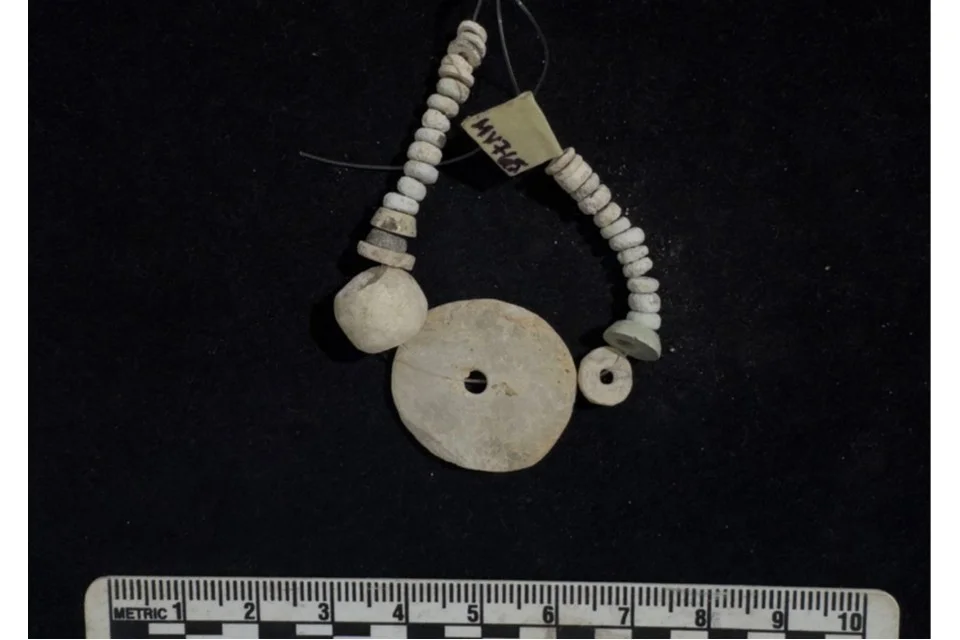
A team from North Carolina State University directed by Dr Kathryn Grossman excavated ten rock-cut tombs between 15 June and 17 July 2025 at Makounta-Voules-Mersinoudia, north-east of Polis Chrysochous in Paphos District, the Department of Antiquities announced. The cemetery lies on a ridge beside the Chalcolithic village the team has dug in earlier seasons, and had first been noted by Darius Maliszewski's survey; Grossman, Tate Paulette, Lisa Graham and Andrew McCarthy had themselves surveyed the village in 2017.
The tombs fall into three kinds: narrow shafts about 1 m across, wider shafts about 2 m across, some with a small side chamber that may have formed through collapse after burial, and a single rectangular pit. Every grave had been disturbed, some in modern times, and only two held finds. One gave dozens of beads of shell, picrolite, faience and quartz; the other held part of a human skeleton with two copper spirals and bits of copper wire. On the shape of the tombs and the finds, the excavators date most of them to the Chalcolithic. The release sets the cemetery beside those at Souskiou, where the Department under Demos Christou excavated 34 rock-cut tombs at Vathyrkakas in 1991–1997 and an Edinburgh team under Edgar Peltenburg counted at least 203 individuals at Laona.
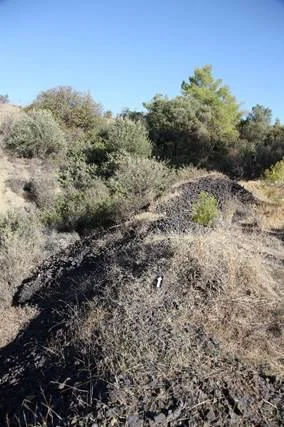
The Hala Sultan Tekke Hinterland Project studies the countryside around the Late Bronze Age town of Hala Sultan Tekke. Begun in 2021 and directed by Ralf Vandam, Jan Coenaerts and Karin Nys of the Vrije Universiteit Brussel, it spent three weeks in October and November 2025 walking fields round the Larnaca Salt Lake and at Pyrga, the Department reported. Earlier seasons at Pyrga had recorded many heaps of copper slag, with dense scatters of Late Roman material close by; misfired pottery on the surface adds to the team's case for a Late Roman production area. After a ground-penetrating radar survey in 2024 under A. Sarris of the University of Cyprus, I. Medarić of the University of Ljubljana and the University of Zurich covered about 8,000 m² with a magnetometer in 2025. Some of the anomalies, linear features and strongly magnetised patches among them, fit metallurgical installations or slag dumps; others may be natural geology.
Books
In Classical Philology, Kevin McGeough of the University of Lethbridge reviews Cyprus and Ugarit: Connecting Material and Mercantile Worlds, a 118-page study by A. Bernard Knapp, Emeritus Professor of Mediterranean Archaeology at the University of Glasgow. Published by Sidestone Press in 2024 and free to read online, the book sets the archaeological and written records of Late Bronze Age Cyprus beside those of Ugarit, on the Syrian coast: shared features such as ashlar masonry, composite anchors and the Cypro-Minoan script, Cypriot seals, metals and pottery found at Ugarit, Levantine goods found on Cyprus, and the merchants who traded between them.
Original sources
- Deputy Ministry of Culture: Completion of the excavation by the North Carolina State University at Makounta–Voules/Mersinoudia
Official release·
- Deputy Ministry of Culture: Completion of the 2025 field campaign of the Hala Sultan Tekke Hinterland Project in Larnaka District
Official release·
- Classical Philology: review of Cyprus and Ugarit: Connecting Material and Mercantile Worlds, by Kevin McGeough
Paper·
- Sidestone Press: Cyprus and Ugarit. Connecting Material and Mercantile Worlds, by A. Bernard Knapp
Book
- Cyprus Mail: Prehistoric cemetery uncovered in Paphos excavation
Press·
- Philenews: The excavation at Makounta and the social organisation of prehistoric Cyprus
Press·
- archaeology.wiki: Fieldwork in the Hala Sultan Tekke hinterland
Press·
On ancientcyprus.com
- Excavations
- Makounta-Voules-Mersinoudia and Stroumpi-Pigi-Agios Andronikos: 2017 survey, Makounta-Voules-Mersinoudia: Maliszewski's survey, Souskiou-Vathyrkakas: Department excavations of the Chalcolithic cemetery, Souskiou-Laona: the Edinburgh excavations of the settlement and cemetery, Hala Sultan Tekke Hinterland Project (Vrije Universiteit Brussel)
- People
- Lisa Graham, Andrew McCarthy, Darius Maliszewski, Demos Christou, Edgar J. Peltenburg, Ralf Vandam, Jan Coenaerts, Karin Nys, Apostolos Sarris, A. Bernard Knapp
- Institutions
- Department of Antiquities of Cyprus, Vrije Universiteit Brussel, University of Cyprus, University of Zurich
- Periods
- Chalcolithic, Late Bronze Age, Roman
More in Fieldwork
- Hellenistic quarry under Paphos's Fabrika hill became an unused tomb, then a church
- This Week in Cypriot Archaeology: 31 August–6 September 2026
- Hollows cut into a Bronze Age threshold at Erimi match a senet game board
- This Week in Cypriot Archaeology: 27 July–2 August 2026
- Grape seeds and unfired loom weights found in Bronze Age work complex at Erimi-Pitharka