
Buying Cypriot Antiquities: A Legal Buyer's Guide
What the law in the UK, US, EU and Cyprus asks of a buyer, which papers show a Cypriot piece left the island legally, and the checks to make before paying.

Alexis Drakopoulos
October 17, 2026·Guides · Collecting·16 min read


Share


Alexis Drakopoulos is a Greek Cypriot Machine Learning Engineer working in Financial Crimes. He is passionate about Archeology and making it accessible to everyone. About Me.
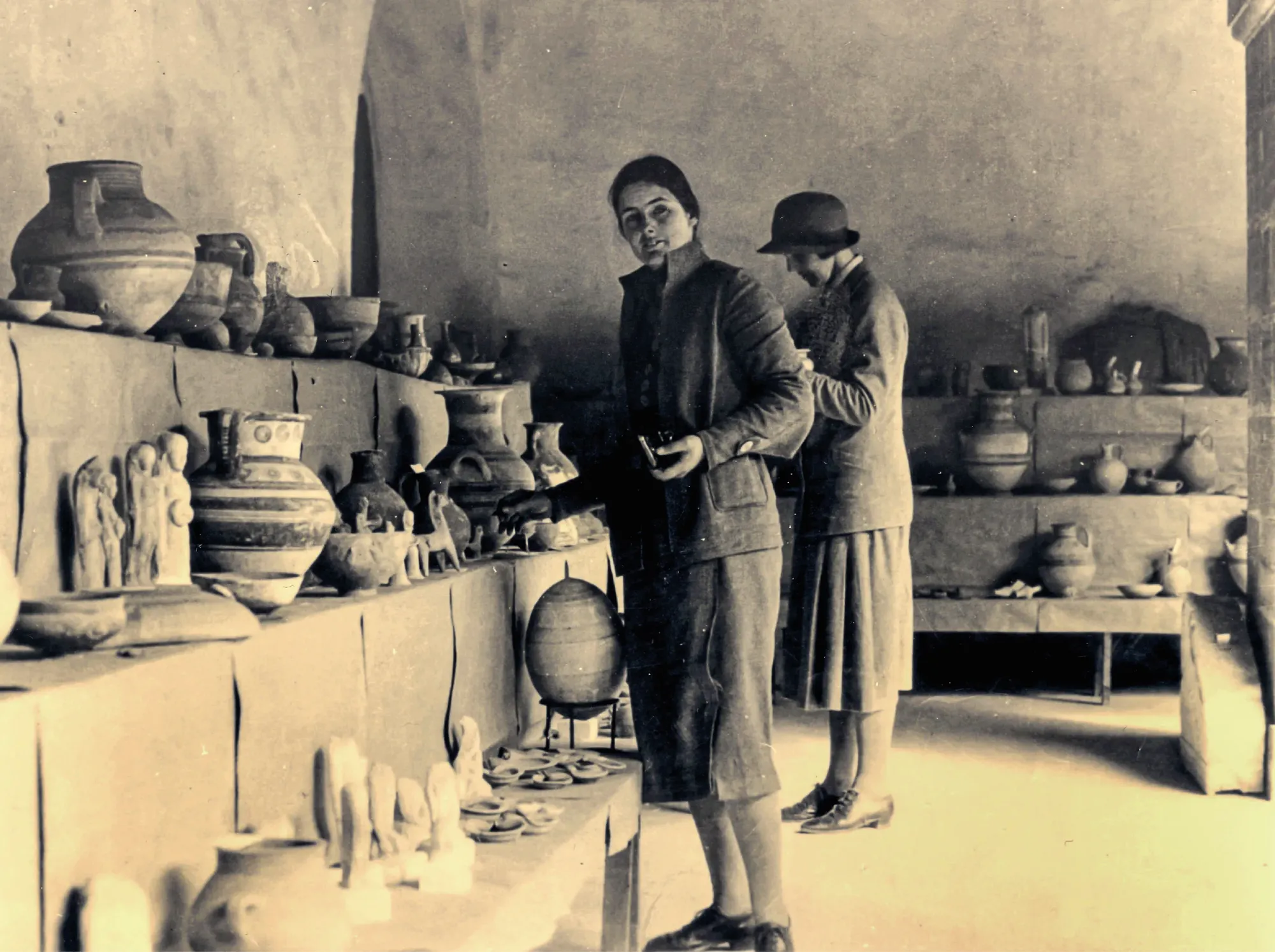
On 2 October 2014 Bonhams in London offered a Red Polished jug as lot 2, estimated at £3,000 to £5,000. Its catalogue entry recorded an American collection that had bought it in 1964, and added "a copy of the Cypriot Government export license dated 20/10/1964". The Cyprus Department of Antiquities, which watches sales of Cypriot material, checked the number against its own archive of old licences and confirmed it [1, p. 37]. A buyer of that jug was paying for a pot and for a sheet of paper that the Republic of Cyprus itself stands behind.
Most Cypriot antiquities on the market today come with less than that, and many with nothing at all. This guide is for someone thinking of buying one, at a regional auction, from a gallery or on a website. It sets out what the law in Britain, the United States, the European Union and Cyprus asks of a buyer as of 2026, which documents show that a piece left Cyprus legally, how to check it before paying, and what to do if a piece you own turns out to have a problem. It is general information about the law, not legal advice; for an expensive purchase, a cultural-property lawyer in your own country is the person to ask.
Is it legal to buy Cypriot antiquities?
Yes, outside Cyprus, for objects that left the island lawfully. No law in the United Kingdom, the United States or the European Union forbids buying a Cypriot antiquity, and lawful export from Cyprus was possible under numbered licences until 1996. Each forbids, in its own way, buying or importing a piece dug up or taken out of Cyprus illegally. The compendium entry on collecting Cypriot antiquities today sets the four systems side by side.
In the United Kingdom
The Dealing in Cultural Objects (Offences) Act 2003 makes it a crime to acquire, sell, import or export a "tainted" cultural object dishonestly, "knowing or believing" it to be tainted [2]. An object is tainted only if it was excavated, or removed from a monument or building, in breach of the law of the place where that happened, after the Act came into force on 30 December 2003. A pot that left Cyprus in 1965 cannot be tainted under it. A pot dug from a Cypriot tomb in 2010 can, and a buyer who suspects as much and buys anyway commits the offence, which carries up to seven years [2]. Behind it stands the ordinary law of theft: a stolen object stays stolen whatever the date, and a thief cannot pass good title.
In the United States
Buying a Cypriot antiquity that is already in America is legal. Bringing one in is controlled. Under a bilateral agreement with Cyprus first signed on 16 July 2002 and last renewed in 2022, US Customs and Border Protection stops designated Cypriot archaeological material at the border unless the importer shows a lawful export from Cyprus or proof that the object left the island before its category was restricted [4][6]. For prehistoric and Classical pottery, terracottas and sculpture, that date is mid-July 2002; for coins of Cypriot types, July 2007. As of October 2026 the current restrictions run to 13 July 2027, and the State Department's Cultural Property Advisory Committee is reviewing a proposed extension [5]. Separately, under the National Stolen Property Act as read in United States v. McClain, an object removed from Cyprus in breach of its ownership law can be treated as stolen property whatever its import date [11]. The guide to selling Cypriot antiquities in the US gives the dates class by class.
In the European Union
Buying inside the EU is legal, and moving a piece between member states needs no import licence. Nor does bringing a Cypriot piece in from the UK, Switzerland or the US: Regulation (EU) 2019/880, which since 28 June 2025 has required an import licence for archaeological objects more than 250 years old, applies only to goods created or discovered outside the EU, and Cyprus is a member state [7][8]. What protects an EU buyer is the provenance file, because Cyprus can reclaim an object unlawfully removed from its territory once it is in another member state, under Directive 2014/60/EU. Taking a piece out of the EU needs an EU export licence under Regulation 116/2009, which covers archaeological objects more than 100 years old whatever their value [9]. A buyer in Paris bidding at a London sale should therefore check, before bidding, that the file shows the piece left Cyprus lawfully.
In Cyprus itself
Inside the Republic there is no open market. Section 26 of the Antiquities Law, Cap. 31, says that no person shall deal in antiquities, with penalties of up to five years' imprisonment or a fine of 45,000 euros [3]. Private collections declared to the Director of Antiquities under the amendment of 1973 (or in a six-month amnesty after the 1996 amendment) may still be held, under a licence from the Director, and a declared piece can still be sold in specific circumstances: when a listed piece changes hands, both the person disposing of it and the person receiving it must notify the Director within fourteen days, and the Minister may require a piece needed by the Cyprus Museum to be handed over [3]. Whether a particular sale is allowed depends on the piece, its registration and the people involved, so send us the details before agreeing anything and we will tell you where it stands. Section 27 allows export only for exhibition, long-term loan, study of excavated material or a gift by the President, and forbids a licence for the export of a private collection [3]. In practice, then, a visitor cannot buy an antiquity in Cyprus and take it home. The pots sold in museum shops, at the Cyprus Handicraft Service and in tourist potteries are modern replicas, legal to buy and to export, and often stamped as such.
| Where you buy | What the law asks of you (as of 2026) |
|---|---|
| United Kingdom | Do not buy a piece you know or believe was illegally excavated or removed after 30 December 2003 (2003 Act); stolen objects stay stolen whatever the date |
| United States | A piece already in the US can be bought freely; importing needs proof it left Cyprus before its category was restricted (2002 for most archaeology) or a Cypriot export certificate |
| European Union | Buying within the EU is free; the 2025 import licence does not apply to Cypriot pieces, which come from a member state; exporting from the EU needs an export licence |
| Cyprus | No dealing in antiquities; transfers of declared pieces notified to the Director within 14 days; no export of private pieces |
What provenance should I ask for before buying?
Ask for a written history that reaches back before 1974, and for any document that shows the piece left Cyprus with a licence. Provenance here means the chain of owners since the object left the ground; for Cypriot material the links are of a few recognisable kinds, and some are much stronger than others.
The strongest is anything the Department of Antiquities can confirm from its own files. From 1935 the Department issued numbered export licences listing each object, and many licensed exports left with a small lead seal stamped C.M. wired to a handle. The Cyprus Museum ran its own saleroom for "duplicate" pottery from the 1920s until the practice was abolished in 1991, with dated tickets and a sales register [15]. Licensed dealers such as Petros Kolokasides in Nicosia gave typed receipts and stock numbers. When a 2016 gallery listing described a Bichrome bowl as acquired from "P. Kolokasides, Cyprus" in the 1950s or 1960s by the botanist Oleg Polunin, with a "Cyprus Museum lead export tag attached to the handle", the Department verified it as it had the Bonhams jug [1, pp. 37-38]. The guide to Cyprus export licences, lead seals and labels shows what each of these looks like and how to read it.
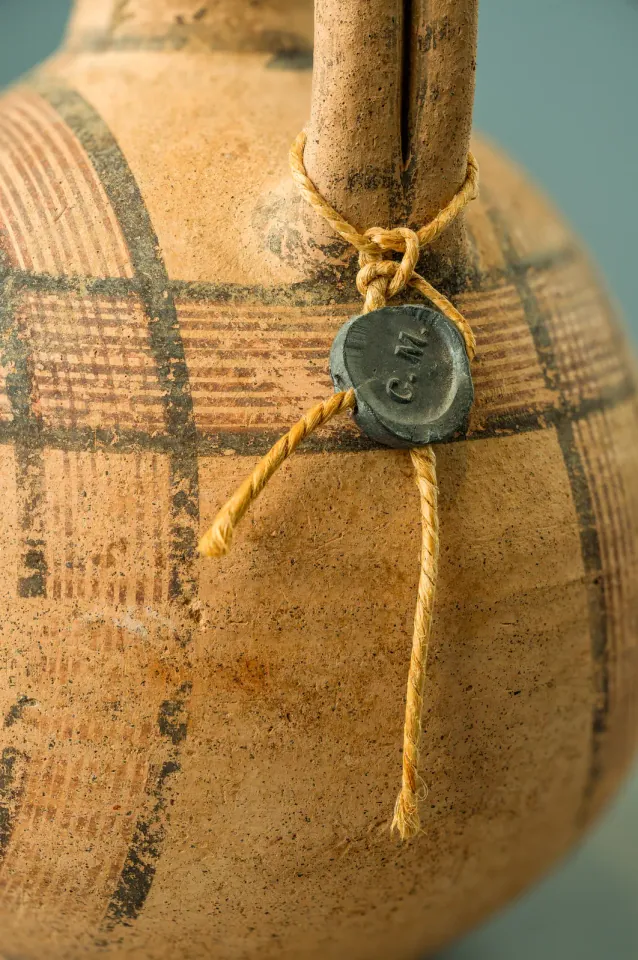
Next come old collection numbers and sale records. A painted number from the Metropolitan Museum's Cesnola collection, whose "duplicates" were sold in New York between 1916 and 1928, a British Museum distribution number from the 1890s, a lot number in a pre-1970 Sotheby's or Drouot catalogue: each places the object outside Cyprus at a date that can be checked in a library. Saleroom receipts and auction histories work the same way when they name the house, the sale and the lot.
Why do the dates 1970 and 1974 matter?
The 1970 UNESCO Convention is a treaty between states, not retroactive, and it binds no private buyer directly [10]. Museums, auction houses and dealers have nonetheless adopted 1970 as the date before which they want an object's history documented, and the argument over that line is set out in the article on UNESCO 1970 and modern collections. For Cypriot material a second date matters more. After the Turkish invasion of July 1974, cemeteries, churches and registered collections in the occupied north were looted on a large scale, and the compendium entry on looting in the occupied north describes what was taken. A history that is documented before 1974 rules that source out.
What does "old private collection" without documents mean?
Usually a gap. Phrases such as "old European collection", "property of a gentleman" or "acquired in the 1970s" are sometimes true and always impossible to check. Alphas, who led the Department's investigations into the trade, found that most provenance lines on Cypriot lots in British online sales, of the "private collection, Wiltshire" kind, did not reach back to 1970 [1, p. 36]. Missing paper is also common for pieces that left Cyprus legally: research on the Malios collection in Leipzig found that export permits "were often lost" over the decades [16, p. 7], and the site's own history of the licensed trade, Licence No. 7070, argues that most Cypriot pots abroad left the island lawfully. What matters to a buyer is whether a history offers anything to test: a named owner with dates, a family that lived in Cyprus in the 1950s, a dated photograph or letter.
How do I check a Cypriot antiquity before paying?
Ask the seller direct questions, search the registers, look at the object, and get a second opinion on anything you are unsure of. A legitimate seller expects all four.
Questions to put to the seller, in writing:
- Who owned it before you, and since when? Can you name them, or the sale they bought it at?
- Is there an export licence, a lead seal, a Cyprus Museum ticket, a dealer's receipt or an old collection number? Can I see photographs of them?
- Has it been published, exhibited, or offered at auction before?
- Has it been restored, and is there a condition report?
- Will you warrant in writing that you have good title and that, to your knowledge, it left Cyprus lawfully, and will you refund me if that proves wrong?
Then check the registers. The Art Loss Register searches its database of stolen and looted art for a fee (£85 plus VAT for a single search, as of 2026) and issues a certificate [13]. INTERPOL's free ID-Art app lets anyone search its Stolen Works of Art database by photograph or description [14]. Both are worth doing and both have a limit: an object taken from an unrecorded tomb was never registered anywhere, so a clean search shows that a piece has not been reported stolen, and nothing about how it left Cyprus. For a documented piece, the Department of Antiquities can confirm whether a licence number or seal matches its archive [1].
Before you pay for anything that matters to you, send us photos of the object, the listing and any paperwork. We will tell you what the piece is, whether its date and ware match the description, and whether the history offered holds up.
What are the red flags when buying Cypriot antiquities?
None of these proves a problem on its own; each is a reason to ask more before paying.
- Fresh soil. Old pieces often keep traces of burial earth or lime crust, which is normal. Loose, dark, recent-looking soil inside a vessel offered with no old history suggests it has not been out of the ground for long.
- Groups of matching pieces. A set of Bronze Age pots in the same fabric and condition, appearing together from one source with no paper, looks like the contents of a single tomb. Licensed exports of the 1950s and 1960s were mostly mixed Iron Age pottery, lamps and glass.
- The wrong class for the story. Visitors in the colonial years bought jugs, juglets and lamps. They rarely left with complete plank figures, large scenic vessels or limestone sculpture, because the Department did not license such things for export and the saleroom did not stock them. The rarer the class, the more paper it needs.
- A vague or shifting history: "European collection" with no name, dates that move between listings, a seller who will not put the history in writing.
- A price too low for the class. In our own unpublished research on Cypriot lots sold at auction, a typical pot makes a few hundred to about two thousand dollars, and a documented plank figure can make tens of thousands: one with a 1967 Paris sale history sold at Bonhams in 2023 for £53,740 with premium [17]. A plank figure offered for a few hundred is either a replica, heavily made up, or a piece someone needs to sell quickly and quietly.
- Reluctance to be checked. A seller who objects to photographs being shown to a specialist or to the Department of Antiquities is a flag in itself, since checking can only help a sound history.
The clearest cases of what goes wrong are in New York. On 24 March 2025 the Manhattan District Attorney returned twelve objects to Cyprus, among them a plank figurine and a Bronze Age flask that had been smuggled out of the island and passed through a New York dealer linked to the London trafficker Robin Symes [12].
Could it be a replica or over-restored?
Yes, and for a buyer this is the commoner risk. Tourist and museum-shop replicas of Cypriot wares have been made for decades, nineteenth-century restorers made up missing parts with plaster and paint, and modern forgeries of the expensive classes exist. A heavily restored pot from an old collection can be a fair purchase at a fair price; undisclosed restoration in a fresh sale is a reason to walk away. The guide to Cypriot pottery replicas and fakes shows what to look for, and how to identify ancient Cypriot pottery helps check that a pot is the ware the listing says it is.
Where are Cypriot antiquities legitimately sold?
At auction, and through established dealers and galleries. In London, Paris and New York the major houses (Bonhams, Christie's and Sotheby's are the ones that sell Cypriot material most often) hold antiquities sales several times a year, and smaller regional and online houses sell larger numbers of cheaper lots. Dealers who belong to trade associations with codes of practice, such as the Antiquities Dealers' Association in Britain or the International Association of Dealers in Ancient Art, undertake to check provenance before selling. We do not recommend any house or dealer. What separates a good source from a poor one is what it tells you: a full catalogue entry with a named history, a condition report, and a willingness to answer questions and to take a piece back if a claim arises.
Documented pieces cost more, and the difference is part of what you are buying. A Bichrome barrel flask with two lead export seals still on its handle made £2,800 at Bonhams in July 2020 [18]; a similar barrel jug with no seals in its catalogue entry made £550 at an online sale in 2023. The guide to what a Cypriot antiquity is worth gives real lots for each class.
The Department of Antiquities watches sales in Britain, Europe and America, small online auctions included, and asks houses to withdraw Cypriot lots whose export it cannot confirm; recent cases are in the guide to selling Cypriot antiquities in the UK. Ask the house what happens if a claim arrives after you have paid, and read its terms.
What paperwork should I keep after buying?
Everything, in one file, kept with the object. That means:
- the invoice or auction receipt, naming the house or dealer, the sale, the lot and the date;
- the full catalogue entry or listing, printed or saved, including the provenance text and condition report;
- copies of every earlier document the seller passed on: export licences, seal photographs, receipts, letters, old catalogue pages;
- any register search certificate (Art Loss Register or similar);
- for an import, the customs entry or the US declaration;
- your own photographs of the object from every side, with close-ups of labels, numbers and seals, and its height.
Do not remove old labels, painted numbers or lead seals, and do not clean the surface. The next owner, an executor or a museum will need them. If you later pass the piece on, the guide for executors handling antiquities in an estate and the guide to selling an inherited Cypriot collection explain what the next owner will be asked for.
What if a piece I bought turns out to be a problem?
Write to us, and take advice before you do anything else with it. Problems take a few forms: the Department of Antiquities queries the piece at resale, a register search returns a match, or you learn something about its history that you did not know when you bought it. Keep it as it is, with its paperwork, and do not sell it on while the question is open. If you bought it from an auction house or a dealer, tell the seller in writing; many terms of sale and dealers' codes provide for a refund where title fails.
Owners in this position have several routes. Some objects turn out to be fine once the missing paper is found, and we can help trace it. Others are resolved by returning the piece to Cyprus through its embassy or high commission, which the Department has repeatedly thanked holders for doing, and the guide to returning or donating Cypriot antiquities explains how that works. A cultural-property lawyer can tell you where you stand on refund and title. A buyer who acted in good faith and raises the question openly is usually in a far easier position.
If you are not sure what you have bought, or how it reached the seller, tell us that too. The same applies if the piece came to you from someone else, such as a relative who bought it years ago; the guide to pieces brought home from Cyprus covers that case.
References
- 1.Alphas, E. (2017). From a Bronze Age tomb in Cyprus to the estate of a gentleman in Sussex: Measures taken and problems faced in the investigations on the illicit trade of antiquities. In D. Pilides & M. Mina (Eds.), Four Decades of Hiatus in Archaeological Research in Cyprus: Towards Restoring the Balance (pp. 30-43). Holzhausen.
- 2.Dealing in Cultural Objects (Offences) Act 2003 (c. 27), ss. 1-3 and 6. https://www.legislation.gov.uk/ukpga/2003/27
- 3.Antiquities Law, Cap. 31 (Republic of Cyprus), as amended by Laws 48/1964, 32/1973, 4(I)/1996 and 200(I)/2014, ss. 26, 27, 33 and 33A. Consolidated text, CyLaw. http://www.cylaw.org/nomoi/enop/non-ind/0_31/full.html
- 4.U.S. Customs and Border Protection. (2022). Extension and Amendment of Import Restrictions on Archaeological and Ethnological Material From Cyprus (CBP Dec. 22-15). Federal Register, 87(136), 42636-42642, 18 July 2022. https://www.federalregister.gov/documents/2022/07/18/2022-15398
- 5.U.S. Department of State. (2026). Meeting of the Cultural Property Advisory Committee; Proposals To Extend Bilateral Cultural Property Agreements With Cyprus, Guatemala, and Peru (Public Notice 13131). Federal Register, 91, 60692, 24 September 2026.
- 6.19 C.F.R. § 12.104c, Importations permitted. Legal Information Institute, Cornell Law School. https://www.law.cornell.edu/cfr/text/19/12.104c
- 7.Regulation (EU) 2019/880 of the European Parliament and of the Council of 17 April 2019 on the introduction and the import of cultural goods. Official Journal of the European Union, L 151, 7.6.2019, pp. 1-14, Articles 3 to 5 and Annex. https://eur-lex.europa.eu/eli/reg/2019/880/oj
- 8.European Commission, Access2Markets (2025). EU introduces new import controls of cultural goods. https://trade.ec.europa.eu/access-to-markets/en/news/eu-introduces-new-import-controls-cultural-goods
- 9.Council Regulation (EC) No 116/2009 of 18 December 2008 on the export of cultural goods (codified version). Official Journal of the European Union, L 39, 10.2.2009, pp. 1-7, Article 2 and Annex I, category A.1. https://eur-lex.europa.eu/eli/reg/2009/116/oj
- 10.UNESCO. (1970). Convention on the Means of Prohibiting and Preventing the Illicit Import, Export and Transfer of Ownership of Cultural Property, Paris, 14 November 1970 (in force 24 April 1972).
- 11.National Stolen Property Act, 18 U.S.C. §§ 2314-2315; United States v. McClain, 545 F.2d 988 (5th Cir. 1977); United States v. McClain, 593 F.2d 658 (5th Cir. 1979).
- 12.New York County District Attorney's Office. (2025, March 24). D.A. Bragg Announces Return Of Antiquities To Spain And Cyprus. https://manhattanda.org/d-a-bragg-announces-return-of-antiquities-to-spain-and-cyprus/
- 13.Art Loss Register. Frequently asked questions (search fees and certificates). https://www.artloss.com/faqs/
- 14.INTERPOL. ID-Art mobile app (free public access to the INTERPOL Stolen Works of Art database). https://www.interpol.int/Crimes/Cultural-heritage-crime/ID-Art-mobile-app
- 15.Stanley-Price, N. (2025). Illicit excavation and the sale of 'duplicate' antiquities: Rupert Gunnis and the Cyprus Museum, 1926-1932. Cahiers du Centre d'Études Chypriotes, 55, 269-301. https://doi.org/10.4000/151c2
- 16.Gatzsche, A. (2023). From Cyprus to Leipzig: Provenance research. In E. Poyiadji-Richter (Ed.), Alexander Malios Collection, Vol. 1: Cypriot Antiquities. AMRICHA.
- 17.Bonhams London, Antiquities, 6 July 2023, lot 47: A Cypriot terracotta plank figure, 23 cm. Estimate £5,000 to 7,000; hammer £42,000, sold £53,740 with buyer's premium. https://www.bonhams.com/auction/28251/lot/47/
- 18.Bonhams London, Antiquities, 23 July 2020, lot 3: A Cypriot Bichrome barrel flask with two lead export seals, 23 cm. Estimate £1,200 to 1,800; sold £2,800.