
Research·Roundup
This Week in Cypriot Archaeology: 17–23 August 2026
Laser scans add 23 possible ships to the temple graffiti at Kition, a group plans to find Cesnola's wrecked Napried, and the odeon of Paphos gets a full-moon evening.



A paper in the International Journal of Nautical Archaeology added 23 possible ships to the graffiti on a Late Bronze Age temple at Kition this week, and Liverpool received a thesis on how Late Bronze Age pottery was made. A group set up to find the Napried, the ship that sank in 1872 with antiquities shipped by Luigi Palma di Cesnola, set out its plans, a Larnaca MP asked when the town's finds will go on show, and the Department of Antiquities announced a full-moon evening at the odeon of Paphos.
Map of Cyprus
This week's stories
- Research and the Larnaca question
- Events
- Ground above 200, 500, 1,000 m
Sites on this map
Research
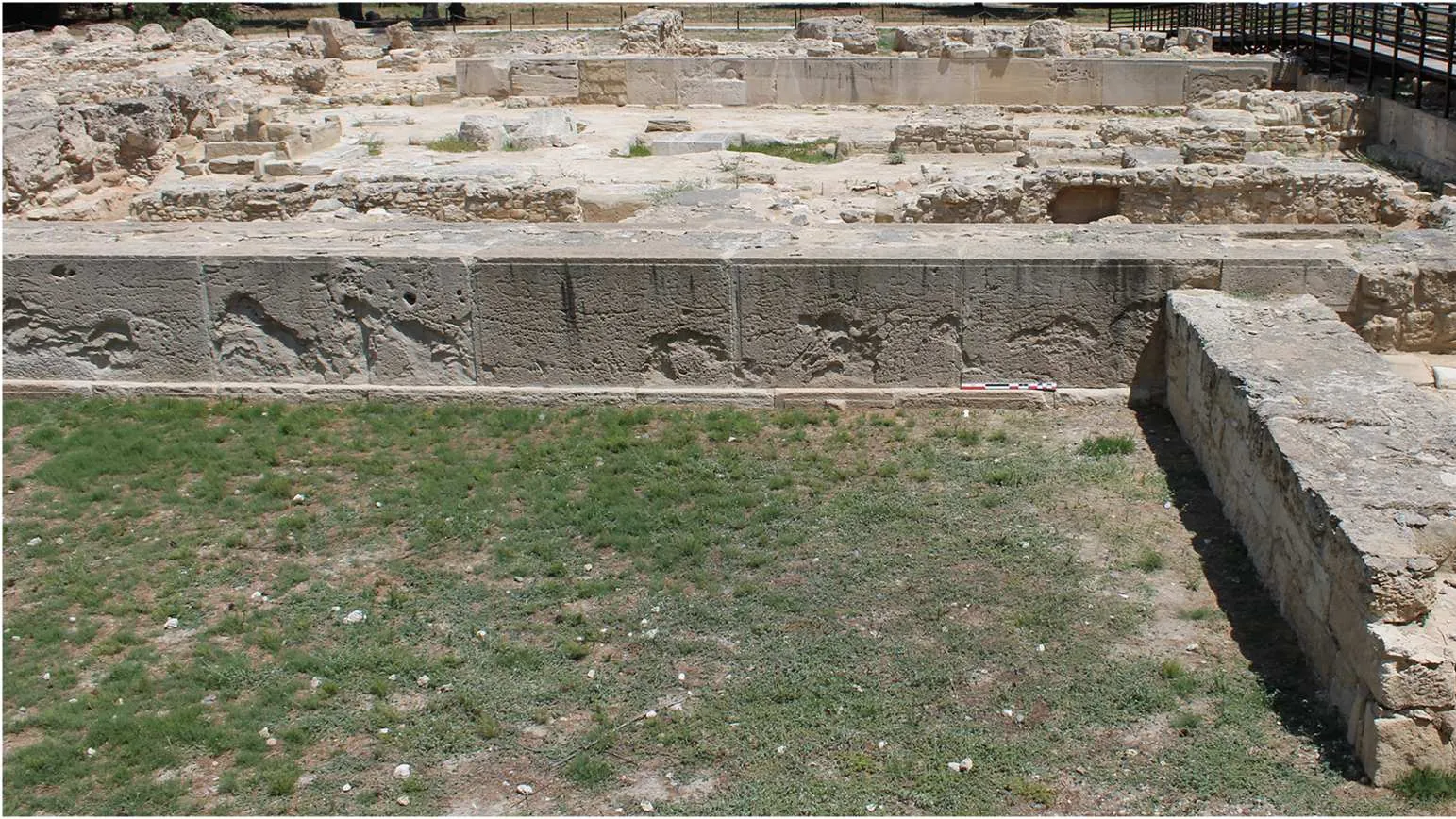
Graham C. Braun, Caroline Barnes and Tzveta V. Manolova published on 18 August their laser scans of the ships carved into Temple 1 at Kition, under modern Larnaca. Lucien Basch and Michal Artzy had counted 19 ships there in 1985; the scans add 23 possible ones, nine of them rated certain, and the authors argue that ships were cut into the wall for perhaps 300 years, from about 1200 BCE into the Early Iron Age (our brief).
On the same day the University of Liverpool deposited Harriet Cliffen's PhD thesis, Wheel Meet Again, supervised by Matthew Ponting and Peter Hommel. It studies how Late Bronze Age ceramics were produced in Cyprus with methods that leave the pots intact, among them X-radiography and portable X-ray fluorescence (pXRF), which reads a vessel's chemical make-up from its surface.
Shipwrecks
The Napried caught fire and sank in 1872 after leaving Beirut, carrying thousands of antiquities that Luigi Palma di Cesnola, the American consul at Larnaca, had sold to the museum in Boston. The wreck has never been found. Napried Exploration, a group founded by Dr Charles Mazel to locate it, set out its aims on 23 August: find the ship, raise the objects and bring them back to Cyprus, where Mazel would like ship and cargo shown as an exhibit. Stella Demesticha, an associate professor who directs the Maritime Archaeological Research Laboratory of the University of Cyprus, said work beyond about 50 to 100 metres of depth is hard and ruled out any partnership with treasure hunters. The Department of Antiquities has said that all coastal and underwater archaeological work in Cypriot waters falls under the antiquities law and stays under its supervision at every stage.
Sites
In a parliamentary question dated 10 August and reported on 18 August, Andreas Pasiourtides, an AKEL member of the House of Representatives for Larnaca, asked for progress on three fronts: the display of the mosaic with the Labours of Heracles found in the summer of 2016 in the Chrysopolitissa parish of Larnaca, the restoration and presentation of the ancient harbour, and the linking of the town's sites, among them the archaeological museum, the mosaics and ancient Kition.
Events
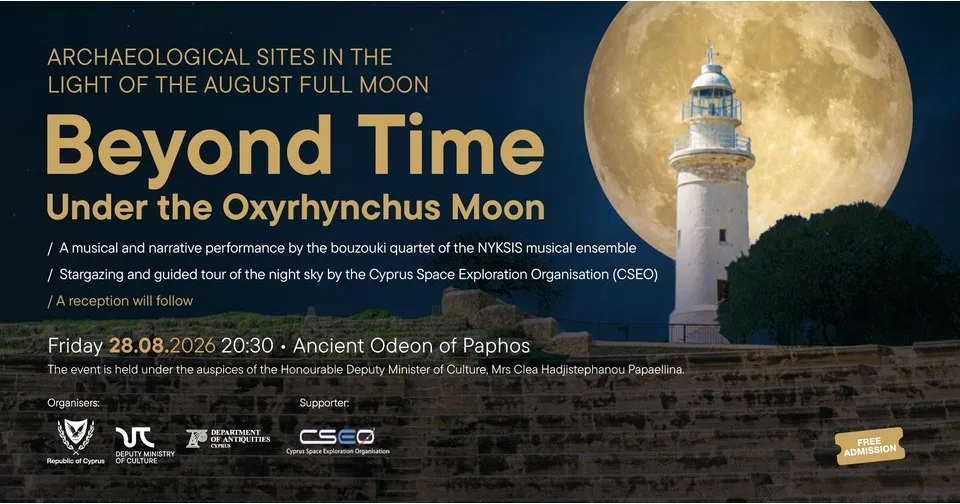
The Department announced on 21 August this year's evening in its series of full-moon openings at ancient sites: "Beyond Time, Under the Oxyrhynchus Moon", on Friday 28 August at 20:30 at the ancient odeon of Nea Paphos, under the auspices of the Deputy Minister of Culture, Clea Papaellina. The theme takes the oxyrhynchus, the sharp-snouted Nile fish linked in Egyptian myth to the dismemberment of Osiris. The programme paired a musical narrative performance by a bouzouki quartet with a guided tour of the night sky by the Cyprus Space Exploration Organisation.
Original sources
- Braun, Barnes and Manolova, International Journal of Nautical Archaeology (Zenodo record)
Paper·
- International Journal of Nautical Archaeology (DOI)
Paper·
- University of Liverpool: Wheel Meet Again: Investigating the production of Late Bronze Age ceramics in Cyprus using non-invasive techniques (PhD thesis)
Paper·
- Cyprus Mail: Can Cyprus' sunken treasure ever be found?
Press·
- Skala Times: Ten years in the drawers: the Department of Antiquities leaves Larnaca's archaeological treasures waiting
Press·
- Deputy Ministry of Culture: Archaeological Sites in the Light of the August Full Moon
Official release·
On ancientcyprus.com
- Sites
- Kition, Nea Paphos
- Periods
- Late Bronze Age, Cypro-Geometric
More in Research
- Wheat traces at Chlorakas-Palloures question the view that cereals were minor in Chalcolithic Cyprus
- Strabo's Arsinoe near Palaepaphos probably never existed, argues study of a Ptolemaic queen's cult
- Charred barley and chaff in a Pyla shaft point to stored animal fodder around 1200 BCE
- Late Bronze Age hoard of at least 111 bronzes at Galinoporni was packed in cloth, cord and grass
- Bronze Age tombs at Hala Sultan Tekke held what may be burnt bouquets of grain and wild flowers