
Research·Brief
Late Bronze Age hoard of at least 111 bronzes at Galinoporni was packed in cloth, cord and grass
Microscopy of mineralised cloth on the 2014 hoard from Vasili hill, in the occupied Karpas, finds 13–15 different tabby fabrics and several kinds of cord.



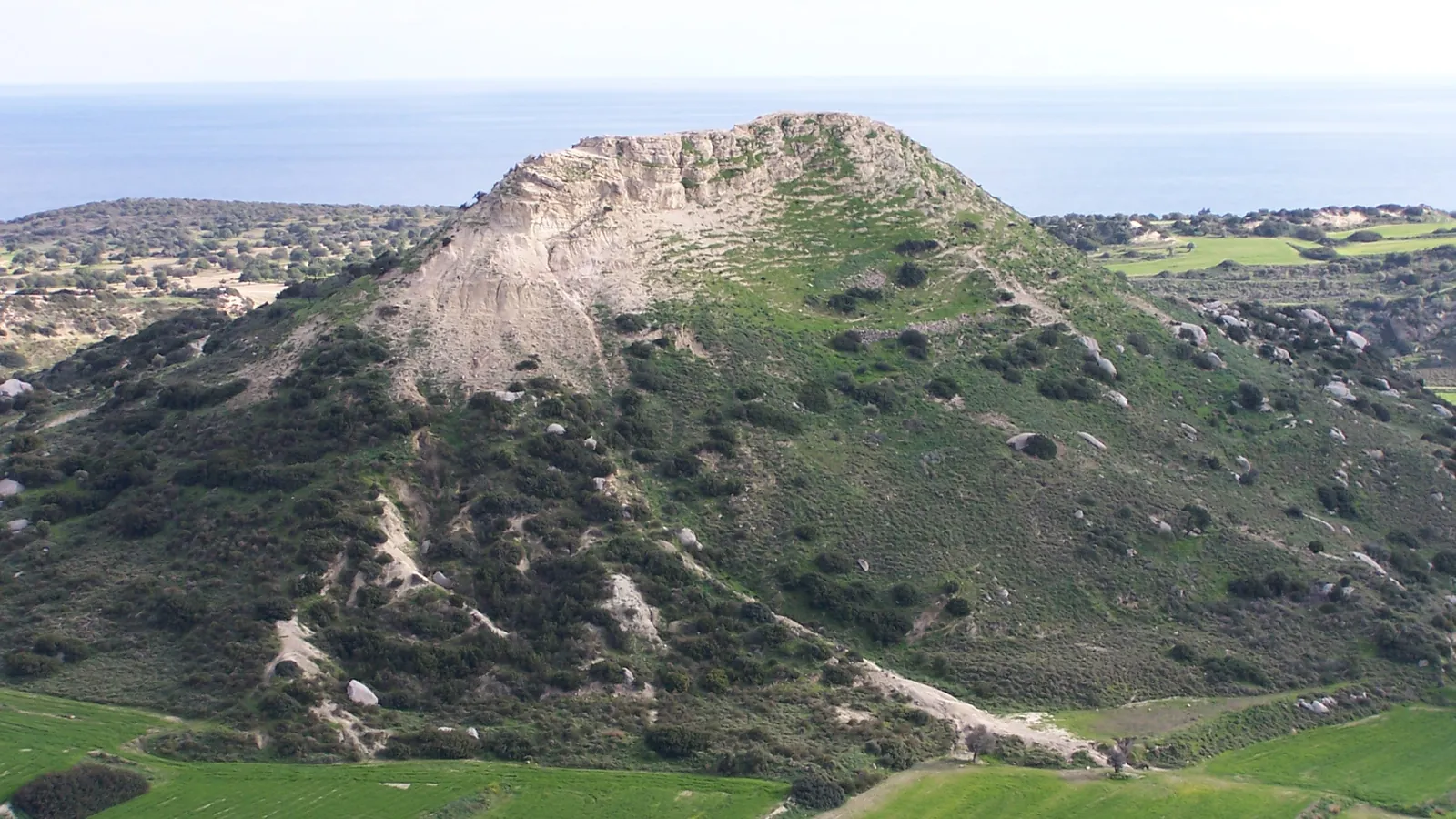
Many of the 111 or more bronzes buried in a storage jar on Vasili hill (Kral Tepesi) at Galinoporni (Kaleburnu), on the Karpas peninsula, went into the ground wrapped in cloth, tied with cord or packed with grass. So finds a paper by Bülent Kızılduman, Karina Grömer, Jaroslav Peška, Neşe Topal-Kusku and Kayleigh Saunderson, published online on 29 September 2026 in TEXTILE. The hoard came to light in 2014, in the area occupied by Turkey since the 1974 invasion.
What the authors examined
The textiles survive only as mineralised remains on bronzes that lay in and around a jar set in a rock-cut well.
Under the microscope the team distinguished 13 to 15 separate fabrics and several kinds of cord. All are tabby, the simplest cloth, in which each weft thread passes over one warp thread and under the next. Almost every yarn has an S-twist, consistent with the textile tradition of the eastern Mediterranean. The authors labelled the fabric types A to O and plotted where each lay in the deposit. From that map they reconstruct how objects were wrapped singly, how groups of them were tied into bundles, and how grass and other organic layers were laid between bowls stacked one inside another.
They call the find self-contained and distinctive, and one of the few cases that show how cloth was used to keep metal wealth in order and protect it in the Late Bronze Age.
The first hoard from the hill, in 2004
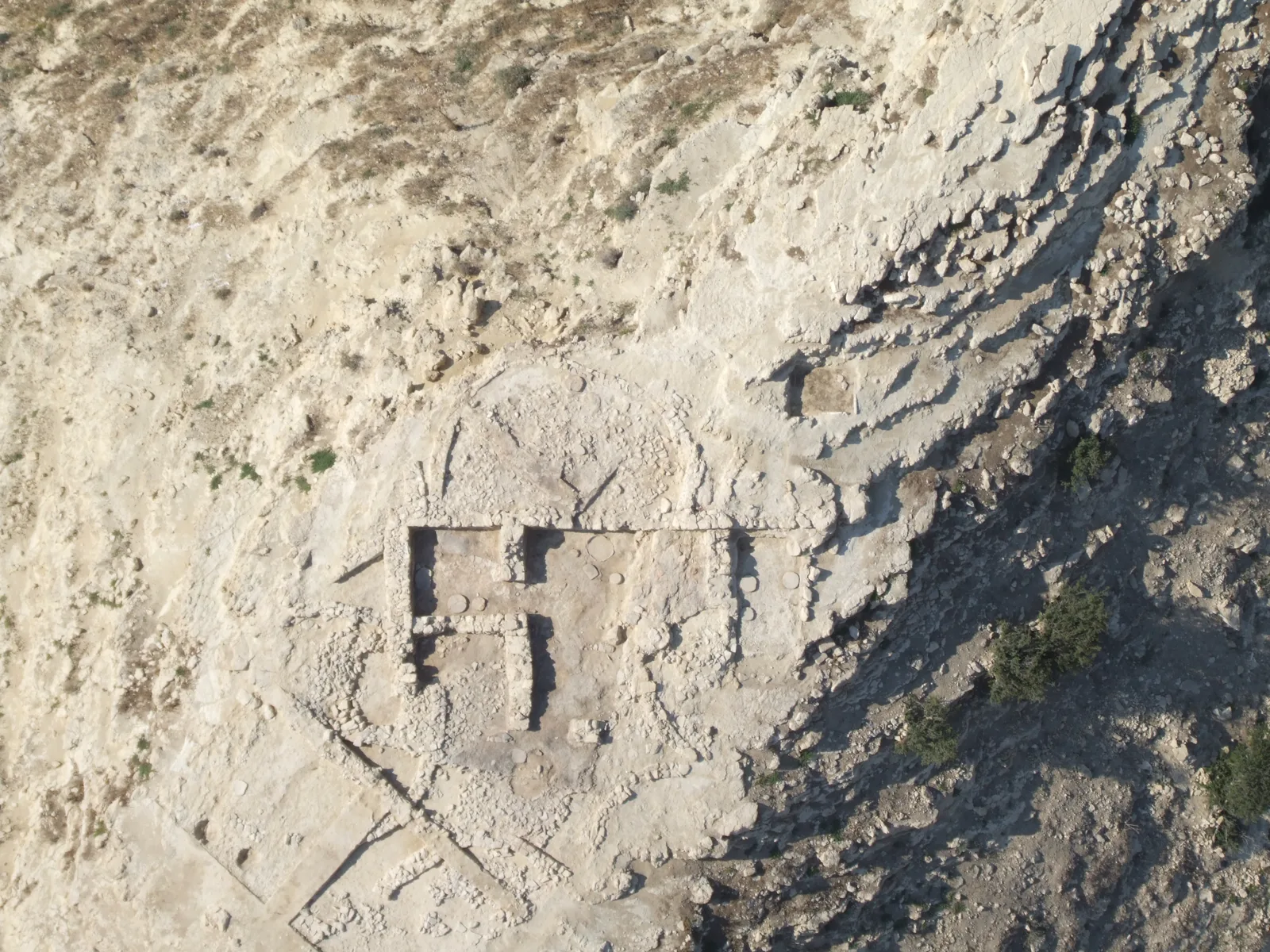
The hill had produced a first hoard ten years earlier. In June 2004 hikers saw that winter rain had washed clear the flat stone over a pithos, a large storage jar, sunk into the bedrock of the summit. It held 26 bronzes weighing about 15.5 kg: 16 vessels, three offering stands, five sickles, a shovel and a saw [1, p. 161]. The finders told the Eastern Mediterranean University in Famagusta, which alerted the "Department of Antiquities and Museums", a body of the Turkish Cypriot authorities in the occupied north. The hoard was lifted the next day for fear of looters and taken to the St Barnabas Museum near Famagusta [1, p. 161].
Martin Bartelheim, Kızılduman, Uwe Müller, Ernst Pernicka and Hasan Tekel published it in 2008. They dated it, with a stirrup jar found beside it, to Late Cypriot IIC/IIIA, the 13th to 12th centuries BCE, and described it as the largest known hoard of finished bronzes from Late Bronze Age Cyprus and the only one with three offering stands. The nearest parallels for the stands are from Ugarit, Megiddo, Beth Shan and Jatt in the Levant [1, p. 161]. They read the hill as a political and economic centre, perhaps also a cult centre, on a sea route to the Levant [1, p. 184].
An excavation without the Republic's consent
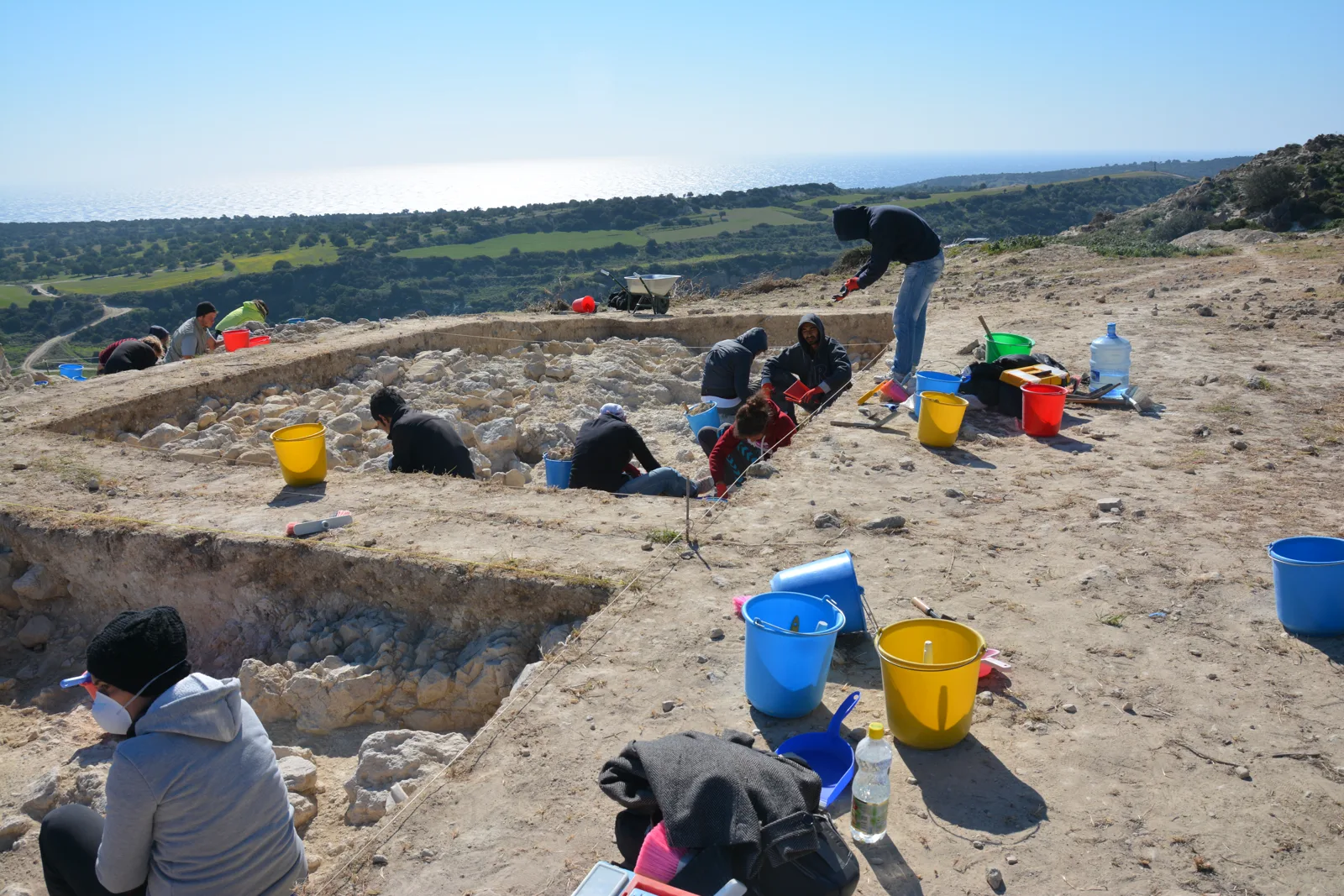
Müller began a rescue excavation after the 2004 find with a team from the University of Tübingen [2, p. 45]. That first phase ran from 2005 to 2009, and Kızılduman has directed the work on the hill since 2014. The excavation has been carried out without the consent of the Republic of Cyprus's Department of Antiquities, which regards all digging in the occupied north since 1974 as contrary to international law, including the 1954 Hague Convention and UNESCO's rules on archaeological work in occupied territory.
The harm is to the record as much as to the law. Excavation destroys the deposit it uncovers, so the only safeguard is a dig run under the state's permit, with its methods, finds, archives and publication answerable to the Department. Work on Vasili hill sits outside that system: the bronzes are held in the north, beyond the Republic's inventory of the island's antiquities, and the hoards' original setting can no longer be checked by anyone outside the project. Foreign scholars who take part lend such digs a standing they lack in law, which is why universities and journals have been urged not to join or publish them.
As Lâtife Summerer reports it, the Department also holds that the hilltop had been known as a Middle and Late Bronze Age site since 1962, which would make the dig a planned excavation, illegal under international law; she calls this incorrect [2, p. 45]. The authors of the 2008 publication describe the settlement as unknown before the hoard was found [1, p. 161]. Summerer writes that Tübingen ended its cooperation early, in 2015 [2, p. 51].
Original sources
On ancientcyprus.com
References
- 1.Bartelheim, M., Kızilduman, B., Müller, U., Pernicka, E. and Tekel, H. (2008). The Late Bronze Age Hoard of Kaleburnu/Galinoporni on Cyprus. Památky archeologické 99, 161–188.
- 2.Summerer, L. (2023). In Fear of Blacklisting. How the Division Shaped Archaeology in Cyprus. In L. Summerer, M. Kiessel and H. Kaba (eds.), New Approaches toward Recording, Preserving and Studying Cultural Heritage in Divided Cyprus. Kyrenia: ARUCAD Press.
More in Research
- Wheat traces at Chlorakas-Palloures question the view that cereals were minor in Chalcolithic Cyprus
- Strabo's Arsinoe near Palaepaphos probably never existed, argues study of a Ptolemaic queen's cult
- Charred barley and chaff in a Pyla shaft point to stored animal fodder around 1200 BCE
- Bronze Age tombs at Hala Sultan Tekke held what may be burnt bouquets of grain and wild flowers
- 48 carved stones near Kourion may come from an unknown Roman temple, study argues