
Lecture·Archaeological Research Unit - University of Cyprus·2021
Biographies of Chalcolithic roundhouses and social structure in Cyprus
Chapters
About the lecture
Victor Klinkenberg, an Onassis postdoctoral fellow at the Archaeological Research Unit of the University of Cyprus and field director at Chlorakas-Palloures, examines how Chalcolithic buildings in Cyprus (c. 3500–2500 BC) reflect the social structure of their communities. While surrounding regions saw the rise of city-states, craft specialization, and long-distance trade during this millennium, Cyprus maintained a distinct material culture of circular houses until the onset of the Philia phase. Previous scholarship, including work by Eddie Peltenburg, Manning, and Bolger, has often characterized this society as fundamentally egalitarian, treating periodic signs of wealth and destruction as temporary deviations followed by a return to equality.
Klinkenberg challenges this view by reconstructing the biographies of individual buildings. Although the standard Chalcolithic roundhouse follows a uniform four-zone layout around a central hearth, ethnographic parallels from Madagascar and the peoples of New Ireland show that houses often grow, change, and die alongside their households. At Chlorakas-Palloures, excavated since 2015 under the direction of Bleda Düring of Leiden University, Klinkenberg applied soil micromorphology to floor sequences across seven buildings, including the 15-to-17-metre-wide Building 1. Thin sections reveal that what appear to be single floors are sequences of multiple lime, clay, and compacted soil layers, demonstrating that houses were continuously renovated.
To trace how a building could endure across generations, the talk re-examines the Pithos Building at Kissonerga-Mosphilia. Rather than a single-phase elite residence destroyed by fire with at least 37 pithoi and an infant skeleton inside, the structure had several phases before and after the conflagration. Later occupants rebuilt on the exact spot, placing a new hearth and doorway directly over the earlier ones and working with metal ore, a possible crucible, imported annular shell pendants, and a stamp seal. Klinkenberg interprets this physical continuity as a claim to inherited prestige.
Returning to Chlorakas-Palloures, he presents material markers of transitions in the lives of houses: a complete jar set into a floor at abandonment containing boar-tusk hooks, a stone axe, and the earliest copper axe from Cyprus; a hoard of large, unused Moni flint scrapers wedged into a wall crevice of Building 1 before a new floor was laid; a stepped entrance deliberately walled up; and a newly excavated building burnt down with upright storage vessels inside. Drawing on Lévi-Strauss's concept of "house societies" and ethnographic comparison with the Kekchi Maya of Belize, Klinkenberg argues that Chalcolithic Cyprus was organized around corporate houses that enforced strict architectural uniformity while competing in status and displaying wealth by destroying or burying valuable goods during public ceremonies.
Found at the places discussed
Objects in our catalogue, in museum collections, recorded as found at these sites.
Background
Where to read more on this site before or after watching.
The site
Chlorakas-Palloures
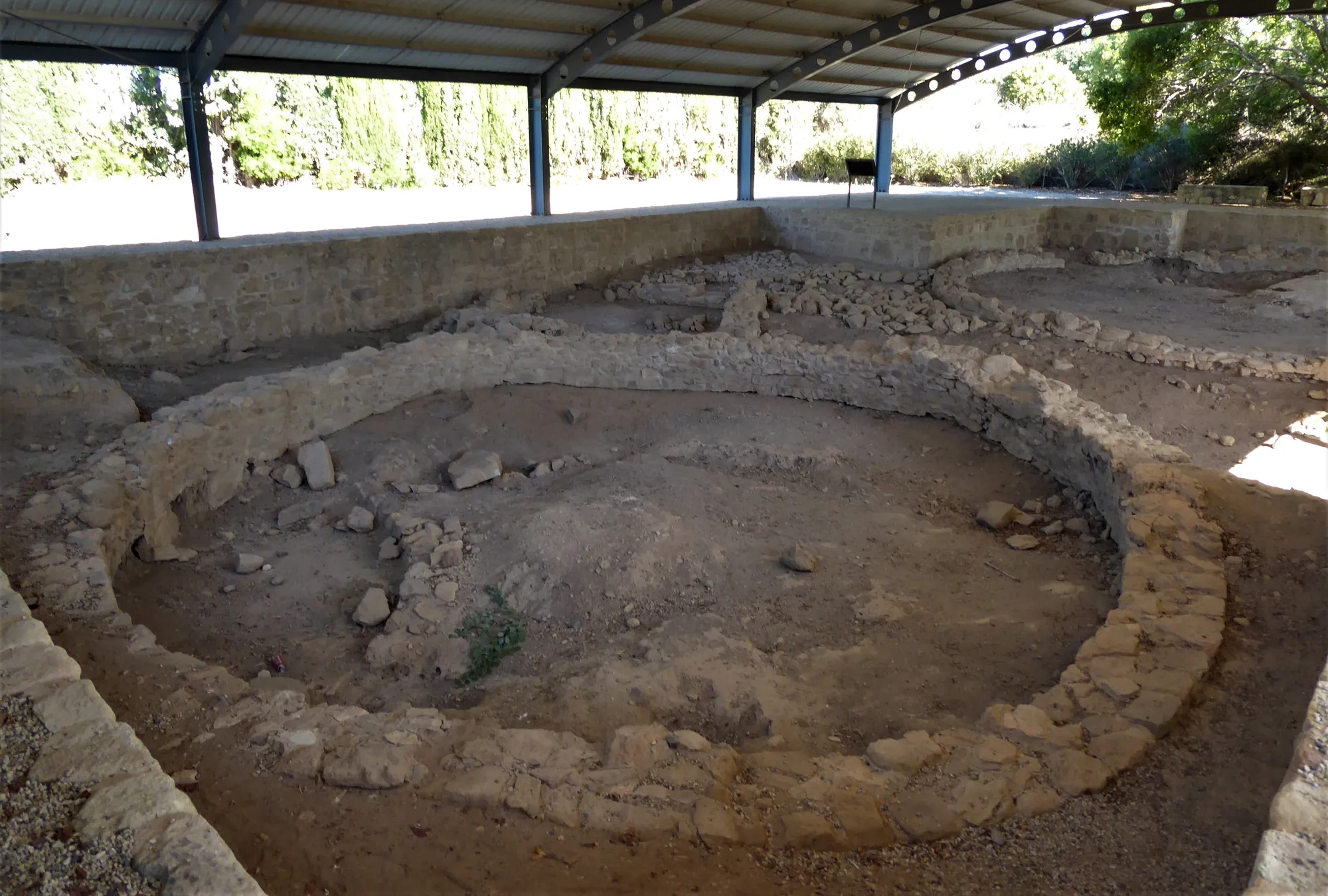
A Middle and Late Chalcolithic village on a terrace edge above the coastal plain at Chlorakas, north of Paphos, lived in from about 3400 to 2400 BC. Rescue excavation since 2015 has found the largest Late Chalcolithic round building yet known on Cyprus and the oldest securely dated copper axe from the island.
In the compendium
Chalcolithic Round Houses
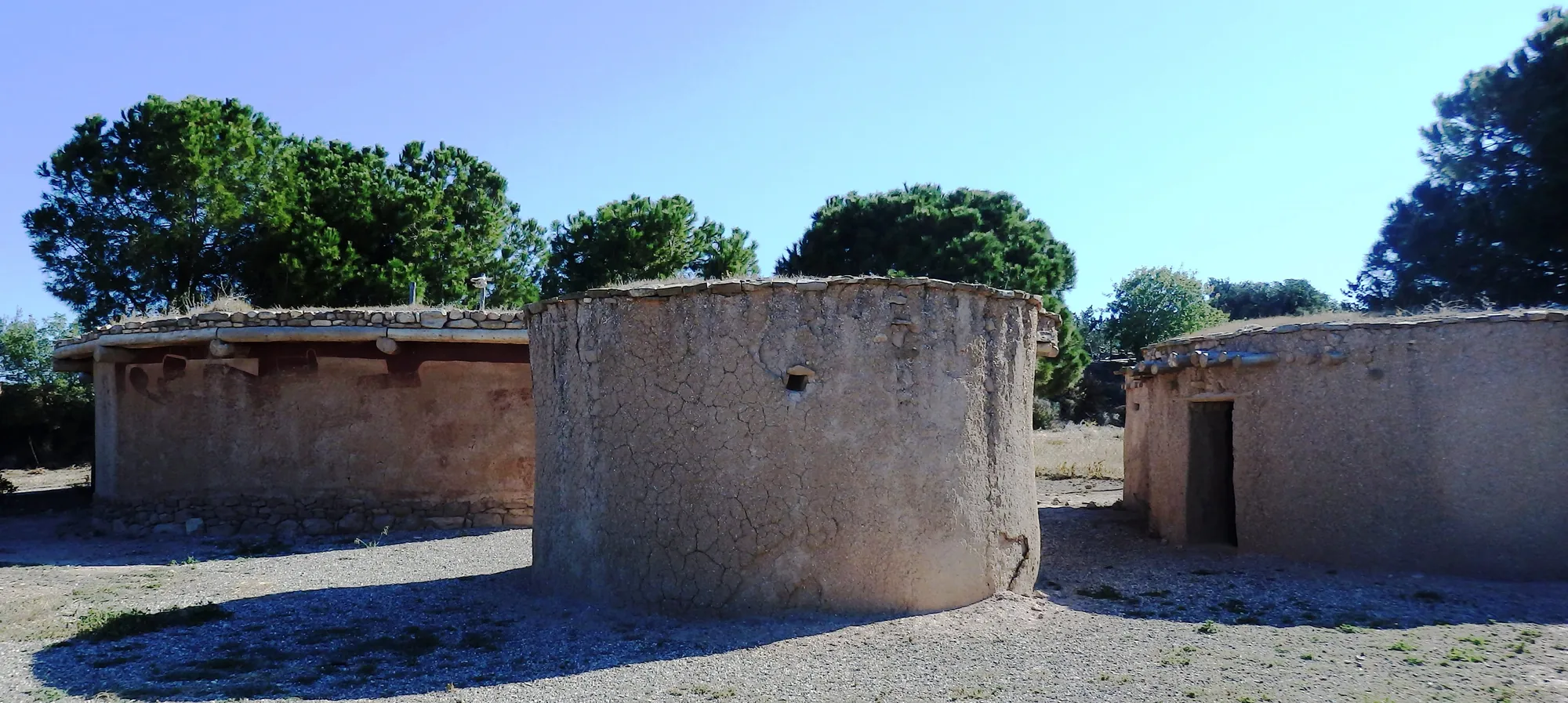
The free-standing circular house of Chalcolithic Cyprus, from timber post rings to stone-footed great houses, and the Kissonerga building model.
In the compendium
Building Materials and Techniques
Cypriot houses were built of local stone, earth and timber: walls of rubble or mudbrick on stone socles, under flat roofs of beams, brush and packed earth.
In the compendium
Food Storage in Ancient Cyprus: Pits, Pithoi and Storerooms
How Cypriots stored grain, oil and wine, from Chalcolithic pits and household jars to the great pithos halls of the Late Bronze Age towns.
Map of Cyprus
Places discussed in the talk
- Has a page on this site
- Other places
- Ground above 200, 500, 1,000 m
Places
- 1Chlorakas-Palloures
- 2Kissonerga-Mosphilia
- 3Lemba (approx.)
- 4Souskiou-Laona (approx.)
- 5Politiko-Kokkinorotsos (approx.)