
Research·Roundup
This Week in Cypriot Archaeology: 9–15 March 2026
Eighteen Cypriot antiquities spotted in an American online sale are handed back, and a paper costs Chalcolithic travel by sea around the Akamas peninsula.



Eighteen Cypriot antiquities withdrawn from an American online sale have been handed back to Cyprus, the Department of Antiquities announced on 10 March. In the same week a paper in the Journal of Maritime Archaeology set the cost of Chalcolithic travel by sea against travel on foot in the Paphos district, and the memoir of the island's first Director of Antiquities was reviewed. The Cyprus Museum also announced a series of artist talks for children.
Map of Cyprus
This week's research
- Ground above 200, 500, 1,000 m
Sites on this map
- 1Chlorakas-Palloures
- 2Makounta-Voules (approx.)
Heritage crime
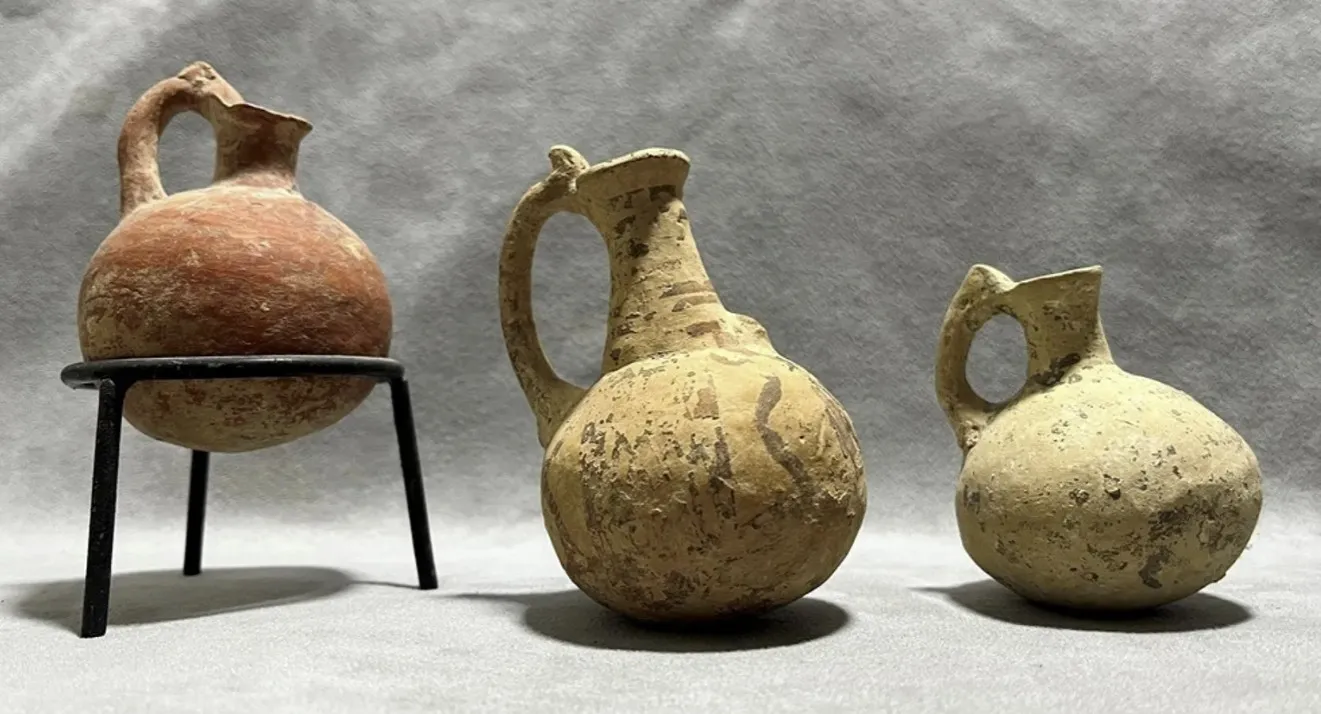
The objects reached Cyprus's embassy in Washington on 23 February 2026. The Department's archaeological officers, whose job includes tracking illegal sales of Cypriot antiquities on the internet, found them in an online auction, and the lots were withdrawn after talks with the house. The Department thanked the auctioneers, Sloans and Kenyon, and the holders for returning the pieces voluntarily.
Seventeen are vessels. The Department dates two to the Early Bronze Age (2500–1900 BCE), eleven to the Middle Bronze Age (1900–1600 BCE), three to Cypro-Archaic I (750–600 BCE) and one to Cypro-Archaic II (600–480 BCE). The last piece is a limestone head of a male statue of the 4th century BCE. Withdrawal from a sale followed by a voluntary handover is the most common route among the returns announced since 2023.
Research
Victor Klinkenberg and Miltiadis Polidorou of the University of Cyprus modelled the energy it took to move goods between two Chalcolithic villages in western Cyprus, Chlorakas-Palloures and Makounta-Voules. Petrographic study of their pottery already shows a good deal of exchange between them. The authors traced the best path on foot with GIS least-cost analysis and an energy equation from military load-carrying research; for the sea they used data from paddled replicas of Neolithic boats, with wind and currents.
By sea, and on foot with the heaviest load of 30% of body weight, the trip came out at roughly 612–642 kilojoules for each kilogram carried; lighter loads cost far more on land. The sea route, rounding the Akamas peninsula, was 60 km long against 31 km overland, so per kilometre it cost under 10 kJ per kg against some 20–50 on land. The authors argue that coastal seafaring would account for the traded pottery and for the ear-canal growths linked to time in cold water that appear in many skeletons of a period long thought to have turned away from the sea. The open-access paper came out on 12 March.
Books
John R. Hilton's memoir of his brief time as Director of Antiquities, edited by Nicholas Stanley-Price and published by Archaeopress (ISBN 978-1805830641), was reviewed by Richard Hodges on 15 March. The text had never been printed. It covers the colonial administration of the 1930s, the drafting of a new antiquities law and the falling-out with colleagues that ended in Hilton's dismissal. Hilton was appointed in 1934 and was the first to hold the post; the Department began work on 1 January 1935, and the new law was signed on 30 December that year (the 1905 and 1935 laws). A. H. S. Megaw succeeded him in 1936. Stanley-Price has also written on the 1874 antiquities law and the founding of the Cyprus Museum.
Museums
The Cyprus Museum in Nicosia announced five free talks in Greek for children aged 6 to 12, on Saturday mornings from 21 March to 11 July. In each, an artist who works on the theme of animals meets the children among the animal figures in the galleries. Places are limited to ten per session and must be booked.
Original sources
- Department of Antiquities: Repatriation of 18 Cypriot antiquities from the United States of America
Official release·
- Cyprus Mail: Eighteen Cypriot antiquities repatriated from US after online auction discovery
Press·
- Knews: Cyprus secures return of 18 antiquities from the United States
Press·
- Seafaring in the Shadows: Maritime Traditions of Chalcolithic Cyprus (Journal of Maritime Archaeology)
Paper·
- Department of Antiquities: Artist Talks for Kids x The Cyprus Museum
Official release·
- Archaeopress: Colonial Intrigues and My Dismissal as Director of Antiquities
Book
- The Past: Colonial Intrigues and My Dismissal as Director of Antiquities, review by Richard Hodges
Press·
On ancientcyprus.com
- Sites
- Chlorakas-Palloures
- Institutions
- Department of Antiquities of Cyprus, Cyprus Museum
More in Research
- Wheat traces at Chlorakas-Palloures question the view that cereals were minor in Chalcolithic Cyprus
- Strabo's Arsinoe near Palaepaphos probably never existed, argues study of a Ptolemaic queen's cult
- Charred barley and chaff in a Pyla shaft point to stored animal fodder around 1200 BCE
- Late Bronze Age hoard of at least 111 bronzes at Galinoporni was packed in cloth, cord and grass
- Bronze Age tombs at Hala Sultan Tekke held what may be burnt bouquets of grain and wild flowers