
Research·Brief
Paddling 60 km round the Akamas matched carrying loads 31 km overland, Chalcolithic model finds
Per kilo and kilometre, canoes used under 10 kJ against 20–50 kJ on foot between Chlorakas-Palloures and Makounta-Voules, two villages that traded storage jars.



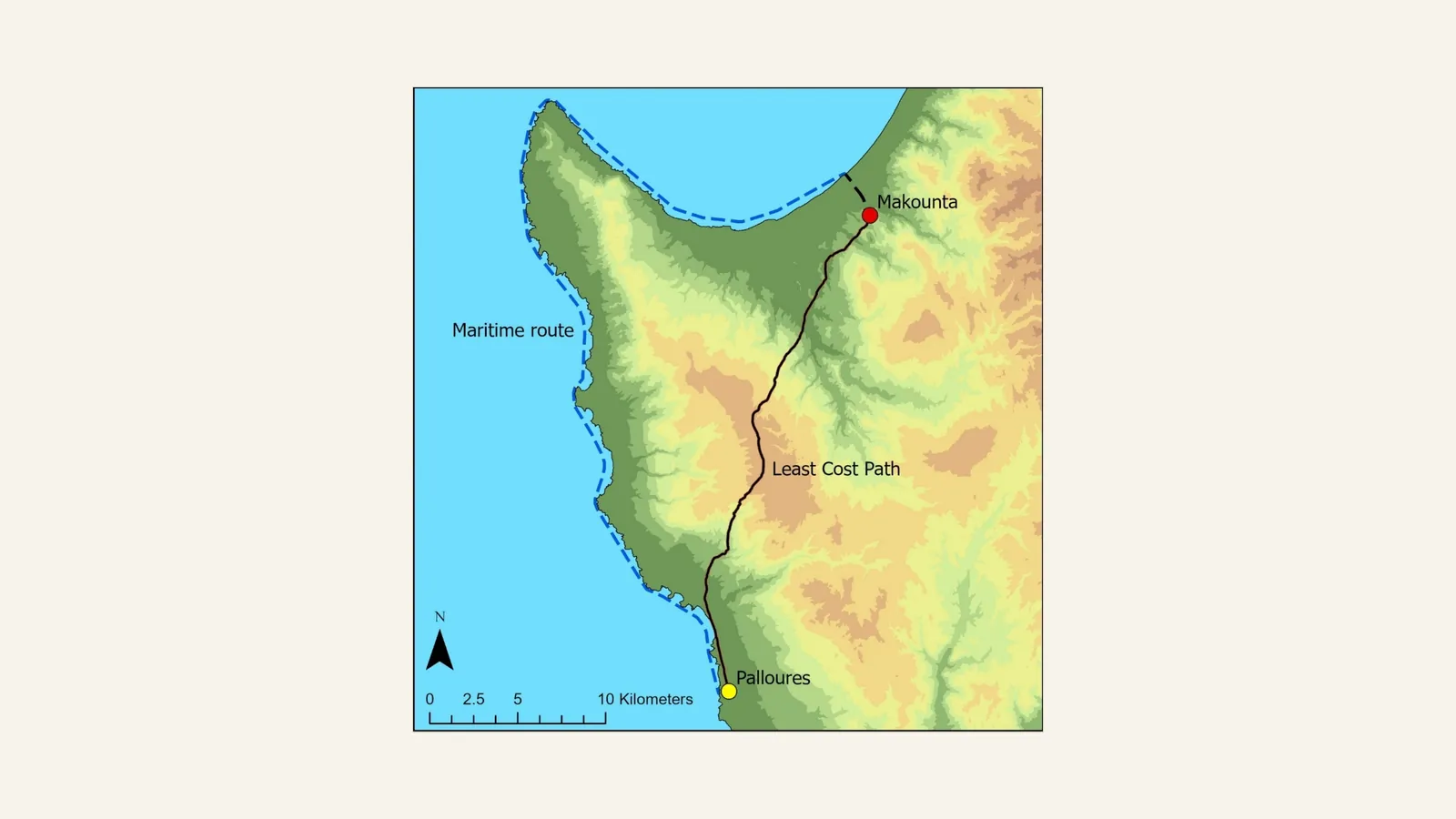
Carrying goods by canoe round the Akamas peninsula would have cost Chalcolithic villagers in western Cyprus about as much effort as hauling heavy loads over the hills, although the sea route is twice as long. Victor Klinkenberg and Miltiadis Polidorou of the Archaeological Research Unit of the University of Cyprus reach this result in a paper in the Journal of Maritime Archaeology, published on 12 March 2026.
Two villages linked by storage jars
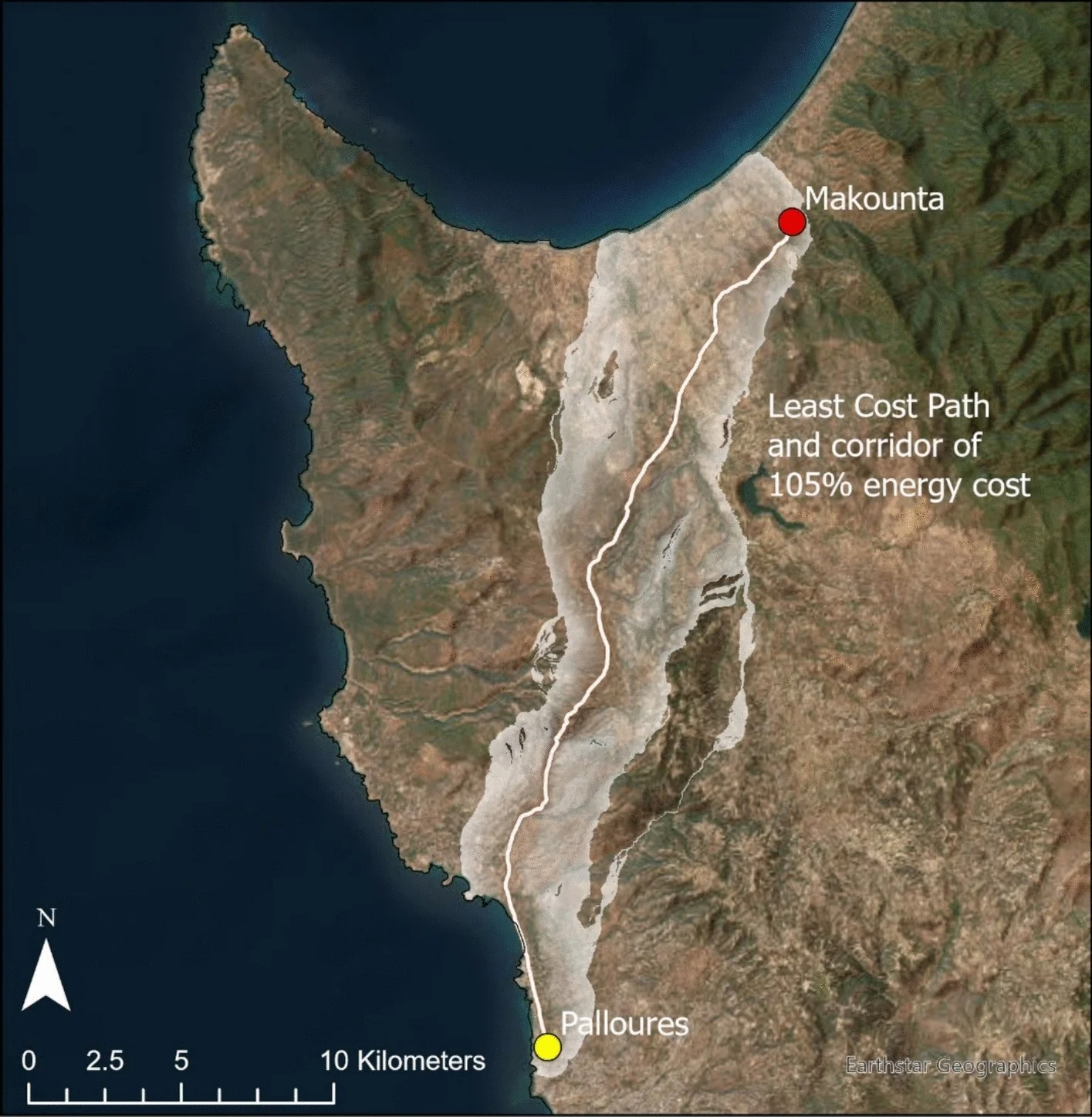
The model joins Chlorakas-Palloures, north of Paphos, to Makounta-Voules in the Chrysochous Bay area, at least 25 km away as the crow flies. At Palloures, Late Chalcolithic Red Monochrome Ware occurs almost only as large storage jars of amphibole-rich clay, about a tenth of that phase's pottery. Petrographic study (identifying clay by its minerals under the microscope) by Hadjigavriel and Dikomitou-Eliadou has shown that this fabric closely matches the main one at Makounta, a site surveyed in 2017. Palloures, dug by a Leiden University team since 2015, lies within 1.5 km of Lemba-Lakkous and Kissonerga-Mosphilia.
The Chalcolithic island had no donkeys or oxen to carry loads, the authors point out, so such jars moved on people's backs or by boat. The period is often described as indifferent to the sea, a view the authors trace to Cyprian Broodbank (2013); following Bernard Knapp (2020), they doubt it, mainly on skeletal evidence. External auditory exostoses, bony growths in the ear canal linked to long exposure to cold water and wind, were found by Kirsi Lorentz and Bianca Casa in 25% of the examined right ear canals of men and 14.2% of women's in the Chalcolithic cemetery at Souskiou-Laona [1]; a skeleton recently excavated at Palloures has them too.
Walking against paddling
On land, the authors traced the cheapest path in a GIS and priced it with the Load Carriage Decision Aid, an energy equation from military research, for a 65 kg porter carrying nothing, or 10, 20 or 30% of body weight. The path runs just over 31 km, a walk of just under seven hours.
At sea, they modelled paddled boats about 10–11 m long, based on trials with replica Neolithic dugouts and on the La Marmotta I canoe (see the oldest Neolithic boats). Each carried 20 crew with 30 kg of cargo apiece and kept 50–500 m offshore. Their base speed of 5.5 km/h was adjusted for wind, which mattered, and currents, which hardly did. The coastal route is nearly 60 km, about 12 hours of paddling, with a short carry from beach to village at each end.
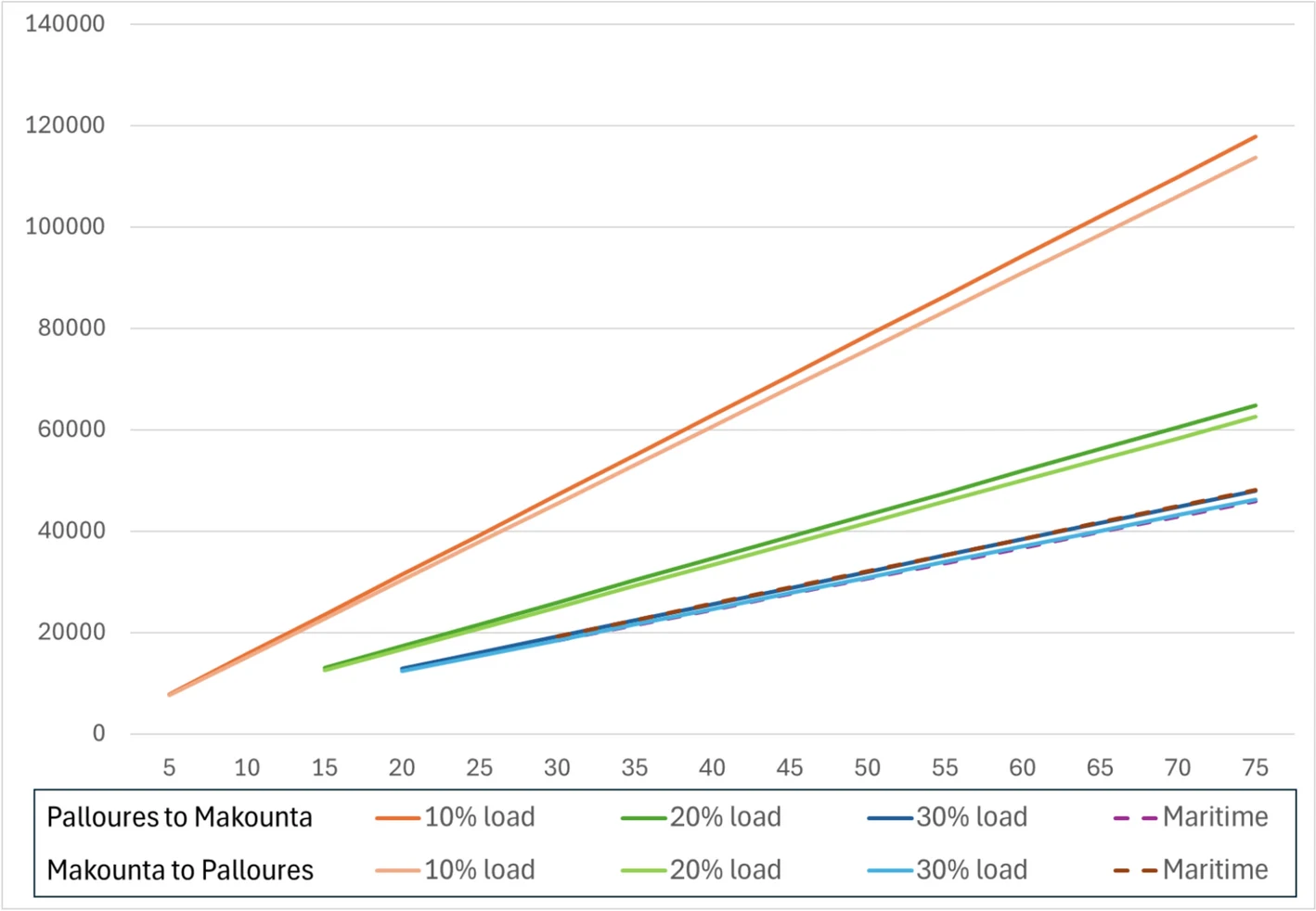
By sea, and on foot with the heaviest load, the trip came out at about 612–642 kilojoules per kilogram carried. Lighter loads cost far more: at least 1,500 kJ per kilo at 10% of body weight. Per kilo and kilometre the boats were two to five times cheaper. The authors take this as support for coastal seafaring in a regional exchange network, which could explain both the jars and the ear growths.
Limits the authors set
The figures hold for this pair of villages only; a more direct crossing of about 50 km would lower the cost at sea. Fish bones are scarce at Chalcolithic sites, so the authors stop short of saying how large a part the sea played. They suggest three levels of contact with it: foraging along the shore by many, coastal transport of bulk goods by a skilled few, and rare voyages off the island. They also doubt that the jars, low-fired and without handles, were made to carry produce; they read their movement as a sign of an economy growing more regional.
A study of plant remains from Palloures argues that wheat mattered more there than the charred seeds suggest; its results are reported separately.
Original source
On ancientcyprus.com
References
- 1.Lorentz, K. O., & Casa, B. (2021). External auditory exostoses, repetitive aquatic activity and increasing social complexity in Chalcolithic Cyprus: specialists of the sea? International Journal of Osteoarchaeology 31, 605–620.
More in Research
- Wheat traces at Chlorakas-Palloures question the view that cereals were minor in Chalcolithic Cyprus
- Strabo's Arsinoe near Palaepaphos probably never existed, argues study of a Ptolemaic queen's cult
- Charred barley and chaff in a Pyla shaft point to stored animal fodder around 1200 BCE
- Late Bronze Age hoard of at least 111 bronzes at Galinoporni was packed in cloth, cord and grass
- Bronze Age tombs at Hala Sultan Tekke held what may be burnt bouquets of grain and wild flowers