
Under a Kilogram
Everything metal that Chalcolithic Cyprus left behind weighs less than a bag of sugar, though the island sat on some of the richest copper ore in the Mediterranean. How it went from there to supplying the Bronze Age world, and giving copper its name, runs through sulphide furnaces, a god recast to stand on an ingot, and four million tons of slag that turn out to be the wrong date.

Alexis Drakopoulos
June 12, 2026·Archeology · History · Research·18 min read


Share


Alexis Drakopoulos is a Greek Cypriot Machine Learning Engineer working in Financial Crimes. He is passionate about Archeology and making it accessible to everyone. About Me.
Everything the people of Chalcolithic Cyprus made of metal, every awl, pin, chisel, bead and blade the excavators have recovered across a thousand years, would together weigh less than a bag of sugar. The island they lived on holds sulphide ore bodies so heavy with copper, and lying so near the surface, that the weathering above them stains whole hillsides ochre and rust. On the mainland to the north, smiths had been hammering copper since the end of the ninth millennium BC. Cyprus, sitting on the metal, came to it perhaps five thousand years later, and even then in trinkets.
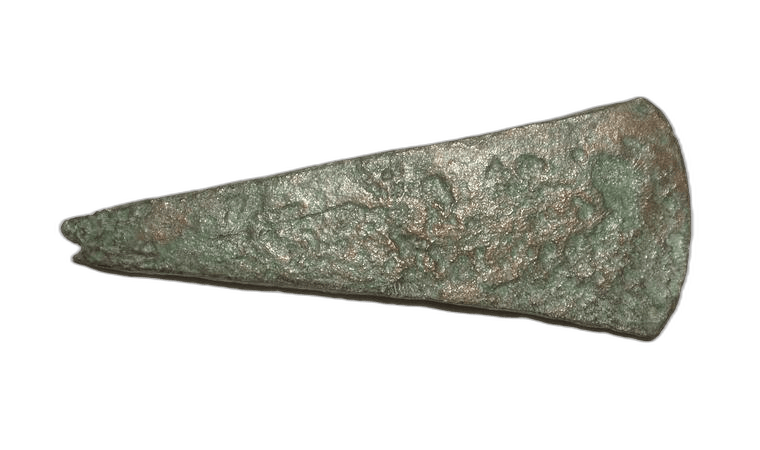
One object breaks the pattern. At Chlorakas-Palloures, a settlement above the coast near Paphos, excavators lifted a complete clay jar that had been buried close to the surface. Inside was a copper axe, seventy-five millimetres long, weighing 119 grams, heavier than any other piece of metal known from the Cypriot Chalcolithic [1]. Packed in beside it were a large stone axe and four hooks cut from pig tusks. The stone axe is of a type made to imitate a metal one, and this particular stone axe imitates this particular copper one: the same thickness, the same tapering trapezoidal body, the same blunt rectangular butt [1]. Someone had carved a copy of the axe in stone and buried the two together, in a pot, with a charred barley seed that dates the deposit to around 2600 BC [1].
It is an odd first impression for the metal island. Cyprus would go on to supply the copper of the Bronze Age world and to give the metal its name: the Romans called pure copper aes Cyprium, Cyprian metal, which wore down to cuprum, and then to copper, cuivre, Kupfer, cobre [2]. How an island this slow to begin became the word for the metal has several answers, and most of them have been overturned at least once.
Primitive and provincial
Noël Gale, who in 1991 ran lead-isotope and trace-element analysis on the Cypriot material, gave it a verdict that held for twenty years. The island's Chalcolithic metallurgy, he wrote, "seems rather primitive and provincial, surprisingly so in view of the large resources of copper ores in Cyprus" [3]. He had a comparison in mind. By the fifth millennium BC the Balkans had produced something like 4,300 copper objects, close to five tons of metal; the Nahal Mishmar hoard, in a cave above the Dead Sea, held 429 copper items on its own. Cyprus, a thousand years after that, offers a few dozen small things, and the securely dated corpus is so thin that specialists argue over whether it numbers eight objects or eighteen [4].
Part of the answer is that the first Cypriot metalwork was barely metallurgy. Native copper, the uncommon nuggets of pure metal that occur without any smelting, can be worked cold: hammered into a strip, bent, and softened again by annealing at a heat a cooking fire reaches. Doing that is closer to working stone, or to carving the blue-green picrolite the islanders strung into pendants, than to the furnace chemistry that lay ahead. The Palloures hoard makes the point in miniature. The copper axe lay in its jar beside its own portrait in stone and four pig-tusk hooks, a set of kept and hidden things. Whoever filled the jar treated the axe as one more curiosity to keep, alongside its stone double and the tusk hooks.
What the metal actually was took thirty years to settle, and the answer reversed. Gale read his analyses to mean the objects were smelted rather than native, and that one of them, an axe butt catalogued KM457, had been imported, probably from north-western Anatolia [3]. Edgar Peltenburg pulled the keystone out in 2011 by showing that KM457 came from a disturbed Bronze Age deposit and had no business being called Chalcolithic at all [4]. Then Andreas Charalambous and Vasiliki Kassianidou passed a portable X-ray fluorescence analyser over seventeen of the objects and produced the picture now generally held: the Middle Chalcolithic ornaments are essentially pure copper, consistent with native metal worked cold, while some of the later tools carry the iron and sulphur traces that smelting leaves behind [5]. One of those tools, a chisel catalogued KM2174, turned out to be bronze, with 3.3 per cent tin [5]. Tin does not occur in Cypriot ore. For that chisel to exist, tin had to be carried to the island from elsewhere, which makes it the earliest bronze known from Cyprus and one of the earliest anywhere [5].
The newest twist runs the same direction as the oldest suspicion, with better evidence behind it. Lead-isotope work published in 2021 on the Palloures metals, the axe in the jar among them, pointed to the Taurus mountains of Anatolia rather than to Cypriot ore, and reinterpreted two pieces long claimed as the first Cypriot copper exports as more likely Anatolian imports instead [1]. The axe whose shape matched nothing on Cyprus and everything across the water turns out, on the current reading, to have been made across the water. Which leaves a question hanging over the whole hesitant business: who brought the knowledge of hot metal to an island that had ignored it for five thousand years?
Axes you could thread on a cord
The answer most of the field now gives is that people did. Around 2400 BC the island's material culture changes so sharply, and across so many unrelated things at once, that the economical explanation is the arrival of a population from south-western Anatolia. The package is broad: a new red polished pottery, rectangular houses, chamber tombs cut outside the settlements, the plough, the warp-weighted loom, cattle, the donkey. And metal. The objects of the Philia phase, named for the site where the assemblage was first recognised, arrive with few local antecedents and in far greater number and variety than anything before, because by now the copper is being smelted from its ore rather than gathered as lumps.
Smelting changes what metal can be. A native nugget is only ever as much copper as nature left lying about; a furnace turns ore, which is everywhere on Cyprus, into as much copper as there is charcoal and labour to reduce it. The island moved along the sequence most early metal cultures followed, from pure copper to arsenical copper, hardened with arsenic drawn from mixed ores, to tin bronze, harder again. The tin kept coming from outside. Webb, Frankel, Stos and Gale traced the metal of three Philia tin-bronze objects, a sword and a spearhead among them, to Bolkardağ in the Taurus, and found a fourth case that tells the most: an axe of purely Cypriot type, cast from Cypriot copper, alloyed with imported tin [6]. The island was now buying tin to make its own bronze, and some of the earliest went into imitation: a set of tin-bronze rings from a tomb at Sotira-Kaminoudhia, chosen for their pale gold colour [6].
Production had begun to leave a footprint. At Marki-Alonia, in the centre of the island, excavators found the chalk and stone moulds for casting flat axes, and the axes carry a detail that turns a tool into a currency: a pierced, domed butt, so they could be strung together and carried. They came in a graded set of weights, near enough 1,000, 460 and 220 grams to look deliberate. An axe you can thread onto a cord and count out is also an ingot. A little later, at Ambelikou-Aletri, the whole sequence survives in one place: stone hammers left inside the mine galleries, the earliest direct evidence of mining on Cyprus, a crucible still slagged from use, and a double clay mould found nowhere else in the eastern Mediterranean [7].
Most of this metal has come out of graves, and the graves show what it was for. At Lapithos, on the north coast, the share of tombs furnished with copper climbs from about 40 per cent in the earlier Bronze Age to 96 per cent by the Middle Bronze Age, and the weapons in them grow longer and heavier than any real fight would want [8]. Metal had become the way a family showed what it was worth, by putting it in the ground. The first outsiders to write Cyprus down were interested in the same metal for the opposite reason. Cuneiform tablets from Mari, Alalakh and Babylon, of the nineteenth to seventeenth centuries BC, name a place called Alashiya, widely taken to be Cyprus, and they name it in connection with copper: the Mari scribes distinguish plain copper, "mountain copper" and refined copper, and fix Alashiyan bronze at seven parts copper to one of tin. The island that buried its wealth had started to ship it.
Roasted seven times
Shipping it in quantity meant solving a hard problem, because Cypriot copper is locked in the wrong kind of ore. The green and blue carbonate ores that early smiths elsewhere reduced give up their copper easily. Cyprus carries those only as a thin weathered skin; below it the orebodies are chalcopyrite, a sulphide of copper and iron, and getting copper out of chalcopyrite means driving off both the sulphur and the iron in stages. The ore is roasted in open air to burn away sulphur, a step that has to be repeated, by Agricola's later account of the same chemistry, seven or nine times over. It is smelted with a silica flux to a matte, an intermediate of copper, iron and sulphur, while the iron runs off into a glassy slag. The matte is roasted and smelted again down to a crude black copper, and refined once more to the better-than-99-per-cent metal an ingot needs. Each stage is a furnace, a charge of charcoal, and someone working bellows.
Two things made it work at scale, both of them Late Bronze Age arrivals absent from the island a few centuries earlier: the tuyère, the ceramic nozzle that delivers a forced draught, and the bellows behind it. Kassianidou calls their introduction a revolution in the Cypriot copper industry [2], and the place that shows it running is Politiko-Phorades, a smelting camp on a creek bank in the foothills, worked through the sixteenth and fifteenth centuries BC. It is the earliest excavated copper-smelting workshop on the island, and it is buried in its own waste: three and a half tons of slag, more than six thousand fragments of furnace, over six hundred pieces of tuyère [9]. The slag is the tell. It was tapped out of the furnace as a liquid into a pebble-lined pit, where the heavy matte sank and the lighter slag set above it in flat cakes of fifteen or twenty kilos, with only a few per cent of copper left trapped in them [9]. Letting the two separate while molten was the advance. The older way had been to let the slag harden and then crush it to pick out the prills of metal caught inside.
Phorades made matte and nothing else; a single surviving lump, almost three-quarters copper, shows the camp ran only the first stage and sent its matte on to be finished elsewhere [10]. It was also small. Its entire working life may have produced three or four hundred kilos of copper, about ten ingots' worth, so it would have taken dozens of operations like it to load one large ship [10]. The refining and casting happened at the towns. At Apliki, a village of miners living against the orebody in the thirteenth century BC, dug by Joan du Plat Taylor just before the modern mine swallowed the site, there were massive tuyères, ore-crushing tools, tap slag, and, oddly, not a single fragment of an oxhide ingot, though the ores of its own district matched the oxhide ingots of the last Bronze Age centuries. The ingots were made at the urban centres, above all at Enkomi, where the metal workshops grew from the town's founding around 1650 BC to an industrial pitch by 1300, with a slag dump eighty metres square [2].
Biscuits with ears
The thing they were casting is the signature object of the entire trade. An oxhide ingot is a flat slab of copper with four ears projecting from its corners. The ears are the point of the shape: they let two men carry the slab slung between them, or rope it to a pack animal. The likeness to a stretched ox hide came later and only gave the ingots their modern name. The divers who raised them from a wreck off Uluburun called them biscuits with ears. A good example from Enkomi is 73 centimetres long and weighs just over 39 kilos; many cluster near 29 kilos, close enough to a known talent to suggest the weight was meant [11]. Each was a single pour of freshly refined copper into an open mould, which is exactly why casting them belonged at centres like Enkomi and not at a primary smelter like Phorades.
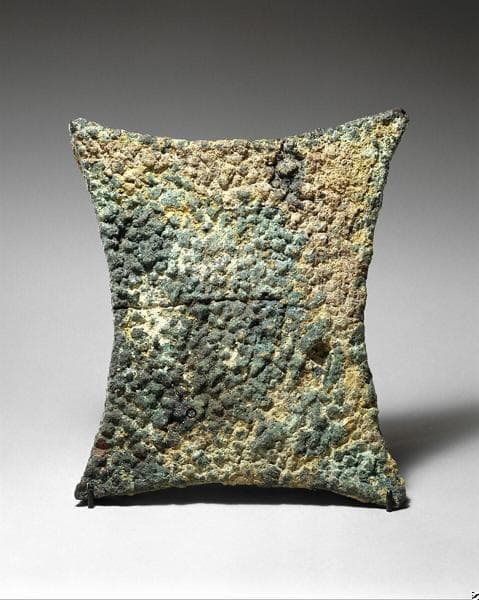
Because copper keeps the lead-isotope signature of the ore it came from, unchanged by smelting, the ingots can be matched to their source. Noël Gale and Sophie Stos-Gale did the matching, and the result is the spine of the whole Late Bronze Age story: every oxhide ingot later than about 1450 BC, wherever it was found, from Crete and Sardinia to the Anatolian coast and the Black Sea, carries Cypriot copper, and the later ones cluster tightly on the ores of the Apliki district [11]. The claim was attacked. Budd and Pollard argued in the 1990s that ingots were recycled mixtures of scrap, which would blur any signature and make provenance meaningless; Gale answered it once the Apliki ores had been properly sampled, and the consensus held [12]. There is one honest gap. The earliest oxhide ingots of all, from Cretan hoards around 1500 BC, are not Cypriot, and no one has yet matched them to a source. The shape may be older than Cyprus's command of it. The metal, from about 1450 BC, is the island's.
The god on the ingot
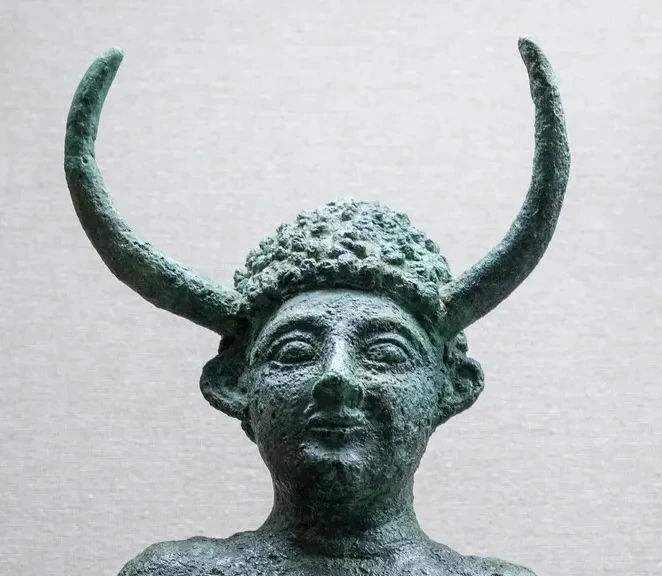
Before the metal was money it had become a god. In 1963 excavators at Enkomi found a bronze figure about 35 centimetres tall, a bearded warrior in a horned helmet with a raised spear and a small round shield, standing on a base cast in the shape of an oxhide ingot. The Ingot God, they named it, and the name took the obvious meaning: a deity set over copper. George Papasavvas has since read the bronze more closely and told a stranger story. What older accounts took for greaves on the figure's shins is a second, cruder skin of metal cast over the first. The statue began as an ordinary striding "smiting god", the standard Levantine type with the arm raised to strike; it was damaged, and was then reworked by a less able hand into a god standing on a slab of copper [13]. The object had been recast, in the most literal way, to put copper under the protection of a god.
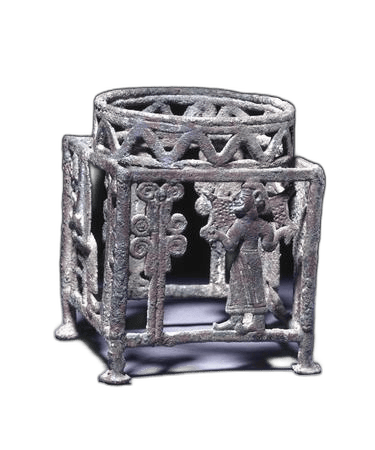
The same foundries turned out the finest bronzes of the age. Cypriot smiths cast openwork four-sided stands, some on wheels, and rod tripods to carry the bowls for mixing wine, by the lost-wax method, and exported them widely enough to be copied from Crete to Sardinia [14]. Papasavvas argues each was cast in a single operation from a composite wax model, its relief panels pressed from moulds and repeated, the same scene, sometimes the same flaw, a damaged sphinx wingtip, appearing twice on one stand [13]. The panels show what their makers thought worth showing. Among the lions and sphinxes and seated harpists are men carrying oxhide ingots in procession: the metal had put a picture of its own production on its most accomplished objects.
What that trade moved is legible in two finds. The ship that went down off Uluburun, on the Turkish coast, around 1300 BC was carrying about ten tons of copper, 354 oxhide ingots of it, nearly all Cypriot, along with a ton of tin to alloy the copper and a cargo of glass, resin, ivory and gold [16]. And in the diplomatic archive of the pharaoh Akhenaten at Amarna, a king of Alashiya writes to Egypt as "my brother", the address of an equal, sends a consignment of copper, and apologises that it is small: a plague, "the hand of Nergal", has killed off his copper-workers [15]. The exact figure is disputed, 500 talents by one reading and 500 shekels by another, but the apology is not. A king measured his standing with Egypt in copper, and expected to be believed when he said his smiths were dead.
When iron came
The Bronze Age ended, around 1200 BC, in a wave of collapse that brought down palaces from Greece to the Levant, and iron came in behind it. Here the metal island has a strong claim to a genuine first. Cyprus holds the largest body of smelted iron objects anywhere in the eastern Mediterranean in the twelfth century BC, and since there was no plausible place to import them from, the iron was being made on the island, from its own iron-rich ochres. The clearest form of the argument is what scholars call the knife horizon: single-edged iron knives with bronze rivets, many with a handle of ivory, appear in Cyprus at the very start of the twelfth century, earlier than in the Aegean and in far greater numbers. Maria Iacovou's judgement is that Cyprus was "preeminent in the exploitation of functional iron" [18].
Not everyone reads this as Cypriot invention. Jane Waldbaum, whose 1978 book gave the bronze-to-iron transition its standard treatment, argued that Cyprus innovated nothing in particular and crossed to iron at much the same time and rate as everywhere else, driven by a shortage of tin rather than of copper [17]. Without enough tin to make bronze, iron was the available hard metal, and an island that had always bought its tin abroad would have felt the want of it early. The one metal Cyprus never had a source of may, on this reading, be the thing that moved it off bronze.
What iron did not do was end bronze, which went on serving everything ceremony asked of it: vessels, tripods, fibulae, the cult figures. Iron stayed close to use, in blades and spits and tools. Among the early iron objects is a class that would matter later, the obelos, an iron roasting-spit deposited in graves in pairs, the gear of an aristocratic feast. The most famous of these spits, though, is bronze, and it carries the oldest substantial piece of Greek on the island: an obelos from a tomb at Palaepaphos-Skales, inscribed in the Cypriot syllabary with a man's name in the genitive, Opheltas, in a recognisably Greek dialect, around the turn of the eleventh and tenth centuries BC. It is among the earliest Greek inscriptions known anywhere, and it was written on a barbecue skewer.
The boom that those four million tons of slag actually record came later still. Every one of the twenty-nine radiocarbon dates from the island's slag heaps falls between 500 BC and AD 500; the two-million-ton mountain at Skouriotissa is Late Roman. The Bronze Age that made Cyprus the copper island left comparatively little slag, scattered and modest, in places like Phorades. The famous heaps belong to the city-kingdoms and the empires that followed them, and the biggest are Roman, of the same period in which Pliny set down the name the metal had taken from the island. By then iron had not displaced copper at all. The world used more bronze than ever, even as it forged its tools and weapons from iron, and Cyprus mined and smelted on a scale the Bronze Age had never reached.
The wealth shows in the royal tombs at Salamis, furnished in a deliberately Homeric key. One held a bronze cauldron 125 centimetres across, its rim ringed with eight cast griffins and four bearded sirens, raised on an iron tripod [19]. Another held the equipment of a heroic feast laid out as Homer describes it: a pair of iron firedogs shaped like the prows of warships, and a bundle of twelve iron obeloi, the roasting-spits again, still showing the traces of their wooden handles [19]. The old habit of making metal under a god's eye held to the end: at Tamassos a smelting and casting workshop was built onto the temple of the goddess the Greeks would name Aphrodite, with slag turning up in the sanctuary's own offering pits [2]. The same kingdoms commissioned silver and gold bowls in the Phoenician manner, worked in concentric bands of Egyptian and Assyrian figures; one from Amathus carries a city under siege that may hold the earliest picture of Greek mercenaries [20].
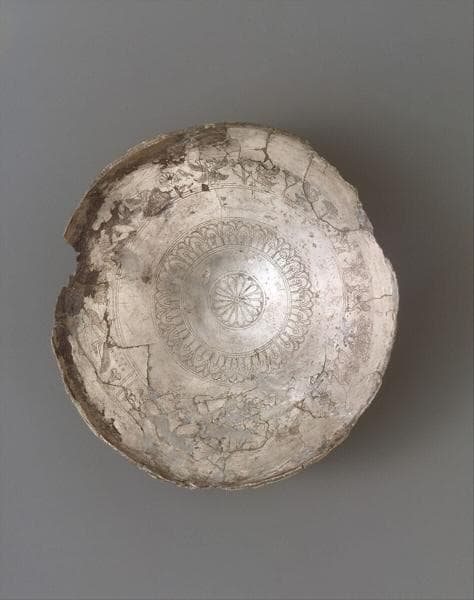
The copper axe at Palloures had been worth burying whole, a thing too rare to spend. Some two thousand years on, Evelthon of Salamis was paying out the wealth that copper had built in silver coin stamped with his own name and a recumbent ram, struck on a weight standard that was Cyprus's own and owed nothing to the Persian empire that, by then, nominally ruled the island [21].
References
- 1.Düring, B. S., De Ceuster, S., Degryse, P., & Kassianidou, V. (2021). Transformative copper metallurgy in Chalcolithic Cyprus: a reappraisal. Antiquity, 95(381), 670–685.
- 2.Kassianidou, V. (2012). Natural Resources and the Importance of Copper. In D. Pilides & N. Papadimitriou (Eds.), Ancient Cyprus: Cultures in Dialogue. Department of Antiquities, Cyprus.
- 3.Gale, N. H. (1991). Metals and Metallurgy in the Chalcolithic Period in Cyprus. Bulletin of the American Schools of Oriental Research, 282/283, 37–61.
- 4.Peltenburg, E. (2011). Cypriot Chalcolithic Metalwork. In P. P. Betancourt & S. C. Ferrence (Eds.), Metallurgy: Understanding How, Learning Why. Studies in Honor of James D. Muhly. INSTAP Academic Press.
- 5.Kassianidou, V., & Charalambous, A. (2019). Chemical analyses of copper objects and faience beads using portable X-ray fluorescence. In E. Peltenburg, D. Bolger, & L. Crewe (Eds.), Figurine Makers of Prehistoric Cyprus: Settlement and Cemeteries at Souskiou (pp. 279–286). Oxbow Books.
- 6.Webb, J. M., Frankel, D., Stos, Z. A., & Gale, N. (2006). Early Bronze Age metal trade in the eastern Mediterranean: new compositional and lead isotope evidence from Cyprus. Oxford Journal of Archaeology, 25(3), 261–288.
- 7.Webb, J. M., & Frankel, D. (2013). Ambelikou Aletri: Metallurgy and Pottery Production in Middle Bronze Age Cyprus (Studies in Mediterranean Archaeology 138). Åströms Förlag.
- 8.Keswani, P. S. (2004). Mortuary Ritual and Society in Bronze Age Cyprus. Equinox Publishing.
- 9.Kassianidou, V. (2008). The Formative Years of the Cypriot Copper Industry. In I. Tzachili (Ed.), Aegean Metallurgy in the Bronze Age (pp. 249–267). Ta Pragmata Publications.
- 10.Knapp, A. B., & Kassianidou, V. (2008). The archaeology of Late Bronze Age copper production: Politiko-Phorades on Cyprus. In Ü. Yalçın (Ed.), Anatolian Metal IV (Der Anschnitt, Beiheft 21, pp. 135–147). Deutsches Bergbau-Museum.
- 11.Stos-Gale, Z. A. (2011). 'Biscuits with ears': a search for the origin of the earliest oxhide ingots. In P. P. Betancourt & S. C. Ferrence (Eds.), Metallurgy: Understanding How, Learning Why. Studies in Honor of James D. Muhly (Prehistory Monographs 29, pp. 221–229). INSTAP Academic Press.
- 12.Gale, N. H. (2001). Archaeology, science-based archaeology and the Mediterranean Bronze Age metals trade: a contribution to the debate. European Journal of Archaeology, 4(1), 113–130.
- 13.Papasavvas, G. (2011). From Smiting to Smithing: the transformation of a Cypriot god. In P. P. Betancourt & S. C. Ferrence (Eds.), Metallurgy: Understanding How, Learning Why. Studies in Honor of James D. Muhly (Prehistory Monographs 29, pp. 59–66). INSTAP Academic Press.
- 14.Catling, H. W. (1964). Cypriot Bronzework in the Mycenaean World. Clarendon Press.
- 15.Moran, W. L. (1992). The Amarna Letters. Johns Hopkins University Press.
- 16.Pulak, C. (1998). The Uluburun shipwreck: an overview. International Journal of Nautical Archaeology, 27(3), 188–224.
- 17.Waldbaum, J. C. (1978). From Bronze to Iron: The Transition from the Bronze Age to the Iron Age in the Eastern Mediterranean (Studies in Mediterranean Archaeology 54). Åströms Förlag.
- 18.Iacovou, M. (2008). Cultural and political configurations in Iron Age Cyprus: the sequel to a protohistoric episode. American Journal of Archaeology, 112(4), 625–657.
- 19.Karageorghis, V. (1973–1974). Excavations in the Necropolis of Salamis III (Salamis Vol. 5). Department of Antiquities, Cyprus.
- 20.Markoe, G. (1985). Phoenician Bronze and Silver Bowls from Cyprus and the Mediterranean. University of California Press.
- 21.Markou, E. (2011). L'or des rois de Chypre: numismatique et histoire à l'époque classique (Meletemata 64). Centre de Recherches de l'Antiquité Grecque et Romaine, Fondation Nationale de la Recherche Scientifique.