
Fieldwork·Roundup
This Week in Cypriot Archaeology: 23–29 March 2026
The Warsaw–Kraków team at Nea Paphos reports its 2025 season: crucibles for melting metal at Maloutena and a previously unknown colonnade in the agora.



The University of Warsaw published its account of the 2025 excavation season at Nea Paphos on 24 March. In the Maloutena quarter the team found crucibles for melting metal next to rooms that a stamped Rhodian amphora handle dates to the late Hellenistic period; in the agora it exposed part of a colonnade that had not been known before.
Fieldwork
The joint expedition of the University of Warsaw, through its Polish Centre of Mediterranean Archaeology, and the Jagiellonian University in Kraków is directed by Ewdoksia Papuci-Władyka. After a spring study campaign in April and May, about 30 staff, students and volunteers dug from 7 September to 7 October 2025. The Department of Antiquities had announced the close of the season in February; the university's report of 24 March sets out the results.
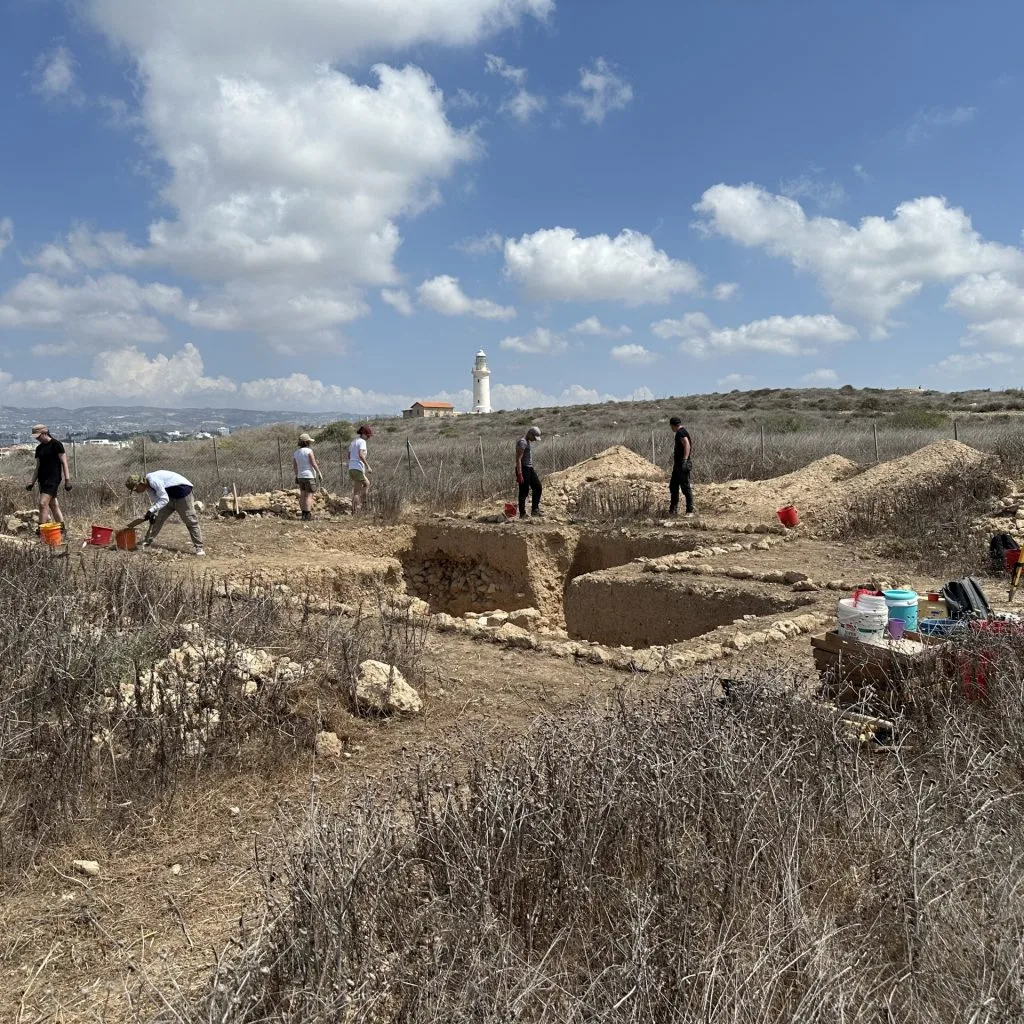
At Maloutena, in the west of the ancient city, work went on in trench MAL TT.X, opened in 2022 where a north–south street of the grid crossed an east–west one. In a 3 by 3 metre extension to the north, the team came down onto stone paving at the level of the street and channel exposed the year before. The extension produced many crucibles for melting metal, cut from the bases of storage amphorae, which point to a small production area on the spot. In Room 1, in the foundation trench of a wall, lay a stamped amphora handle naming Aristombrotidas, the Rhodian eponym (the official who gave his name to the year), and dated to about 117 BCE. The excavators take it as confirmation that these rooms, probably part of a house, are late Hellenistic; the Department's release calls such well-preserved architecture of that date unique for Paphos. Warsaw has worked in this quarter since 1965, when a mission under Kazimierz Michałowski began the excavations that uncovered the Villa of Theseus and the House of Aion; 2025 marked sixty years of that work and fifteen of the Kraków team in the agora.
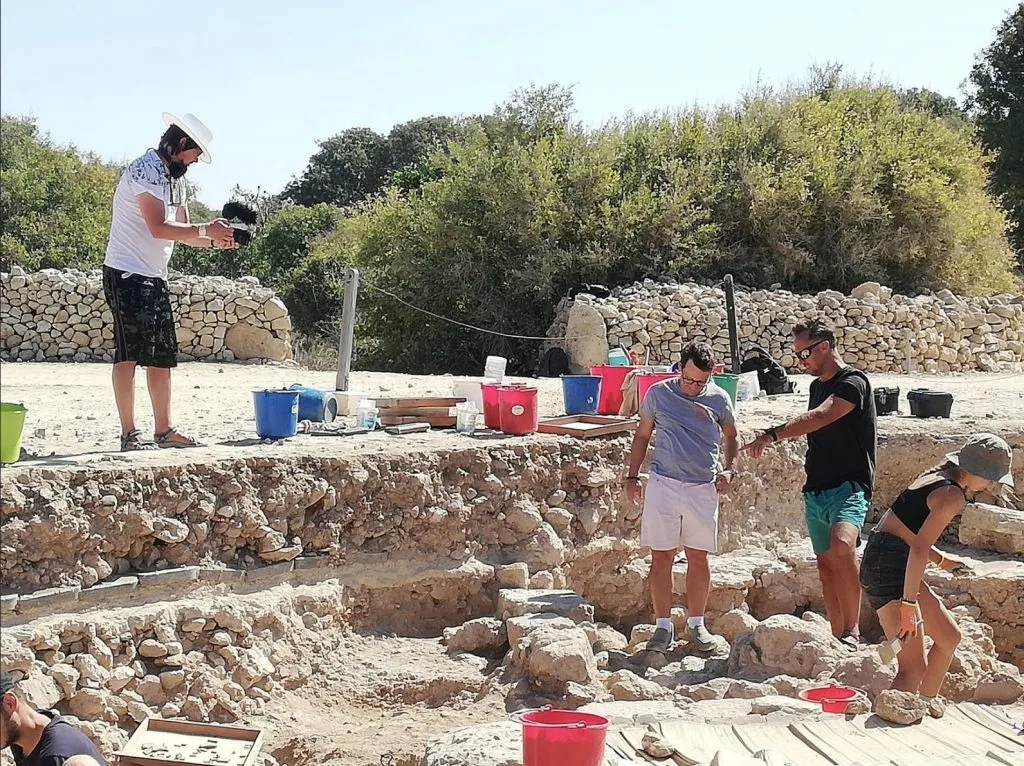
The agora of Nea Paphos is a square of 95 by 95 metres lined with colonnades, of which the eastern side survives best. In trench T.II, at the north end of that eastern portico, the excavators reached bedrock only in the south-east corner. There they found a shallow settling basin, fed by a ceramic pipe from the north and linked to Well S.233, found in earlier seasons and placed in the first half of the 2nd century BCE. North of the basin a stretch of stylobate, the stone base on which a row of columns stood, came to light with the lower drums of two fluted columns. The team cannot yet date it, but thinks it belonged to an earlier phase of the portico than the last one, of the first half of the 2nd century CE, and plans to return to it next season.
Study work ran alongside. Aleksandra Brzozowska-Jawornicka of Wrocław University of Science and Technology recorded 350 pieces of architectural decoration in the Maloutena houses and the stone stores beside them. At the Archaeological Museum in Paphos, Jarosław Bodzek of the Jagiellonian University's Institute of Archaeology studied the coins, and Barbara Zając of the National Museum in Kraków conserved 71, all bronze but one silver, and also treated a small piece of gold foil and a bronze situla handle (a situla is a bucket-shaped vessel).
Original sources
On ancientcyprus.com
- Sites
- Nea Paphos
- Excavations
- Nea Paphos: MA-P, Maloutena and Agora in the Paphos Urban Plan (Warsaw and Kraków), Nea Paphos: the Polish Archaeological Mission (Maloutena), Nea Paphos: the Paphos Agora Project (Jagiellonian University)
- People
- Ewdoksia Papuci-Władyka, Kazimierz Michałowski, Aleksandra Brzozowska-Jawornicka, Jarosław Bodzek, Barbara Zając
- Institutions
- University of Warsaw, Polish Centre of Mediterranean Archaeology, Jagiellonian University, Department of Antiquities of Cyprus, Wrocław University of Science and Technology
- Periods
- Hellenistic, Roman
More in Fieldwork
- Hellenistic quarry under Paphos's Fabrika hill became an unused tomb, then a church
- This Week in Cypriot Archaeology: 31 August–6 September 2026
- Hollows cut into a Bronze Age threshold at Erimi match a senet game board
- This Week in Cypriot Archaeology: 27 July–2 August 2026
- Grape seeds and unfired loom weights found in Bronze Age work complex at Erimi-Pitharka