
Research·Brief
Bull and ibex gold diadems from Hala Sultan Tekke tombs were probably made on Cyprus, study argues
Nine diadems and two mouth-pieces from Late Bronze Age family tombs mix Egyptian, Aegean and Near Eastern motifs; the heavier ones show wear from use in life.



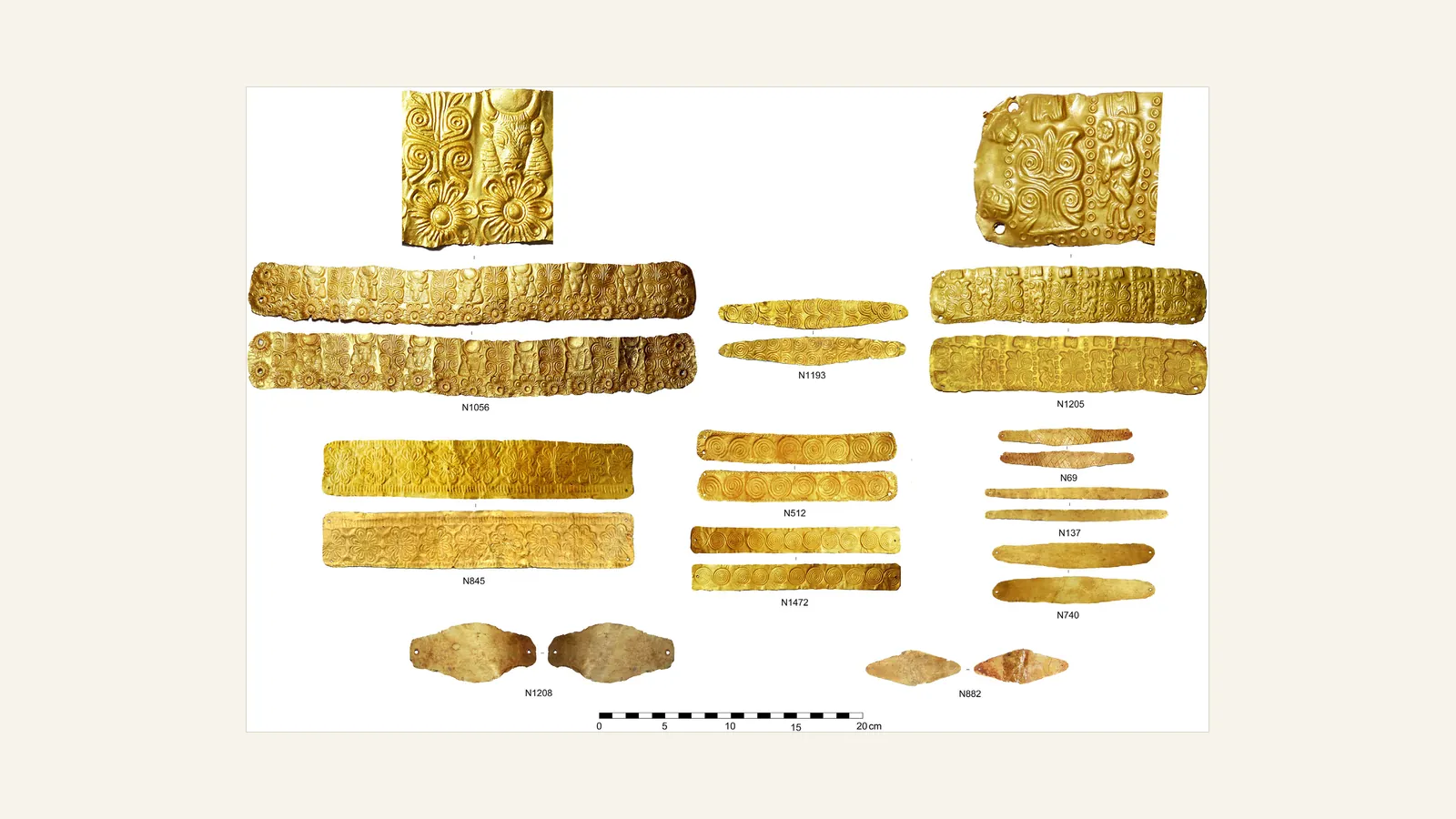
Eleven gold-sheet ornaments from the tombs of Hala Sultan Tekke, the Late Bronze Age port beside the Larnaca Salt Lake, were probably made on Cyprus and possibly in the town itself, argues Peter M. Fischer of the University of Gothenburg. His study of nine diadems and two mouth-pieces was published online in the Oxford Journal of Archaeology (vol. 45, no. 2, pp. 151–179) on 24 February 2026.
They come from seven chamber tombs and a shaft tomb just east of the town, excavated in 2016–2024 by the New Swedish Cyprus Expedition, which Fischer has directed since 2010. Paul Åström's Gothenburg mission had dug at the site in 1971–1987. The burials span the 15th to the 13th century BCE.
Eleven strips, two kinds
For Fischer a diadem is a band long enough to cross the forehead, worn by the living and the dead; a mouth-piece is shorter and was laid only over a corpse's mouth.
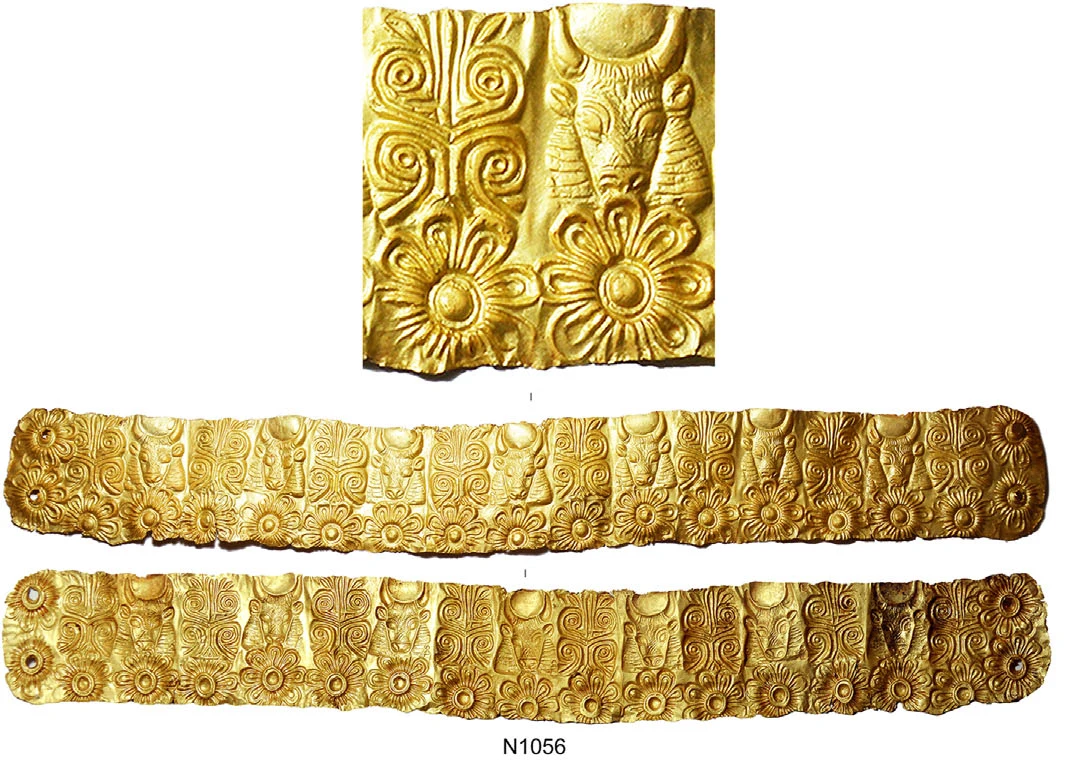
The longest, N1056, repeats a frontal bull's head seven times, a disc between the horns, among palm-and-flower motifs and 19 rosettes. It lay with a woman aged 35–40 in Chamber Tomb XX, whose 29 burials and 299 objects make it, by Fischer's account, the wealthiest tomb found so far. He links the bull with a sun disc to the Egyptian god Apis and the plants to Mycenaean vase painting, and reads a "masculine" bull on a woman's diadem as a sign of some gender parity or shared symbolic roles.
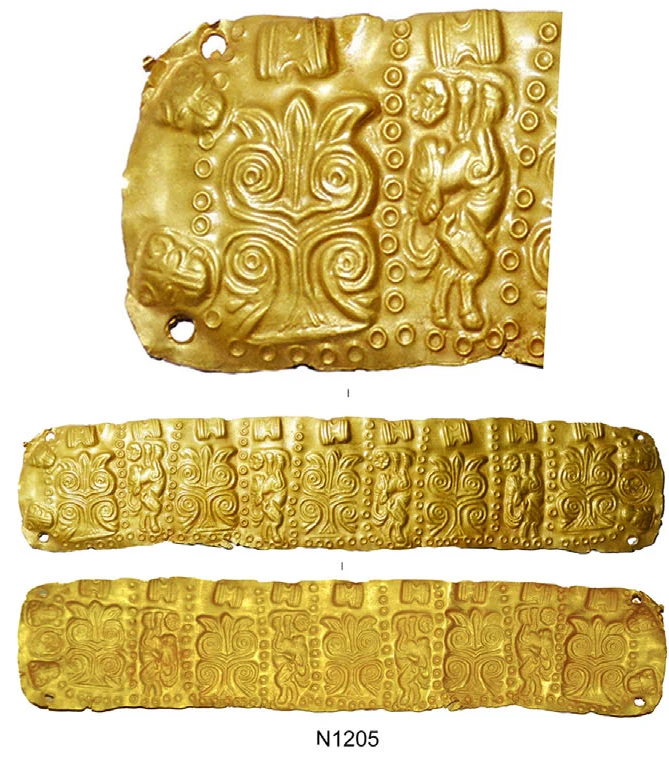
The heaviest, N1205 from the same tomb, weighs 23.14 g on a sheet nearly three times as thick as the bull diadem's. It carries Minoan hourglass shapes, four ibexes at full stretch and four feline heads, perhaps lions, which Cyprus lacked. Fischer's nearest parallel for the running ibex is a galloping lion on a gold-plated box from Grave Circle A at Mycenae.
The others are plainer: a rosette band, N845, the most worn, buried with a man aged 40–49 in Chamber Tomb YY; three bands of double spirals; one cross-hatched; two plain; and the two mouth-pieces.
Worn in life or made for the grave
Wear on the heavier diadems (11.7–23.14 g) suggests to Fischer that they were worn in life, probably rarely given how brittle they are, though wear and final polishing are hard to tell apart. The light bands (1.02–2.66 g) show no clear wear and may have been made for burial.
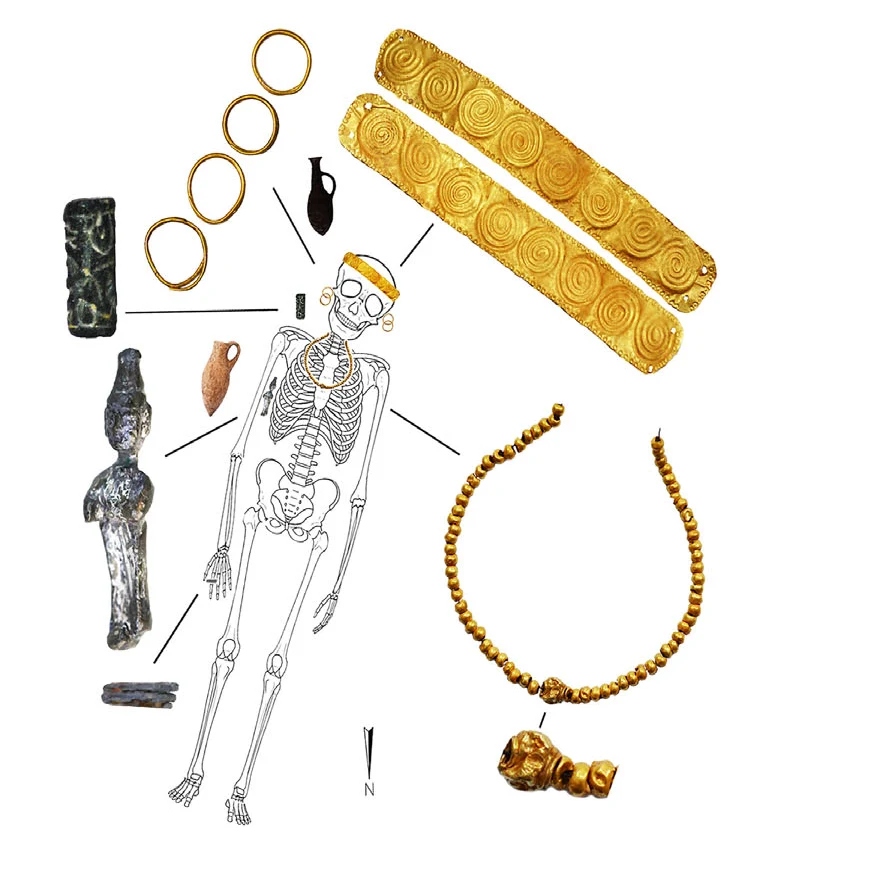
Men, women and children were buried with them. In Chamber Tomb RR, the project's most crowded with at least 34 dead, a child of four or five was buried around 1350 BCE with spiral diadem N512 still on the forehead, a silver ring and a chlorite cylinder seal among the other gifts. Fischer takes the burial as evidence that the elite's children shared its standing.
Whose goldsmiths
In her 1983 London thesis, Elizabeth Goring found no link between Aegean and Cypriot diadems, placed the Cypriot decoration in a Syro-Palestinian tradition and judged the heavy bands purely funerary, which Fischer disputes. Kition, Enkomi and Paphos had been proposed as workshop centres before the current excavations.
The motifs were stamped, and near-identical palms on different bands came from different matrices. No mould or stamp has turned up at Hala Sultan Tekke, but its quantity of gold jewellery keeps the town, in Fischer's view, among the possible workshops. The gold may be recycled, Nubian, or, though no analyses yet support it, from Ada Tepe in southern Bulgaria.
Tomb YY's imported pottery came only from the Mycenaean and Minoan world, and Tomb XX held little Levantine and nothing clearly Anatolian, which Fischer suggests may mean that each elite family traded mainly in one direction.
Original source
On ancientcyprus.com
More in Research
- Wheat traces at Chlorakas-Palloures question the view that cereals were minor in Chalcolithic Cyprus
- Strabo's Arsinoe near Palaepaphos probably never existed, argues study of a Ptolemaic queen's cult
- Charred barley and chaff in a Pyla shaft point to stored animal fodder around 1200 BCE
- Late Bronze Age hoard of at least 111 bronzes at Galinoporni was packed in cloth, cord and grass
- Bronze Age tombs at Hala Sultan Tekke held what may be burnt bouquets of grain and wild flowers