
Contents
This page is about church art: icons, frescoes, mosaics and liturgical objects, most of them medieval or later. They are not archaeological finds, and their trade was a separate market from the trade in ancient pottery, sculpture and metalwork. See church art and antiquities.
The monastery of the Apostle Barnabas stands on the plain north-west of Famagusta, between the Bronze Age town of Enkomi and the city of Salamis, at the place where tradition says the apostle's tomb was found in the reign of the emperor Zeno. It is the founding shrine of the Church of Cyprus. After the Turkish invasion of 1974 it was in the occupied north. Its last monks were expelled at the end of 1976, icons were stolen from the church in 1980, and some of them were found the next year in chests stopped at Ankara airport on their way to Germany. From 1991 the Turkish Cypriot antiquities department turned the church into an icon museum and the monks' cells into an archaeological museum, which it remains. The icons in the church are mostly of the eighteenth century and later. The archaeological rooms are a separate matter, treated in museums and excavation stores in the north.
The church and its icons before 1974
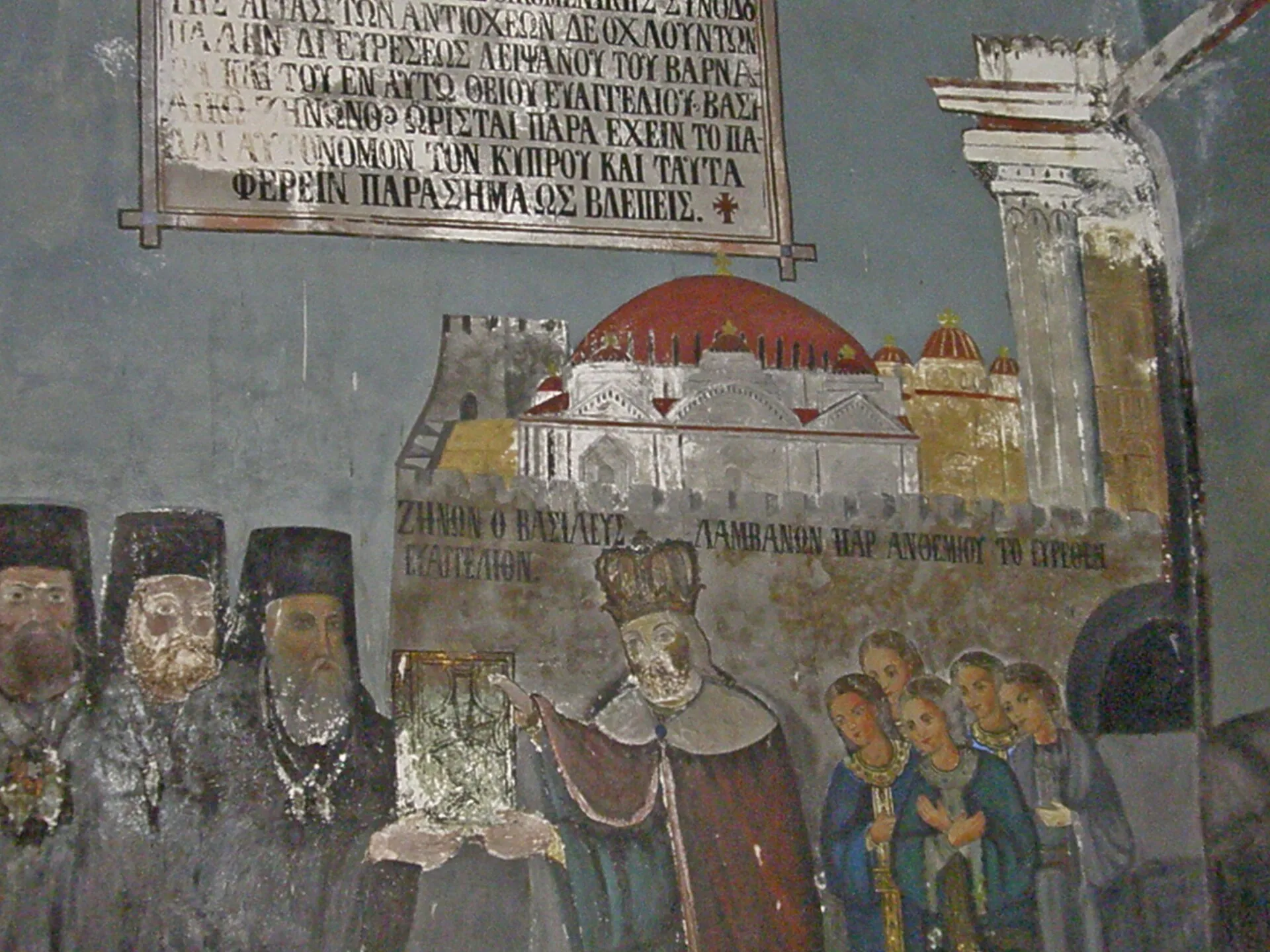
The present church, with two domes on tall drums, was rebuilt in the eighteenth century on the remains of earlier churches, and reuses marble capitals and a green marble column from them [1, p. 249; 2, p. 89]. Rupert Gunnis, who saw it in the 1930s, was not impressed by its contents: "The iconostasis and icons are without interest save for a long panel of the late seventeenth century with portraits of various saints upon it; this icon is kept on a ledge in the north apse" [1, p. 249]. He also noted "a series of crude life-size frescoes" recently painted on the walls, showing the finding of the saint's body and Zeno's grant of privileges to the Church of Cyprus [1, p. 249].
Those murals, and many of the icons, were the work of the monastery's last community, three brothers, Chariton, Stephanos and Barnabas, who lived by painting icons for other churches. Colin Thubron, who stayed with them in 1972, describes the three working on each icon in turn, one drawing the outline, one laying in the colours and one finishing the details [9]. The monastery's icons were therefore of two kinds: older panels, mostly of the eighteenth century, and twentieth-century work by the monks themselves. Neither group was published as a whole before 1974, and no inventory of the church's icons from before the invasion has been published.
The monks' departure
The brothers stayed on after the invasion and were among the last Orthodox monks in the north. The Church of Cyprus describes their departure at the end of 1976 as an expulsion; the two surviving brothers went to the monastery of Stavrovouni in the south. A guidebook of the north describes the church as "exactly as it was when its last three monks left it in 1976", with the pulpit, lectern and pews in place [2, p. 90]. From the end of 1976 the church was empty and in the keeping of the Turkish Cypriot authorities.
The thefts of 1980
The church was robbed in May 1980. The documents submitted to the United States Helsinki Commission by Father Evagoras Constantinides record that the Turkish Cypriot newspaper Bozkurt reported on 22 May 1980 that icons had been stolen from the church on 20 May; it gave the number as 36, valued at C£10,975, and published a list [3, pp. 53–54]. Two years later the Turkish Cypriot weekly Olay, in Mehmet Yaşın's series "Perishing Cyprus", gave the number as 35, "together with the small and very valuable icons found on the iconostasis", and described how the gaps were filled: "The empty spaces were filled up by valuable large icons after they were sawn into 4 to 6 pieces" [4, p. 144]. Olay noted that the theft took place while the night-watchman was in the monastery, and that he said he had heard nothing [4, p. 144].
Both reports come from inside the north. The theft was reported in the Turkish Cypriot press at the time, and the icons that were found were found by Turkish Cypriot officials.
The Ankara chests and the recovered icons
On 16 March 1981 three chests sent from Tymbou airport to an address in Germany were opened at Ankara and found to contain 158 objects, among them icons sawn into pieces. When the objects were handed back to the authorities in Cyprus on 29 May 1981, "it was found that the antiques listed in the Kyrenia Castle and St. Barnabas inventories were also amongst them" [4, p. 144]. Olay accounts for the St Barnabas icons as follows: "Eleven of the icons stolen from St. Barnabas Church were found in an abandoned house in Kythrea, and 11 more were found amongst the antiques which were smuggled through Ankara airport to Germany. The others are still missing or were sold by the smuggler's partners in Germany" [4, p. 144].
The Turkish Cypriot antiquities department gave a higher figure. In an interview printed in the same series, an official of the department said that the theft "occurred when the guard was not there", that "the nightwatchman was relieved of his duties", and that "80% of the icons were found" [4, p. 149]. Twenty-two of 35 is 63 per cent. The two statements cannot both be exact, and no later count has been published. The chests, their sender and the address in Germany are the subject of the Ankara airport seizure of 1981; the parallel loss from the icon store in Kyrenia castle is in the Kyrenia castle icon depot.
| Date | Event | Figure | Reported by |
|---|---|---|---|
| 20 May 1980 | Icons stolen from the church | 36 icons, C£10,975 | Bozkurt, 22 May 1980 [3, pp. 53–54] |
| 1980 (as reported 1982) | Icons stolen, gaps filled with sawn panels | 35 icons | Olay [4, p. 144] |
| Before 1982 | Found in an abandoned house at Kythrea | 11 icons | Olay [4, p. 144] |
| 16 March 1981 | Found in the Ankara chests | 11 icons | Olay [4, p. 144] |
| 1982 | Share recovered, in the department's account | 80 per cent | Department official in Olay [4, p. 149] |
The icon museum from 1991
According to the museum's own handout, as cited by Theopisti Stylianou-Lambert and Alexandra Bounia, the Turkish Cypriot authorities began restoring the monastery and church in August 1991, and more icons were added to the collection in 1992 [5, p. 167]. The church became the icon museum and the cloister cells the archaeological museum. A guidebook describes the church as housing "a rich collection of painted and gilt icons mostly dating from the 18th century" [2, p. 90]. The statement that icons were added means that some of the icons now shown are not from St Barnabas; where they came from is not stated in the published record.
The display has been read in opposite ways. Stylianou-Lambert and Bounia set out the dispute through two documentaries: the Turkish Cypriot account presents the museum as care for the monument, while a documentary made for the Republic dismisses it and says that the oldest icons were removed after 1974 and replaced with nineteenth- and twentieth-century ones [5, pp. 168–169]. The Australian conservation architect Susan Balderstone, writing in 2007, judged the church "carefully conserved as an icon museum", "well done" as a tourist site, but with "no sense of the venerability of the place" for Greek Cypriot pilgrims [6]. Since 2005 an annual service on the saint's feast in June has been allowed [5, p. 168].
The evidence against a large loss
The strongest case against treating St Barnabas as a major loss of church art is in the record itself. Gunnis found its icons "without interest" save one [1, p. 249]; many of the icons were twentieth-century work by the monks; the theft of 1980 was reported by the Turkish Cypriot press; and by Olay's count at least 22 of the 35 stolen icons were recovered within about a year by Turkish Cypriot officials, who then put the church on show as a museum. Against that, the stolen icons included the small and valuable panels of the iconostasis, and some were sold in Germany and never traced [4, p. 144]. No list of what was lost and what was found has been published by either side, so the two cannot be reconciled.
The church today
In April 2026 work began on the roof of the church, funded by the European Union and carried out under the technical supervision of the United Nations Development Programme for the bicommunal Technical Committee on Cultural Heritage; its co-chairman Sotos Ktoris said he hoped that work on the iconostasis and the wall paintings would follow [7]. By June 2026 the roof work was nearing completion [8]. Archaeological material from the region, including pieces that may be from the Famagusta collection of Christakis Hadjiprodromou, is shown in the cloister; that question is treated in the Hadjiprodromou collection.
What this means for an object on the market
An icon said to come from St Barnabas can be checked only against the list Bozkurt published in 1980 and against the photographs of the church, and the list has not been republished. Most icons of the kind the church held, eighteenth-century and later panels, are common on the market and were exported lawfully from Cyprus and from the Greek world for generations; a Cypriot origin alone is not evidence of theft. A panel sawn into pieces, or one matching a published photograph of the iconostasis, should be referred to the Church of Cyprus before purchase. None of this concerns the antiquities in the cloister rooms, which are a different class of object with a different documentary record.
References
- 1.Gunnis, R. (1936). Historic Cyprus: A guide to its towns and villages, monasteries and castles. Methuen.
- 2.North Cyprus: Mosaic of cultures. (n.d.). Guidebook, Nicosia.
- 3.Commission on Security and Cooperation in Europe. (1986). Implementation of the Helsinki Accords: Human rights abuses in Cyprus. Hearing, July 20, 1985, New York. US Government Printing Office. Appendix 4, documents submitted by Father Evagoras Constantinides, Annex VIII. https://archive.org/details/micro_IA41152841_0156
- 4.Yaşın, M. (1982). Perishing Cyprus. Olay (Nicosia), four instalments from 26 April 1982. Reprinted in translation in Commission on Security and Cooperation in Europe, Implementation of the Helsinki Accords: Human Rights Abuses in Cyprus. Hearing, July 20, 1985 (Washington, DC: US Government Printing Office, 1986), pp. 137–152. https://archive.org/details/micro_IA41152841_0156
- 5.Stylianou-Lambert, T., & Bounia, A. (2016). The political museum: Power, conflict, and identity in Cyprus. Routledge.
- 6.Balderstone, S. (2007). Managing heritage in the wake of war and conflict in Cyprus. Paper, ICOMOS Conference Extreme Heritage, James Cook University, Queensland, 19–21 July 2007.
- 7.Cyprus Mail. (2026, April 25). Restoration work begins at Famagusta district church. https://cyprus-mail.com/2026/04/25/restoration-work-begins-at-famagusta-district-church
- 8.Cyprus Mail. (2026, June 8). Roof works at Saint Varnavas monastery near completion. https://cyprus-mail.com/2026/06/08/roof-works-at-saint-varnavas-monastery-near-completion
- 9.Thubron, C. (1975). Journey into Cyprus. Heinemann.