Excavator · Expedition member · Numismatist · Cataloguer
Bruno Helly
fl. 1970–1999
French epigrapher of ancient Thessaly who dug with the Lyon mission at Salamis between 1967 and 1974 and published its Byzantine and medieval coins and the Vespasianic coinage of Cyprus.
Biography
Bruno Helly, a French specialist of the inscriptions and historical geography of ancient Thessaly, took part in the Lyon mission's excavations at Salamis in campaigns between 1967 and 19749,10,11.
Lyon and Thessaly
The French library authority file gives his year of birth as 19379. A staff list of the Lyon centre names him "MR CNRS" in classical antiquity12. In 2004 he was directeur de recherche at the CNRS in the HiSoMA unit of the Maison de l'Orient et de la Méditerranée in Lyon9. The same year the Inventory of Archaic and Classical Poleis listed him as professor at the Maison de l'Orient méditerranéen, Université Lumière Lyon 213. The HiSoMA laboratory now lists him as emeritus, with the rank of directeur de recherche classe exceptionnelle14.
His Gonnoi, in two volumes on the city's history and its inscriptions, was published at Amsterdam by Hakkert in 197315. Helly organised the round table "La Thessalie" at Lyon on 21 to 24 July 197516. With Jean-Claude Decourt and Thomas Heine Nielsen he wrote the chapter on Thessaly and the adjacent regions in the Inventory13. His research themes include Greek archaeology, epigraphy and history, and the seismic history of ancient communities14. On 8 June 2017 the president of the region of Thessaly paid tribute to him for 55 years of work there14.
Digging at Salamis
Helly was in the Salamis campaign of 4 September to 21 October 1967 under Jean Pouilloux, with Georges Roux and others10. He took part again in 1968 and 1969, the second time alongside Gilbert Argoud17,18. The 1970 campaign, in which he was listed with Annie Caubet, Marguerite Yon and many others, gave its second part to the temple of Zeus19.
The sources describe his part at the Campanopetra basilica in different terms: the chronicle for 1970 says its exploration was "conduite par G. Roux, avec l'assistance de B. Helly", and that it revealed one of the largest and most complex Byzantine ensembles of the Near East19. A 2019 volume calls it the basilica "excavated by Bruno Helly and published by Georges Roux"20.
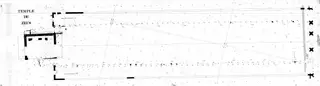
In the campaign of 1974 Helly worked on the temple of Zeus and the Huilerie house with Argoud, Olivier Callot, Anne-Marie Larribeau and T. Monloup11. The chronicle announced a fuller account of the temple by Argoud, Callot and Helly for the Report of the Department of Antiquities of 197511. A 2019 volume records that the excavation team of Argoud, Callot, Helly and Larribeau dated the temple to the end of the second century BC20.
With Argoud and Callot he wrote Une résidence byzantine, l'Huilerie, volume XI of Salamine de Chypre, and its year is given in two ways: Paris 1980 in a 2019 volume, 1984 in a 2014 list of the series20,21. Luca Zavagno describes the Huilerie as a large fifth-century household a few metres west of the Campanopetra, where an inscription naming Epiphanios may point to a church function, perhaps an episcopal palace22.
The coins
Helly wrote "Les monnaies" for two volumes of Vassos Karageorghis's Excavations in the Necropolis of Salamis, volume II in 1970 (pp. 236-68) and volume III in 1973 (pp. 204-13)23. Pierre Aupert used his attribution of bronze coins to Antigonus the One-eyed for a hoard at Amathus, and judged that Helly's arguments "paraissent solides", while finding the lack of coins of 300 to 294 singular in the Amathus context24. With Caubet he published Cypriot ex-votos in the Louvre in 197125.
His chapter in Salamine de Chypre IV (1973), dated June 1971, publishes the rare gold and silver pieces among the more than six hundred coins found at the Campanopetra26,27. It includes a hoard of eighteen billon coins found on 14 and 16 April 1965, which he gives mostly to the counts of Blois and Chartres26. Helly concluded that the last Byzantine coins to circulate in quantity at Salamis were those of Constans II, and that the hoard showed the city still occupied at a time no one had suspected26. D. M. Metcalf listed the hoard in 198328.
In 1980 Helly published the coins of Vespasian struck in Cyprus in the acts of the 1978 Salamis colloquium, and in 1981 a statistical study of them29. A paper of his titled "Monnaies de Vespasien frappées à Chypre" was reprinted in the Numismatic Review of Cyprus, and an abstract of the reprint by Michael Santamas gives as an important conclusion that these coins were meant to circulate across the eastern Mediterranean, not as provincial currency30. Michel Amandry wrote that Helly's 17 obverse dies for 114 tetradrachms suggest that practically the whole production is known31. Maurice Sartre reached "a conclusion close to" Helly's32. A paper at the 1991 numismatic congress corrected his reading of the legend on the Cypriot coins of Galba33. Yon records that Callot took the Vespasianic coins up again in Salamine de Chypre XVI29.
Life and work
1970
Assisted G. Roux in exploring the basilica of Campanopetra, Salamis, in the thirteenth campaign of the Lyon mission (first campaign October 1964); the chronicle calls it one of the largest and most complex Byzantine ensembles of the Near East.
Co-authored Salamine de Chypre XI, Une résidence byzantine 'l'Huilerie'; also published 'Monnaies de Vespasien frappées à Chypre' in Yon (ed.), Salamine de Chypre. Histoire et archéologie (Paris 1980), pp. 293-311.
Named in the École française d'Athènes reports on Amathus (BCH): «semble-t-il, à Antigone le Borgne (fig. 19 ; pour l'attribution, cf. B. Helly, Exc. in the Necropolis of Salamis, vol. 4/II, p. 252-3). L'homogénéité du»
The Campanopetra upright block proved to be a door jamb of a large early Christian basilica complex buried under dunes several metres high; clearance with a…
23.“[Article on Cypriot coinage, JSTOR 10.2307/42678759, bibliography]”.
24.Pierre Aupert (1978). “Rapport sur les travaux de la mission de l'École française à Amathonte en 1977”. Bulletin de correspondance hellénique 102, 939-975.
25.Musée du Louvre. Louvre collections record cl010134215 (Cypriot ex-voto). Online
26.Bruno Helly (1973). “Monnaies d'or et d'argent byzantines et médiévales”. Salamine de Chypre IV. Anthologie salaminienne, 197-200.
27. (1973). Salamine de Chypre IV. Anthologie salaminienne (table des matières).
28.D. M. Metcalf (1983). Coinage of the Crusades and the Latin East in the Ashmolean Museum, Oxford.
29.M. Yon (2009). “Le culte impérial à Salamine”. Cahiers du Centre d'Études Chypriotes 39.
30.American Numismatic Society (1996). “Numismatic Literature 135-136”. Numismatic Literature.
31.Michel Amandry (1995). “Le monnayage provincial chypriote”. Cahiers du Centre d'Études Chypriotes 23.
32.Maurice Sartre (1994). El Oriente romano.
33. (1993). Actes du XIe Congrès international de numismatique (Bruxelles 1991).
37.Yon, "Un cinquantenaire", in Salamis of Cyprus (2019), bibliography pp. 49–50.
38.Pierre Aupert, «Rapport sur les travaux de la mission de l'École Française à Amathonte en 1977», Bulletin de correspondance hellénique 102 (1978).
39.2019, Salamis of Cyprus: History and Archaeology from the Earliest Times to Late Antiquity.
40.Karageorghis, Chronique des fouilles ... à Chypre en 1970, BCH 95 (1971).
41.V. Karageorghis, 1971, Chronique des fouilles et découvertes archéologiques à Chypre en 1970.
42.2019, Salamis of Cyprus: History and Archaeology from the Earliest Times to Late Antiquity; 2019, Salamis of Cyprus: History and Archaeology from the Earliest Times to Late Antiquity.
43.Antoine Hermary, Images archaïsantes de l'Aphrodite chypriote (2015).
44.<i>Excavations in the Necropolis of Salamis, II</i>. By V. Karageorghis. (1972).
45.M. Yon, 2019, Un cinquantenaire: La mission de l'université de Lyon à Salamine.
Corrections and additions
Did you know this person?
We would like to hear from relatives, colleagues and anyone who knows more about this person's life and work.