
Research·News
Storage jar from Pyla bears four signs in Cyprus’s undeciphered Bronze Age script
A 3D model of the rim, dug up in 2019 at Pyla-Kokkinokremos, picked out a sign too faint to read by eye, a rare sign otherwise known from Enkomi.



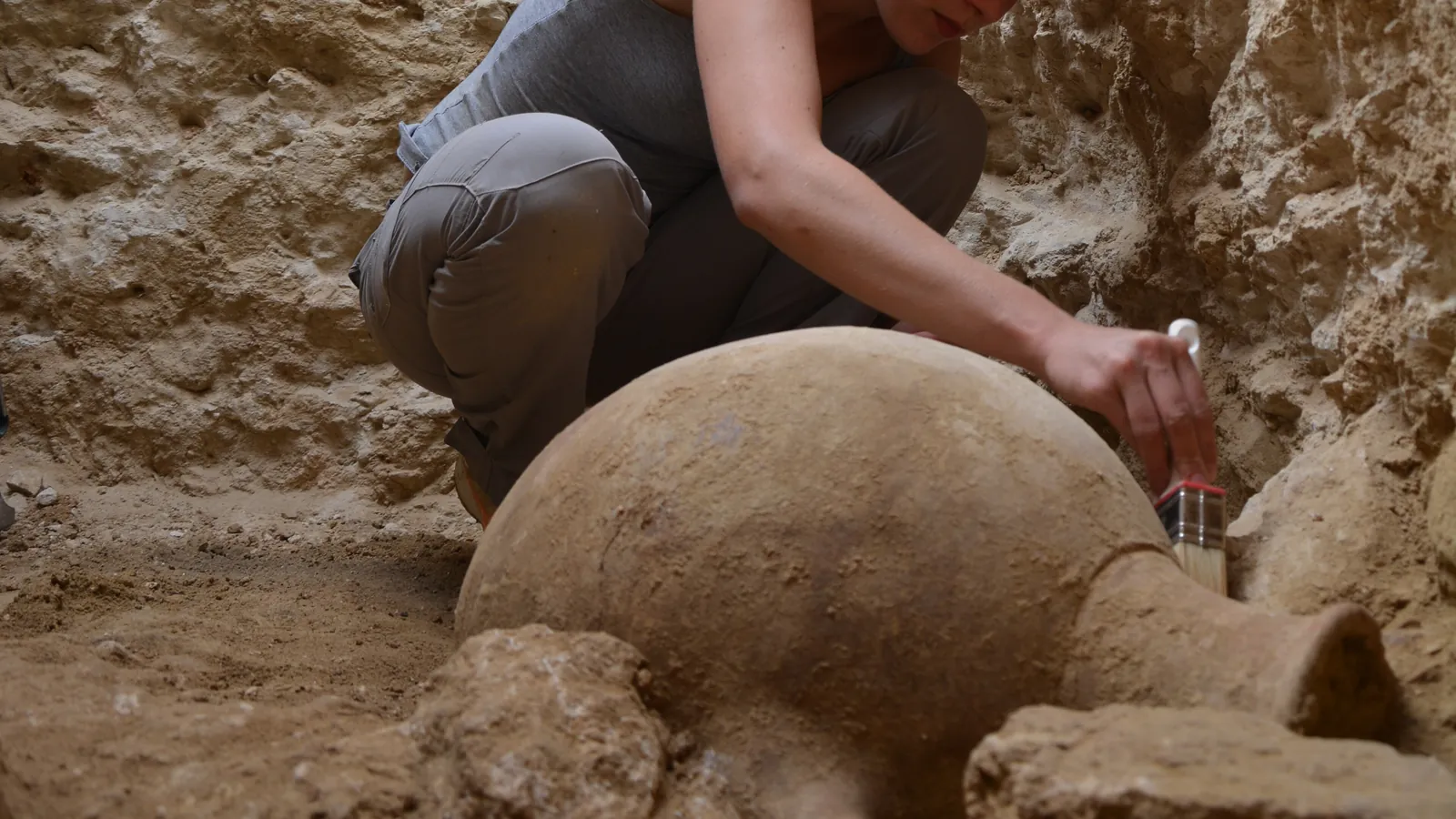
A large Cypriot storage jar dug up in 2019 at Pyla-Kokkinokremos, the short-lived Late Bronze Age settlement above Larnaca Bay, carries a short text in Cypro-Minoan, the island's undeciphered script of the period. Francesca Porta, Silvia Ferrara, Roberta Ravanelli and Joachim Bretschneider publish the four signs, cut into the jar's rim, in a paper that appeared on 16 November in the German Archaeological Institute's journal Archäologischer Anzeiger. A detailed 3D model of the rim fragment let them pick out one sign and a word divider that are hard to see with the naked eye.
A pithos from Space 5.27
The jar is a pithos, a large storage vessel, of the short-necked kind with two ribbed vertical handles running from rim to shoulder; one handle is lost. The authors call the type common across Cyprus in Late Cypriot IIC–IIIA, and several others like it have come from Pyla. Petrographic study of the clay, a pale calcareous fabric with limestone, basalt and grains from the Troodos rocks, points to Cypriot manufacture.
It came from Sector 5, the Ghent University team's area on the south-eastern slope of the plateau, in the joint excavation Bretschneider has directed there with Athanasia Kanta and Jan Driessen since 2014. Space 5.27, about 4.5 m square, is the central room of the south-eastern wing of a building the team calls Complex 5F. Two large rock-cut shafts open in its floor. The inscribed pithos was put back together almost whole from pieces scattered across the room, the inscribed rim fragment among them (field number PK19-05-00644-C).
The room was full of storage. Four more pithoi lay there, one standing upright in the middle of the northern shaft, together with a bathtub or basin, Mycenaean pottery including a krater in the Pastoral Style, three pieces of metallurgical slag and a lump of lead of about 2.5 kg. A chamber 1.45 by 1.25 m opens sideways from the northern shaft, the first such passage recorded at the site; it held no burial. A decorated Egyptian calcite-alabaster drop jar lay at the bottom of the southern shaft, probably washed or thrown in. What the shafts were for is still debated.
Four signs, one or two dividers
The signs read from left to right, the normal direction for Cypro-Minoan. Their thin, drawn-out strokes suggest to the authors that they were cut when the clay was already fairly dry, which would make the text part of the jar's manufacture rather than a later mark of use.
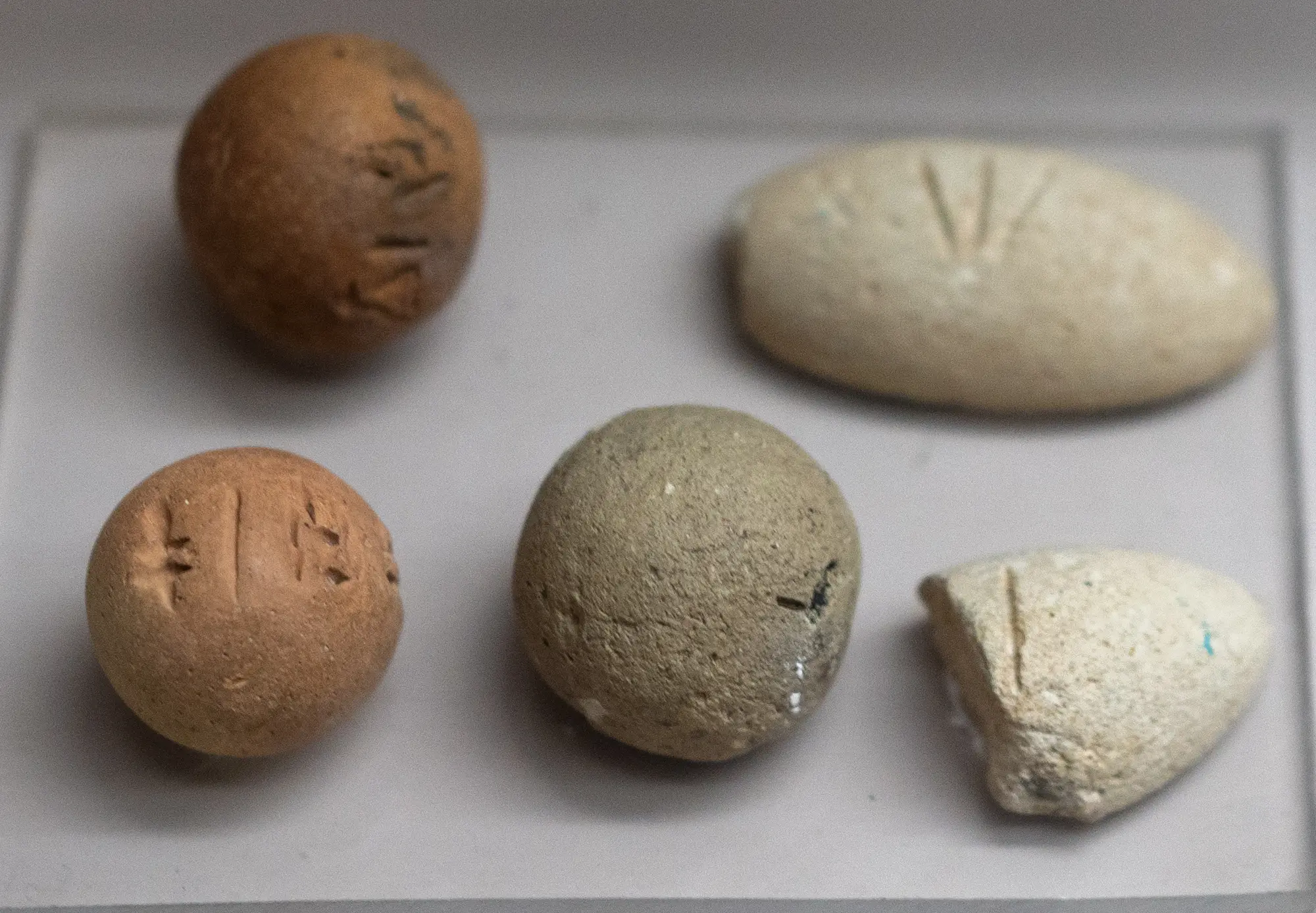
The first sign is CM 102 in the sign list of J.-P. Olivier. It is one of only ten Cypro-Minoan signs with a reading scholars agree on, the vowel a, and it usually opens a word. The second sign could be made out only on the 3D model. The authors identify it as CM 112, a rare sign found on three inscribed clay balls and one vase from Enkomi, the Late Bronze Age town near Famagusta, though never on the Enkomi tablets; they see it as a link between the writing of the two places. Enkomi lies in the north of the island, illegally occupied by Turkey since the 1974 invasion. The third sign is CM 005, with the agreed reading lo. The fourth looks closest to the last sign of a three-sign text on a bronze vase of unknown origin in the Zintilis collection in the Cyprus Museum; the authors take it as CM 067, also seen on Enkomi clay balls, and do not rule out a variant of CM 99 or 100.
A clear, thickly cut divider, the stroke that separates words, stands between the second and third signs. The 3D model also showed a fainter, shallow stroke between the first and second, possibly added after firing, and a scratch after the third that the authors cannot confirm as a divider even on the model. If every stroke is a divider, the text would be four one-syllable abbreviations; if not, it may be two words of two signs each. Isolated signs of this kind occur on many Enkomi clay balls, most often at the end of a sequence. Cypro-Minoan, written on Cyprus from about 1600 BCE, has not been deciphered, and no meaning is proposed for the text as a whole.
What the 3D model adds
Ravanelli, who lectures in the Geomatics Unit of the University of Liège, combined two photogrammetry methods. The inscribed area was shot with a 100 mm macro lens while the fragment turned on a turntable, using focus stacking (merging several exposures at different focus distances into one sharp image): 101 stacks built from 1,996 macro images. The rest of the fragment was covered with 774 pictures from a tablet computer. The resulting mesh has about 16 million vertices, and checks against scale bars put the error of its measurements at about 0.03 mm. Rendered with relief filters, the model brought out the faint divider and the strokes that identify the second sign. Ravanelli, Ferrara and L. Lastilla first developed the macro method for small Aegean inscriptions.
Pyla's tablets and storage jars
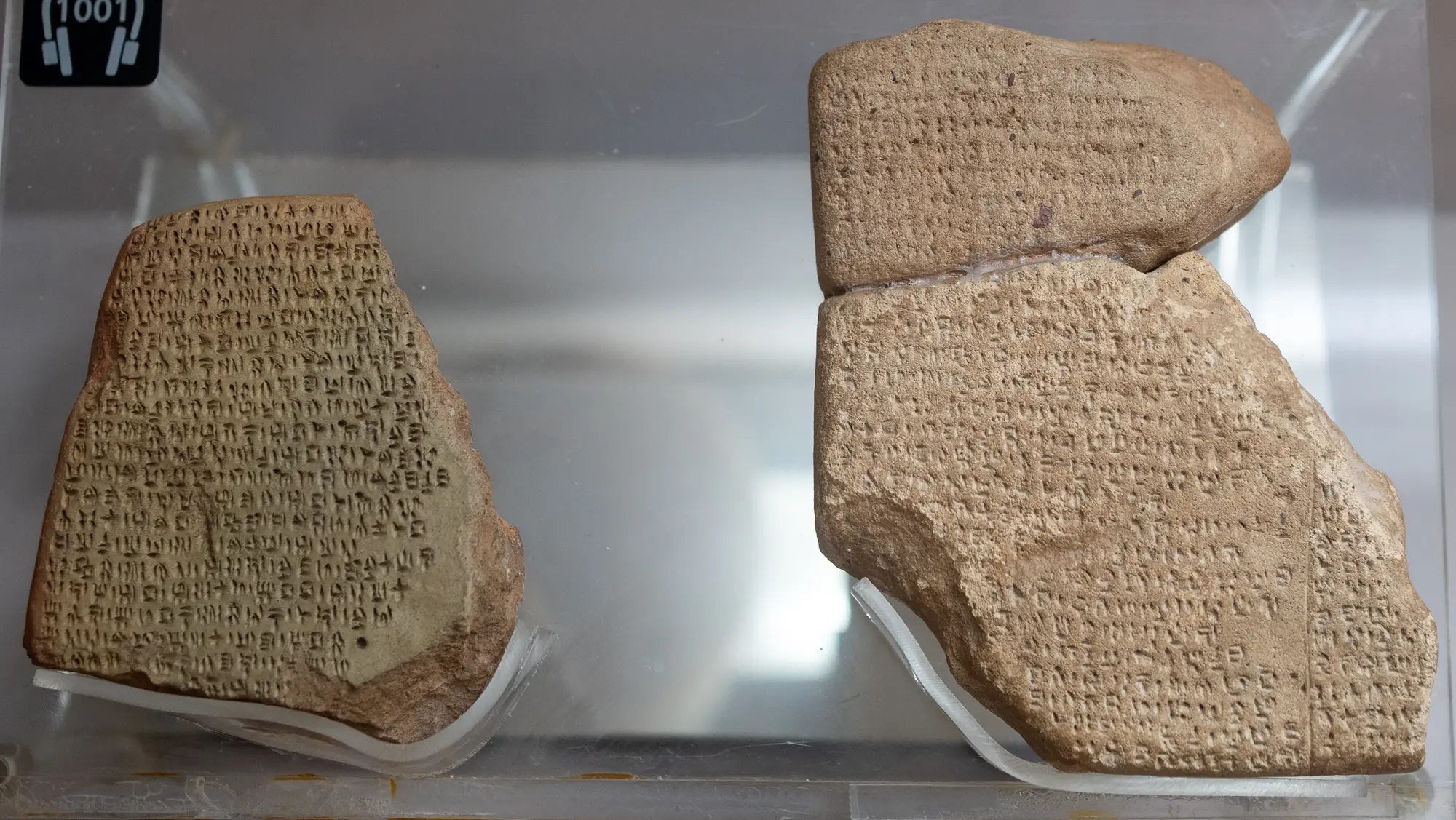
Cypro-Minoan signs and marks were already known at Pyla on local and imported things: Mycenaean and Cretan pots, Canaanite jars and metal objects. The two tablet fragments that Kanta found in 2012, in the excavations she directed with Vassos Karageorghis, are the strongest sign of writing at the site. They have had only a short preliminary report so far, and the authors stress that any comparison waits on their full edition. Every other Cypro-Minoan tablet found on the island comes from Enkomi, and the authors set the Pyla pair beside its three long tablets, one of them joined from two fragments. Those run continuously in signs a couple of millimetres high, and the authors think them more likely narrative than accounts. The signs on the Pyla tablets are larger and less evenly spaced, though the tablets share the thick edge of the Enkomi ones, and one of them has faint ruled lines like those on an Enkomi fragment now in the Louvre. The two Pyla tablets are on show in the Larnaca District Museum.
The storage side of the paper builds on Porta's earlier work on Pyla's pithoi. At centres such as Kalavasos-Ayios Dhimitrios and Alassa, large storerooms sit inside administrative buildings; at Eirimi-Pitharka and Analiondas they go with farm production. At Pyla, by contrast, storage was spread through the settlement in middle-sized groups, which the authors link to its brief life and possibly sudden end in the Crisis Years at the close of the 13th century BCE. A few of Pyla's many pithoi bear Cypro-Minoan signs or potmarks.
For the authors, the tablets, the marked pots and the metal objects together show that people at Pyla met writing in many settings. In their words, "exposure to literacy was broad, extensive and multi-layered". Further study of Complex 5F and its finds is under way.
Original source
On ancientcyprus.com
More in Research
- Men on bronze stands and cylinder seals show the elite ideal of Late Bronze Age Cyprus, paper argues
- Farm soil near Soloi in Cilicia held about 1,000 fragments of jars that look Cypriot
- Five Hala Sultan Tekke tombs held Mycenaean pots, Mittani-style seals and lead fishing lures
- 22 girls in a Phoenician account tablet from Kition took part in a substitution rite, study argues
- Doctorate gathers the scattered finds of Idalion's Aphrodite/Astarte sanctuary in one catalogue