
Research·News
Five Hala Sultan Tekke tombs held Mycenaean pots, Mittani-style seals and lead fishing lures
The Swedish team's 2025 report counts at least 50 people in three of the tombs near Larnaca and describes painted clay that may come from a coffin-like structure.



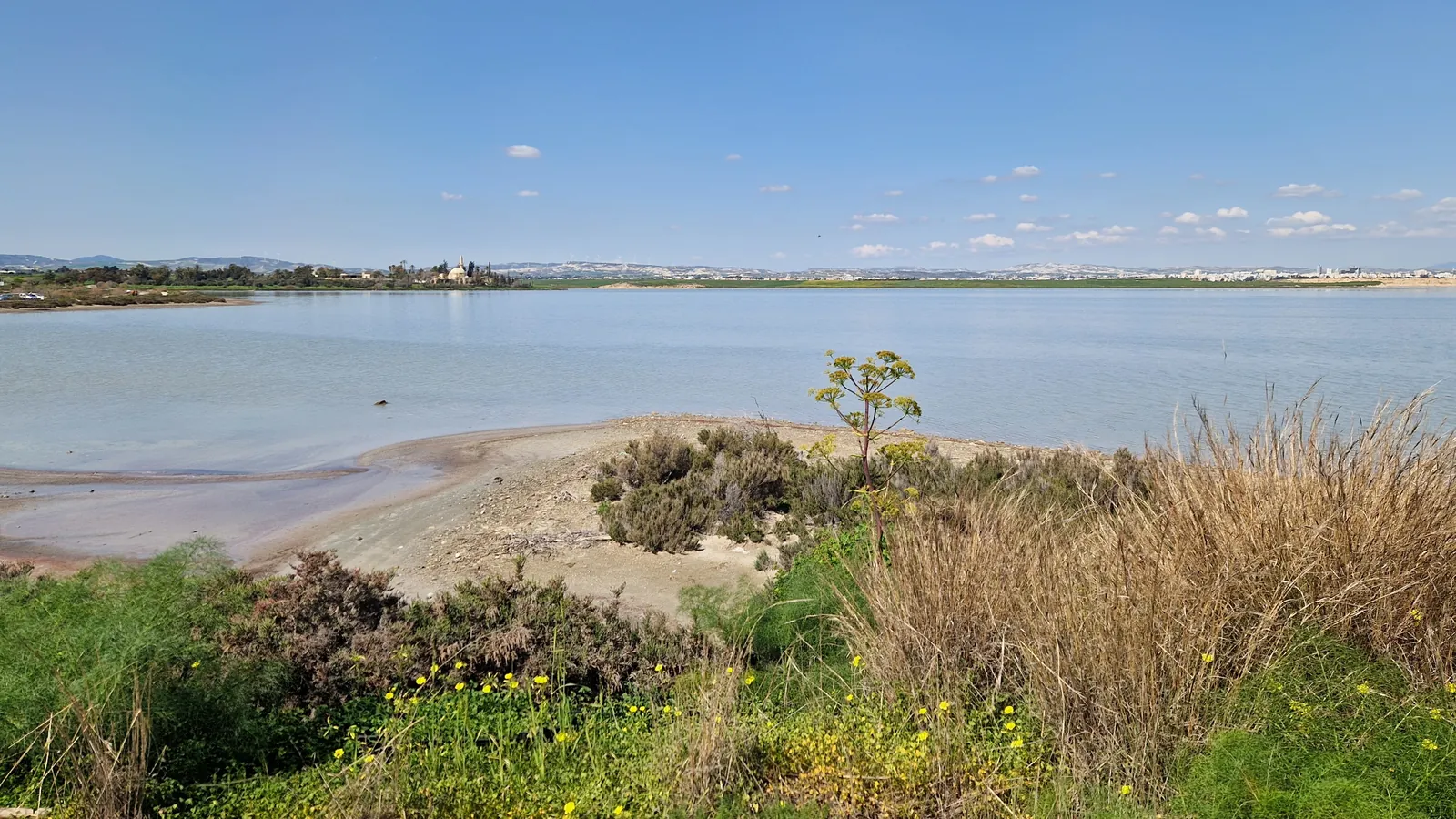
Five chamber tombs dug in 2025 in the cemetery of Late Bronze Age Hala Sultan Tekke, beside the Larnaca Salt Lake, were used mainly in the 14th century BCE and held Cypriot and Mycenaean pottery, seals in the Mittanian style, Egyptian calcite and glass, and four lead fishing lures. Peter M. Fischer of the University of Gothenburg, Rainer Feldbacher and nine colleagues set out the season in a preliminary report published on 19 November in Opuscula, the annual of the Swedish Institutes at Athens and Rome.
The Department of Antiquities announced the season in January, and our earlier report followed two of the tombs and their amber and lapis lazuli. The paper goes tomb by tomb, layer by layer, with the object counts, the dates of each burial layer and the first results on the skeletons.
Five tombs on one plan
The season, the New Swedish Cyprus Expedition's 16th, finished Tombs ZZ, AB East and AB West, opened in 2024, and began two more, AC and AE. All five are figure-eight tombs: two rounded chambers cut into the marl, with a pillar of natural soil left standing on each side of the narrow passage between them. Magnetometer readings from 2017, matching scatters of sherds that ploughing had brought to the surface, led the team to them; radar was of little use, because the clay soil stops its signal within about half a metre.
The authors date the group to Late Cypriot II(A–)B, which they equate with Late Helladic IIIA1–2 on the Greek mainland. Area A, the cemetery just east of the town, has no buildings, and the authors stress that an extramural cemetery is unusual in Late Bronze Age Cyprus, where chamber tombs more often lay inside the towns.
Seals, a resized ring and fishing gear in Tomb ZZ
Tomb ZZ, 4.75 m by 3 m, yielded 159 virtually complete objects, 108 of them from the eastern chamber, and the remains of at least 23 people. In its lowest layer lay a small cylinder seal of white paste cut with a net pattern and two fish. Teresa Bürge finds its closest parallels across the Mittanian sphere, at Alalakh, Ugarit and Nuzi, from the mid-16th century BCE until at least the close of the 15th; unless it was an heirloom, the authors argue, the tomb's first burials go back to about 1400 BCE at the latest. A second cylinder seal, of haematite, is in the Mittani Common Style.
A gold ring of Egyptian make from the western chamber carries a scaraboid, possibly of enstatite, engraved with a four-petalled rosette and four uraei, the royal cobras. Fischer notes a stretched wire on one side, a sign that the ring was enlarged for a bigger finger, and reads it as a possible heirloom.
The upper layers held arrowheads of bronze and of stone (the stone ones perhaps for shooting birds), seven ivory points the team takes for projectiles, and the four boat-shaped lead lures, pierced at both ends. The best preserved weighs 125 g; one of 153 g came from City Quarter 4 in the town. The authors suggest that some of the dead were fishermen or seafarers, and put the tomb's use at 50 to 100 years.
Two tombs joined by one passage
Tombs AB East and AB West share a horizontal passage 2 m long, reached by a short shaft from the surface that two dressed slabs partly blocked and marked. A reused stone anchor closed the door of the eastern tomb. The team counts 92 objects and at least 13 people in AB East, and 71 objects and at least 14 people in AB West, and suggests that the two served one family or social group in the second half of the 14th century BCE.
AB East produced the seated bird-faced figurine of Base Ring ware found in 2024 under an upturned skull, which the authors call unique: it mixes the bird-faced type with the seated normal-faced type, and is the first seated figurine of its kind recorded in place in a sealed layer. The same tomb held a Cypriot stamp seal with a palm tree on one face and probably a griffin on the other, at least four children of about two, Mycenaean miniatures the team reads as toys, and the complete skeleton of a grouper beside one of the dead.
In AB West lay an articulated skeleton of a 15- to 17-year-old, possibly female, buried with an Egyptian calcite juglet, an ivory distaff, a gold diadem and a silver ring on one toe. The same layer gave a pomegranate-shaped glass pendant, also Egyptian. The oldest person in that tomb was well over 60.
The octopus krater, an owl rattle and painted clay
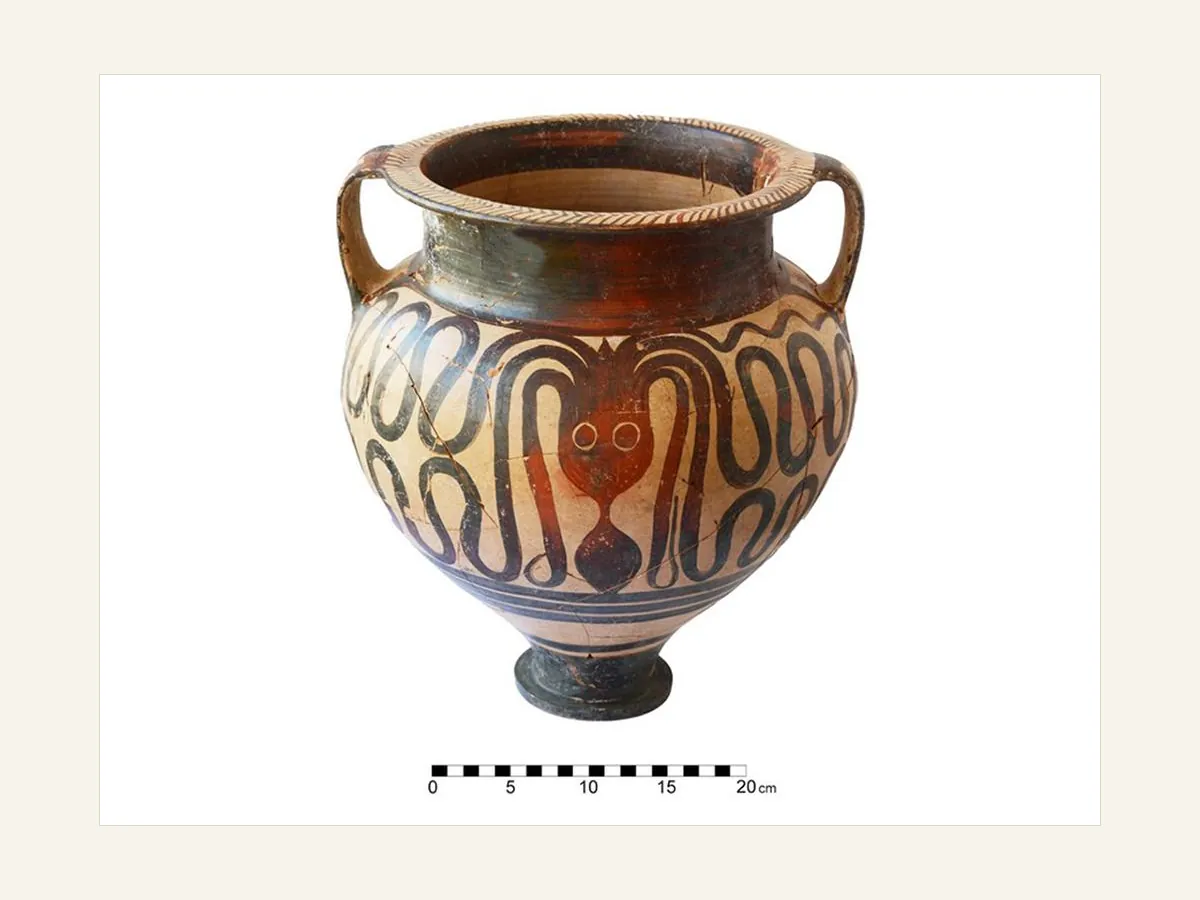
Tomb AC, dug in May and June 2025, held 71 objects. At the top of the burials in its eastern chamber lay a complete large Mycenaean krater painted with two octopuses, which the authors date to the second half of the 14th century BCE and set beside a similar krater from Tomb XX. The western chamber gave a painted Anatolian chalice, rare at the site and outside the usual range of Red Lustrous Wheel-made ware there, and a rattle decorated with a modelled bird, perhaps an owl. Two juglets about 2 m north of the tomb may have been offerings. The authors think AC was in use for perhaps two generations, the shortest of the tombs dug in recent years.
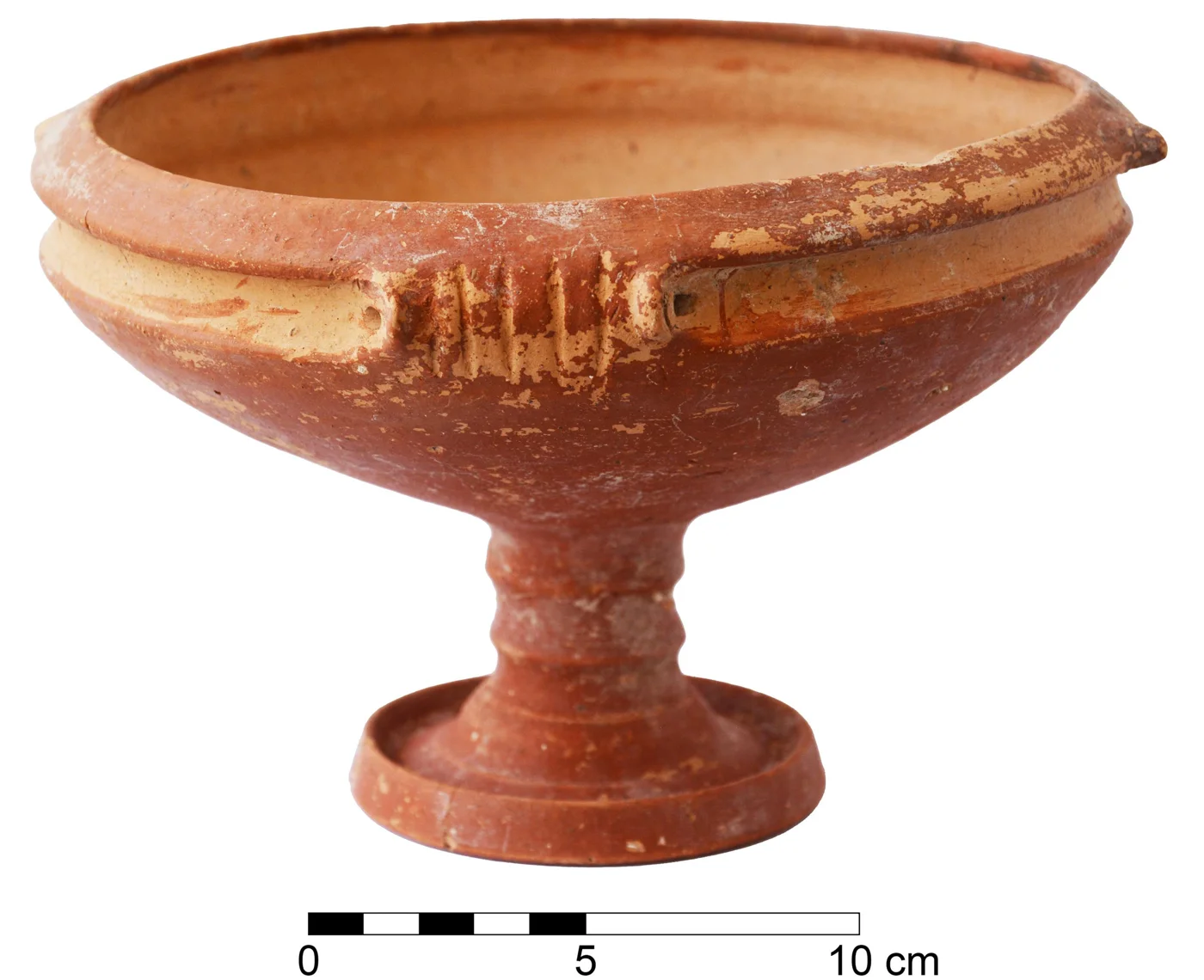
Tomb AE, larger than the other figure-eight tombs and due to be finished in 2026, has so far given 78 objects, 51 of them Cypriot vessels and 13 Mycenaean, with an Egyptian calcite jug and beads of gold, faience and carnelian. A ring of stones about 1 m across lay in the fill of its southern chamber, and its latest burials were untouched by looters. Fragments of smoothed clay 2 to 3 cm thick, painted on both faces, also came from it. A team from The Cyprus Institute, Sorin Hermon among them, found red and yellow ochre on them, which rules out shrouds coloured with organic purple dye, and what may be fibre imprints. The authors suggest a small internal dividing wall or an open, painted, coffin-like structure, which, to their knowledge, would be a feature not recorded before in Late Bronze Age Cypriot tombs.
The bones and what remains to do
The bioarchaeologists Kirsi O. Lorentz and Yuko Miyauchi report on ZZ and the two AB tombs only; the bones from AC and AE will come later. Their counts are minimums based on whole skeletons and separate skulls, and work on the mixed bones goes on. Salt groundwater and sea spray have left much of the bone in poor condition. In ZZ, rainwater seeping in over the winter of 2024–25 moved what was left, so that no articulated skeleton or separate skull could be lifted in 2025.
The team says fuller analyses and final interpretations will follow in later publications. Citing the years passing since burial, modern activity and polluted rainwater from Larnaca's international airport nearby, the authors call for the cemetery's remaining tombs to be located, excavated and recorded.
Original source
On ancientcyprus.com
More in Research
- 22 girls in a Phoenician account tablet from Kition took part in a substitution rite, study argues
- Doctorate gathers the scattered finds of Idalion's Aphrodite/Astarte sanctuary in one catalogue
- Mazotos desalination pipes should wait for an antiquities survey, Ecologists leader argues
- Architects map the 19 khans that survive inside the walls of Nicosia
- Akrotiri was once an island off Cyprus, and its salt lake an arm of the sea, NASA says