
Fieldwork·News
Conservation begins at Morphou's Panagia tou Mnasi, a medieval church looted and burnt after 1974
The bicommunal Technical Committee on Cultural Heritage has begun EU co-funded work on the vaulted chapel, among the last remains of the medieval village of Mnasi.



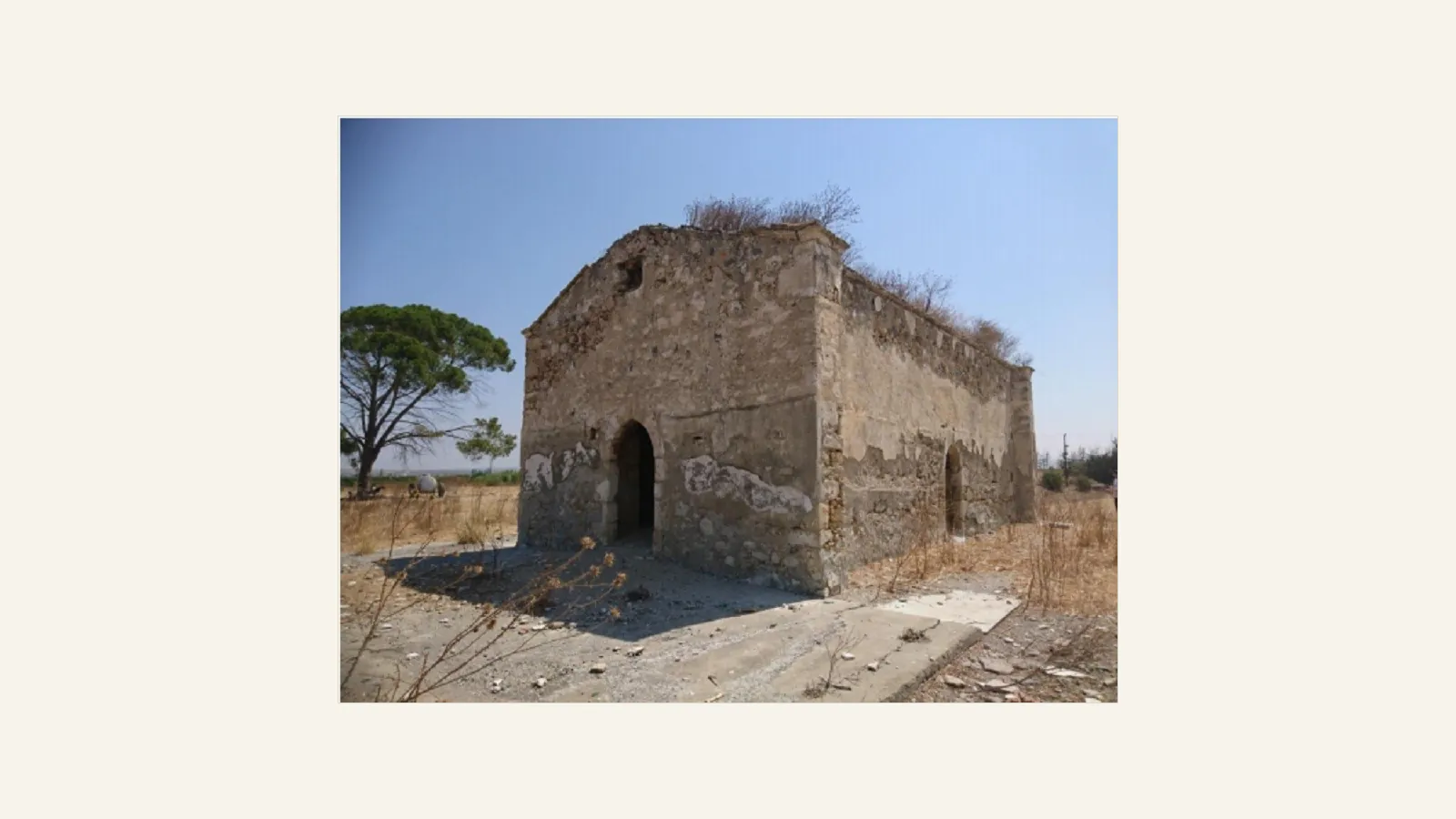
Conservation work has started on the church of Panagia tou Mnasi, a small vaulted chapel in Morphou (Güzelyurt), in the north-west of Cyprus. Sotos Ktoris, Greek Cypriot co-chair of the bicommunal Technical Committee on Cultural Heritage, announced the start of the project on Monday 23 November. According to Ktoris, the European Union co-funds the work and the United Nations Development Programme (UNDP) is carrying it out.
Morphou lies in the part of Cyprus illegally occupied by Turkey since the 1974 invasion.
A church left from a vanished village
According to Ktoris, the church is one of the few remains of Mnasi, a medieval settlement that appears in records from the Frankish period and is marked on early maps of the island. In Cypriot history the Frankish period is commonly taken as the centuries of the Lusignan kingdom, 1192 to 1489. Over the following centuries the village emptied and disappeared, and the chapel is what survives of it on the ground. Ktoris described it as an important record of the history of the area and of the people who once lived there.
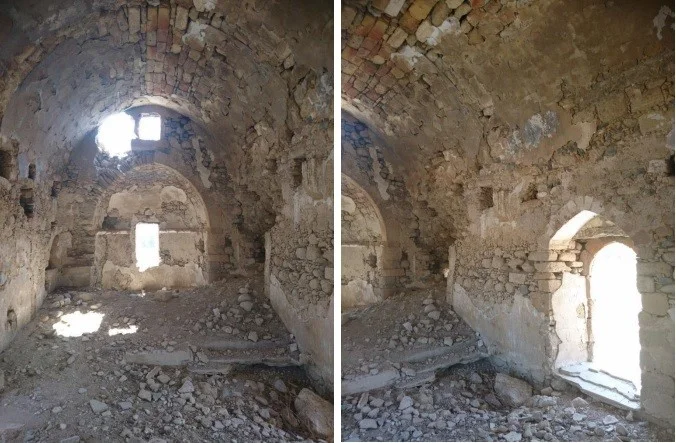
The building is a single-nave church roofed with a barrel vault (one long room under a continuous stone arch). The scope of the repairs, their timetable and their cost have not been published.
Looted, burnt and partly collapsed
The church's condition was described six years ago by the Municipality of Morphou and the Holy Metropolis of Morphou, which in September 2020 launched a joint appeal to pay for its restoration. In their account, the church was stripped of everything inside it after 1974, then damaged by fire, and parts of it fell in. A medieval cemetery around the church had been robbed and wrecked as well. The two bodies warned that the building would collapse entirely without urgent action, estimated the cost of a restoration at €82,000, and opened a donations account under permit N.P. 11/2020 from 1 September 2020 to 1 March 2021.
Part of the Committee's ninth phase
The church is listed for conservation works in the ninth phase of the EU-funded programme for monuments of great importance to the island's two communities, which UNDP lists as running from 2024 to 2030 with the European Commission as donor. Other churches listed for conservation in the same phase include Panagia Katokopia in Katokopia and Panagia Chrysopolitissa in Kyrenia.
The Committee was set up under an agreement reached by the leaders of the two communities on 21 March 2008, under United Nations auspices, and UNDP has administered its conservation works since 2010. This autumn Ktoris has announced completed works at Panagia Apsinthiotissa and Agios Prokopios, at the monastery of Apostolos Varnavas near Salamis and at two churches in Karavas. In November he said the Committee had helped conserve, protect or restore more than 210 monuments since 2008.
Mnasi and the archaeology of Morphou
The name Mnasi had already appeared in the archaeology of Morphou before 1974. In his report on the finds of 1962, Vassos Karageorghis published a bronze lamp from Morphou, "lieu-dit Mnasi" (the locality of Mnasi), registered in the Cyprus Museum as 1962/VIII-27/1. It has a raised base, a long nozzle flat on top with an incised palmette, a handle ending in a palmette, knobbed rosettes on its sides and the hinge of a lost lid. He dated it to the Hellenistic or Roman period; it is 6.5 cm high and 19.7 cm long [1, p. 336].
The wider Morphou plain is better known. Porphyrios Dikaios cut a trial trench at the Bronze Age mound of Toumba tou Skourou in 1936, and Emily T. Vermeule led the Harvard and Museum of Fine Arts, Boston expedition there from 1971 to 1973, which found plastered basins read as a potters' quarter, inscribed pithoi (large storage jars) and six tombs. In 1960 Kyriakos Nicolaou excavated a three-roomed building near the Ovgos river that Karageorghis took to be a sanctuary of Aphrodite.
The town's own church history goes deep. In 1958, before a new floor was laid in the church of Ayios Mamas, the Department of Antiquities made soundings beneath it and found the remains of at least three earlier churches under the present building.
Map of Cyprus
Morphou and its bay
- Ground above 200, 500, 1,000 m
Sites on this map
- 1Morphou-Toumba tou Skourou
- 2Soli
Original sources
On ancientcyprus.com
References
- 1.Karageorghis, V. (1963). Chronique des fouilles et découvertes archéologiques à Chypre en 1962. Bulletin de correspondance hellénique 87(1), 325–387.
More in Fieldwork
- A project to unify Larnaca's archaeological sites gets 12 diggers
- Foundations in Alexandria's royal quarter could be Ptolemy IV's royal tomb, Egyptian experts say
- Graz survey logs a new Roman and medieval site at Amargeti and identifies a Cleopatra VII coin
- 250 kg of pottery shows how Pyla-Vigla's garrison cooked and drank before c. 294 BCE
- Bicommunal committee has worked on 210 monuments, from Apostolos Andreas to Othello's Tower