
Fieldwork·News
Hexagonal church of Apsinthiotissa and Byzantine Agios Prokopios restored in the occupied north
The bicommunal Technical Committee on Cultural Heritage handed over the two churches on 23 October; it has now restored more than 210 religious monuments across Cyprus.



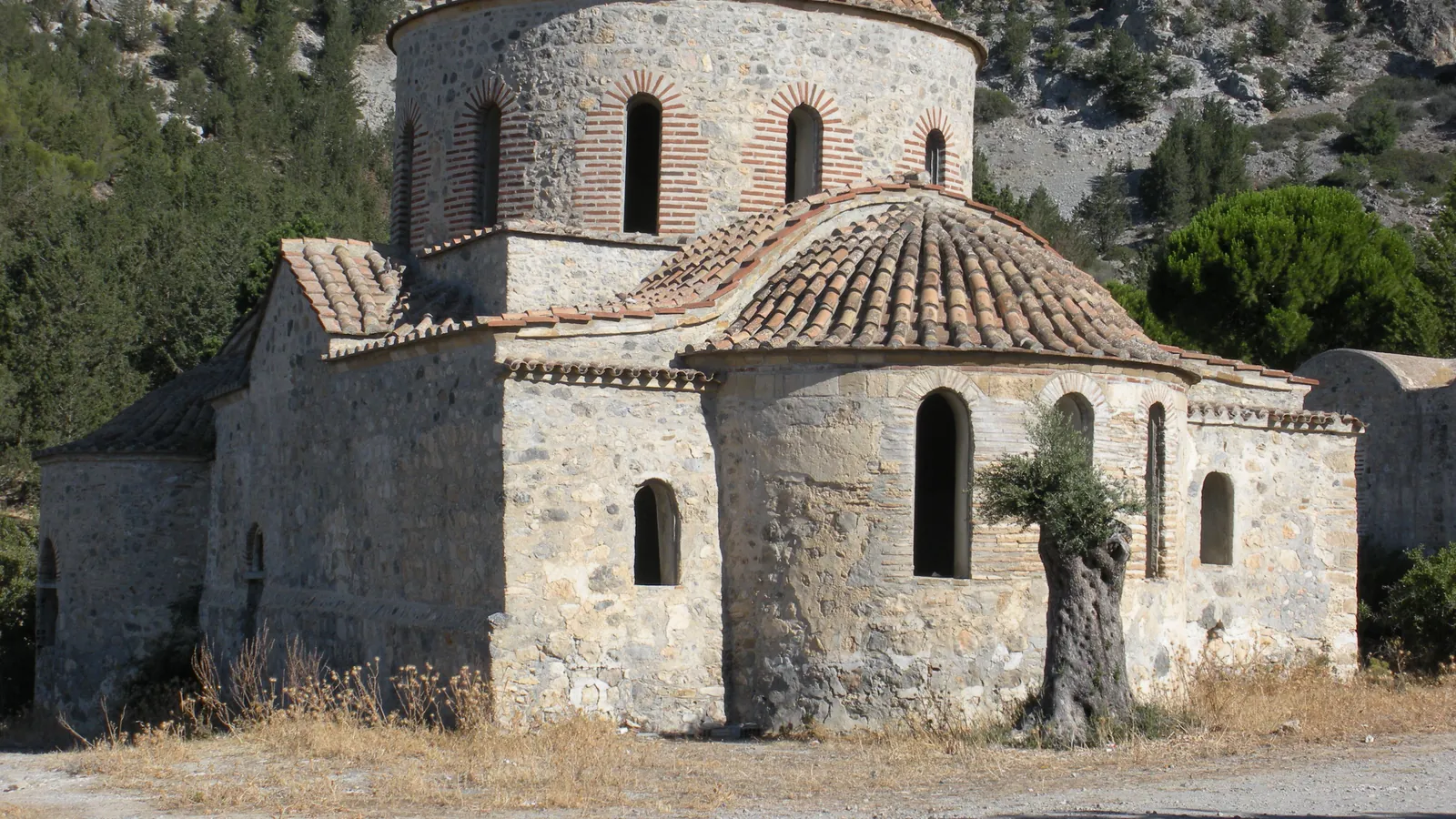
Two Byzantine churches in the part of Cyprus occupied by Turkey since the 1974 invasion were handed over after restoration on Friday 23 October 2026: the monastery of Panagia Apsinthiotissa on the southern slopes of Pentadaktylos above Sychari, and the church of Agios Prokopios in the village of Sygkrasi. The bicommunal Technical Committee on Cultural Heritage carried out the work with the United Nations Development Programme (UNDP) as its implementing agency, and the European Commission paid for it.
The monastery above Sychari
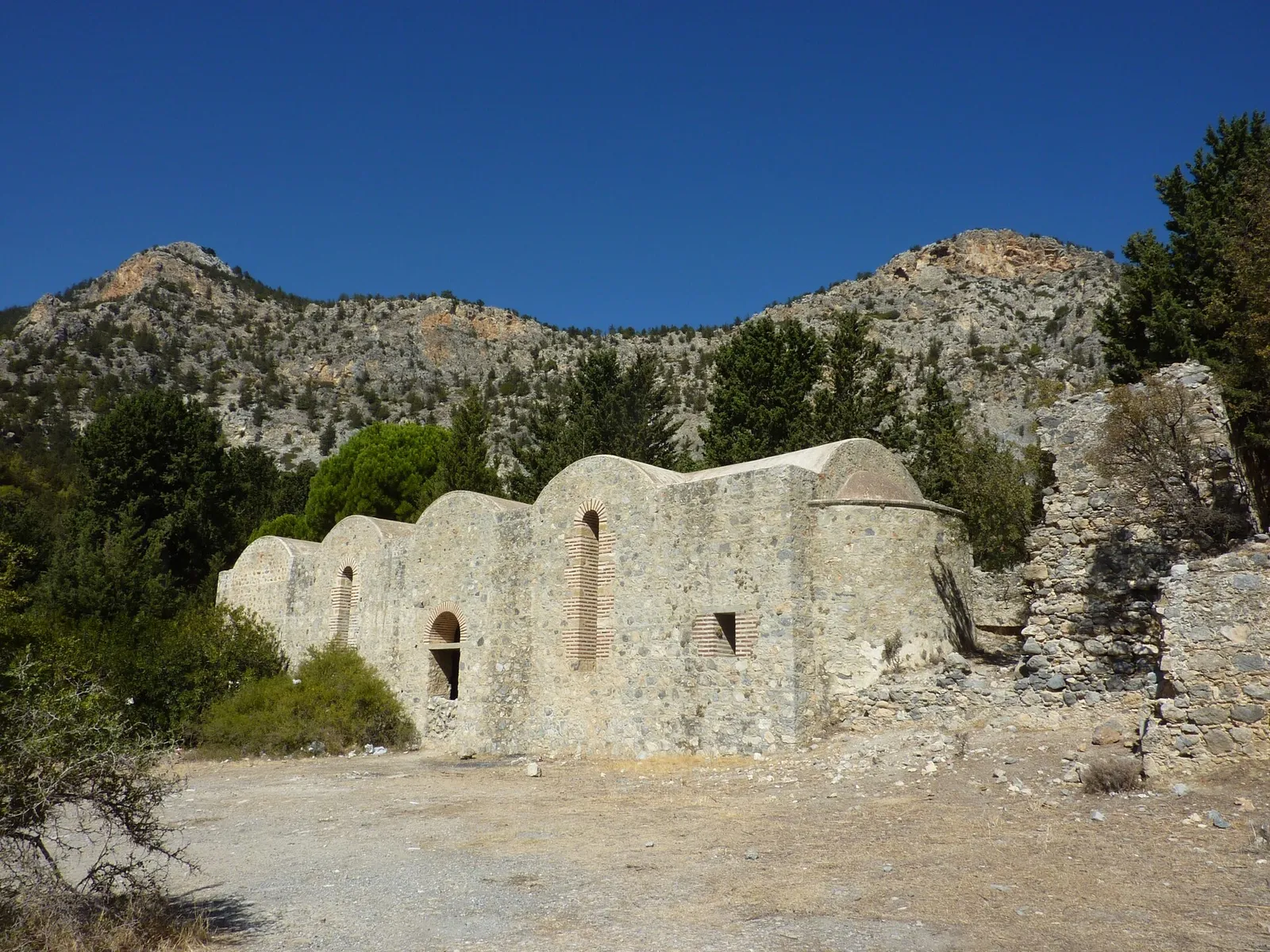
Andreas Foulias, a Byzantinist who sits on the Committee, dates the church to the 12th century. It is of the inscribed-cross hexagonal type, which he describes as rare in Cyprus, under a large dome; a Gothic narthex was added on the west in the 15th century. He also singled out the refectory, the hall where the monks took their meals, as the only Byzantine monastic refectory left on the island, with some of its wall paintings in place.
By local tradition the icon of the Virgin was found in a cave overgrown with wormwood, apsithia in Greek, which gave the monastery its name. Hakan Gokberk, the Turkish Cypriot engineer and architect who supervised the restoration for UNDP, said the building had decayed badly after years of abandonment. He said he is now working on two further projects in the Agios Amvrosios area, one of them the monastery of Panagia Melandryna.
Agios Prokopios at Sygkrasi
Agios Prokopios, the patron church of Sygkrasi, stands on the Mesaoria plain in the district of Famagusta, about 40 km east of the monastery and, in the historian D. M. Metcalf's description, a couple of miles west of Trikomo [1, p. 226]. Foulias compares features of its architecture with Agios Lazaros in Larnaca and the church of the Apostolos Varnavas monastery. According to Cem Taneri, the UNDP conservation specialist on the project, work ran from December 2024 to September 2025; with basic maintenance, he said, the church should stay sound for at least 50 more years. A wall painting inside was conserved, and the cemetery beside the church was cleared and crosses set on its graves.
The church is best known for a long painted inscription high on an arch in its south-western corner. Metcalf reads its 35 damaged lines in uncial script as funerary: the writer seems to have survived a shipwreck in which a cargo was lost, settled at Sygkrasi and married a woman named Irene, whose death the text records. It places these events under the emperors Basil II and Constantine VIII, during the revolt of Bardas Skleros (976–979), which makes it a rare piece of evidence from the late 10th century [1, p. 226].
Map of Cyprus
Apsinthiotissa and Sygkrasi
- Ground above 200, 500, 1,000 m
Sites on this map
- 1Sychari-Apsinthiotissa Monastery (approx.)
- 2Sygkrasis (approx.)
Where the two churches sit in Byzantine Cyprus
Metcalf counts Agios Prokopios among the earliest domed cross-in-square churches recognised on the island, second after Agios Antonios at Kellia, with a starting date for the building in the late 10th century; the fifteen or more others of the type are of the 11th and 12th centuries [1, pp. 267–268]. He groups Apsinthiotissa with the dome-hall churches at and near Koutsovendis on the same range, possibly quite early, and treats its hexagon as a variant of the domed octagon, a plan found in only five Cypriot churches, for which St John at Koutsovendis may have been the model [1, p. 268].
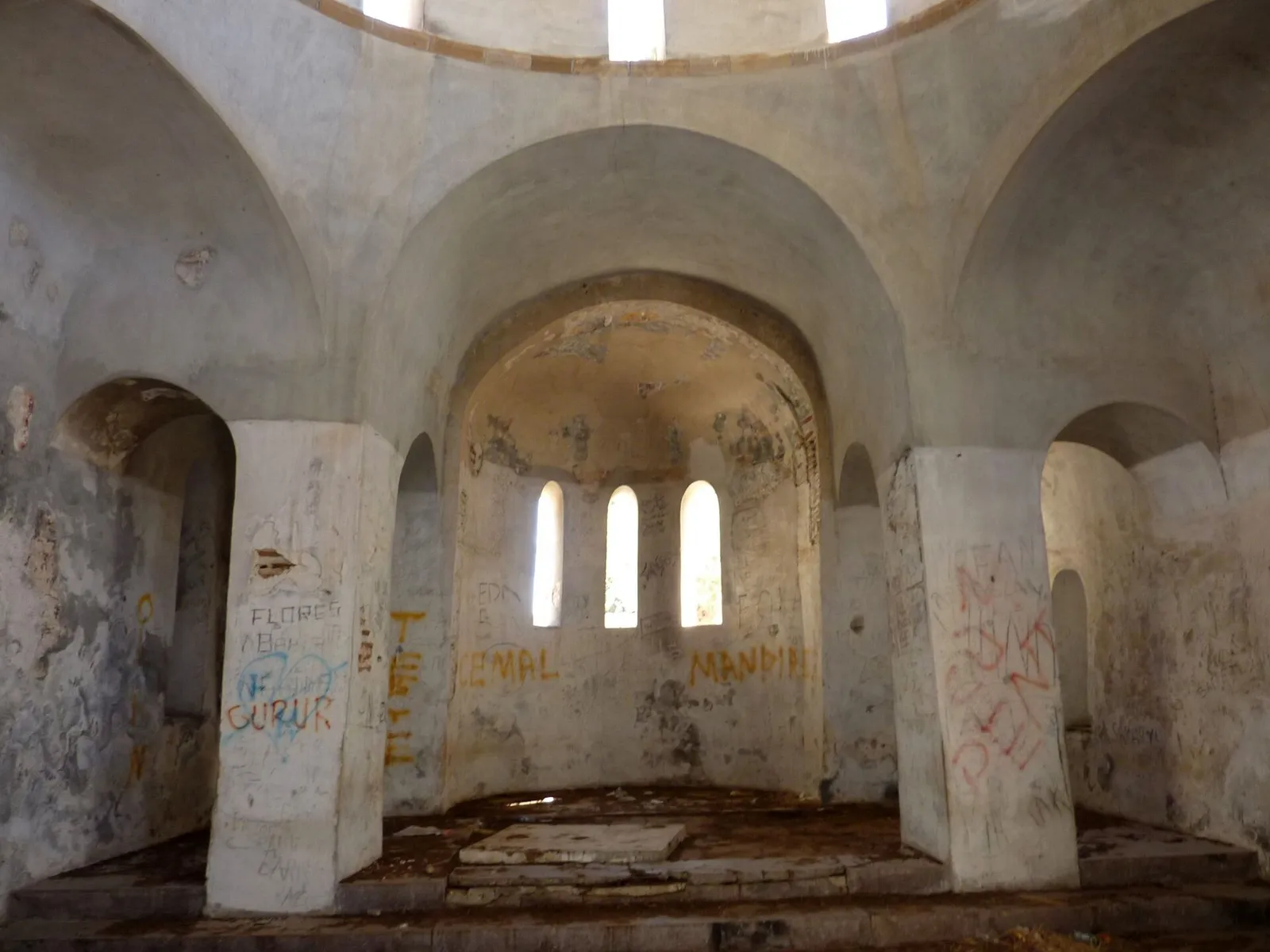
Writing in 2006 on the state of churches in the occupied areas, the art historian Charalampos Chotzakoglou noted that paintings had once covered the whole interior of the monastery church, its katholikon, and the western porch [2, p. 121]. The Virgin in benediction between two angels survived in the apse, with late 12th-century fragments on the narthex and porch and traces under the white plaster and cement then on the walls; fragments on the east side of the refectory showed that it was painted too. At Agios Prokopios he recorded, besides the inscription, a mounted saint on the north wall of the nave, probably Prokopios, and standing saints in the south aisle from the medieval decoration, and a second mounted Prokopios of the 19th century on the south wall [2, p. 123].
Earlier restoration and losses
The monastery had been restored once before. In 1963 Athanasios Papageorghiou made soundings for the Department of Antiquities while the buildings were consolidated, and defined the refectory, which had been painted and later turned into monks' cells. When the work resumed in December 1964 the refectory was cleared, exposing part of a Turkish bath with its hypocaust, together with the foundations of the west-wing cells and a row of semi-underground rooms. The restoration of the church was completed in 1965.
Some of the paintings were later cut from the walls. Chotzakoglou reported that detached fragments from Apsinthiotissa had turned up among the holdings of Aydin Dikmen and were held by the German authorities [2, p. 122]. Two fragments of the 12th-century paintings, which an anonymous Canadian collector had bought on the illicit market and then donated, were shown at the House of Lords in London in December 2014 [3, p. 133], one episode in the wider looting of the occupied north.
The Committee's programme
Set up in 2008, the Committee says it has now restored more than 210 religious monuments of every faith across the island, large and small. Ali Tuncay, its Turkish Cypriot co-chair, said work had been completed, was under way or had started at about 70 cemeteries. He and the Greek Cypriot co-chair, Sotos Ktoris, called the restorations a project of cooperation and confidence-building between the two communities. "For me, it is a school," said Tuncay (our translation).
The monastery's feast falls on 21 November. Filippos Filippou, the community leader of Sychari, said that requests to hold a service there are still being refused.
On ancientcyprus.com
References
- 1.Metcalf, D. M. (2009). Byzantine Cyprus 491–1191. Texts and Studies in the History of Cyprus LXII. Nicosia: Cyprus Research Centre.
- 2.Chotzakoglou, C. G. (2006). Christian Mosaics and Mural Paintings in the Occupied Areas of Cyprus: Preliminary Report on their Condition. In J. Chrysostomides (ed.), Sweet Land: Lectures on the History and Culture of Cyprus, 101–164. Camberley: Porphyrogenitus.
- 3.Hadjisavvas, S. (2015). Perishing Heritage: The Case of the Occupied Part of Cyprus. Journal of Eastern Mediterranean Archaeology and Heritage Studies 3(2), 128–140.
More in Fieldwork
- Bronze Age Pyla-Kokkinokremos, beside a British firing range, will not open to visitors
- Kourion's mosaic conservators are to get two prefabricated buildings in a €113,447 tender
- 167 Roman granite column fragments trace the main streets of ancient Paphos
- Idalion excavators fixed points by RTK, 3D-scanned a statue fragment and logged finds in OCHRE
- Rescue dig in the Nile Delta finds a 1.6-metre head of Ramesses II