
Research·In brief
Akrotiri was once an island off Cyprus, and its salt lake an arm of the sea, NASA says
A Landsat 8 image shows the Akrotiri Peninsula tied to Cyprus by two bars of sand and gravel; the eastern one shut off its lagoon between about 4,000 and 2,000 years ago.



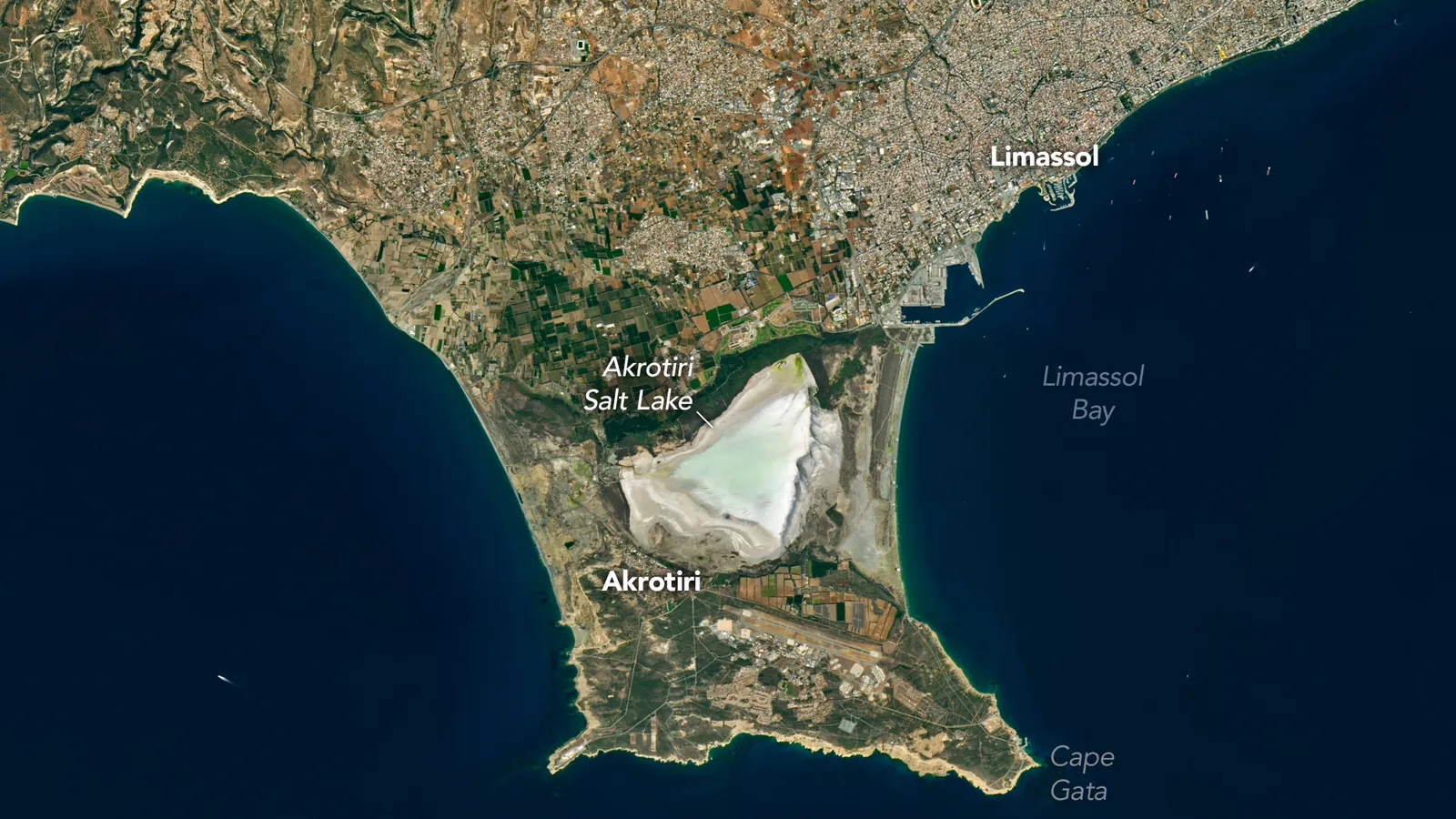
The Akrotiri Peninsula, below Limassol, began as a separate island, and its salt lake was once open water of the Mediterranean, NASA's Earth Observatory explained on 5 November in its Image of the Day. Its Landsat 8 picture of 10 October 2026 shows autumn rains starting to fill the lake.
In NASA's account, the smaller island rose from Miocene chalk, limestone and marl. Sediment from rivers and the sea then built two tombolos, bars of sand and gravel. The western one, laid down by the Kouris, the river below Kourion, came first, about 50,000 years ago.
The eastern bar is far younger. From cores drilled through the lake bed, Miltiadis Polidorou and colleagues trace an open bay turning into a semi-closed lagoon about 4,000 years ago and into a restricted lagoon about 2,000 years ago, as a spit from the north-east lengthened into a narrow tombolo. Storms could still drive the sea over it; the bar widened into a full barrier over the last two millennia [1, pp. 13–14].
People used the peninsula long before. The rock shelter of Akrotiri-Aetokremnos, dug by Alan H. Simmons from 1987, holds traces of visits some 12,000 years old beside the bones of dwarf hippos; the shore near it at that time is uncertain. At Dreamer's Bay, a survey led by John R. Leonard from 1989 recorded a breakwater and warehouse foundations of a port he dated from Hellenistic to Late Roman times.
Original sources
On ancientcyprus.com
References
- 1.Polidorou, M., Evelpidou, N., Tsourou, T., Drinia, H., Salomon, F., & Blue, L. (2021). Observations on palaeogeographical evolution of Akrotiri Salt Lake, Lemesos, Cyprus. Geosciences, 11(8), 321. https://doi.org/10.3390/geosciences11080321
More in Research
- Archbishopric seeks permit to refit Phaneromeni school for University of Cyprus archaeologists
- Saint Therapon's underground tomb in Larnaca lies on a petrol station's plot
- The Peleset Sea People came from the Anatolian coast facing Cyprus, new paper argues
- Famagusta's Lusignan walls have lost far more stone to sea salt than its Venetian walls, study finds
- Network study of 299,171 km of Roman roads puts Byzantium and Antioch ahead of Rome