
Fieldwork·In brief
Ochre working, a hearth and a second round building found at Chalcolithic Erimi-Pamboula
The University of Athens dug at the 5,000-year-old village near Limassol from 25 June to 24 July 2026, close to where Porphyrios Dikaios excavated in 1933–35.



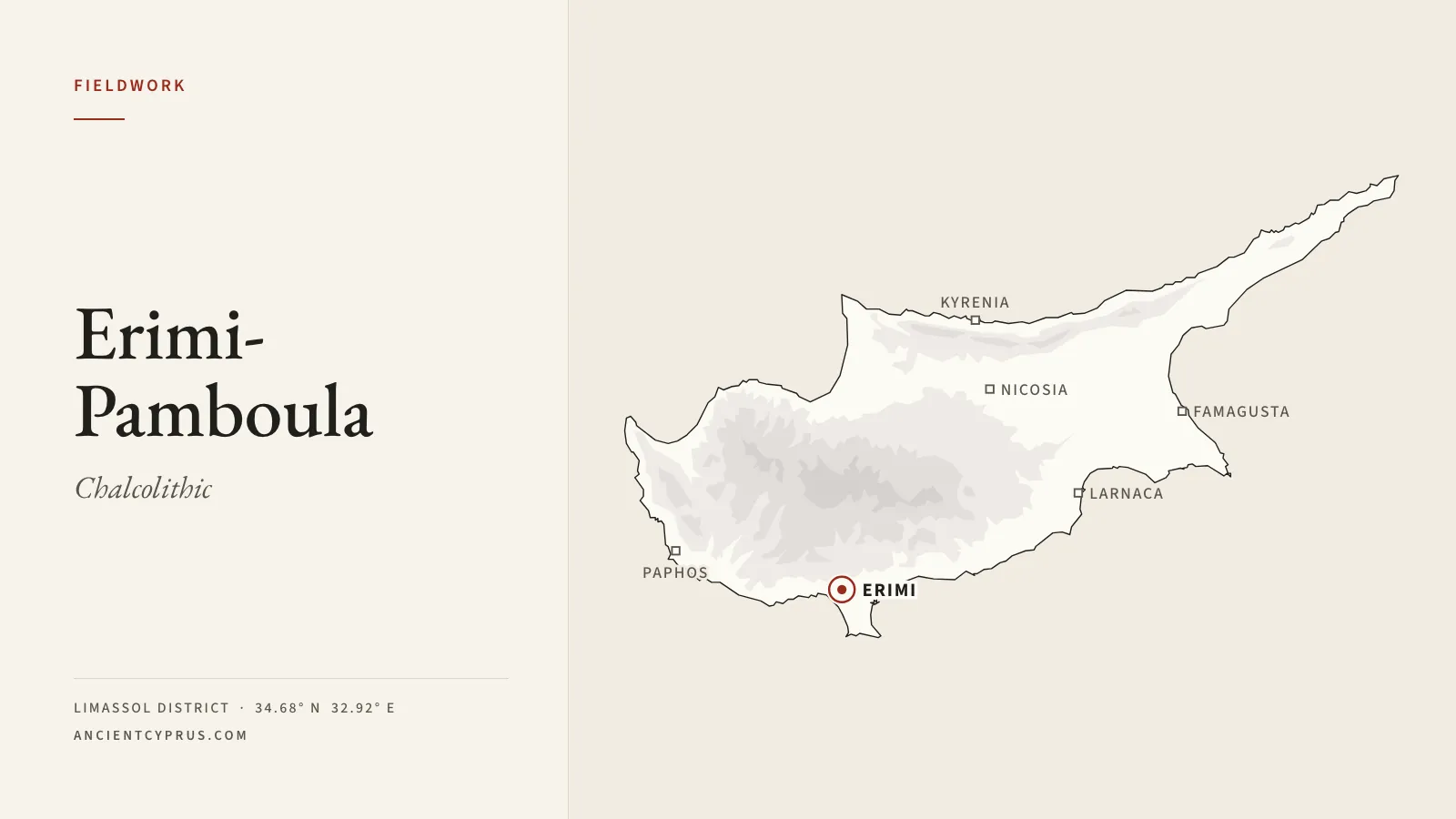
A team from the National and Kapodistrian University of Athens has nearly completed the plan of a round building at Erimi-Pamboula, the Chalcolithic village in the Kouris valley that is the type site of the Erimi culture. The Department of Antiquities announced the results on 21 October. The project's second season, directed by Professor Giorgos Vavouranakis, ran from 25 June to 24 July 2026.
Part of the building had been excavated in earlier work. A straight wall exposed in 2025 proved to belong to a second round building next to it. Between them the team opened a wide outdoor area with traces of floor, a hearth of mud plaster, a stone mortar, a rubbish pit and clear evidence that ochre, a mineral pigment, was processed there.
Red-on-White is the commonest pottery among the many sherds. The other finds include ground and chipped stone tools, picrolite pebbles, beads and half-worked pieces, lumps of clay, sea shells and animal bones, most of them from deer. According to the Department, the pottery again places the life of the village between the Middle Chalcolithic and the beginning of the Late Chalcolithic, 3500–2900/2800 BCE.
The new trenches lie near the area Porphyrios Dikaios excavated in 1933–35. Specialists at the Cyprus Institute, the University of Siena and the Greek Ministry of Culture are now studying the plant, human and animal remains, the chipped stone and the clay from the buildings.
On ancientcyprus.com
More in Fieldwork
- Idalion excavators fixed points by RTK, 3D-scanned a statue fragment and logged finds in OCHRE
- Rescue dig in the Nile Delta finds a 1.6-metre head of Ramesses II
- Late Bronze Age tower found on the city wall of Palaepaphos, near Aphrodite's sanctuary
- Swedish team reaches Hala Sultan Tekke's earliest town levels, of the 17th–15th centuries BCE
- Jars off Turkey's Kekova may come from the oldest known shipwreck, up to 4,700 years old