
Fieldwork·In brief
Rescue dig in the Nile Delta finds a 1.6-metre head of Ramesses II
The head, found at Behbeit el-Hagar after a villager reported an inscribed stone, may come from a statue about 8.5 m tall; a second colossus lay nearby.



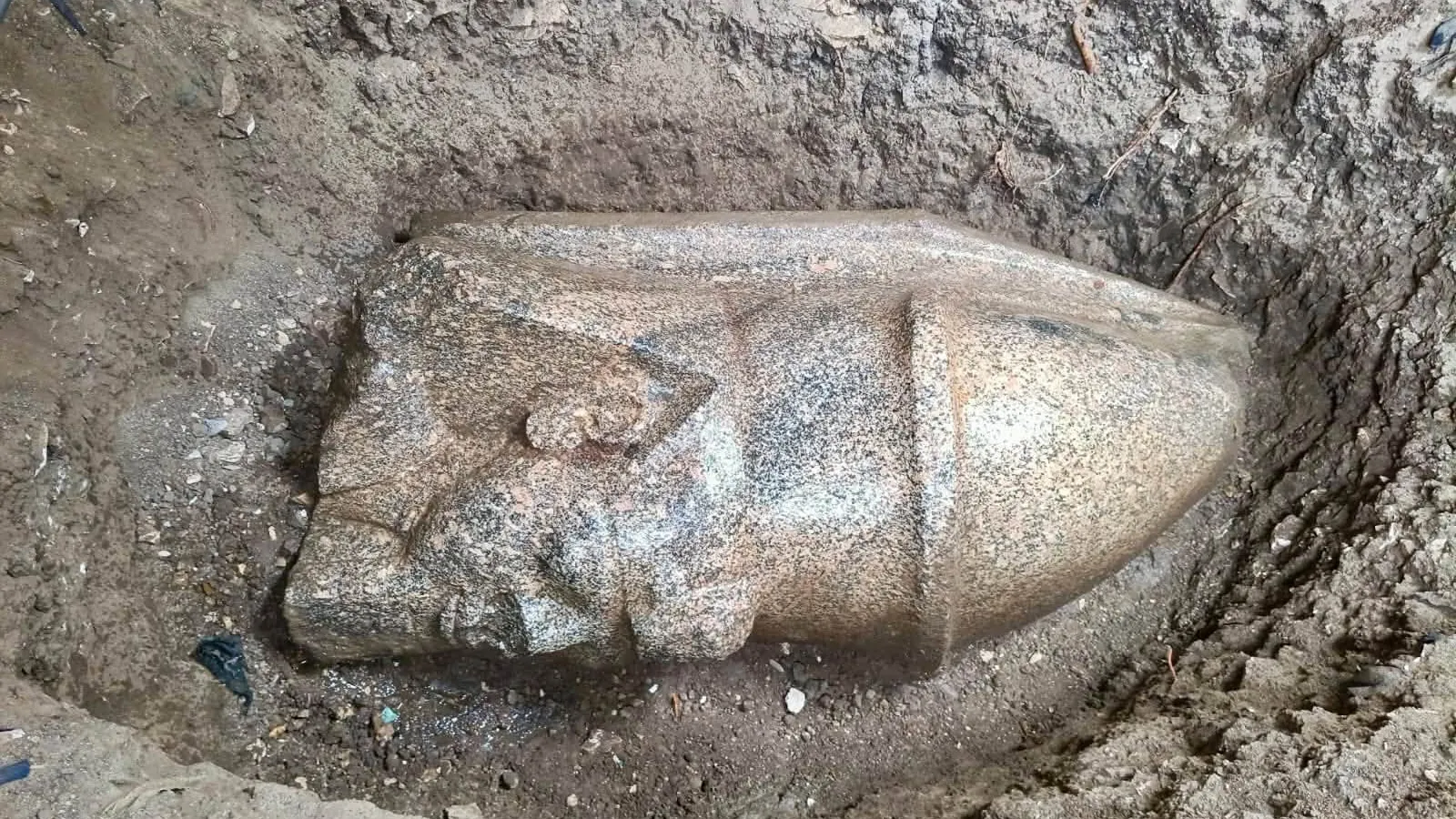
Egypt's Ministry of Tourism and Antiquities announced on 13 October 2026 that rescue excavations at Behbeit el-Hagar, a Nile Delta village in Gharbia Governorate, had found two colossal royal statues. A resident had reported an inscribed stone in front of his house.
The first is a head of Ramesses II about 1.60 m high, in the double crown of Upper and Lower Egypt. From its size, Hisham El-Leithy, secretary-general of the Supreme Council of Antiquities, puts the whole figure with its base at about 8.5 m. A fragment of its back pillar gives his Horus name, Ka-nakht Meri-Maat. The second statue, 2.40 m long without its legs and base, wears the nemes headcloth; its head, with features close to the first, survives, and El-Leithy considers it probably Ramesses II too. A metre to its north lay a 1.30 m pink granite block inscribed with two royal titles, sa-Ra (Son of Ra) and nesu-bity (King of Upper and Lower Egypt). Work continues at the site, known for its Isis temple.
Ramesses II reigned in the 13th century BCE, in Cyprus's Late Bronze Age. An Egyptian procession text of his reign lists "the mountain of Alasa", the Egyptian name for Alashiya, among lands sending silver and bronze [1]. At Hala Sultan Tekke a gold-mounted scarab with his name came from Tomb 23, and a steatite seal with his throne name from a town courtyard [2, pp. 199–201].
Original source
- Egyptian Ministry of Tourism and Antiquities (X)
Official release·
On ancientcyprus.com
- Periods
- Late Bronze Age
References
- 1.Knapp, A. B. (2008). Prehistoric and Protohistoric Cyprus: Identity, Insularity, and Connectivity. Oxford: Oxford University Press.
- 2.Steel, L. (2013). Materiality and Consumption in the Bronze Age Mediterranean. New York and Abingdon: Routledge.
More in Fieldwork
- Idalion excavators fixed points by RTK, 3D-scanned a statue fragment and logged finds in OCHRE
- Late Bronze Age tower found on the city wall of Palaepaphos, near Aphrodite's sanctuary
- Ochre working, a hearth and a second round building found at Chalcolithic Erimi-Pamboula
- Swedish team reaches Hala Sultan Tekke's earliest town levels, of the 17th–15th centuries BCE
- Jars off Turkey's Kekova may come from the oldest known shipwreck, up to 4,700 years old