
Heritage crime·Roundup
This Week in Cypriot Archaeology: 22–28 June 2026
A clay four-horse chariot of about 600 BCE, found in a French online sale, is returned to Cyprus, and a French mission ends its season on the walls of Nea Paphos.



The Department of Antiquities announced the return from France of a clay four-horse chariot of about 600 BCE, found by its officers in an online sale in May 2025. In Paphos, the Avignon University mission ended its season on Fabrika hill and the Hellenistic city wall, where it identified a tower cut into the bedrock.
Map of Cyprus
This week's fieldwork
- Ground above 200, 500, 1,000 m
Sites on this map
- 1Fabrika hill, Paphos (approx.)
Heritage crime
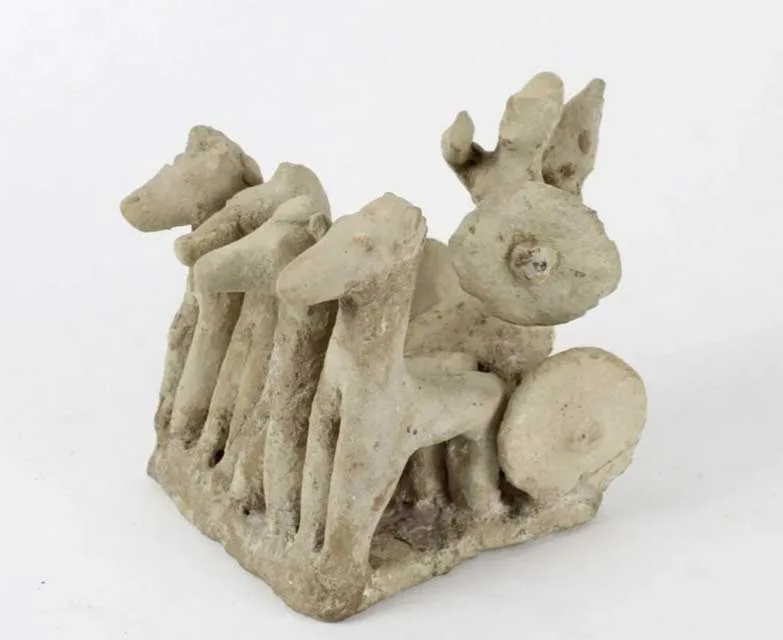
A terracotta quadriga, a chariot drawn by four horses, was handed over at the Cypriot embassy in Paris on 18 June, the Department of Antiquities announced on 22 June. Department officers who monitor online trafficking in Cypriot antiquities had found it in a French internet auction on 14 May 2025. A year of joint work followed between the Department, the Cyprus Police, Interpol and the French Ministry of Culture, in particular its Regional Archaeology Service of Occitanie, after which the holder decided to return the piece.
The Department dates the model to Cypro-Archaic I–II, about 600 BCE. Two figures in conical helmets stand in its rectangular box, a charioteer and a warrior with a shield. Votive quadrigas like it have been excavated in both sanctuaries and tombs. Cypriot chariot groups in clay begin in the Cypro-Archaic period, and most belong to the 7th and 6th centuries BCE. It is the second such model returned within a year: on 4 August 2025 the FBI handed a terracotta quadriga and a Bichrome flask to the Cypriot embassy in Washington, given up by a New York gallery. Both cases come from the Department's monitoring of sales abroad, in which a Cypriot lot is spotted, the sale is challenged and the holder usually hands the object to a Cypriot embassy.
Fieldwork
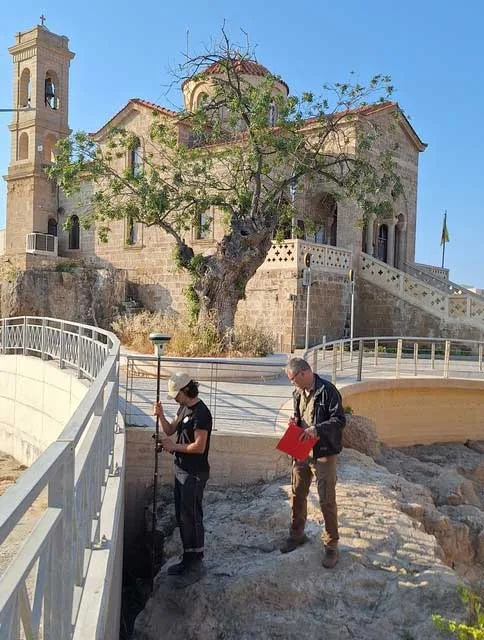
On 24 June the Department announced the end of this year's season of the Avignon University mission, led by Professor Claire Balandier with the French School of Athens. The team works on Fabrika hill and around the walls of Nea Paphos, aiming at a full study of the Hellenistic fortifications through new trenches and the publication of the Department's own excavations on the wall in the 1980s.
The mission also finished chamber 5, one of 15 underground spaces it has recorded on the hill (our brief). It began as an early Hellenistic quarry and seems to have been meant as a tomb, but was abandoned before use, probably once the city wall took in the hill in the second half of the 2nd century BCE. It was partly filled in Roman times and used as a church in the early Byzantine period.
Below the church of Agios Agapitikos, a large square cut in the bedrock was identified as the north-east tower of the Hellenistic wall. Some of its facing blocks were taken by the Romans; others went into the base of the church, which stands inside the tower's remains. At the north-west gate, a trench in the south tower reached its last floor, partly preserved. On the hilltop, the rock-cut water channel found in 2025 proved to run further south-east. A severe crack in the western wall of the underground water gallery, probably caused by an earthquake, let water escape from the top, and the team says this is why the gallery was given up. At right angles to that wall stands another, about 3 metres high and possibly Roman or even Hellenistic, whose foundation the team plans to reach next year.
Original sources
- Department of Antiquities, Cyprus: Repatriation of a Cypriot antiquity from the Republic of France
Official release·
- Department of Antiquities, Cyprus: Completion of the excavation by the French Archaeological Mission of Avignon University on Fabrika Hill in Kato Pafos
Official release·
- Archaeology Wiki: Repatriation of a Cypriot antiquity from the Republic of France
Press·
- Cyprus Mail: Ancient Cypriot artefact returned from France
Press·
- Cyprus Mail: Ancient Paphos defences revealed in new excavation at Fabrika Hill
Press·
On ancientcyprus.com
- Sites
- Nea Paphos
- People
- Claire Balandier
- Periods
- Cypro-Archaic, Hellenistic, Roman
More in Heritage crime
- Two 14th-century Asinou icons stolen after the 1974 invasion return to Cyprus from Britain
- This Week in Cypriot Archaeology: 29 June–5 July 2026
- Cyprus brings home 25 antiquities spotted in online auctions abroad, among them a chariot model
- This Week in Cypriot Archaeology: 8–14 June 2026
- Greece returns 48 Cypriot antiquities an ambassador acquired on the island in the 1960s and 1970s