
Museums·Roundup
This Week in Cypriot Archaeology: 13–19 April 2026
The Idol of Pomos, the Chalcolithic picrolite figure on Cyprus's 1- and 2-euro coins, wears a small copy of itself at its neck. It is on show in the Cyprus Museum.



The week's story is a single object: the Idol of Pomos, a cross-shaped stone figure of about 3000 BCE that Cyprus has carried on its 1- and 2-euro coins since 2008, profiled on 13 April by Live Science.
Map of Cyprus
This week's story
- Found
- Displayed
- Ground above 200, 500, 1,000 m
Sites on this map
- 1Pomos (approx.)
- 2Cyprus Museum, Nicosia (approx.)
Museums
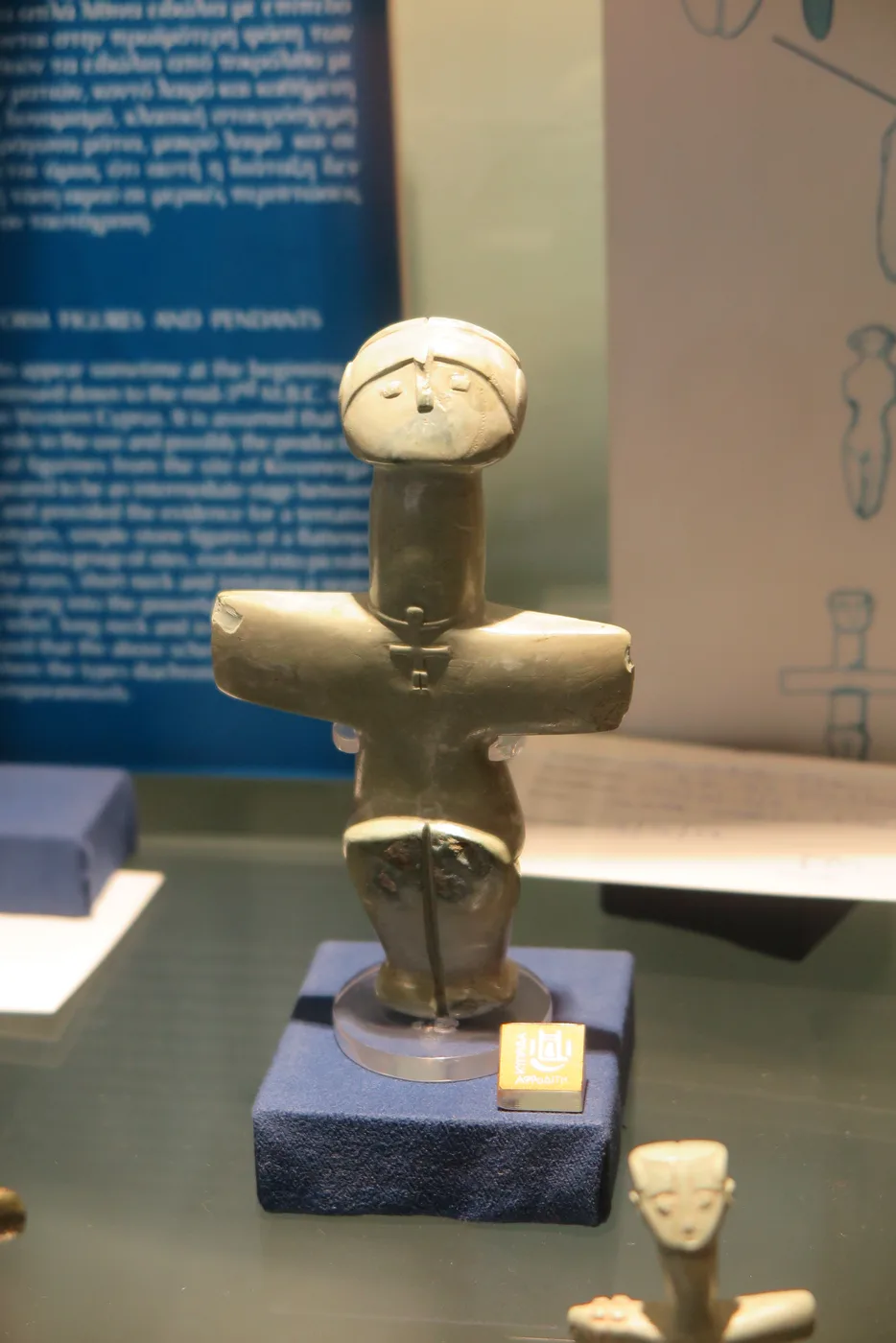
Porphyrios Dikaios found the figure in the early 1930s while excavating in the village of Pomos, on the island's northern coast. It is 15.3 cm tall, carved from picrolite, a soft green stone native to the Troodos mountains, and belongs to the Chalcolithic, the Copper Age of Cyprus. Today it is displayed in the Cyprus Museum in Nicosia.
Unlike most cruciform figurines, whose faces are left blank, this one has eyes, a nose and a cap with ears. A miniature cruciform hangs at its neck; only a few cruciforms, in picrolite or clay, are shown wearing such a pendant [1, p. 152]. Edgar Peltenburg suggested that figures of this kind might be birth charms or fertility deities. Joan R. Mertens, who wrote on the Pomos figure as an assistant curator at the Metropolitan Museum of Art, thought its long neck and flat back meant it may once have been hung up.
Later work has questioned both the goddess and the birth readings. Diane Bolger and Elizabeth Goring rejected the Mother Goddess interpretation, and Bleda Düring points out that picrolite cruciforms rarely show the figure's sex and stand with their legs pressed together, unlike the clay birthing figures from Kissonerga-Mosphilia [1, pp. 151–152].
Original source
On ancientcyprus.com
- Institutions
- Cyprus Museum
- Periods
- Chalcolithic
References
- 1.Düring, B. S. (2023). Reconsidering Cruciform Figurines of Chalcolithic Cyprus. In B. S. Düring & P. M. M. G. Akkermans (Eds.), Style and Society in the Prehistory of West Asia (pp. 149–156). Leiden: Sidestone Press.
More in Museums
- Nicosia's €144m new Cyprus Museum will not be delivered before 2028, MPs told
- Aphrodite at the Ashmolean: Cyprus lends a sanctuary figurine of a woman giving birth
- This Week in Cypriot Archaeology: 12–18 October 2026
- This Week in Cypriot Archaeology: 5–11 October 2026
- This Week in Cypriot Archaeology: 21–27 September 2026