
Events·Roundup
This Week in Cypriot Archaeology: 23 February–1 March 2026
Cyprus and Italy open a 120-object exhibition at Castel Sant'Angelo in Rome, and Peter M. Fischer publishes the gold diadems from Hala Sultan Tekke's tombs.



About 120 antiquities from Cyprus and Italy went on show at Castel Sant'Angelo in Rome on 27 February, in an exhibition opened by the two countries' presidents. Earlier in the week, a paper on gold diadems and mouth-pieces from the Late Bronze Age tombs of Hala Sultan Tekke came out in the Oxford Journal of Archaeology, and in Nicosia an exhibition on three women of the Venetian city opened in the old town hall on the D'Avila Bastion.
Map of Cyprus
This week's stories
- Events
- Research
- Ground above 200, 500, 1,000 m
Sites on this map
- 1Souskiou-Laona (approx.)
- 2Nicosia-D'Avila Bastion (approx.)
- 3Hala Sultan Tekke
Events
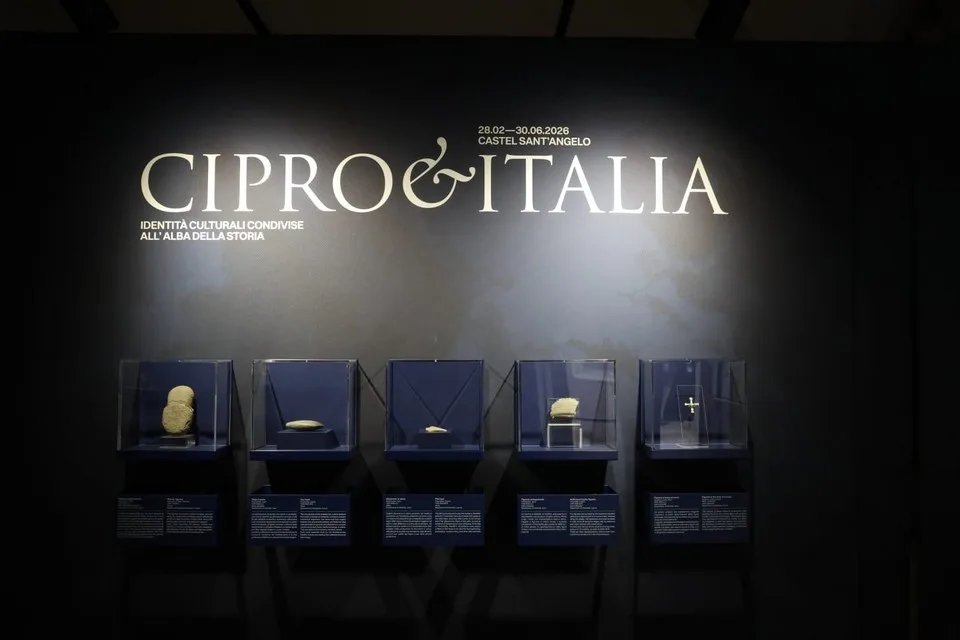
Nikos Christodoulides and Sergio Mattarella inaugurated "Cyprus and Italy: Shared Cultural Identities at the Dawn of History" on Friday 27 February, with the Deputy Minister of Culture, Vasiliki Kassianidou, among the guests. Curated by Anastasia Christophilopoulou, the show sets Cyprus beside Sicily and Sardinia across seven millennia, and the two culture ministries organised it for the cultural programme of Cyprus's 2026 presidency of the Council of the EU. It is open until 30 June 2026.
The Cypriot government singles out a copper oxhide ingot found at Serra Ilixi in Sardinia, made of Cypriot copper and dated c. 1500–1200 BCE. Other loans include a stone pendant with a cruciform figurine from the Chalcolithic site of Souskiou-Laona, excavated by an Edinburgh team, a bronze boat model (navicella) from Orroli in Sardinia, ivory combs from Frattesina in the Veneto and the Bisenzio cart from the National Etruscan Museum of Villa Giulia. The rooms are arranged by theme: everyday life, funerary ritual, art, mobility and technology.
In Nicosia, the Press and Information Office opened an exhibition on Mediaeval Nicosia on 27 February in the old town hall, which stands on the D'Avila Bastion of the Venetian walls. It follows the 82 years of Venetian rule, from 1489 to the fall of Famagusta in 1571, through three women: Elena Denores, whose husband Petros Synglitikos died defending the D'Avila bastion in 1570; Lucretia Lasse, enslaved for some twenty years after the city fell; and Katerina Flangi, who according to her father fought the Ottoman army in men's clothes and died in the fighting. Poems on them by the historian and poet Nasa Patapiou run through the rooms. Entry is free until 25 June, on Wednesdays and Fridays 4–9pm and at weekends 10am–1pm.
Research
The gold diadems and mouth-pieces found in eight Late Bronze Age tombs at Hala Sultan Tekke, seven of them chamber tombs and one a shaft tomb, all dated to the 15th–13th centuries BCE, are the subject of a paper by Peter M. Fischer of the University of Gothenburg, published online on 24 February and open access in the Oxford Journal of Archaeology (45.2, pp. 151–179). The New Swedish Cyprus Expedition excavated them in recent seasons; each chamber tomb held burials of several generations. Fischer classifies the ornaments by type, use and the age and sex of the dead buried with them, and argues that the results point to local Cypriot workshops with a regional style of their own, drawing on Minoan, Mycenaean, Egyptian and Near Eastern influences.
Museums
The Department of Antiquities announced on 26 February that the Cyprus Museum in Nicosia would close to visitors from 3pm on Thursday 5 March.
Original sources
- Gov.cy: The archaeological exhibition Cyprus and Italy: Shared Cultural Identities at the Dawn of History was inaugurated on Friday in Rome
Official release·
- Cultural Fusion in Late Bronze Age Goldwork: Diadems and Mouth-Pieces from Hala Sultan Tekke, Cyprus (Oxford Journal of Archaeology)
Paper·
- Finestre sull'Arte: In Rome, Castel Sant'Angelo dedicates exhibition to shared cultural identities between Italy and Cyprus
Press·
- Cyprus Mail: Mediaeval heroines of Cyprus come to life
Press·
- Gov.cy: The Cyprus Museum closed to the public on 5 March 2026
Official release·