
Archaic I
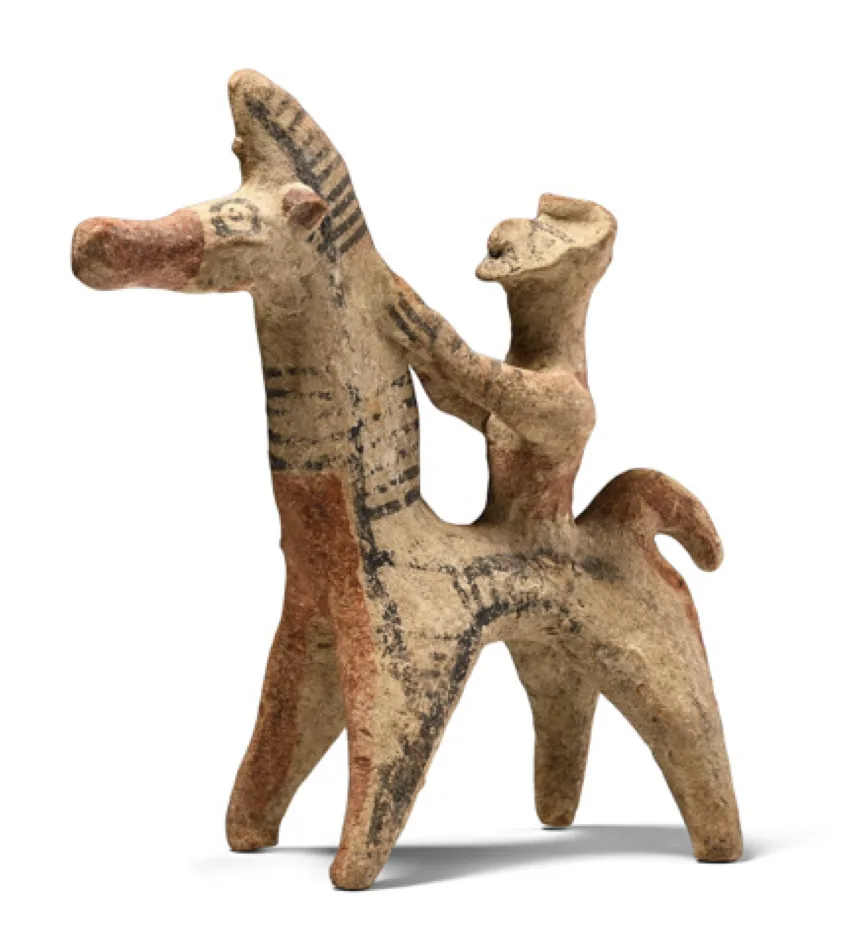
Handmade Horse and Rider, the Rider in a Flaring Cap
Cypro-Archaic I handmade terracotta horse and rider painted with black ladder bands and red, the rider seated near the rump in a flat-topped flaring cap.
Classification
- Object type
- Terracotta figurine
- Decoration techniques
- Painted, PaintedPainted in two colours
- Motifs
- Horse, Human figure, Bands and lines
- Material
- Clay
- Date
- 750 - 600 BC
- Place of production
- Cyprus
Collection
Alexis Drakopoulos
Identifiers
- Inventory no.
- STA-AR-019
Cypro-Archaic I, c. 750–600 BCE · Terracotta, pale buff slip with black and red paint · Handmade, solid
A horse and rider modelled by hand in pale buff clay. The horse is lean and upright, on four splayed, tapering legs. Its neck rises into a high, narrow crest that curves forward, edged with a ladder of short black strokes. The head projects forward into a thick cylindrical muzzle painted red; the eye is a painted circle with a central dot, and an applied pellet ear sits behind it. Black ladder bands ring the neck and run along the back and down the legs, and the forelegs and chest are washed red. A short tail rises from the rump and curls over, also red. The rider sits well back towards the rump, body upright, both arms stretched forward to grasp the mane. He wears a flat-topped cap that flares outward like a turban, his face carries faint painted details, and his body is washed red. Surface worn, with paint loss.
Commentary
This is a handmade Cypro-Archaic horse-and-rider figure of Karageorghis's Type II(i), the commonest male votive type of the period [1]. The Metropolitan Museum catalogue describes the horse and rider as "perhaps the most popular type of figurine" of Cypro-Archaic Cyprus, a subject tied to the horse-owning elite [2]. Such figures were dedicated chiefly in sanctuaries of male gods, with the sanctuary of Apollo Hylates at Kourion as the type-site [3], and were also placed in tombs. The body is built in the solid "snow-man" technique common to Cypro-Archaic handmade figures [4].
The long-legged horse, the high arched neck with its crest, the rider seated near the rump with both arms reaching forward, and the painted ladder ornament all belong to the larger Cypro-Archaic I figures of sub-type II(i)a, perhaps edging towards the transitional group II(i)b around 600 BCE [1]. Two Cesnola Collection figures in the Metropolitan Museum make close comparisons. 74.51.1768, said to be from Ormidhia, has a rider sitting near the rump and stretching his arms forward to the mane, wearing a knobbed headdress described as resembling a turban, on a horse with a long neck and high forelock; 74.51.1774, also said to be from Ormidhia, shows the ladder pattern along the body and legs [2]. Louvre AM 236, with red paint on the horse and on the rider's cap, is another close parallel in its painted scheme.
The rider's cap has been described in the trade as a Macedonian kausia and taken as a sign of northern Greek influence. It is the ordinary flat-topped, flaring headdress of Cypriot Archaic riders and needs no outside source. We know of no recorded find-spot for this figure, and the Ormidhia attributions of the Cesnola comparanda are themselves only reported.
References
- 1.Karageorghis, V. (1995) The Coroplastic Art of Ancient Cyprus IV: The Cypro-Archaic Period, Small Male Figurines. Nicosia: A.G. Leventis Foundation.
- 2.Karageorghis, V., Mertens, J.R. and Rose, M.E. (2004) Ancient Art from Cyprus: The Cesnola Collection in The Metropolitan Museum of Art. Terracottas. New York: The Metropolitan Museum of Art, p. 61 (cats. 98–99) and p. 257.
- 3.Young, J.H. and Young, S.H. (1955) Terracotta Figurines from Kourion in Cyprus. Philadelphia: University Museum, University of Pennsylvania.
- 4.Gjerstad, E. (1948) The Swedish Cyprus Expedition IV:2. The Cypro-Geometric, Cypro-Archaic and Cypro-Classical Periods. Stockholm: Swedish Cyprus Expedition, section on minor plastic (terracotta figures).
Corrections and additions
Do you know this object?
We are always looking for more of an object's history: who owned it, where it was sold or shown, and where it was published.
We would like to hear about
- Earlier owners, sales or exhibitions
- Publications that illustrate or mention it
- Where it is now, if it has moved
- Better photographs, or a close parallel
- A mistake in what we say about it
Messages are read by us alone and kept confidential, unless the law requires otherwise. Tell us if you would like to be thanked by name on the page.
Similar pieces
 Cypro-Geometric Terracotta Horse and RiderCyprus Museum, Jacksonville
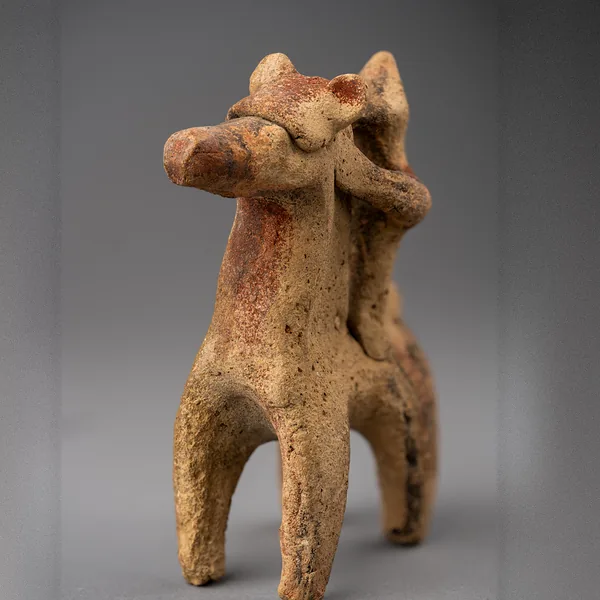 Horse and Rider Figurine with a Painted Star on the NeckDrakopoulos Collection
 Terracotta statuette of rider on horseMedelhavsmuseet (Museum of Mediterranean and Near Eastern Antiquities)
 Painted Horseman FigurineBritish Museum
 Terracotta Horse and Rider FigurineBritish Museum
 Terracotta rider on horse statuetteAmathus-Western Necropolis, SCE Tomb 11
 Terracotta Horse and Rider FigureBritish Museum
 Terracotta Horse RiderLarnaca Museum
 Cypro-Archaic Terracotta Horse and RiderCyprus Museum, Jacksonville
 Cypro-Archaic Terracotta Horse and RiderCyprus Museum, Jacksonville
 Horse and riderMetropolitan Museum of Art
 Rider on horseVienna Museum
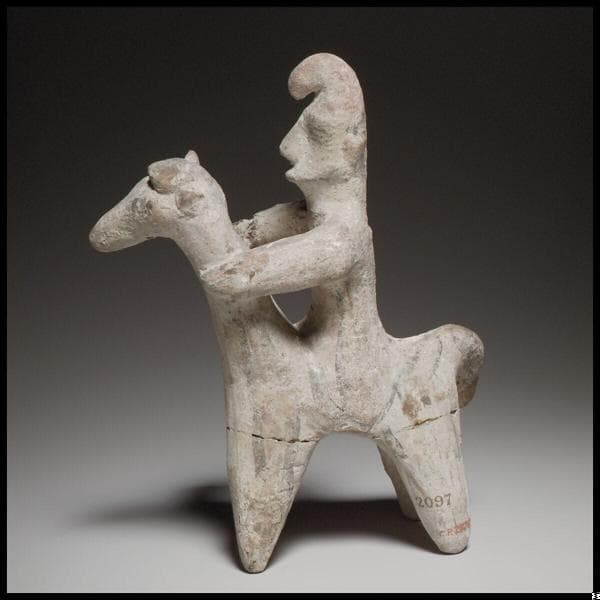 Horse and riderMetropolitan Museum of Art
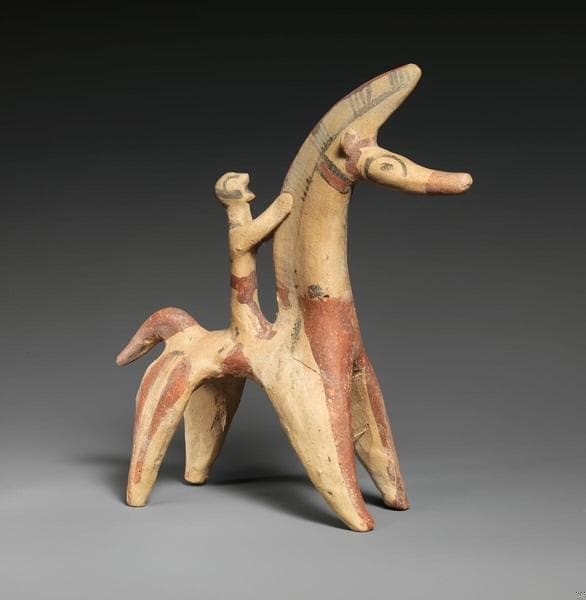 Terracotta horse and riderMetropolitan Museum of Art
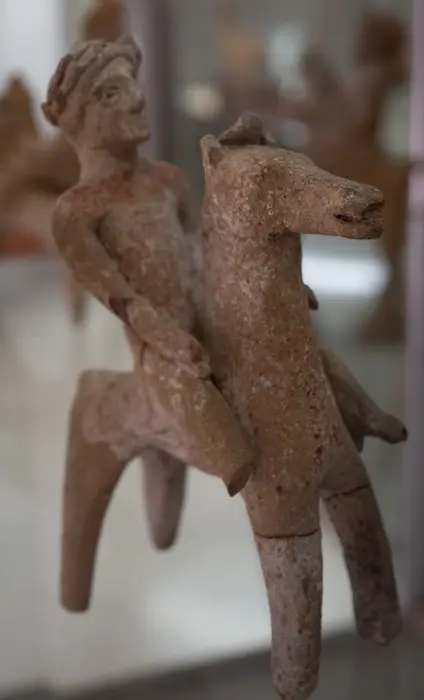 terracotta riderKourion Museum
 Terracotta Horse RidersLarnaca Museum
 Horse-and-rider figureOntario Museum
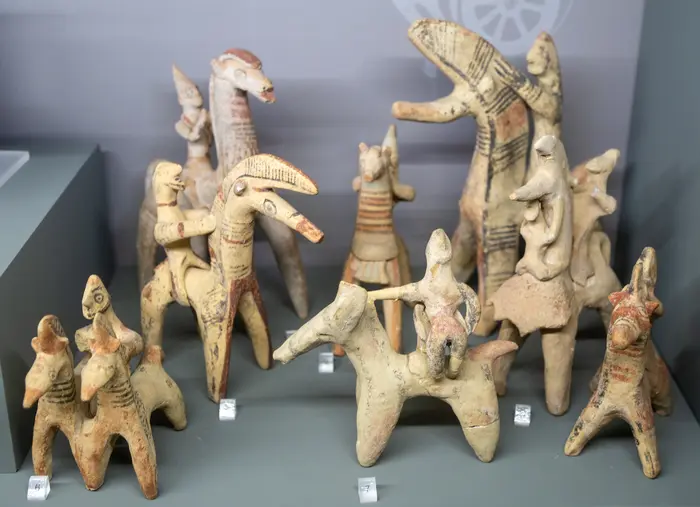 Terracotta Horse RidersCyprus Museum, Nicosia
 Horse-and-rider figureOntario Museum
 Chariot GroupLarnaca Museum