
Books·New book
Cypriot votive terracottas get one chapter in an Archaeopress volume on clay figures in motion
Edited by Jaimee Uhlenbrock and Maya Muratov, the 700-page book is due in January 2027. Claudina Romero Mayorga and Anna Reeve write its Cypriot chapter.



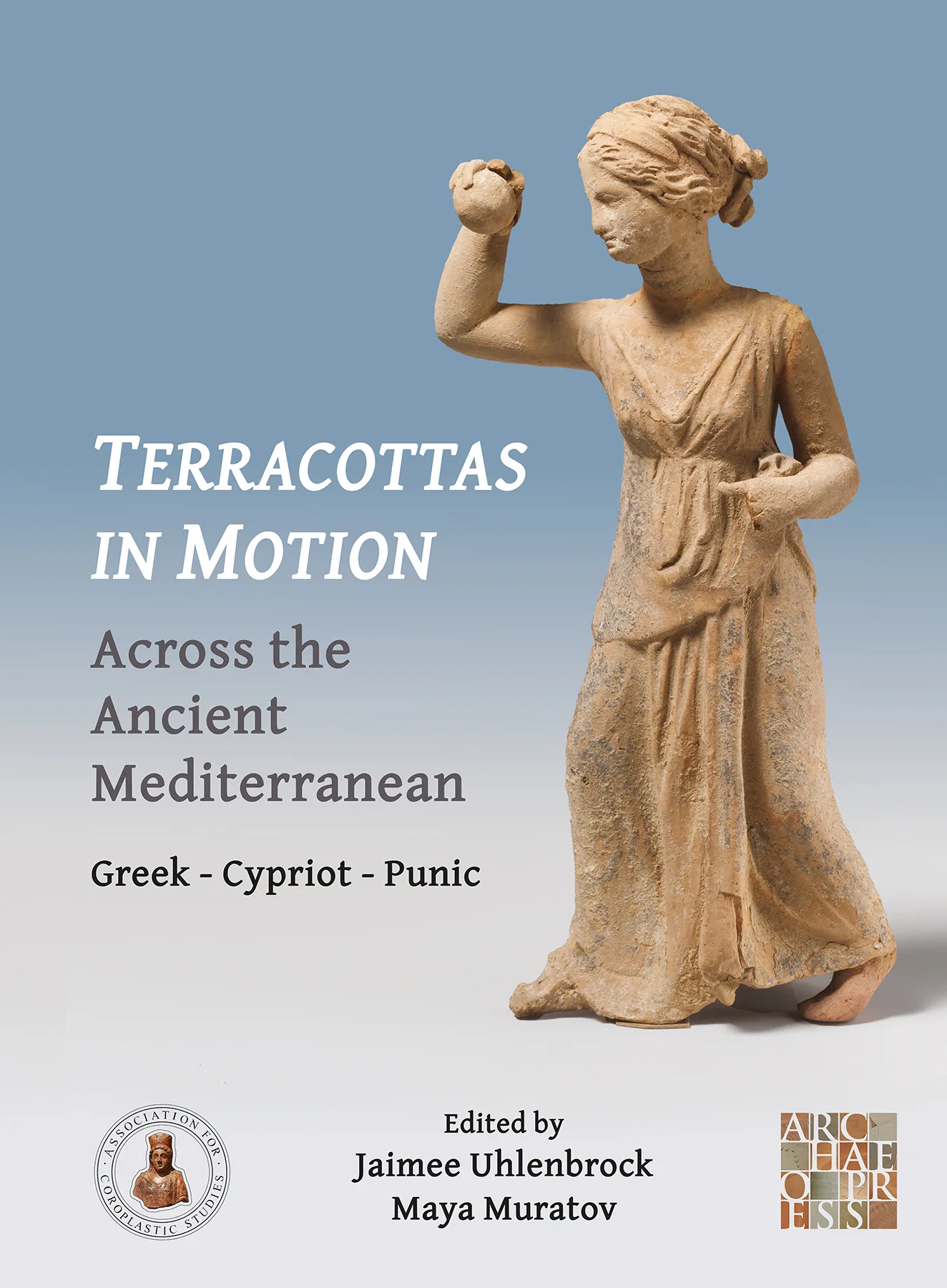
The book
- Title
- Terracottas in Motion across the Ancient Mediterranean: Greek – Cypriot – Punic
- Edited by
- Jaimee Uhlenbrock and Maya Muratov
- Publisher
- Archaeopress, 2027
- Series
- Archaeopress Archaeology
- Pages
- 700
- ISBN
- 9781805833727
Ancient Cyprus has one of the eight chapters in Terracottas in Motion across the Ancient Mediterranean, a collection edited by Jaimee Uhlenbrock and Maya Muratov that Archaeopress lists as due in January 2027. In that chapter Claudina Romero Mayorga and Anna Reeve look at how museums can represent motion when they display Cypriot votive terracottas. The publisher is taking pre-orders for the paperback, 700 pages with 129 colour figures, at £90 (ISBN 9781805833727); the digital edition (ISBN 9781805833734) can be downloaded once the book is out. Its DOI is 10.32028/9781805833727.
From a Zoom colloquium to a book
The volume began with the Association for Coroplastic Studies, the society for scholars of clay figures (coroplasts were the people who made them). In 2022 Muratov and Uhlenbrock's call for papers asked for work on terracottas that depict movement, imply it through the places they were left, or have parts that move, and expected the accepted papers to be published together. Eighteen papers were given over three mornings on Zoom, 20 to 22 October 2022, according to the organisers' report in Les Carnets de l'ACoSt. The book has eight chapters.
Uhlenbrock is Professor Emerita at the State University of New York at New Paltz, a founding member of the association and its president. Muratov is Associate Research Curator for Provenance in the Greek and Roman department of the Metropolitan Museum of Art.
What the chapters cover
Motion is taken widely: figures with movable limbs or loops for hanging, types repeated for centuries, terracottas broken in a rite and their fragments used again elsewhere or joined in repair, moulds carried by trade and by travelling craftsmen, and the figures' later lives in collections and museums. Victoria Sabetai writes on Boeotian figurines, Eukene Bilbao Zubiri on the Gulf of Taranto, Marina Albertocchi on a community in procession, and Antonella Pautasso on the basket-bearers (kanephoroi) of Syracuse. Jennifer Moore takes Punic incense burners, Uhlenbrock follows terracottas from Camarina in Sicily to Paris, and the two editors close the book.
The Cypriot chapter
Romero Mayorga and Reeve gave the Cypriot paper on the colloquium's last day. The organisers' report describes it as a study of how movement could be built into a museum display of small Cypriot figurines of musicians. Reeve's doctoral thesis at Leeds traced how the city's Cypriot collection was formed, the subject of her CAARI lecture on 5 November.
Musicians are a frequent subject of Cypriot terracotta figurines. Katerina Kolotourou finds most Iron Age images of music-making in the clay figures of the Cypro-Geometric and Cypro-Archaic periods [1], and Anastasia Leriou counts 89 lyre players and 23 flute players in the Karageorghis catalogue of Cypriot terracottas, most of them from sanctuaries [2, p. 530]. Some figures were made as moving groups: in the clay ring dances, three to six dancers holding hands circle a flute player or a tree on a round base [2, p. 528]. Our entry on music and instruments covers the players and what they hold.
Original sources
On ancientcyprus.com
- People
- Anna Holly Reeve
- Institutions
- Metropolitan Museum of Art
- Periods
- Cypro-Geometric, Cypro-Archaic
References
- 1.Kolotourou, K. (2005). Music and cult: The significance of percussion and the Cypriote connection. In V. Karageorghis, H. Matthäus, & S. Rogge (Eds.), Cyprus: Religion and society from the Late Bronze Age to the end of the Archaic period (pp. 183–204). Bibliothek am Guthof.
- 2.Leriou, A. (2017). The musician, the dancer and the priest: Readdressing Cypro-Archaic ritual. In V. Vlachou & A. Gadolou (Eds.), *ΤΕΡΨΙΣ: Studies in Mediterranean archaeology in honour of Nota Kourou* (Études d'archéologie 10). CReA-Patrimoine.
More in Books
- Amulets, ivories and lead objects from the Met’s Cesnola Collection get their own catalogue
- Catalogue to accompany a new Kykkos gallery for David Johnson's donated Cypriot antiquities
- Early Neolithic groups gathered seasonally at Ais Giorkis in the Troodos foothills, final report argues
- Jennifer Webb's forthcoming book studies 3,327 Early and Middle Bronze Age metal finds from Cyprus
- Children painted some 'crude' Bronze Age pots at Kalopsidha, new book on Cypriot ceramics argues