
Museums·News
Cypriot Chalcolithic figure sells for $12,000 in Chicago after a collector sought the state's view
The 9.5 cm picrolite figure, lot 175 at Freeman's on 19 November, reached the top of its $8,000–12,000 estimate; its recorded history begins in London in 1960.



A picrolite figure with outstretched arms, carved in Cyprus in the Chalcolithic, sold for a hammer price of $12,000, the top of its estimate, after competitive bidding at the American auction house Freeman's in Chicago on 19 November. It was lot 175 in the Antiquities and Ancient Art sale. Before the sale Antonis Antoniou, a Cypriot collector who follows foreign sales for Cypriot pieces and spotted this one, said he would like to buy it, but first wanted the Cypriot authorities to state their position and explain how an import into Cyprus would be handled.
The lot and the sale
The catalogue entry dates the figure to the Chalcolithic period, early 3rd millennium BCE, and gives its height as 9.5 cm, or 12 cm on its stand. Freeman's estimated it at $8,000–12,000 and opened the bidding at $4,000. The condition report mentions encrustation, surface cracks, a loss toward the bottom and chips at the ends of the arms, and calls the piece stable. Live bidding began at 10:00 Chicago time, 18:00 in Cyprus; the figure came up shortly before 21:45 Cyprus time. The buyer has not been named.
Two Cypriot vessels came up earlier in the same session, both catalogued as Bichrome Ware amphorae of c. 7th–6th century BCE: lot 156, 34 cm high, estimated at $1,000–2,000, and lot 157, 38.5 cm high, estimated at $1,200–1,800. Bichrome is Cypriot pottery painted in black and red on a pale ground, a long-lived class in the Iron Age.
Antoniou regards the figure as a characteristic piece of prehistoric Cypriot sculpture, one that could join a public collection on the island it came from. He held back from bidding until the relevant services said where they stood and what would happen once the object reached Cyprus. The case brought him into contact with Maria Pafiti, an art historian and appraiser whose work includes finding stolen or missing antiquities and church art and getting them returned.
A record that starts in London in 1960
Freeman's lists three earlier owners. A private collection in London, identified only by the initials T.S., held the figure from 1960 to 1979; a second London private collection followed; and Ariadne Galleries in New York had acquired it before 12 March 2015. The entry gives no date or circumstance for the figure's departure from Cyprus.
The gallery was founded in 1972 by Torkom Demirjian, according to its own published profile, and by 2017 his sons James and Gregory Demirjian were its co-presidents. According to Pafiti, who knows the Demirjian family, contact with them could help trace the figure's earlier history.
What cruciform figures are
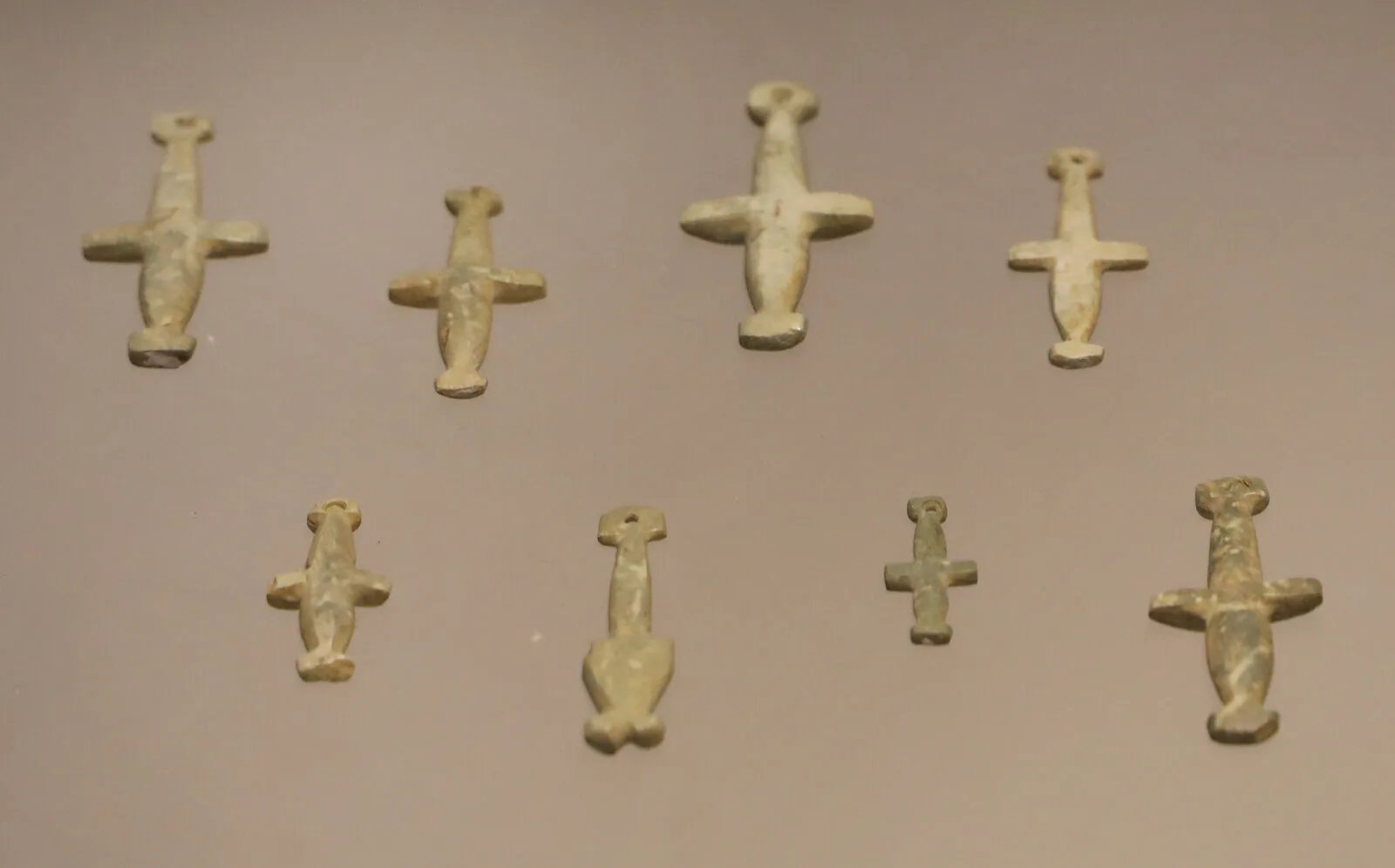
Cruciform figures are small, schematic human figures with the arms stretched straight out, a long neck, a head tilted back and the legs usually drawn up. Most were carved in picrolite, a soft blue-green stone that the Kouris and Karyotis rivers carry down as pebbles from the serpentinite of the Troodos mountains. The smaller ones, pierced through the head, were worn as pendants. The tradition belongs to the Chalcolithic, above all its middle phase, and to the south-west of the island; it had all but ended by c. 2700 BCE (our entry on the class sets out the scholarship).
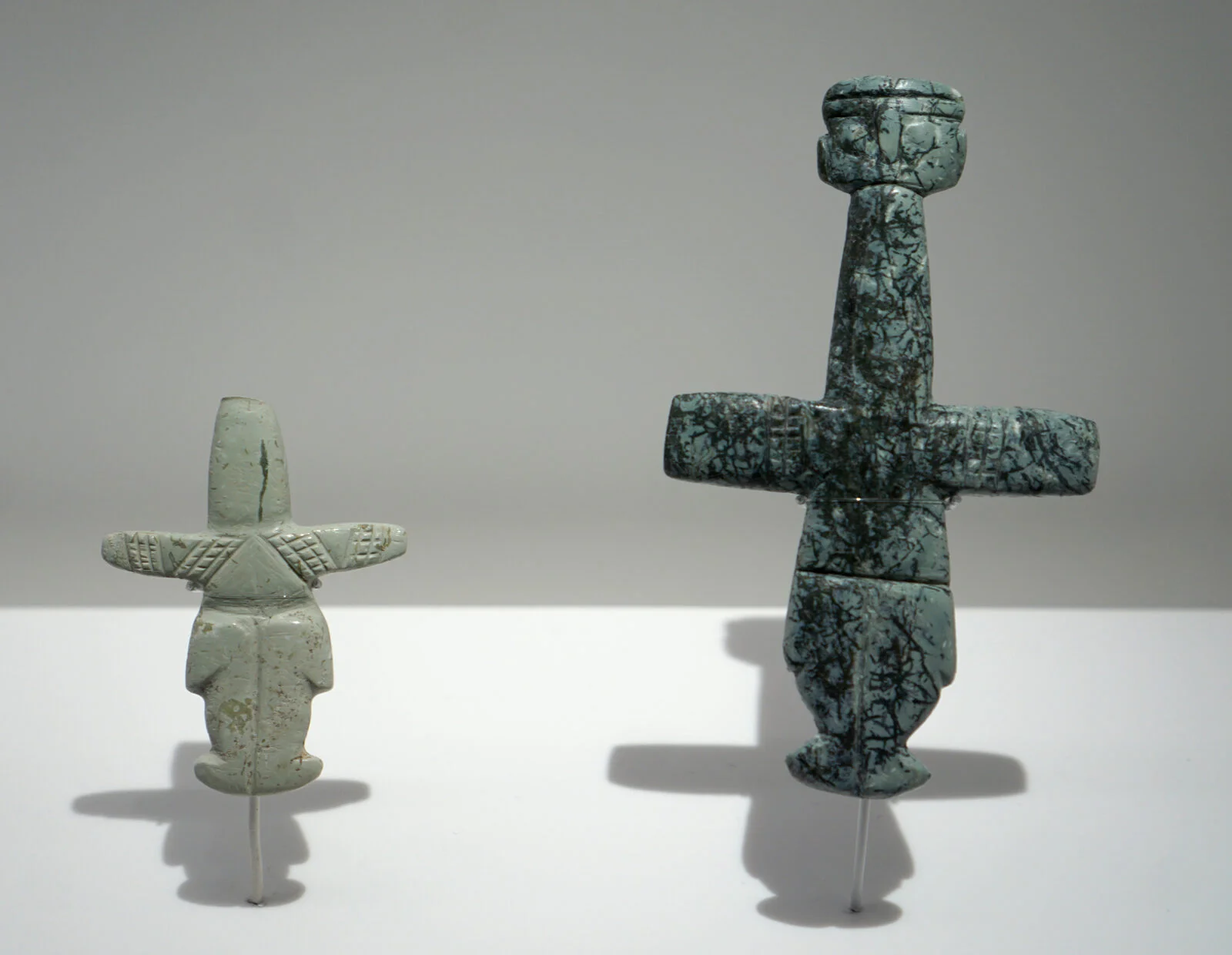
They turn up in houses and in graves. Kissonerga-Mosphilia has produced 20, the largest group from one excavated site, and Lemba-Lakkous and Erimi are among the other excavated settlements of the period. At Souskiou-Laona, more than 300 pieces of picrolite, including carving waste, were spread across the settlement. Burials with cruciforms are few: about 20 figures and pendants came from 137 burial facilities at Souskiou-Laona, and one grave out of 73 at Kissonerga-Mosphilia. In that grave, Grave 563, a figure 10.1 cm high lay at the chest of an infant among dentalium shell beads, apparently the centre of a necklace.
The best-known cruciform circulates as money. The €1 and €2 coins carry the idol of Pomos, which the European Commission dates to c. 3000 BC (the Chalcolithic) and describes as representing "the country's contribution to civilisation since prehistoric times".
Figures in collections abroad
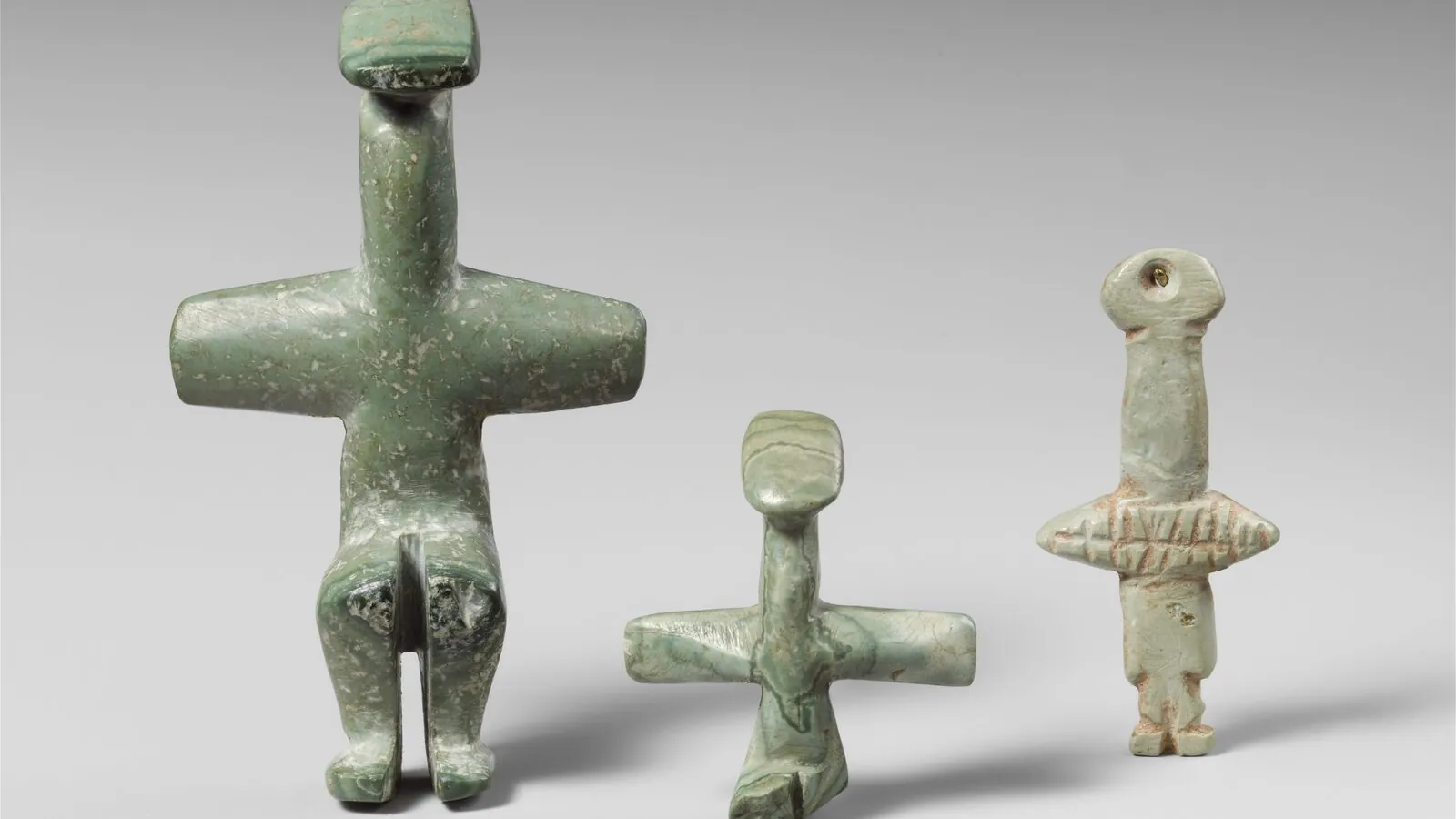
Many cruciform figures in museums have no recorded find-spot. Among them is one of the three picrolite figures the Metropolitan Museum of Art in New York bought through its Rogers Fund in 1951 (51.11.5–7, pictured above), which the museum dates to c. 3900–2500 BCE.
Since 1970 the Department of Antiquities, the A. G. Leventis Foundation and the Church of Cyprus have at times bought objects back when they could not be claimed through the courts.
Original sources
- Freeman's | Hindman, A Cypriot Picrolite Figure, lot 175, Antiquities and Ancient Art (lot listing)
Official release
- Freeman's | Hindman, A Cypriot Bichrome-Ware Amphora, lot 156 (lot listing)
Official release
- Freeman's | Hindman, A Cypriot Bichrome-Ware Amphora, lot 157 (lot listing)
Official release
- European Commission, Cyprus: national sides of euro coins
Official release
- The Metropolitan Museum of Art, Picrolite figure, 51.11.5
Official release
On ancientcyprus.com
- People
- Torkom Demirjian
- Institutions
- Ariadne Galleries, Department of Antiquities of Cyprus
- Periods
- Chalcolithic, Cypro-Archaic
More in Museums
- €1.6m redesign will strengthen Kourion's 1937 museum house at Episkopi against earthquakes
- Groundbreakers: Petrie Museum display on women archaeologists opens in London on 5 November
- Cyprus's draft 2027 budget cuts antiquities development spending by 43%, to €3.8m
- 3D reconstructions and AI scenes planned for Kourion, including contests at its Roman stadium
- Two artists, one a plastic surgeon, show new work among the Cyprus Museum's antiquities before its move