
Fieldwork·News
Excavators near Kophinou find a domed church of the 8th–10th centuries and a potters' clay tank
The University of Cyprus team traced four building phases at Agios Herakleios, from an Early Byzantine basilica to a post-16th-century chapel, in a cemetery used from the 6th to the 16th century.



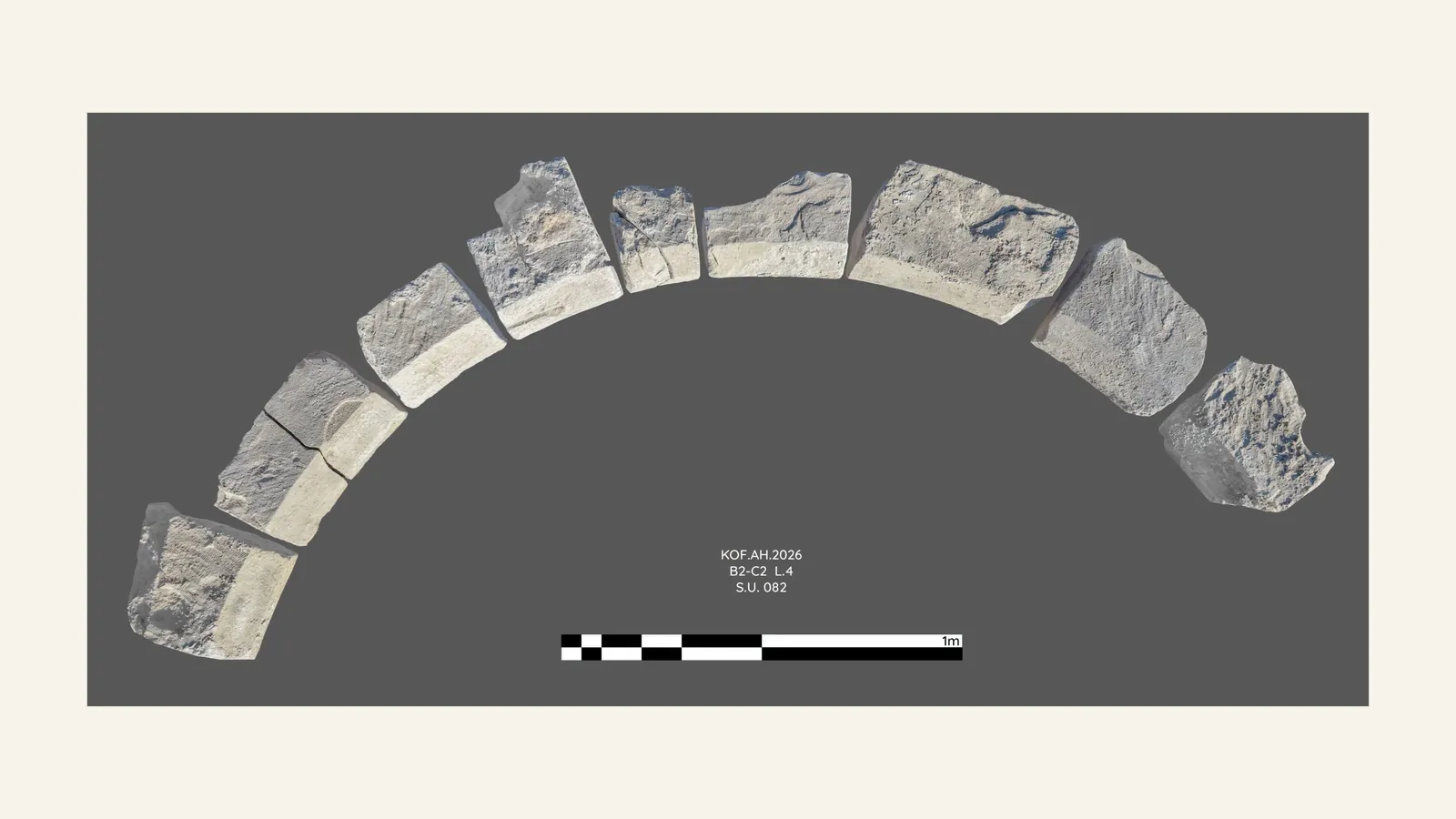
Curved dome stones and a square central bay found inside a ruined church at Kophinou-Agios Herakleios, in the Xeros valley of the Larnaca district, show that the building was a domed church of the 8th to 10th centuries, the Department of Antiquities announced on 26 October. At the nearby Early Byzantine pottery workshop of Menogeia-Limnes, the same team found a built tank in which clay was prepared for the potters. Both sites were dug between 15 June and 24 July 2026 in the third season of the University of Cyprus project Settled and Sacred Landscapes of Cyprus (SeSaLaC), run by its Archaeological Research Unit with the summer field school of the Department of History and Archaeology.
The season was directed by Athanasios Vionis, Associate Professor of Byzantine Archaeology and Art at the university, and Doria Nicolaou.
Inside the church at Agios Herakleios
Work in 2026 concentrated on the interior of the single-aisled church exposed in earlier seasons. The team cleared almost all of its floor, which is paved with large gypsum slabs. Strips of lime mortar on the paving mark where the templon, the screen in front of the sanctuary, once stood, and a dense cluster of iron nails in the middle of the church suggests that the screen was of wood. Pieces of glass lamps belong to the church's fittings.
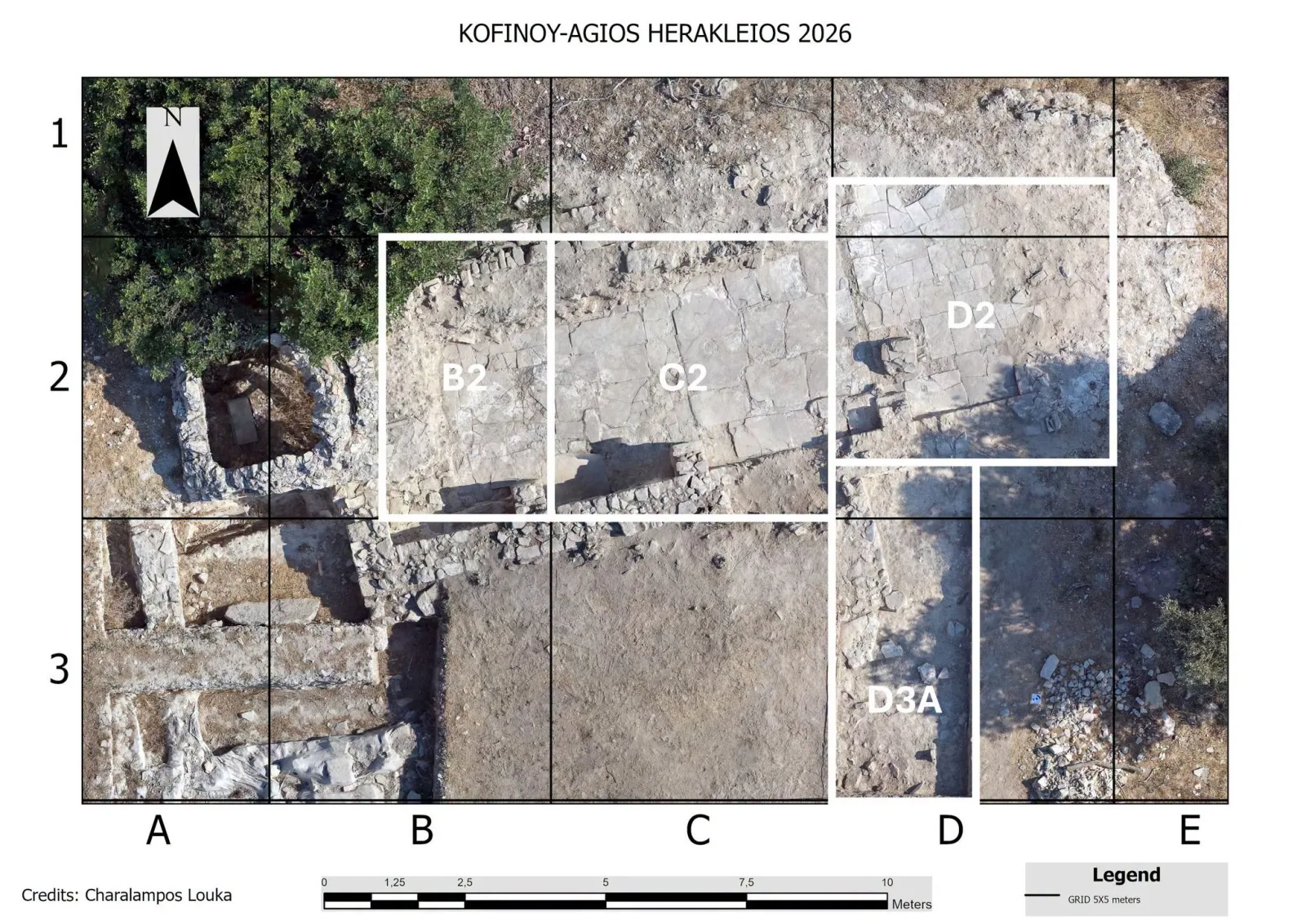
Raised benches of gypsum slabs, coated with lime mortar, run along the south wall and stand in the south-west corner. At the centre of the floor, under the dome, lay a round gypsum slab with an incised spiral, which the team identifies as probably an omphalion. On the lower part of the south wall survive fragments of painted plaster without figures: red and green bands on a white ground, imitating marble panelling. In the sanctuary a second, smaller apse had been built inside the larger apse of the first basilica.
The Department counts the dome among the season's main results. Stones cut to a curve are read as parts of the dome's base ring, and the second and third pairs of pilasters enclose a square of 3.20 by 3.20 metres beneath it. Together they place the church among six-column compact cross-in-square churches, a type dated between the 8th and 10th centuries CE. After the 2025 season the Department had described this single-aisled church as a later, medieval building on top of the basilica.
A thousand years of use
Pottery in the layers of fallen masonry dates the abandonment of the church to the middle of the 14th century. From the late 14th to the middle of the 16th century the ruin was put to uses other than worship: the fallen masonry held hearths, cooking pots and animal bones. Burials went on around it. Human bones lay scattered in Trench D3A, dug against the outside of the church to the south-east, with what is probably a grave slab and pottery of the 15th and 16th centuries. In 2025 the team had found an Early Byzantine burial in a stone larnax, a chest-shaped coffin, outside the south wall of the chapel known as the martyrion, with the skeleton still in place.
The excavators now propose four building phases, as a preliminary dating.
According to the Department, Cyprus has never before had archaeological documentation of an organised burial ground kept in use without a break for ten centuries, from the 6th to the 16th, together with secure evidence of worship in the troubled 8th to 10th centuries.
The clay tank at Menogeia-Limnes
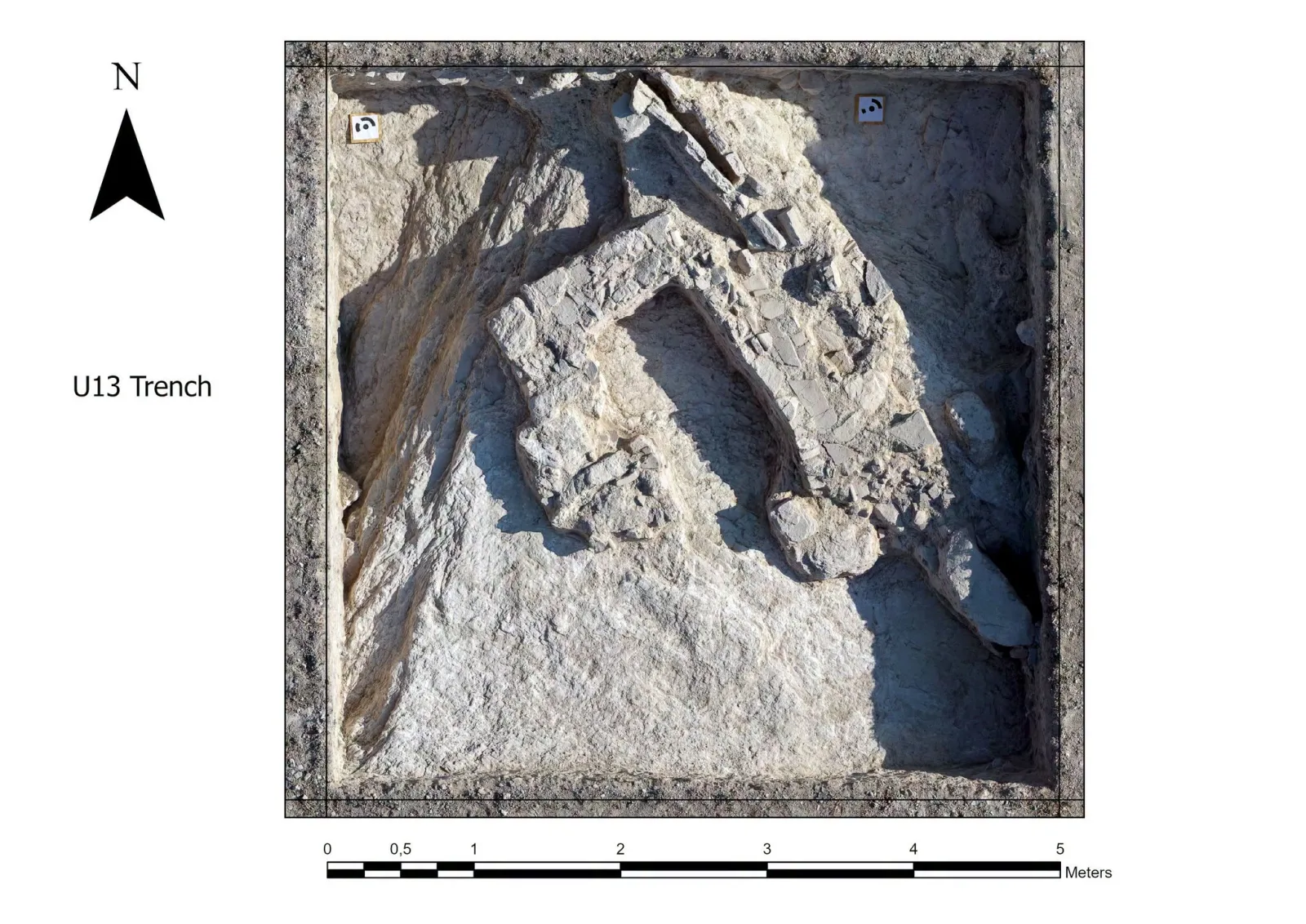
At Menogeia-Limnes the team opened five new trenches in the Early Byzantine pottery workshop, where a single trial trench was dug in 2025 at a spot marked by wasters, unfired clay and burnt residues. This year's main find, in trenches U13A–B, is a built tank set directly on the bedrock. Inside it the excavators recorded bands of clean clay alternating with sieved soil, the residue of preparing the potters' raw material. Water reached the tank along a channel lined with stones set on edge in two parallel rows. The Department calls the tank the first direct archaeological evidence in Cyprus for this stage of work in a pre-modern potters' workshop.
Trenches R10A–B and T10A exposed rooms used for storage and work. They held heaps of wedged clay, a large pithos (storage jar) still where it had stood, fragments of potters' wheels and plenty of debris from firing, including misfired and overfired sherds. Taken together, the sherds from the five trenches show the workshop at work in three phases: the late 4th to 5th century, the 6th to the mid-7th century, and the late 7th to the mid-8th century CE.
The valley in the "Dark Ages"
The 8th to 10th centuries are the stretch of Cypriot history between the Arab raids of the mid-7th century and the Byzantine recovery of the island in 965, often called the Cypriot "Dark Ages" (see Byzantine and medieval Cyprus). The Department notes how little of the period survives in the island's excavated record and says the 2026 results help to fill that gap.
Vionis had argued in 2023, from the project's survey of the Xeros valley, that the valley was not abandoned in those centuries. Survey had identified the workshop about 2 km north-east of Kophinou, then dated to the 6th and 7th centuries, making domestic pottery and roof tiles in shapes found across the eastern Mediterranean and the Aegean [1, p. 165]. A radiocarbon-dated sample of the period from the Alaminos tributary of the Xeros comes from deposits of a regularly flowing river under humid, stable conditions, land suitable for farming and a source of clay for potters [1, p. 169]. He listed churches of the period nearby: the former basilica of Panagia at Kophinou, with pottery showing use into the 8th and perhaps the 9th century; Saints Athanasius and Cyril at Menogeia, built in the late 7th or 8th century; and St Athanasios Pentaschoinitis at Pentaschoinos, of the 8th or 9th century [1, pp. 169–170]. He suggested that once the late antique agrotown of Kophinou came to an end, churches such as these probably took its place as points of reference for scattered or seasonal communities [1, p. 170].
The domed church at Agios Herakleios adds an excavated building of the 8th to 10th centuries to that list, and the workshop's last phase of production now runs into the mid-8th century.
Original sources
- Department of Antiquities, Cyprus: press release on the 2026 excavations at Kophinou-Agios Herakleios and Menogeia-Limnes (Facebook)
Social media·
- Department of Antiquities and Deputy Ministry of Culture: Completion of the excavation at the site of Kofinou – Agios Herakleios and Menogeia – Limnes (2025 season)
Official release·
On ancientcyprus.com
- Institutions
- Department of Antiquities of Cyprus, University of Cyprus
References
- 1.Vionis, A. K. (2023). A boom-bust cycle in Cyprus at the end of Antiquity: landscape perspectives for settlement transformation. In P. Panayides & I. Jacobs (Eds.), Cyprus in the Long Late Antiquity: History and Archaeology Between the Sixth and the Eighth Centuries (pp. 161–176). Oxford and Philadelphia: Oxbow Books.
More in Fieldwork
- A dog's paw prints survive on a 4,000-year-old mudbrick from a burnt house at Tavşanlı Höyük
- Hexagonal church of Apsinthiotissa and Byzantine Agios Prokopios restored in the occupied north
- Bronze Age Pyla-Kokkinokremos, beside a British firing range, will not open to visitors
- Kourion's mosaic conservators are to get two prefabricated buildings in a €113,447 tender
- 167 Roman granite column fragments trace the main streets of ancient Paphos