
Fieldwork·News
French team finds 8th–7th century BC walls beneath Classical stone robbing at Kition
The September 2026 season at Kition-Bamboula exposed the oldest phase over nearly all of Sondage 11 and tied the storage jars found in 2025 to Wall 988.



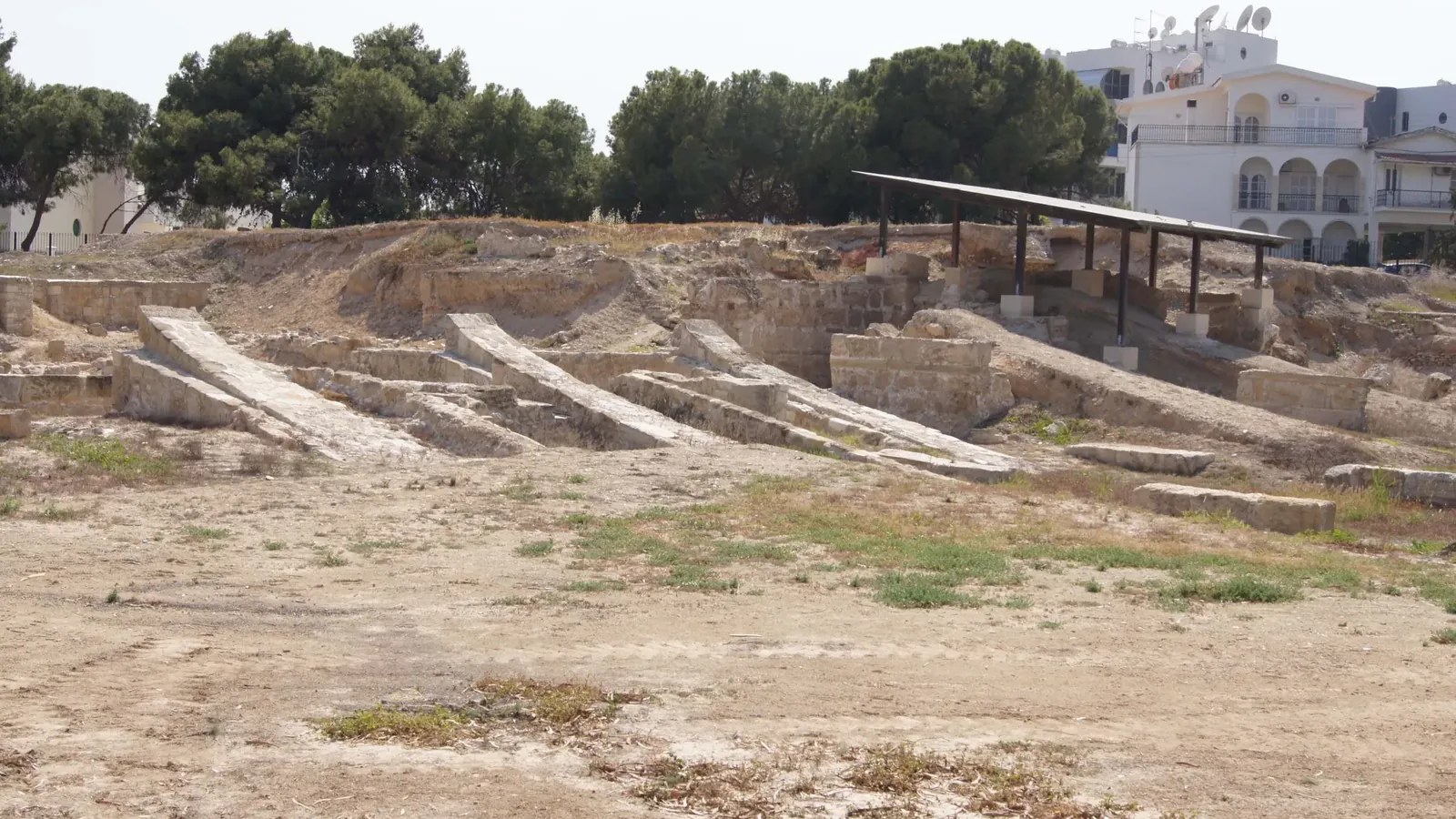
New walls of the 8th and 7th centuries BC came to light at Bamboula, a mound in the ancient city of Kition under modern Larnaca, when the French archaeological mission dug there in September 2026. They had survived in corners of Sondage 11 (Sector 11) that the stone robbing and dumping of the Classical period missed. The Department of Antiquities announced the results on Monday 9 November; the team had worked in the same trench in 2025.
Wall 988 and the storage jars
The new walls lie in the north and east of the trench, in Cypro-Archaic I layers. One of them, Wall 988, runs east to west and was used in two successive phases. The Department links the large storage jars found in place last year to the first of those phases.
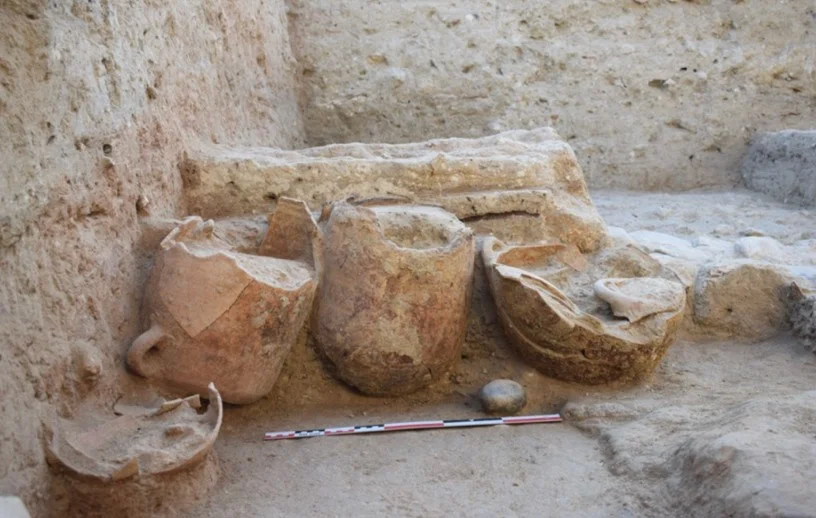
The jars were the main find of 2025. They stood in a room whose southern side had been cut away by one of the Classical robber trenches, while stone walls carrying mud brick closed it on the east and north. When the mud brick fell, it sealed what was inside: imported Phoenician transport amphoras, a locally made plain white amphora and jug, and a Bichrome barrel-jug. The mission's December 2025 release dated the room firmly to the Cypro-Archaic period and called it the oldest thing yet reached in the sector.
That earliest occupation, Phase I, is dated to the 8th–7th centuries BC. A year ago it showed only at the northern limit of the sector; this season the team reached it over the whole trench, or close to it. A still older phase, in Cypro-Geometric III, remains possible.
A quarry and a rubbish dump
Most of what once lay above Phase I was destroyed in the Classical period (5th–4th centuries BC), which the excavators split into Phases III to V. The area served as a quarry, its dressed blocks won by pulling down the walls of abandoned buildings, and as a place to dump refuse. One batch of that refuse was a group of Phoenician ostraca, potsherds used for writing: about 100 fragments carrying around 70 separate texts. According to the Department, these works cut deep into the older remains and wiped them out in places.
Floors between the robber trenches
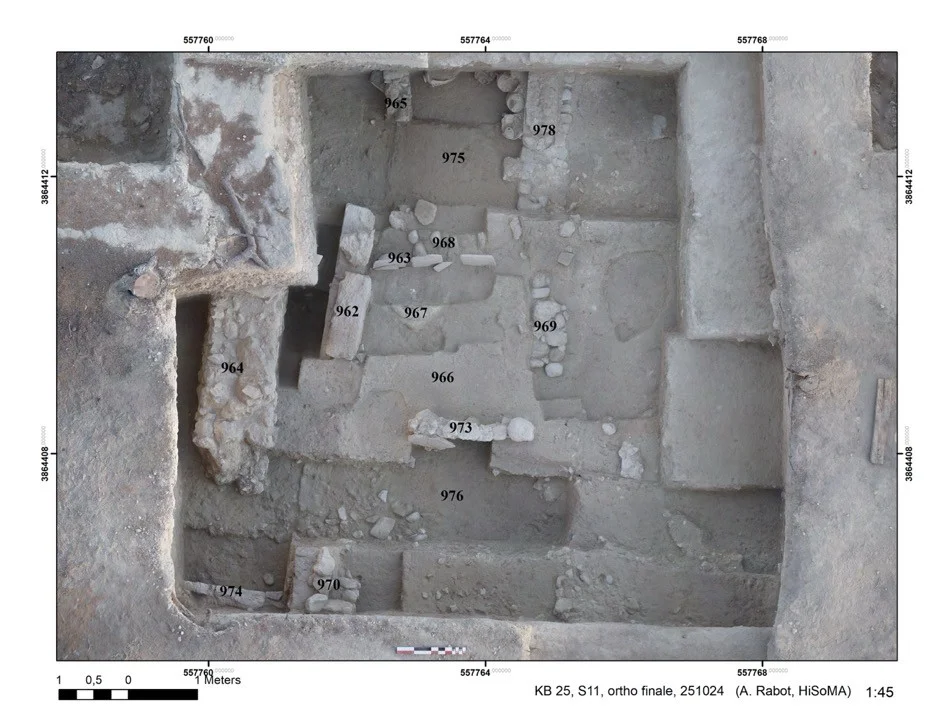
In the centre of the trench, the 2024 and 2025 seasons removed what the team now reads as the last use of the sector before the Classical works. This is Phase II, placed at the end of Cypro-Archaic II and the start of the Cypro-Classical period (late 6th to early 5th century BC). The Department describes it as an occupation, or a light reoccupation, for craft work: people made do with older structures, some half fallen, taking material from stretches of wall still upright. Which craft it was has yet to be identified.
At least four layers have been dug there, one on another, with at least three floors among them. Each floor was resurfaced again and again with spreads of ash, lime and hearth debris. The small group of vessels found under a floor last year, a three-legged cooking pot (a tripod) and a juglet, goes with the earliest. In 2025 the mission compared it with foundation deposits from other Classical contexts, among them the palace at Amathous.
Earlier seasons had divided the trench into six successive phases, and the Department said this year's work lets the excavators separate sub-phases within them.
Bamboula and its French excavations
Bamboula is a low mound in the east of ancient Kition. Much of it was cut away in 1879 to fill the marshes of the silted harbour, and the Swedish Cyprus Expedition later exposed part of an Iron Age sanctuary there [1, p. 125], the sanctuary of Astarte and Herakles-Melqart. A French mission led by Marguerite Yon began work in 1976, and over the following decades it uncovered the ship sheds of Kition's Classical war harbour on the north side of the mound. Sabine Fourrier has directed it since 2008.
Under Fourrier the mission went back to the north of Bamboula in 2016 with two trenches. Sondage 10 enlarged the 1976 excavation and found floors running from the 13th century BC, on bedrock, to the 11th, with occupation continuing to the 8th. Sondage 11, higher up and further west, held intact layers of later date [1, p. 125].
Phase I falls in the period when, as Fourrier has written, the Phoenician character of Kition's material culture is undeniable, from the beginning of the 8th century BC onward; she also notes Phoenician inscriptions on vases and ostraca from Kathari and Bamboula that are securely dated to the Archaic period [2, p. 116].
Next seasons
For the coming seasons in Sector 11 the Department names two aims: to work out the order in which the structures in the east of the trench were built, and to keep exposing Phase I so as to understand its nature and function.
Original source
On ancientcyprus.com
- Sites
- Kition
- Excavations
- Kition-Bamboula: the French Mission
- People
- Marguerite Yon, Sabine Fourrier
- Periods
- Cypro-Geometric, Cypro-Archaic, Cypro-Classical
References
- 1.Georgiou, A., Georgiadou, A., & Fourrier, S. (2022–2023). Traditions and innovations during the 12th-to-11th century BC transition in Cyprus: new data from Kition-Bamboula. Cahiers du Centre d'Études Chypriotes 52–53, 117–152.
- 2.Fourrier, S. (2013). Constructing the Peripheries: Extra-Urban Sanctuaries and Peer-Polity Interaction in Iron Age Cyprus. Bulletin of the American Schools of Oriental Research 370, 103–122.
More in Fieldwork
- Heritage committee to restore Maronite churches and an Armenian monastery in the occupied north
- Geophysical survey searches for buried remains at Agia Marina Xyliatou, a Roman copper-smelting site
- Karavas churches of 1804 and 1854 restored by Greek Cypriot and Turkish Cypriot conservators
- New Central Prisons at Agios Sozomenos to be kept apart from the Bronze Age site
- Iconostasis and monk-painted walls restored at the monastery of Saint Barnabas near Salamis