Early Bronze Age · c. 2000–1800 BC

The Plank Figures

Two flat figures of red clay from Bronze Age Cyprus, one with two necks and one with three. For fifty-three years they stood under glass in Oxford.

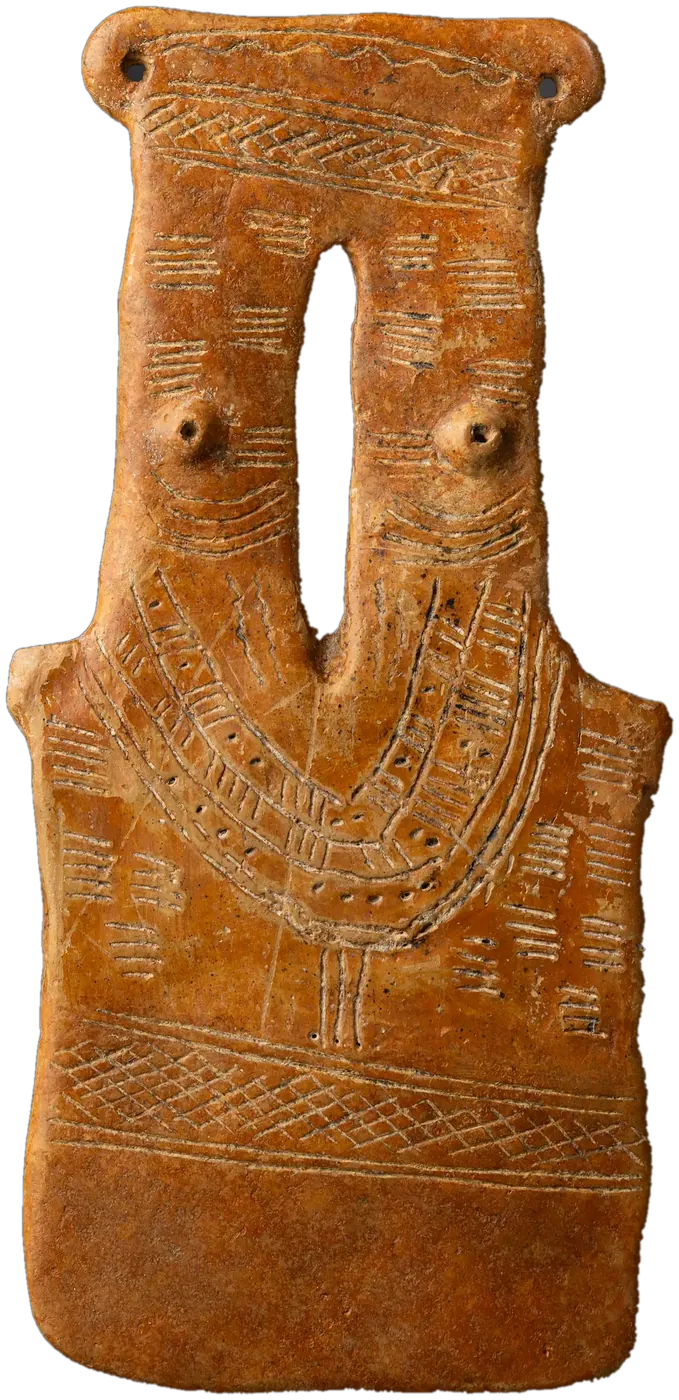
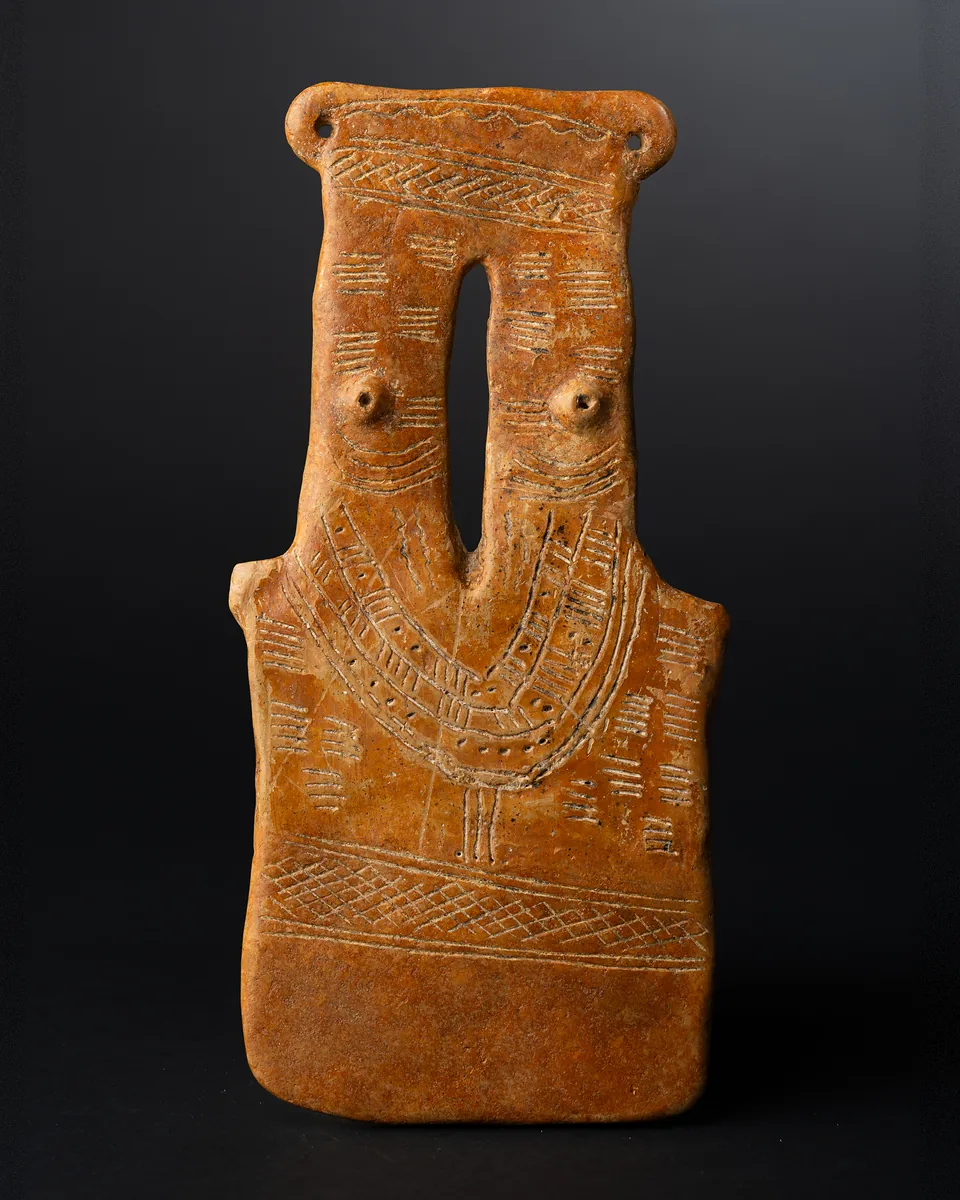
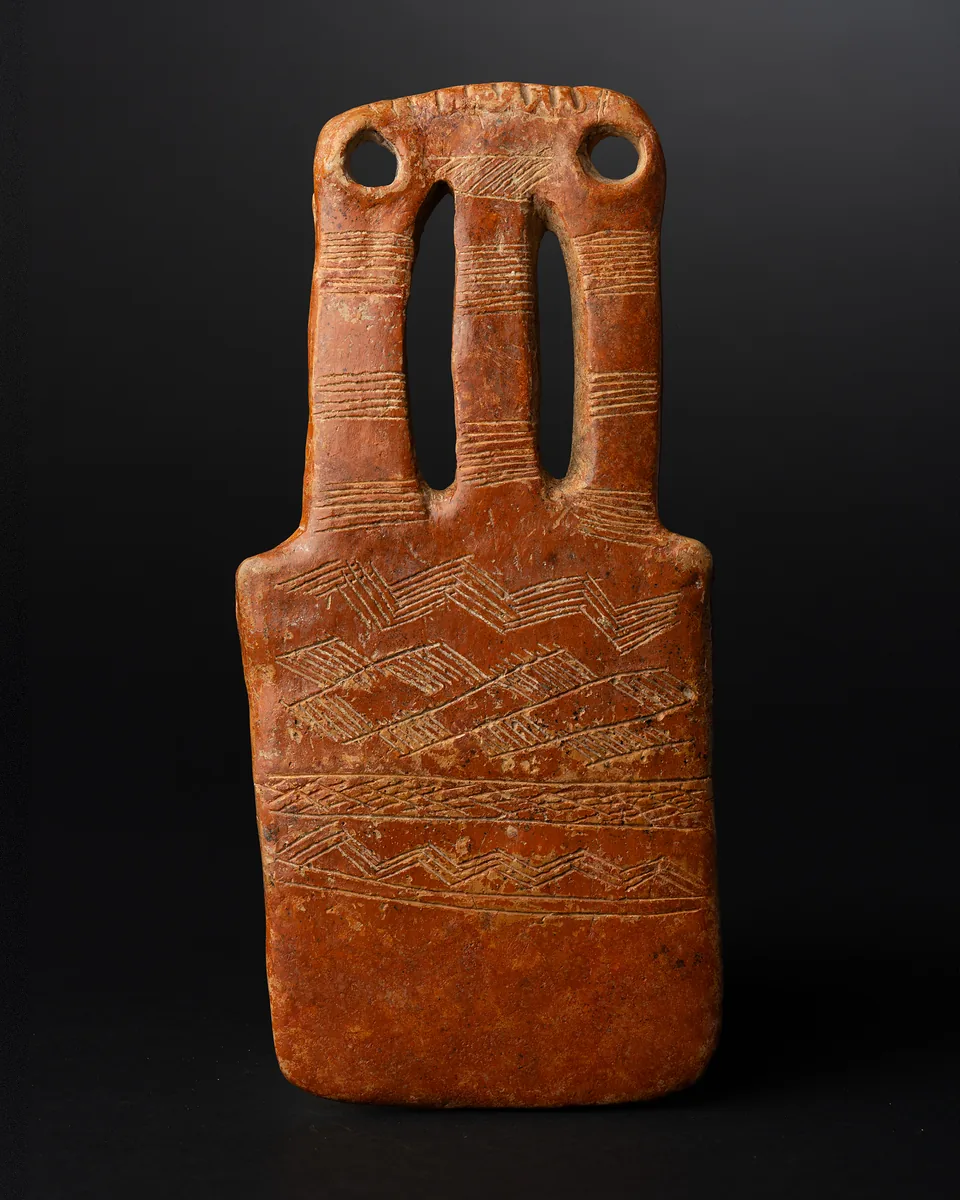
The two-necked plank figure, front: a flat slab of red clay with two necks bridged at the top, a pierced ear at each corner, two small breasts and an arched dotted collar.
Two necks25.4 cm · Brew no. 114
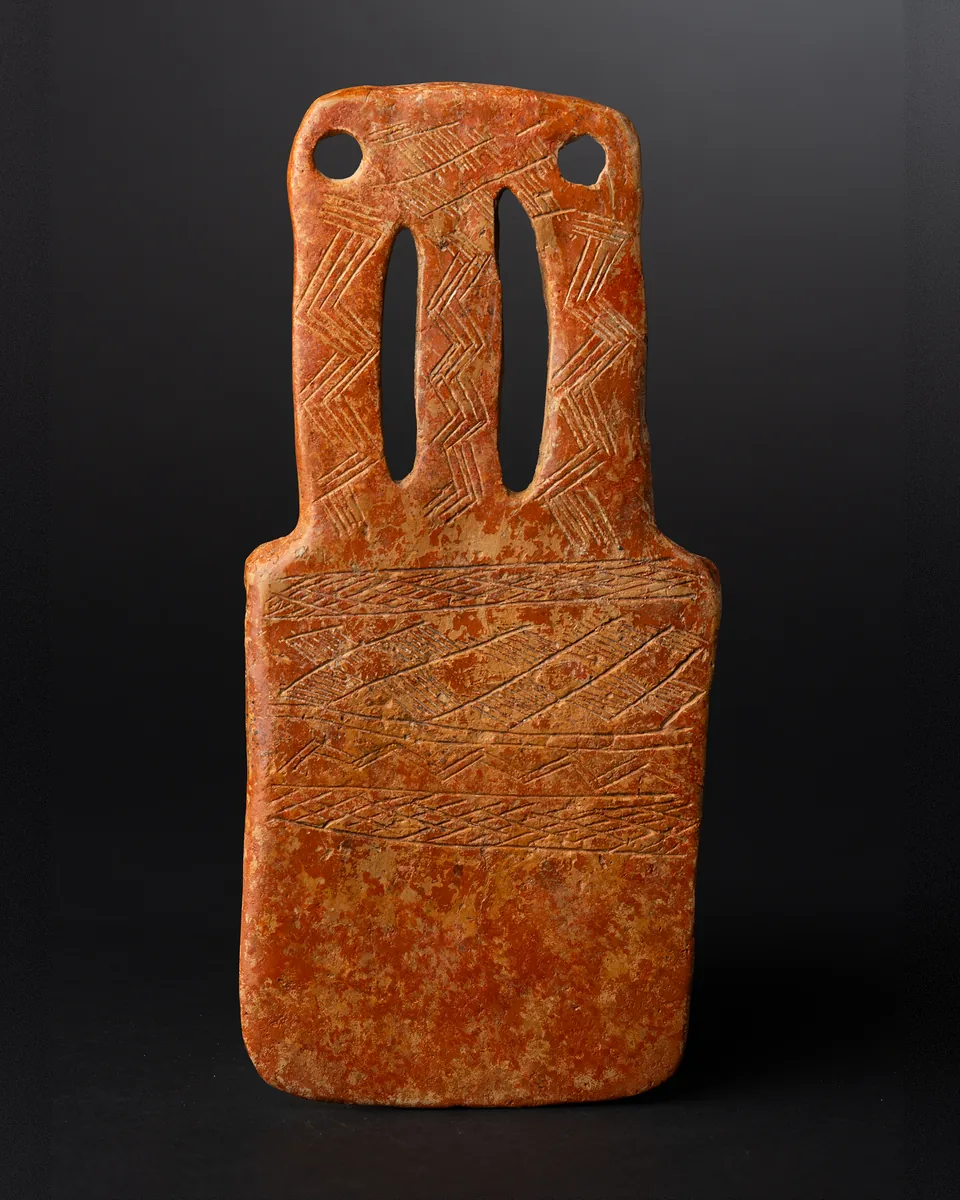
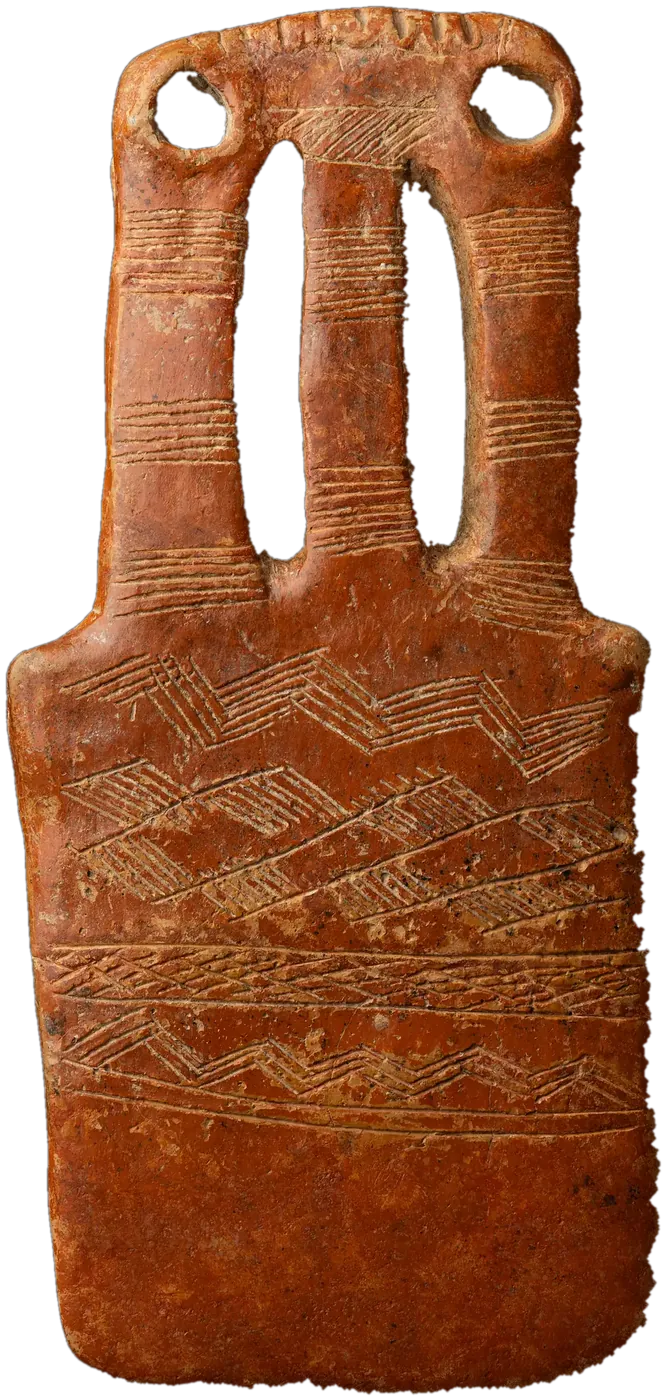
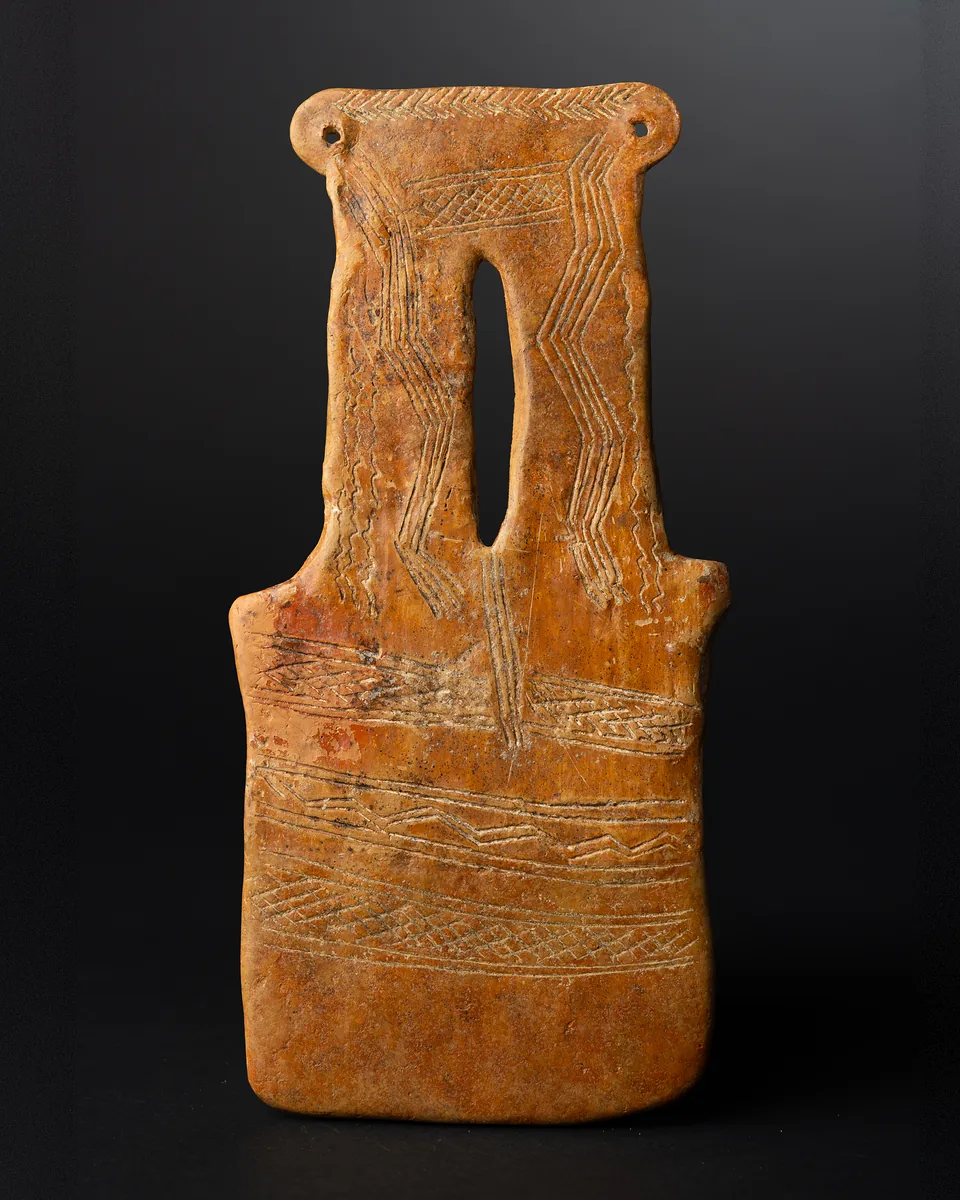
The three-necked plank figure, front: a flat slab of red clay with three necks divided by two long slots, a large pierced ear at each upper corner, no face, and bands of incised zigzag and lozenge.
Three necks23.2 cm · Brew no. 115
Begin

Around 2000 BC, potters on the north coast of Cyprus began cutting flat rectangles of red clay and giving them shoulders, necks, ears and dress. These plank figures were the first free-standing images of the human body made on the island for roughly a thousand years. Each was burnished on both faces and incised while leather-hard, and the lines were rubbed with white paste so that the pattern stood out pale against the red.

Most have one neck. These two have two and three. A Manx art teacher bought them in Cyprus in the 1960s, and from 1972 they stood in a case at the Ashmolean Museum in Oxford for fifty-three years. The three-necked figure was published five times between 1975 and 1991. One scholar made it the only example of a type of its own, and the main exhibit in her case that the multi-necked planks had been misread.

STA-BA-003

The two-necked figure

Date
c. 2000–1850 BC, Early Cypriot III–Middle Cypriot I
Size
25.4 × 12.3 cm as restored; ancient fragment 18.1 cm high
Restored
About a third: the tops of the necks, most of the right neck and the plain lower body
Find-spot
No recorded find-spot; north-coast (Lapithos) style
Brew list
No. 114 (1972)
Ashmolean loan
LI1100.80, 1972–2025
Published
Karageorghis Bd.12; Frankel no. 151; Belgiorno Tipo N
Catalogue entry

STA-BA-004

The three-necked figure

Date
c. 2000–1800 BC, Early Cypriot III–Middle Cypriot I
Size
23.2 × 10.8 cm as restored; ancient fragment 19 cm high
Restored
About a fifth: the right neck and the plain lower quarter of the body
Find-spot
No recorded find-spot; north-coast (Lapithos) style
Brew list
No. 115 (1972)
Ashmolean loan
LI1100.81, 1972–2025
Published
Karageorghis Bf.2; Frankel no. 152; Belgiorno Tipo H, its only example
Catalogue entry

IFront and back

Turn it over

Plank figures were decorated on every surface, and the back carries a different scheme from the front. Drag a figure sideways to turn it, and select a number to read what the incision shows. The two share pierced ears at the top corners, a lattice band across the body and, on the back, zigzags running down every neck.

The two-necked figure, front.
The two-necked figure, back: zigzag lines run down each neck.

Front

Two necks · front · 1 of 9

Pierced ears

An ear at each top corner, pierced once. The holes probably took metal earrings, now lost; a few planks show the earring modelled in the clay itself.

Restored on this figure: the tops of the necks, most of the right neck and the plain lower body, about a third of it as it stands. Read the decoration of those zones as reconstruction.

IIHow rare

One neck, two, three

The class is small. The fullest statistical study, by a Campo, counted seventy-eight free-standing figures; a later and more generous count by Knox reached a little over two hundred across the three and a half centuries the type was made. At least half come from one cemetery, Lapithos, on the north coast. The doubled and trebled figures cluster there too. Desmond Morris thought them “probably the work of one, or a few artists.”

  • One neck · 29
  • Two necks · 9
  • Three necks · 1
  • Stone figure, c. 70 cm · 1

In a Campo's count of seventy-eight free-standing figures, twenty-three have more than one neck, nearly 30 per cent. Most of the doubled figures have two necks.

Among the forty complete or near-complete figures drawn here there is exactly one with three necks. The Berlin Antikensammlung, publishing its own three-necked plank from Lapithos, counts three such figures known in all. The Drakopoulos figure is one of them.

Counts: a Campo 1994, as tabulated by Talalay and Cullen 2002; Brehme 2012 for the Berlin figure. One plank = one figure.

IIIThe debate

Three necks, or one neck and two locks of hair?

In 1984 the Italian archaeologist Maria Rosaria Belgiorno studied the three-necked figure and decided that it had one neck. She made it the sole example of her Tipo H. Seven years later Vassos Karageorghis catalogued the same object for his corpus of Cypriot terracottas, recorded her reading, and rejected it.

The three-necked plank figure, front: three uprights divided by two long slots, joined by a bridge with a large pierced ear at each end, and no face.
Front
The three-necked plank figure, back: each of the three uprights carries its own incised zigzag.
Back

The object

Three uprights, two ears, no face.

Two long slots, closing at the shoulders, divide the top of the slab into three uprights. A bridge joins them, with a large pierced ear at each end. There is no nose, no eye, no mouth. Everything that follows depends on what those three uprights are.

Maria Rosaria Belgiorno, 1984

One neck, framed by two long locks of hair.

There is no face on any upright. She read the bridge as the head, with a face that was never carved, and the two outer uprights as thick locks falling to the shoulders, a coiffure she called Egyptian in style.

She pointed to a figure in Stockholm with the same hairstyle and no central neck. The Berlin three-necked plank fits her reading too: only its middle upright carries a face, with a relief nose, a mouth line and eye hollows. The two beside it have none.

Vassos Karageorghis, 1991

Three necks, and nothing more meant by the third.

Two-necked planks with their necks bridged at the top form an established group in his catalogue, where the two-necked figure here is Bd.12. A third upright is the same scheme taken one step further: the coroplast, “perhaps unconsciously,” made one “with three necks, without having any specific iconographic intention.”

The three uprights are treated alike: each is ringed with the same groups of horizontal lines, and on the back each carries its own zigzag. A three-necked plank from Lapithos in Berlin is built on the same scheme, three necks bridged at the top with an ear at each corner.

Where it stands

Karageorghis recorded Belgiorno's reading in the standard corpus and refused it: “difficult to accept.” The question has stayed open.

The back does not settle it. Each of the three uprights carries a zigzag, the device used for hair on the necks of single planks: a neck with hair falling down it, or hair itself. Talalay and Cullen argue that plank figures were made to hold several meanings at once, and point out that some single-headed planks are decorated on the back as though they were double.

The count itself turns on the answer. Read as Karageorghis read it, this is one of about three three-necked planks known. Read as Belgiorno read it, it is a single figure with long hair.

IVScale and repair

In the hand

Clay planks run from under nine centimetres to over thirty-three, and average about twenty-two. Both of these stand a little above the average, and both are partly modern. Karageorghis gives the ancient fragments as 18.1 and 19 cm high; the rest is restoration, about a third of the two-necked figure and a fifth of the three-necked one.

Loss of this kind is typical. Knox found a break across the torso on at least 44 per cent of plank figures, too regular to be chance, and reads it as deliberate snapping at the end of an object's life. Planks were also stood upright long enough to mark the clay, and are the only Cypriot figurine type known to have been mended in antiquity.

The two-necked figure at true relative scale, 25.4 cm high.
25.4 cm
The three-necked figure at true relative scale, 23.2 cm high.
23.2 cm

VProvenance

Fifty-three years under glass

The ancient find-spot of the two figures was never recorded. Their modern history is written down almost year by year, in a loan list, museum letters, five publications and a ledger.

  1. 1960s

    An art master in Cyprus

    James Alfred Brew (1923–2008), a Manx artist trained at Manchester and the Slade, spends the decade teaching at British services schools, with postings in Cyprus and Hong Kong. He buys from villagers and dealers, by eye. A lamp in his collection is scratched on the base in his hand.

    Paphos 1965, J.A. Brew
  2. Before 1970

    Out of Cyprus

    By his family's account, the two figures leave the island with Brew before 1970. Nobody wrote down where in Cyprus they were found. On style they belong with the planks of the north coast, above all Lapithos.

  3. 29–30 August 1972

    Numbers 114 and 115

    Brew lends about a hundred and twenty pieces to the Ashmolean Museum, Oxford. On his loan list the planks appear among the pieces with no recorded find-spot.

    114. Red Polished III figurine, two necks. E.C. III.115. Red Polished III figurine, three necks. E.C. III.
  4. 7–9 September 1972

    Indefinite, revocable

    The Keeper, R. W. Hamilton, sets the terms: the loan is indefinite and revocable, Brew keeps ownership, and the museum has full liberty to publish. Brew replies that he feels “most honoured that my collection should be housed in such a splendid place as the Ashmolean.”

  5. 1975

    First in print

    The three-necked figure appears in the Ashmolean's handbook, Brown and Catling's Ancient Cyprus.

  6. 1983

    Catalogued

    David Frankel publishes both in the museum's corpus of Early and Middle Bronze Age material, as nos 151 and 152.

  7. 1984

    Tipo H

    Maria Rosaria Belgiorno makes the three-necked figure the only example of her Tipo H, and reads its outer necks as locks of hair.

  8. 1985

    Figure 227

    Desmond Morris illustrates the three-necked figure in The Art of Ancient Cyprus.

  9. 1991

    Bd.12 and Bf.2

    Vassos Karageorghis catalogues both in The Coroplastic Art of Ancient Cyprus, the standard corpus, and finds Belgiorno's reading “difficult to accept”.

  10. 2004

    Twenty-three pieces go home

    Brew, now eighty, takes part of the collection home. The museum's letter lists twenty-three pieces, most of them medieval glazed bowls. The planks stay in Oxford.

  11. 9 March 2008

    Brew dies in London

    The loan continues with his heirs.

  12. 2010

    New numbers

    The loan is recatalogued and the planks become LI1100.80 and LI1100.81.

  13. c. 2012

    Watercolours

    A ceramics student, Ann Kelcey, paints the pair in watercolour and copies the gallery label into her sketchbook: “Figurine, probably female, 2300–2000 BC.”

  14. 30 September 2025

    The loan closes

    The museum's ledger records the loan as running from 29 August 1972 to 30 September 2025, with both figures on display to the end. They pass to the Drakopoulos Collection, London.

A question in the margin

Sketching the pair in Oxford, the ceramics student Ann Kelcey noted a very shallow forehead, eyes widely spaced, stumps for arms and no feet. Against the two-necked figure she wrote a question: why is there a cut-out between the breasts?

The figure has two necks and a single chest, with a slot cut where the chest should be whole. No catalogue has explained it.