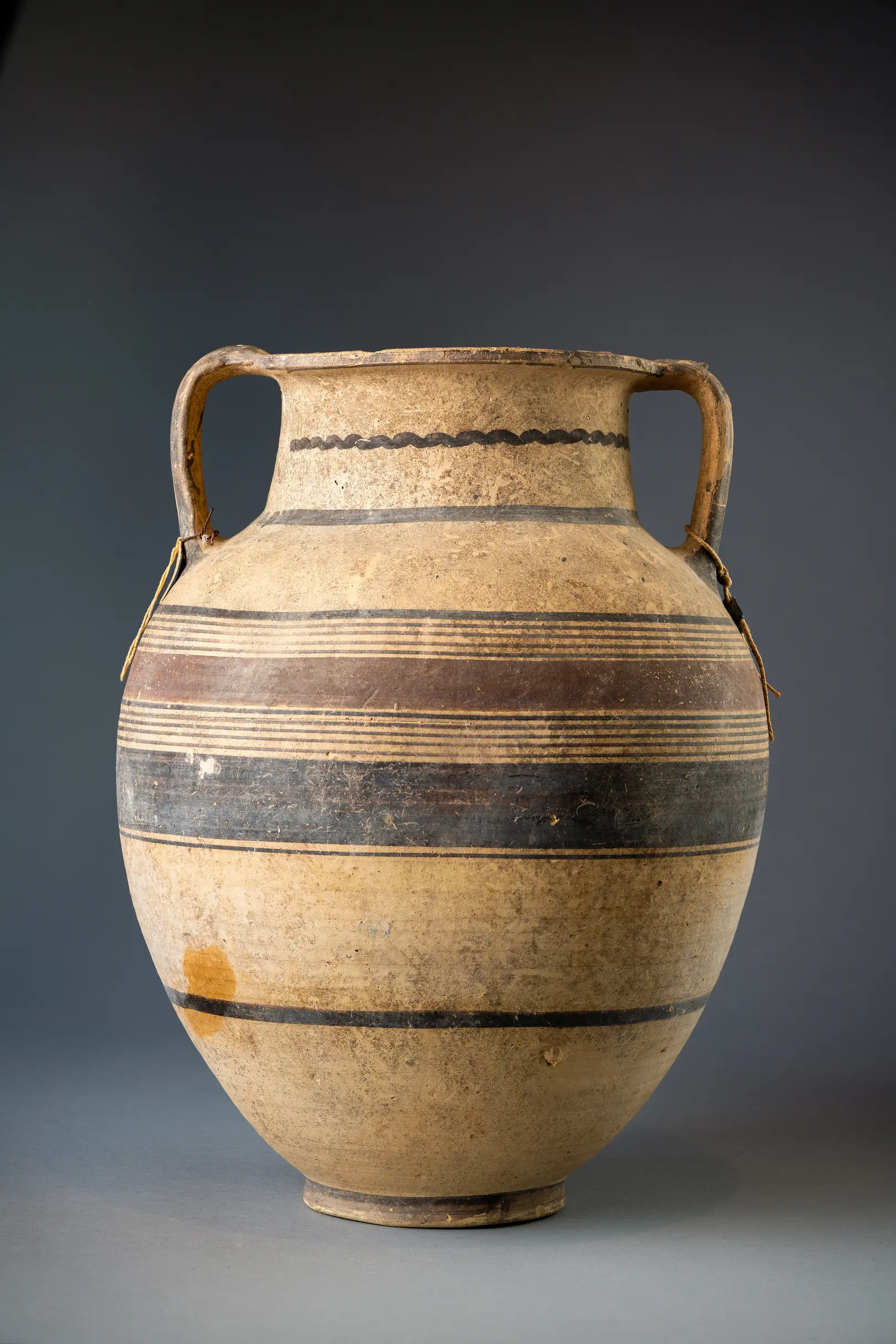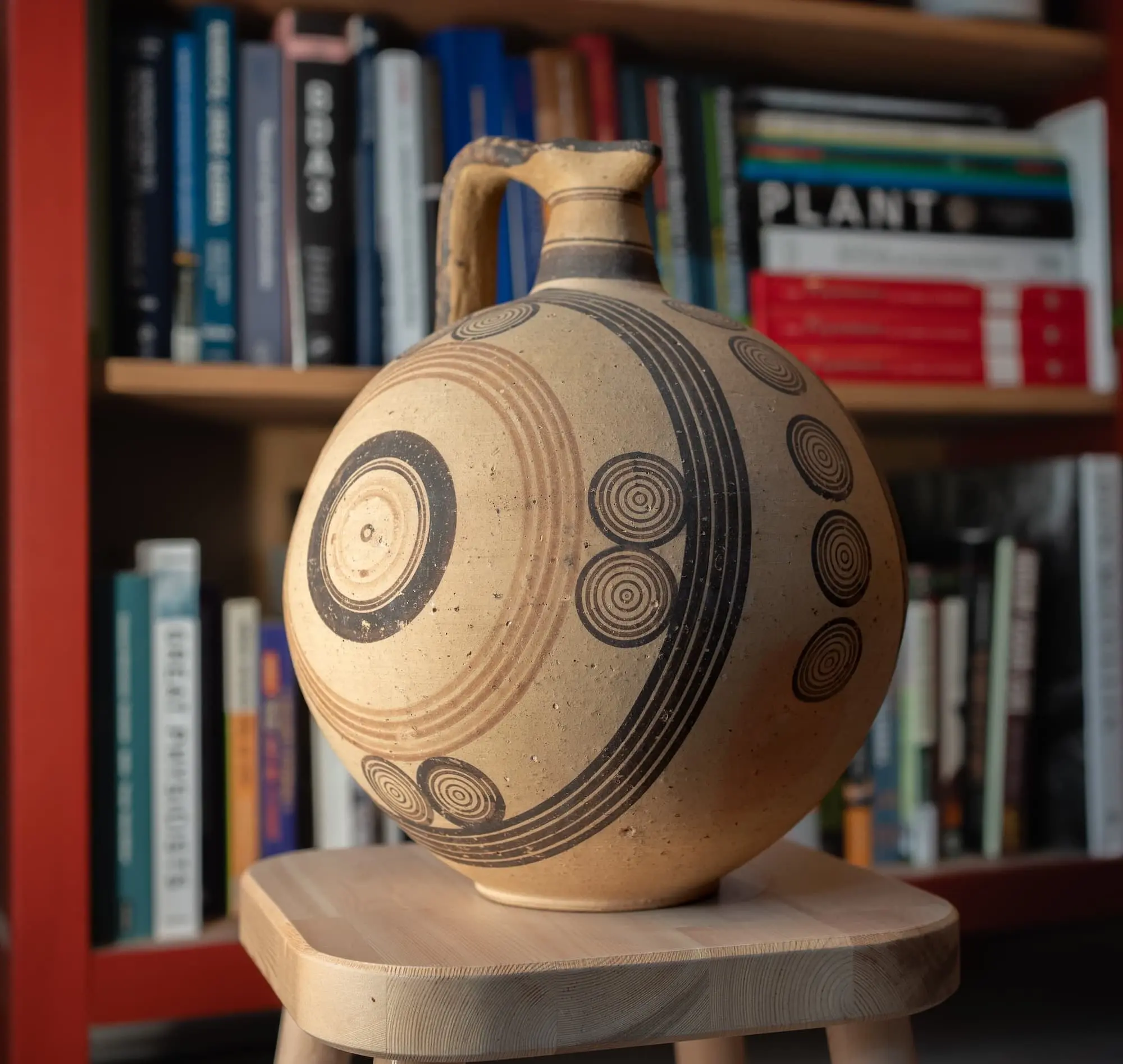
The Cypro-Archaic Period
When the island found its own voice
750 – 480 BCBetween roughly 750 and 480 BC, Cyprus settles into the shape that the rest of antiquity would recognise. The loose chiefdoms of the earlier Iron Age harden into a constellation of city-kingdoms — Salamis, Kition, Paphos, Idalion, Kourion, Marion, Soloi, Tamassos and the rest — each with its own ruler, its own coinage in time, its own sanctuaries, and its own quarrels with the neighbours. They are small polities on a small island, yet they sit at one of the busiest crossings in the ancient world, and that position makes them rich, watched, and endlessly courted.
It is also an age lived under the long shadow of empires. The Neo-Assyrian kings claim the island first; a stele of Sargon II set up at Kition records Cypriot rulers bringing tribute. When Assyria falls, a brief Egyptian overlordship follows under the Saïte pharaohs, and then, from the later sixth century, Cyprus passes into the Persian sphere. The remarkable thing is how lightly these masters seem to have sat. The kingdoms went on minting, building, fighting and worshipping much as before. Distant tribute did not flatten local identity so much as feed it — Near-Eastern, Egyptian and increasingly Greek currents all arrive on the same harbours, and Cypriot craftsmen absorb them into something unmistakably their own.
You can read that confidence most clearly in two materials. In clay, the rigid lattices of the Geometric period relax: a single bird, a fish, a lotus, a lone figure is allowed to stand alone on a plain ground, and decoration edges towards story. In soft local limestone, the island's sculptors begin carving votaries by the thousand to stand in the great open-air sanctuaries. Both are arts of the threshold — between order and image, between the human worshipper and the god — and both are gathered here. The collection holds around eight pieces from this period: a large Bichrome oinochoe, a group of Black-on-Red jugs and a bowl, the fragmentary great plate, and a limestone votive head. Together they let you stand, for a moment, where a Cypriot of the seventh century once stood.
In this section
The Free Field
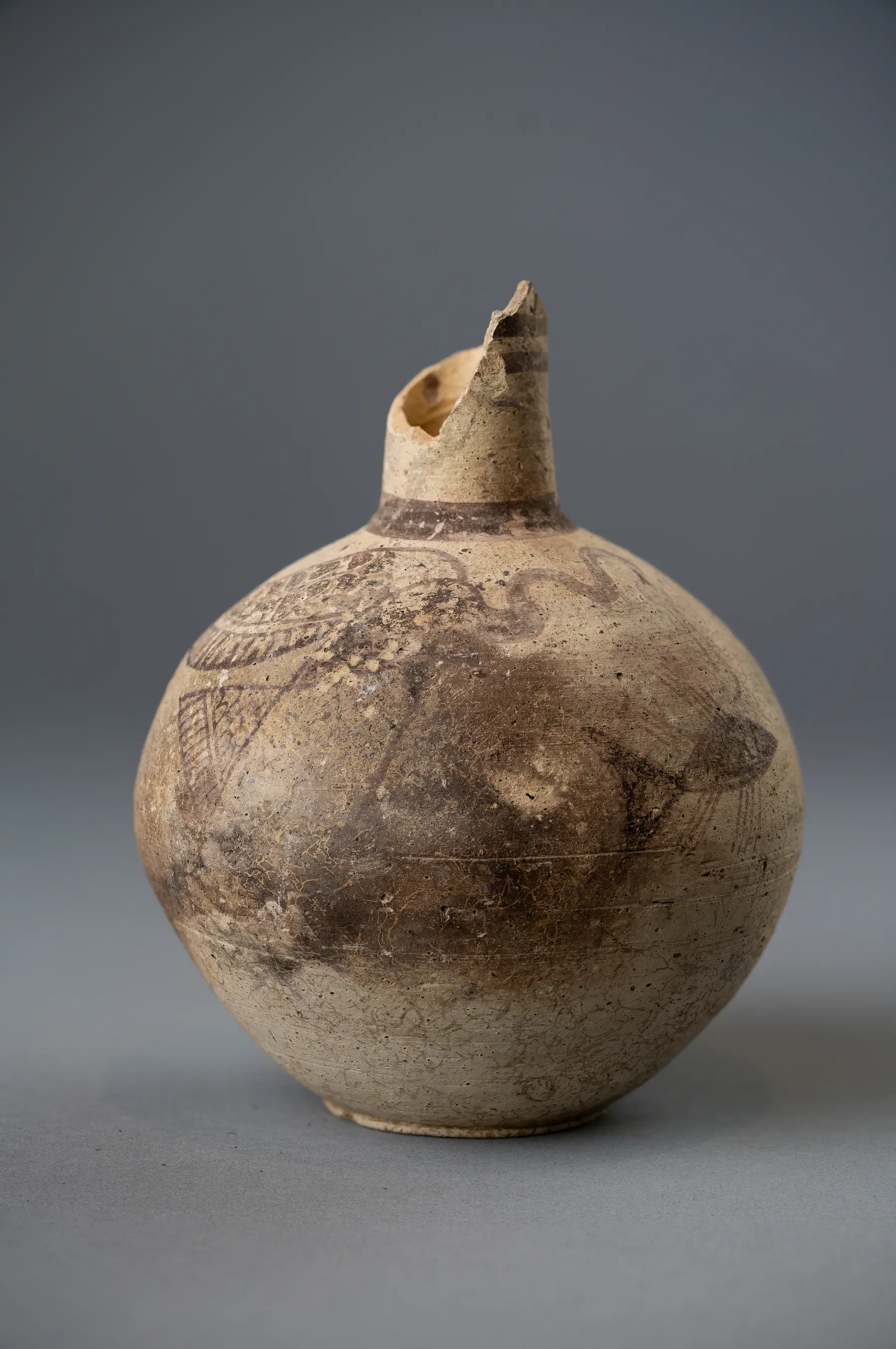
For centuries Cypriot potters had filled their vessels edge to edge. Bands, lozenges, concentric circles, hatched triangles, cross-hatched panels — the Geometric eye abhorred a vacuum, and the surface of a jug was a problem to be solved by repetition. Then, in the Cypro-Archaic period, something loosens. The painters begin to leave the ground empty. A single bird is set on the swelling shoulder of a jug with nothing around it but bare, pale clay. A fish, a stylised flower, a lone human figure floats in open space. Scholars call this the Free-Field style, and it is one of the most distinctive things Cypriot ceramics ever produced.
The change is more than decorative housekeeping. To isolate a single creature is to invite the viewer to look at it — to read it as a subject rather than a pattern unit. The bird becomes a particular bird, turning its head, lifting a wing. Decoration begins to lean, however gently, towards narrative and observation. It is no accident that this happens in the same generations that orientalising motifs are flooding in from the Levant and the Greek world: lotus and palmette, sacred trees, files of animals, the whole vocabulary of Near-Eastern luxury art. Cypriot painters take these foreign images and set them loose on their own pale fields.
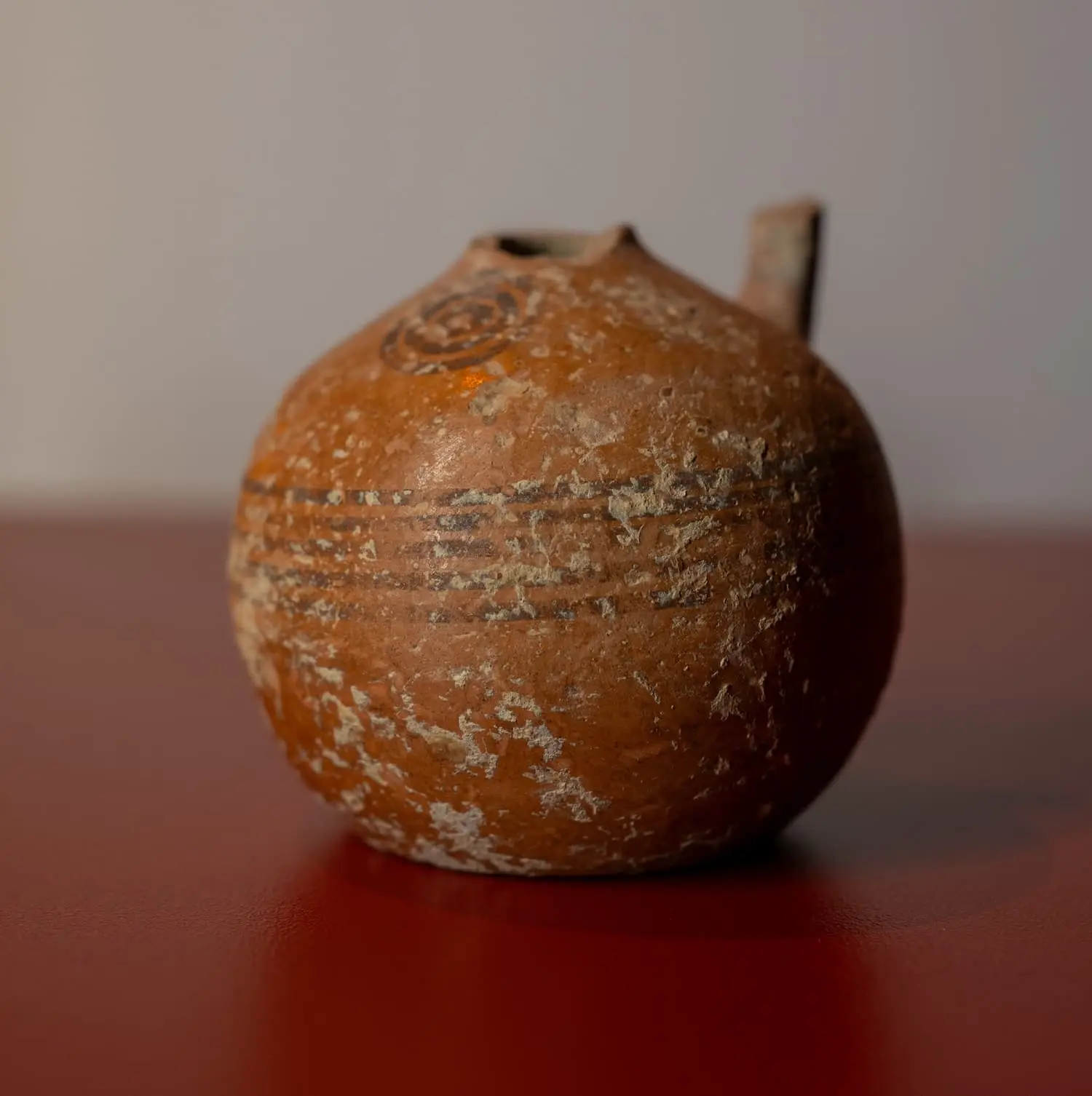
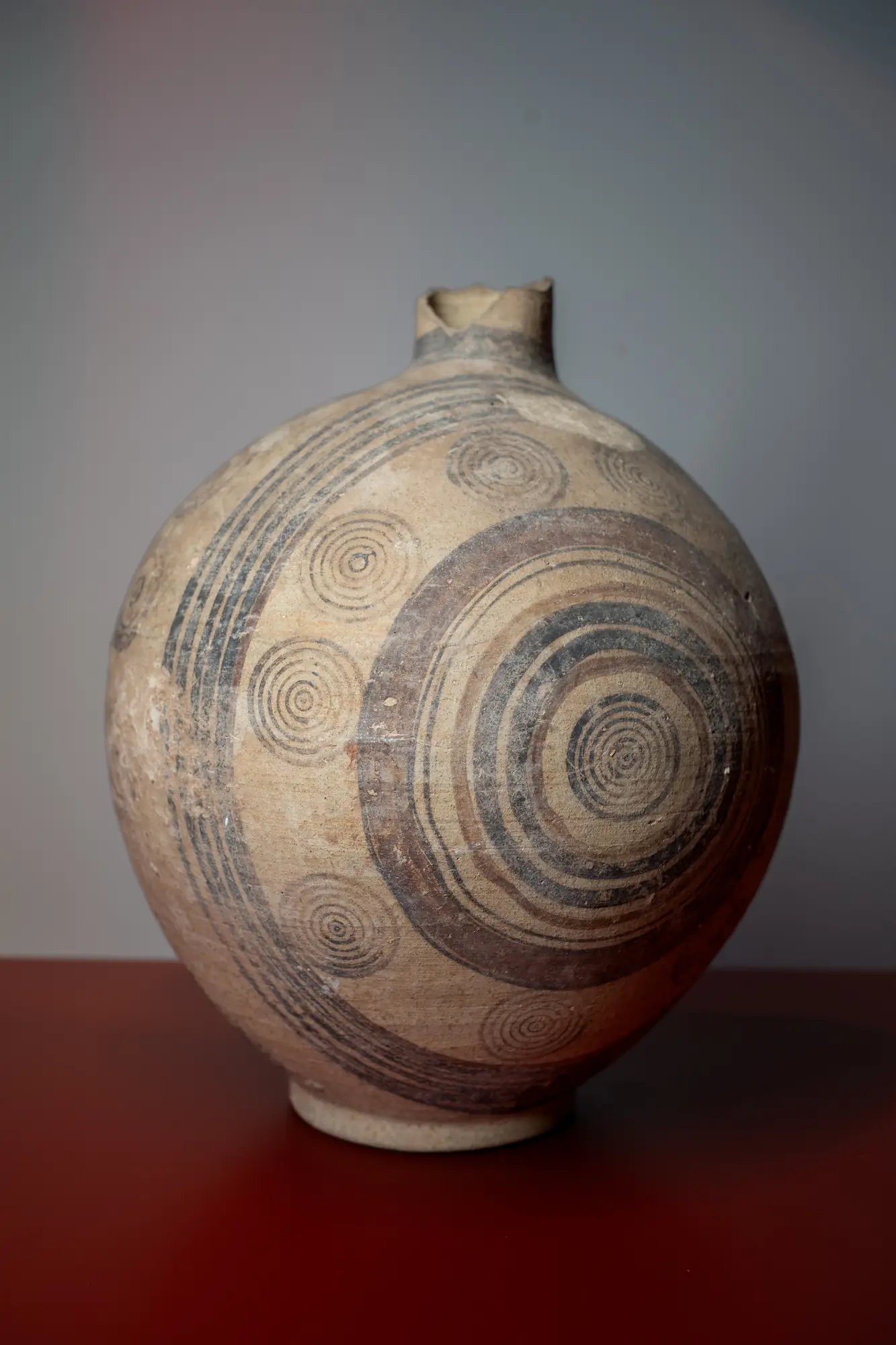
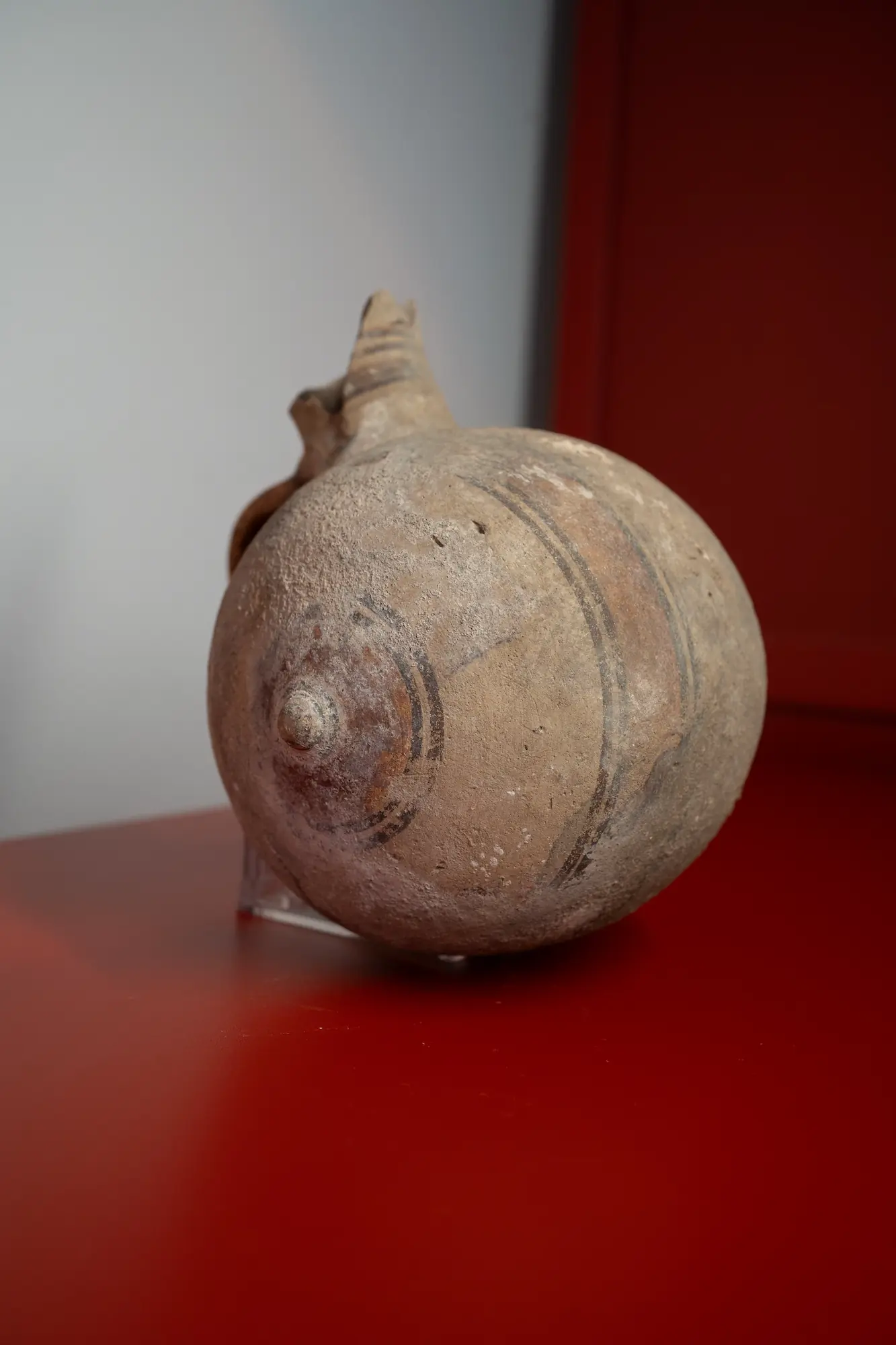
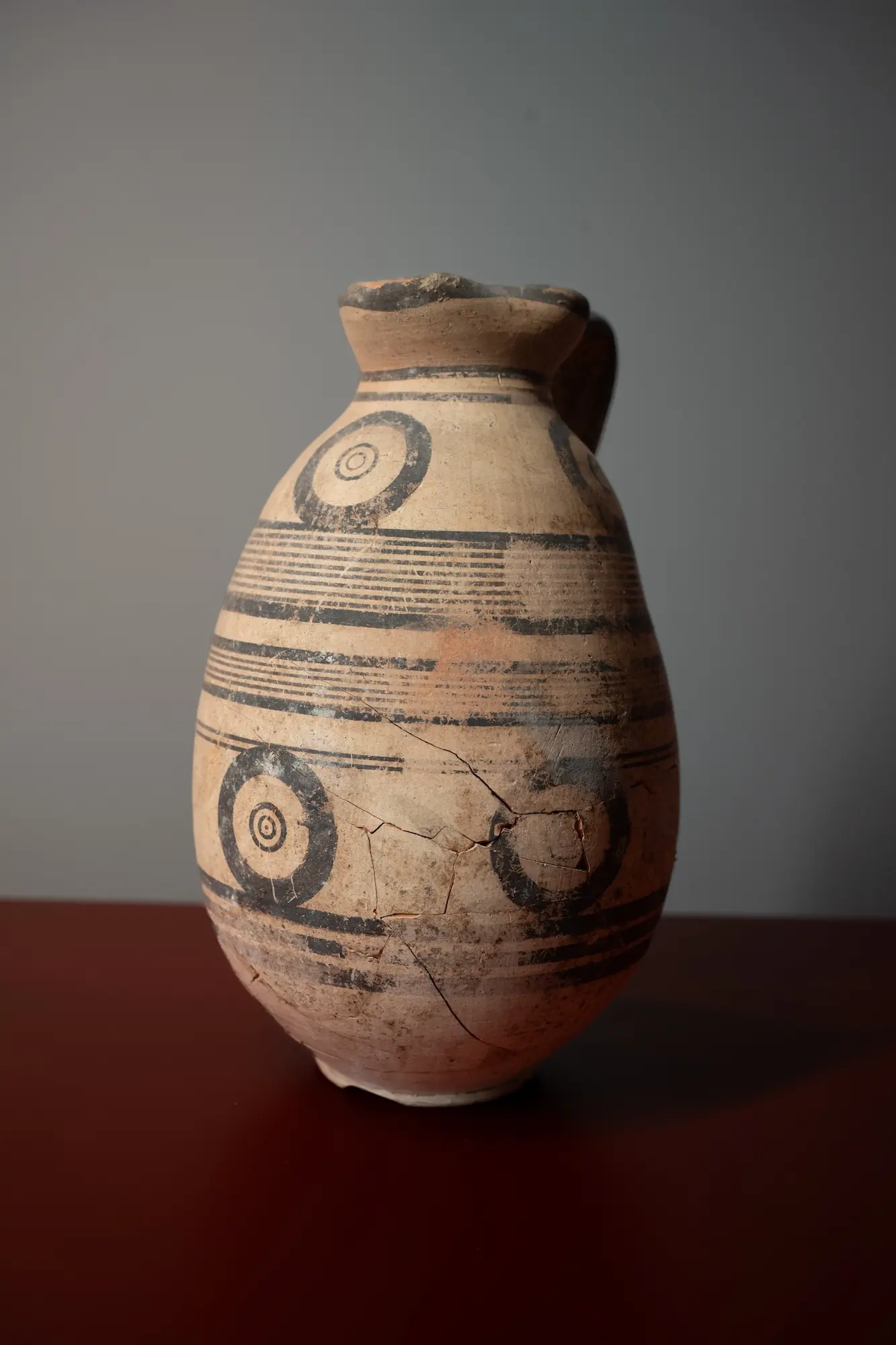
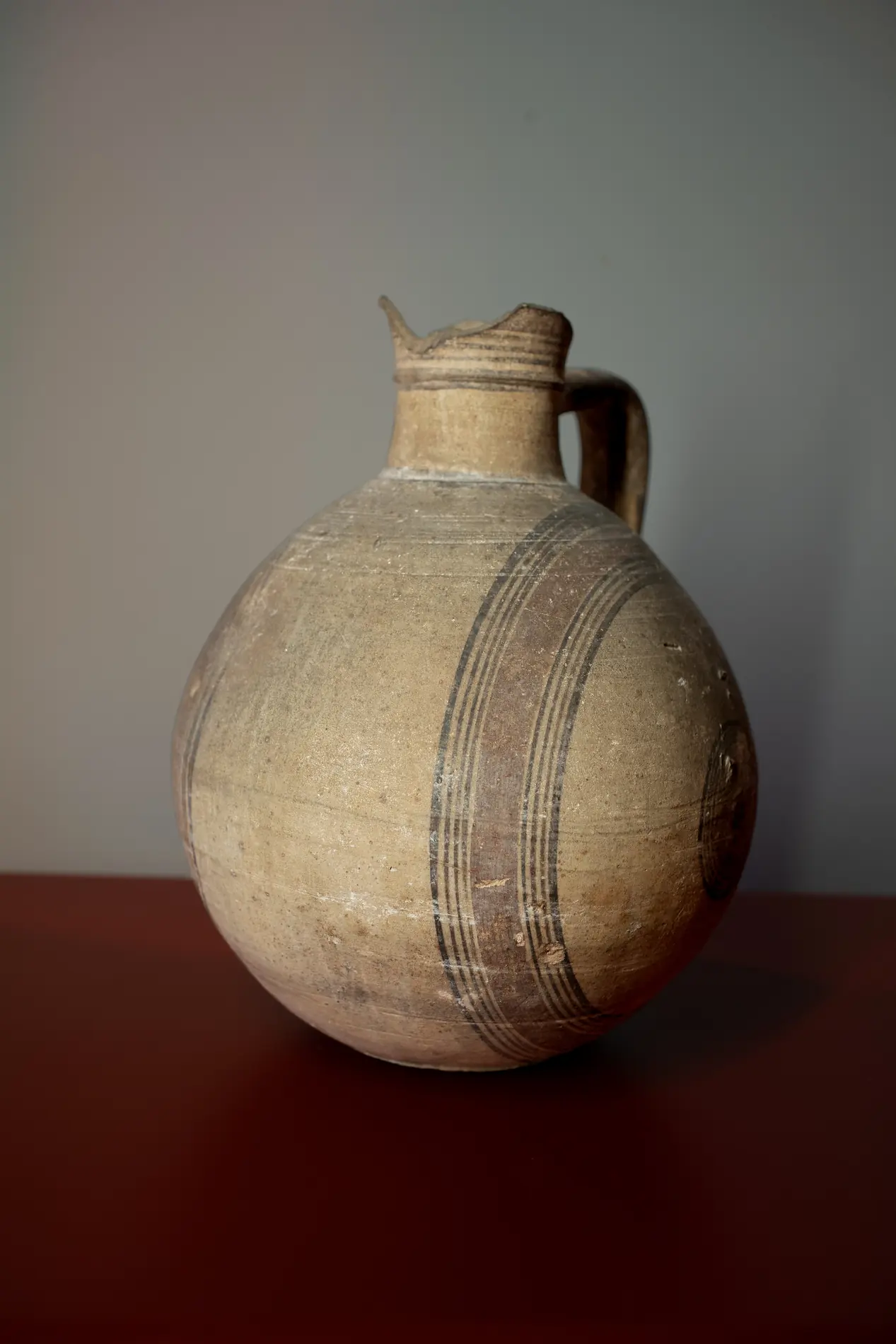
Much of this work is carried by two related techniques. Black-on-Red ware coats the vessel in a lustrous red slip and draws over it in dark, almost black lines — a high-contrast surface that the island exported widely, with examples turning up across the Levant and beyond. Bichrome ware adds a second colour, usually red and black together over a lighter ground, for richer, more legible scenes. The pieces gathered in this chapter — the jugs and the bowl — show the style at its most assured, in the very decades the city-kingdoms were at their height.
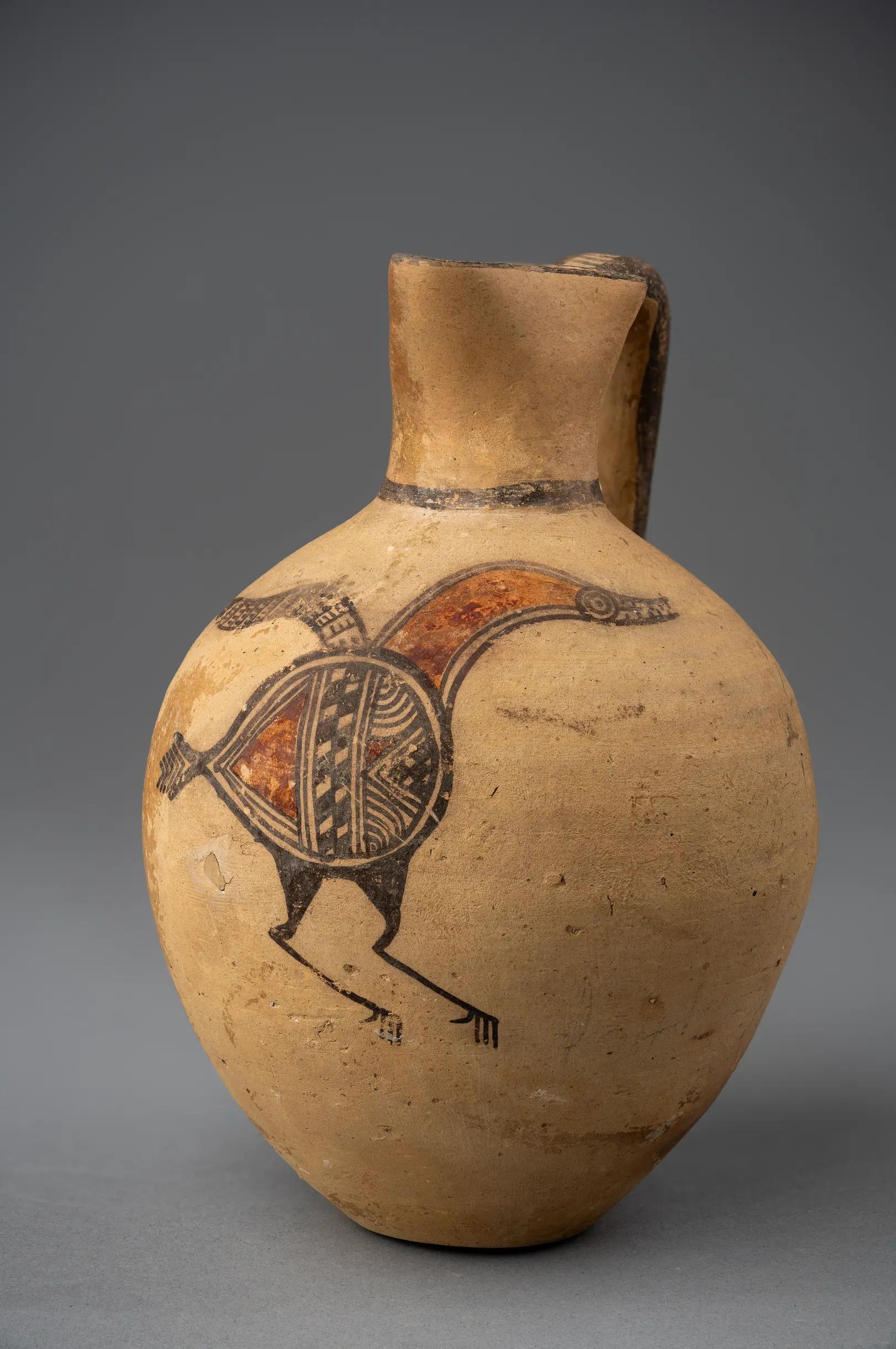
700 BC – 575 BC
Free Field Bird Oinochoe
Free Field Bird
Provenance:
- Major Alessandro Palma di Cesnola (1839–1914); from his excavations in Cyprus 1876-79, likely in Ormidhia
- Lieut-General Fox Pitt-Rivers (1827-1900), Dorset, UK; acquired 1st June 1883, and held in his museum room IV, from 8th August 1896
- George Henry Lane-Fox Pitt-Rivers (1890-1966), Dorset, UK; by descent from the above
- Stella Pitt-Rivers (1913-1994), Dorset, UK; from the above
- Charles Ede Ltd, London, UK; acquired 24th February 1975, stock number E4614
- Dr. Ian Mueller, Chicago, USA; acquired May 1976 from the above
- Harlan J Berk, New York
- Charles Ede Ltd, London, UK, acquired 25th July 2016
- Margaret Janet Bourne, Surrey, UK; acquired from the above 26th October 2018
- Charles Ede Ltd, London, UK
- 2025 - Current, Alexis Drakopoulos, acquired at TEFAF Maastricht 2025
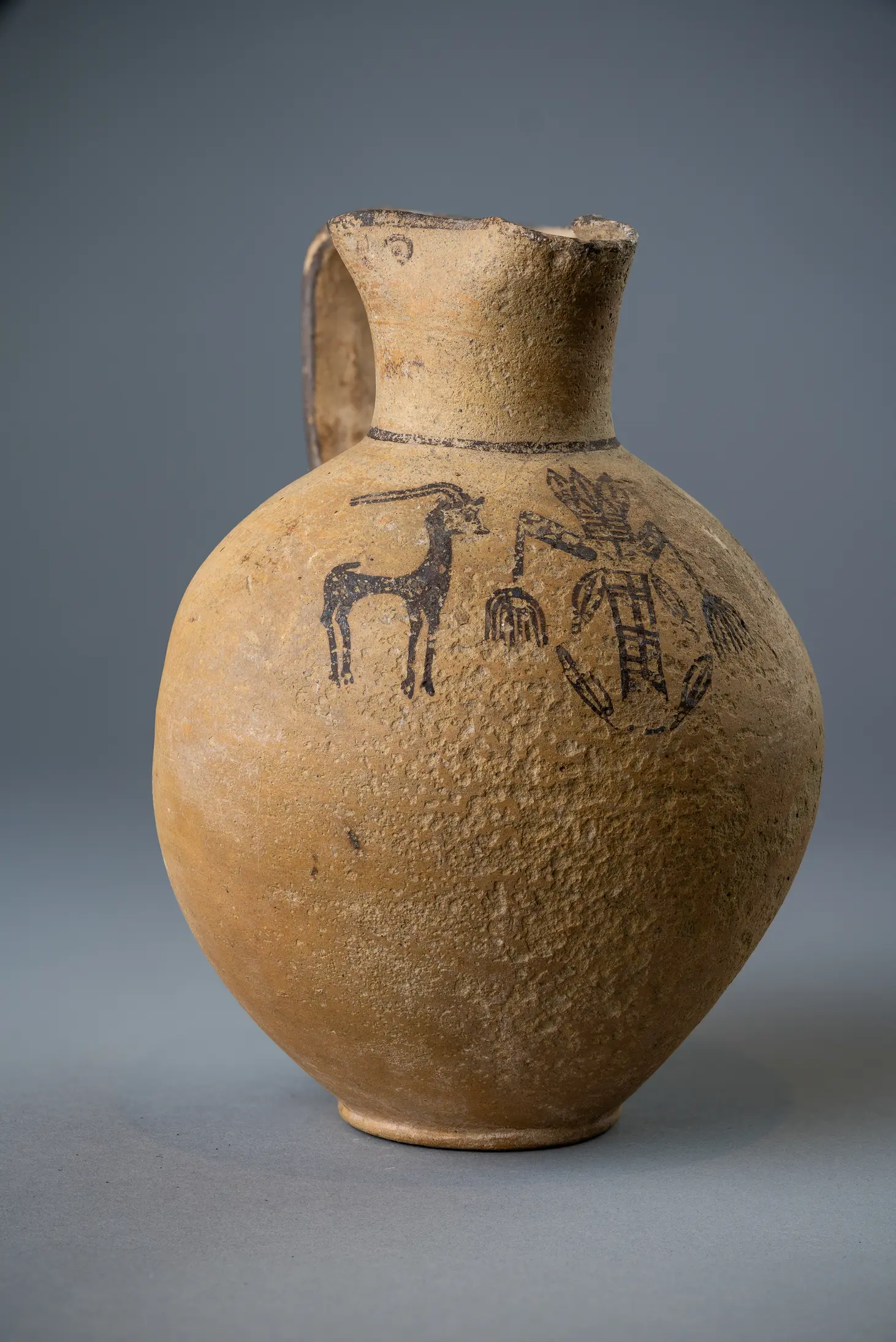
750 BC – 575 BC
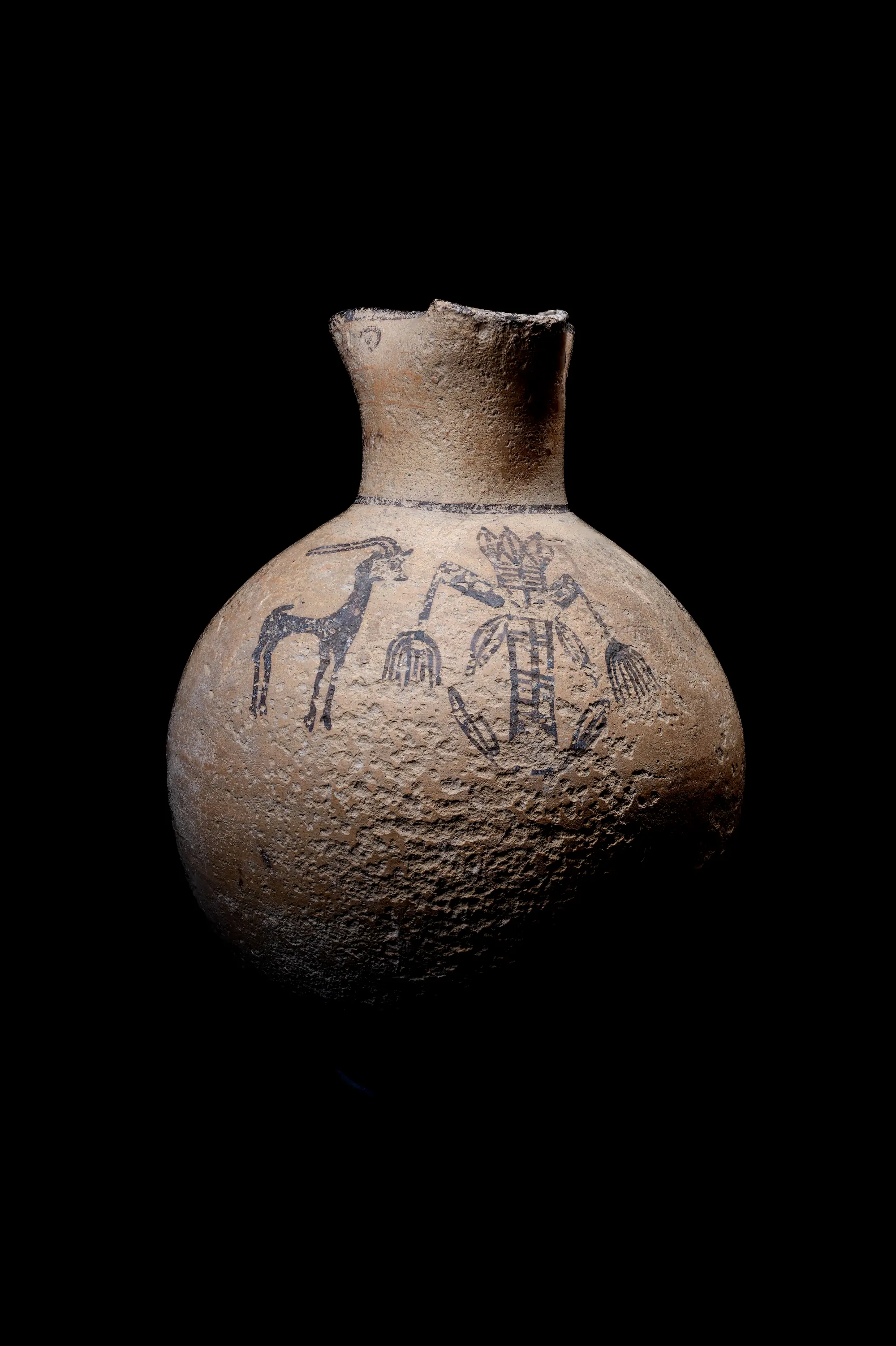
Free Field Anthropomorphic Date Palm Oinochoe
Ancient Cypriot Jug in the Free Field Style (circa 700-600 B.C.) The jug (Oinochoe) is 22cm tall and depicts a free field scene. The scene shows an antelope or deer like animal next to a human shaped figure drawn in an abstract form. The Cypriot Iron Age (1050-480 B.C.) introduced new styles of pottery and motifs that deviated from the earlier Bronze Age traditions. The most iconic of these new styles is the Geometric style, characterized by a liberal use of circles, arrows, and other prototypical patterns harmoniously arranged to create captivating artistic compositions. However, Cypriot potters, potentially inspired by their neighbors throughout the Levant, soon began to break free from the confines of these Iron Age patterns and ventured into the realm of free field art. This style is distinguished by its intricate, free-flowing forms that allowed for greater artistic expression and experimentation. One of the most popular subjects in free field art was the depiction of birds and other animals. However, in very rare cases, human forms were also represented. This ancient Cypriot jug, dating back to circa 700-600 B.C., is one such exceptional example. Alongside a more commonly seen antelope, we find an abstract representation of a human figure. The identity and significance of this human form remain enigmatic. While it is tempting to interpret the figure as a deity or shaman and assign religious meaning, conclusive evidence supporting such claims is scarce. The scarcity of parallels to this human representation in contemporary Cypriot pottery adds to the enigma surrounding its meaning and purpose. Further research and comparative analysis with other artifacts from the region and period may shed light on the intended symbolism behind this intriguing figure.
Provenance:
- 1980s - 2023, Henry Sandon, UK
- 2024 - Present, Alexis Drakopoulos, London, UK
Jugs for the Pouring
Black-on-Red and Bichrome jugs whose painters let a single bird or motif stand alone on bare clay — the Free-Field style at the moment Cypriot pottery turned towards image.
Bowls and the Open Hand
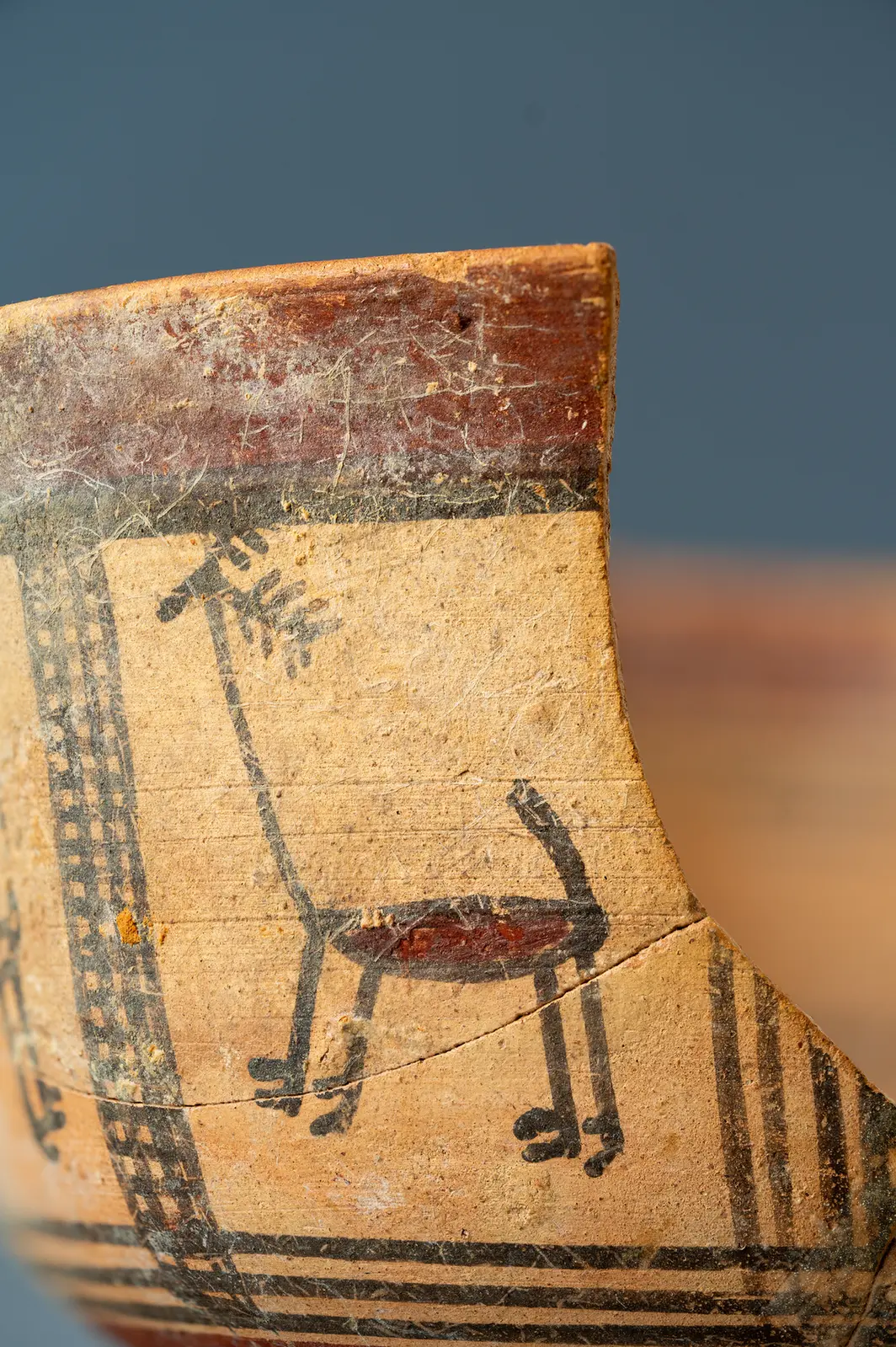
Black-on-Red bowls whose interiors carry the same high-contrast decoration, designed to be read from above as the vessel was lifted, passed and set down.
The Plate That Was Almost Lost
A large decorated Archaic plate so rare it was first taken for a forgery — until the clay itself testified to its own age.
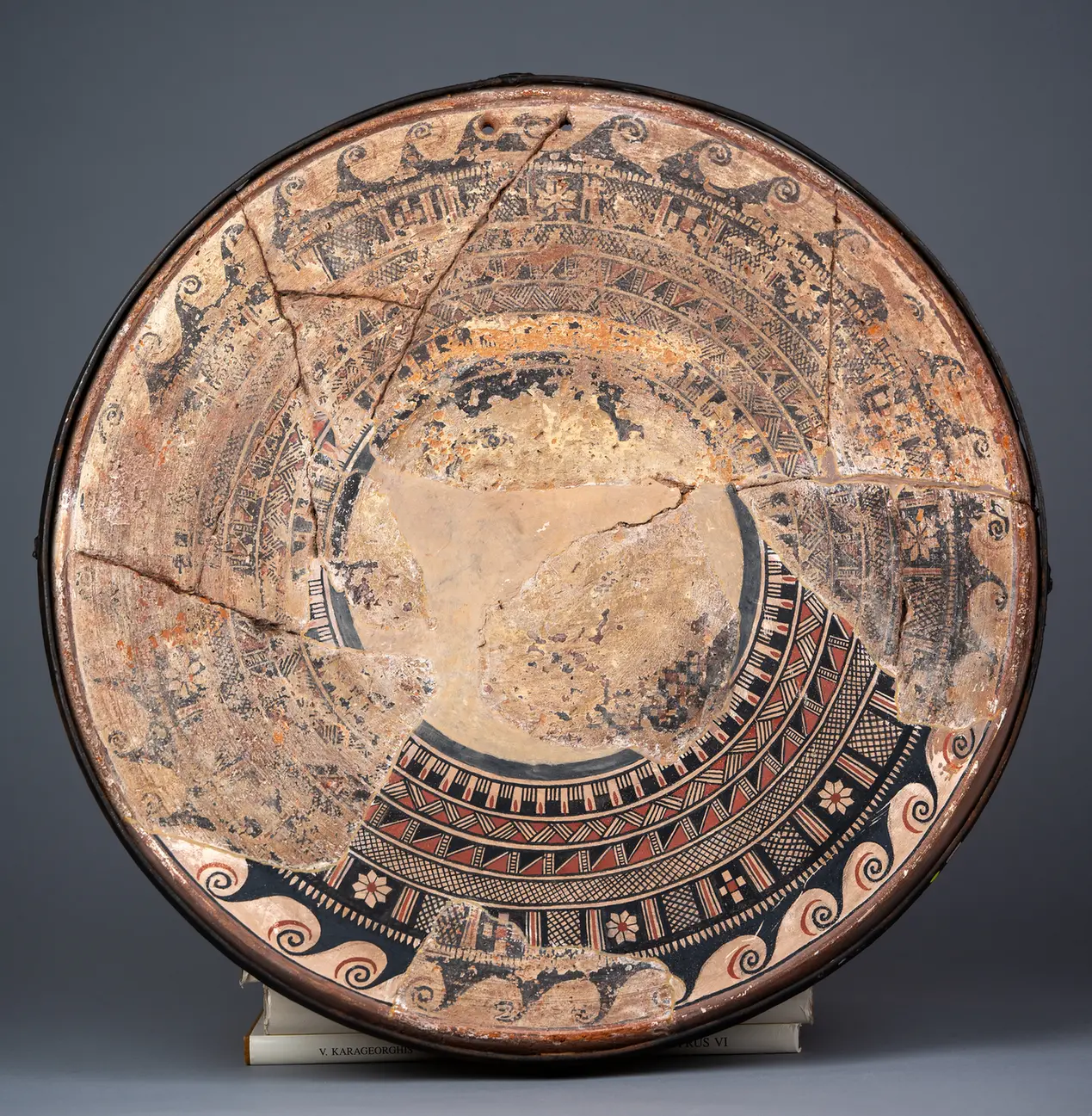
Move across all ten fragments in deep zoom — watch the painted bands carry over each break.
The object
What survives is fragmentary: a large Archaic plate, broken and rejoined, its decorated surface incomplete but generous enough to read. It is the best-documented piece in the collection, photographed from ten angles so that every fragment, every join, every passage of paint can be examined in turn. The breaks are part of its biography now, not a flaw to be hidden.
Large open plates of this kind are not the everyday cups and jugs that fill museum cases. They are display objects — wide, flat fields that a painter could treat almost like a panel, with room for a central motif and concentric framing. To decorate a plate on this scale, and decorate it well, was to make something that demanded to be seen face up, set out rather than poured from. That is precisely what makes it scarce, and scarcity, in this trade, has a way of breeding suspicion.
The dating here runs to roughly 700–575 BC, placing the plate squarely in the Cypro-Archaic horizon, among the same workshops producing the Free-Field jugs in the gallery before it. It came to the collection from the Goodman Collection, where — on current understanding, and the collector will confirm the detail — it had rested since the 1960s before passing to its present home.
Why rarity invites suspicion
The honest version of this story begins with doubt. Well-decorated Archaic plates of any size are uncommon; large ones are rarer still. When something is rare and desirable, the market produces imitations to meet the demand, and the better the imitation, the harder the question becomes. A piece that is both unusually fine and unusually scarce is, paradoxically, the very thing a serious buyer should distrust first.
So this plate was, at the outset, suspected of being a modern forgery. That is not a mark against it; it is the proper reflex of anyone who has watched the antiquities trade. The eye alone — even a trained eye — can be fooled by a skilled hand working from genuine prototypes. Stylistic judgement narrows the field, but it cannot, by itself, settle whether a pot was fired three weeks ago or twenty-six centuries ago.
The collector's draft account of this episode runs roughly as follows, to be checked and corrected against his own records: the piece raised exactly these alarms when first assessed, and rather than rely on connoisseurship alone, the decision was taken to interrogate the clay itself.
What the clay remembered
The test that settled it is thermoluminescence dating — TL for short — and it works on a quietly beautiful principle. The clay of any pot contains tiny crystals, mostly quartz and feldspar, embedded in the fabric. Buried or simply existing in the world, these crystals are bombarded by faint, ceaseless natural radiation from their surroundings, and they trap a little of that energy in their lattice, electron by electron, year after year. The clock is set to zero only once: in the kiln. When a pot is first fired, the heat empties every trap and the count begins again from nothing.
To read that clock, a laboratory drills a small sample from an inconspicuous spot, grinds it to powder, and heats it under controlled conditions. As the crystals are heated, they release their stored energy as a faint glow of light — thermoluminescence. The brighter the glow, the more radiation has accumulated, and so the longer it has been since the clay was last fired. Set against the rate at which that local environment delivers radiation each year, the glow yields an age. A forgery fired in a modern workshop has almost no signal to give; an ancient pot lights up.
This plate lit up. The TL result placed its last firing in deep antiquity, not in any recent decade, and the suspicion of forgery fell away. The clay had, in effect, testified to its own age. It is worth being plain about the method's limits — TL gives a firing window with a margin of roughly twenty per cent, not a calendar date — but for the question that mattered here, ancient or modern, the answer was unambiguous.
What such plates were for
Knowing the plate is genuine returns us to the more interesting question of what it meant to the people who made and used it. A vessel this wide and shallow is not built for liquids in any quantity. Its whole logic is the upturned face: a surface to be looked down into, its central motif framed by encircling bands, its decoration composed for a viewer standing over it rather than tilting it to drink.
Plates of this kind likely served at the higher end of domestic and ceremonial life — set out at a meal of some standing, used in the rituals of a household or sanctuary, or deposited as an offering. We should be careful not to over-specify a single function from a fragmentary object; the safest statement is that a large, carefully painted plate was an object of display and occasion rather than daily kitchen ware. Its value lay partly in the skill it advertised.
Look closely at the painted decoration and you can still follow the painter's discipline: the controlled banding, the deliberate placement of motif within field, the same Free-Field instinct for letting an image breathe that runs through the whole chapter. On a curved jug that instinct produces a floating bird; on a flat plate it produces a composition you read like a target, from the centre outward.
Examine it yourself
Ten photographs exist precisely so that this plate need not be taken on trust — the same spirit, in the end, that sent it to the laboratory. The breaks invite scrutiny rather than concealing it.
Move across the fragments and watch how the decoration carries over the joins, how the paint thins and pools, where the surface has worn and where it holds. You are looking at the work of a single hand, twenty-six centuries gone, and at the clay that quietly kept the record straight.
“The eye can be fooled by a skilled hand. The clay cannot lie about when it was last in the fire.”
Provenance
- Goodman Collection, 1960s - 2025
- 2025 - Present, Alexis Drakopoulos, London, UK
650 BC – 550 BC
Archaic Limestone Head
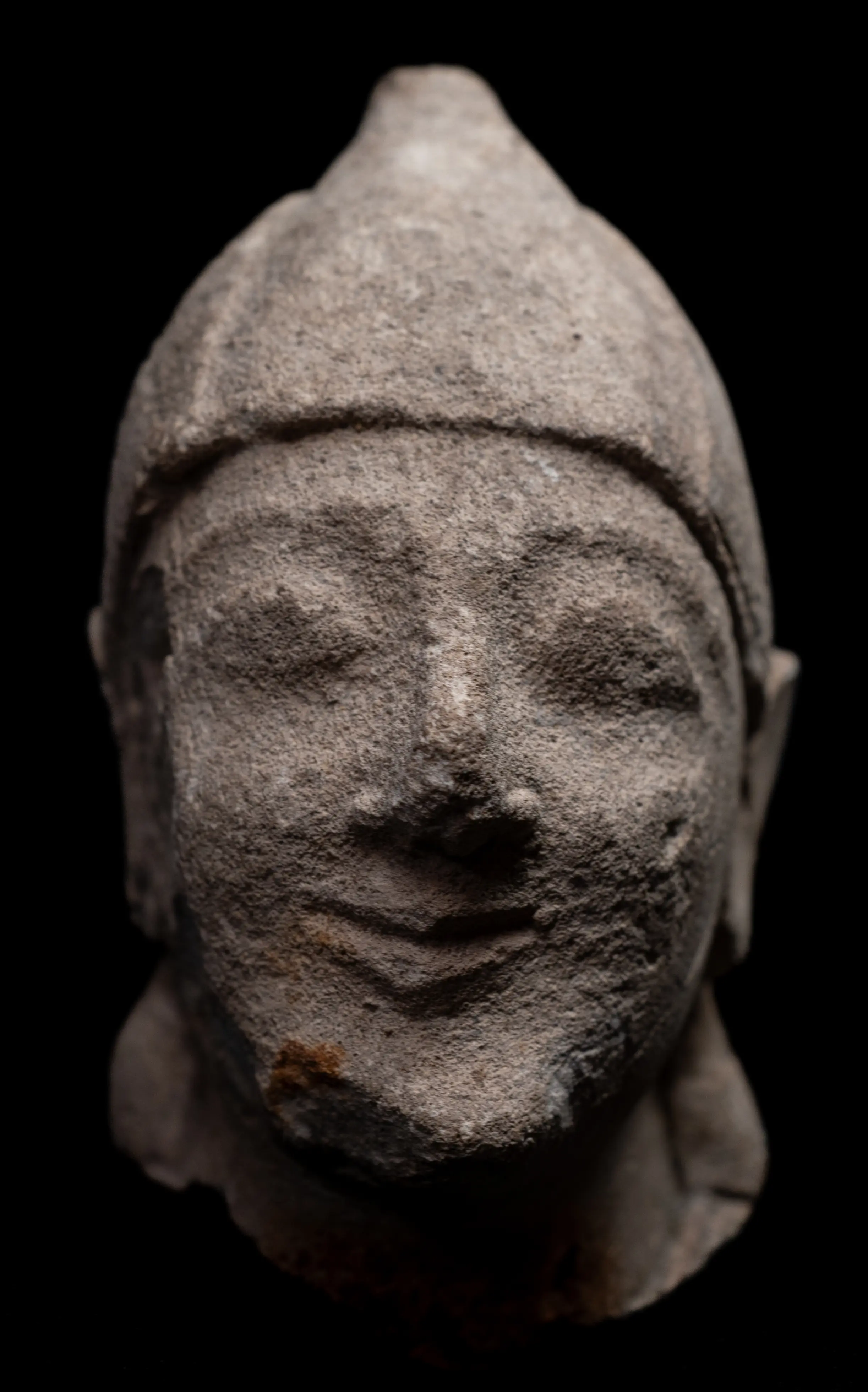
Votive limestone head, archaic, smiling, head of a man. 10cm. Part of the Victor Emille Gabriel Chevallier (1889 - 1979) and his wife Marguerite Jeanne Verel (1887 - 1962) Collection.
Provenance:
- Early 1900s (Pre 1969), Chevallier-Verel Collection, Paris, France
- 1969 - 2024, Mr X, Paris, France
- 2024 - Present, Alexis Drakopoulos, London, UK
The Face of a Worshipper
A late-Archaic limestone head of a woman, carved to stand for ever in a sanctuary on the worshipper's behalf.
Turn the head from front to profile — the frontal view is the worshipper's; the profile is the carver's.
A head from the sanctuaries
This is a late-Archaic limestone head of a woman: a face lifted from a votive figure that once stood, complete, in one of the island's open-air sanctuaries. (The piece is still being catalogued, and the collector will refine the particulars; what follows is grounded in the well-understood class to which she belongs rather than in invented detail about this single head.)
To understand her you have to picture the place she came from. From the later seventh century BC onward, Cypriot worshippers did not simply pray and leave. They commissioned a stone image of themselves — a votary — and set it up in the sacred precinct so that their devotion would continue after they had gone home. The figure stood in for the donor, perpetually present before the deity, perpetually offering. A sanctuary of any importance therefore filled, over generations, with a silent crowd of these surrogates.
The numbers are genuinely staggering. At sites such as Golgoi, Idalion and Arsos, votive figures were dedicated by the hundred and the thousand. When the great deposits were eventually excavated, they yielded ranks of limestone men and women, large and small, of every quality from the crude to the masterly. This head was once one face in such a multitude.
Soft stone, local hand
The material itself shaped the art. Cyprus has abundant soft, fine-grained limestone, easily quarried and easily worked — it can be cut with relatively simple tools and takes detail readily. That accessibility is part of why votive sculpture became a mass practice on the island in a way it did not elsewhere: a workshop could turn out figures in quantity, scaled and priced to the means of the donor.
The softness is also why so many of these heads survive in the state they do. The stone weathers and abrades; sharp edges soften; surfaces that were once crisply tooled now read as gently worn. What you lose in precision you sometimes gain in a kind of tenderness — the features rounded by time into something quieter than the carver intended.
Golgoi in particular became famous for its workshops, producing limestone sculpture in such volume that it served as a regional centre for the craft. Idalion and Arsos followed. These were not the products of a single court atelier but of a broad, competitive industry answering steady local demand from worshippers who wanted to leave something of themselves before the god.
The archaic smile and its borrowed styles
Look at a head like this and the first thing you meet is the expression — the faint, deliberate upturn at the corners of the mouth that art historians call the archaic smile. It is a convention, not a portrait of mood; the same gentle smile appears across the archaic Mediterranean, from Greek kouroi to these Cypriot votaries. Yet it does its work. The face is composed, attentive, faintly serene, exactly as a worshipper standing before a deity might wish to be remembered.
What makes Cypriot sculpture distinctive is the way it braids together the styles arriving from every direction. There is an Egyptianising current — frontal poses, certain treatments of wig and headdress — carried in large part through Phoenician intermediaries active on the island in the sixth century. There is a Near-Eastern strain in the modelling and ornament. And, increasingly through the period, there is the soft modelling and that very smile inherited from East Greek art across the Aegean. A Cypriot carver did not choose among these; he worked in a milieu where all of them were simply available, and the result is a local idiom that is recognisably its own.
Female votaries carry their own distinguishing features. They are typically shown richly adorned — elaborate headdresses, diadems or veils, and jewellery worked into the stone: earrings, necklaces, sometimes a band across the brow. The ornament is not vanity but status and offering, the worshipper presenting herself to the deity in her finest aspect. Where such detail survives on this head, it is worth lingering over; where the soft stone has worn it away, the loss is its own kind of record.
A companion already in the collection
She does not stand alone here. The collection already holds a male votary head of the same broad tradition — a small Archaic limestone head of a smiling man, around ten centimetres high, with a documented earlier history in the Chevallier-Verel collection in Paris before it came to London. Setting the two together is its own quiet pleasure.
They would never have been carved as a pair, and may come from different sanctuaries and different hands. But they belong to the same world and the same act: two ordinary Cypriots, a man and a woman, each commissioning a stone proxy to stand for them before a god. Placed side by side now, centuries after the precincts that held them fell silent, they restore something of the crowd they once belonged to.
The pairing also lets the eye compare. Male and female votaries share the archaic smile and the frontal composure, but diverge in headdress, in ornament, in the conventions of hair and feature. Read them against each other and the workshop logic of Cypriot votive sculpture starts to come clear.
Face to face
Most ancient art keeps its distance. Pottery shows us what people owned and used; architecture shows us where they lived. A votive head is rarer, because it was made expressly to be a face — and made to be looked at, indefinitely, in the presence of the sacred.
The collector's draft reflection, to be revised in his own words, is something close to this: that holding such a head is unlike holding any pot. You are not meeting an object the ancients used. You are meeting the way an ancient person chose to present themselves to their god — composed, adorned, faintly smiling, and meant to stay that way for ever. The deity they faced is gone; you are standing, more or less, where the deity once stood.
Look at her straight on, then turn her in profile. The frontal view gives you the votary's intended address — the calm, outward-facing presentation. The profile gives you the carver: the depth of the cut, the line of the jaw, the soft stone's surrender to time. Between the two views, a single anonymous worshipper of Archaic Cyprus comes about as near to us as the centuries allow.
“You are not meeting an object the ancients used. You are meeting the way an ancient person chose to stand before their god.”