
Cypriot Plank Figures: Three Necks, or One Neck and Two Locks of Hair
Two Cypriot plank figures from Cyprus, with no recorded find-spot and fifty-three years in the Ashmolean behind them, have joined the Drakopoulos collection. One of them is the single object on which a published reinterpretation of the whole class was built.
Alexis Drakopoulos
June 14, 2026·Archeology · History · Collection·15 min read


Share


Alexis Drakopoulos is a Greek Cypriot Machine Learning Engineer working in Financial Crimes. He is passionate about Archeology and making it accessible to everyone. About Me.
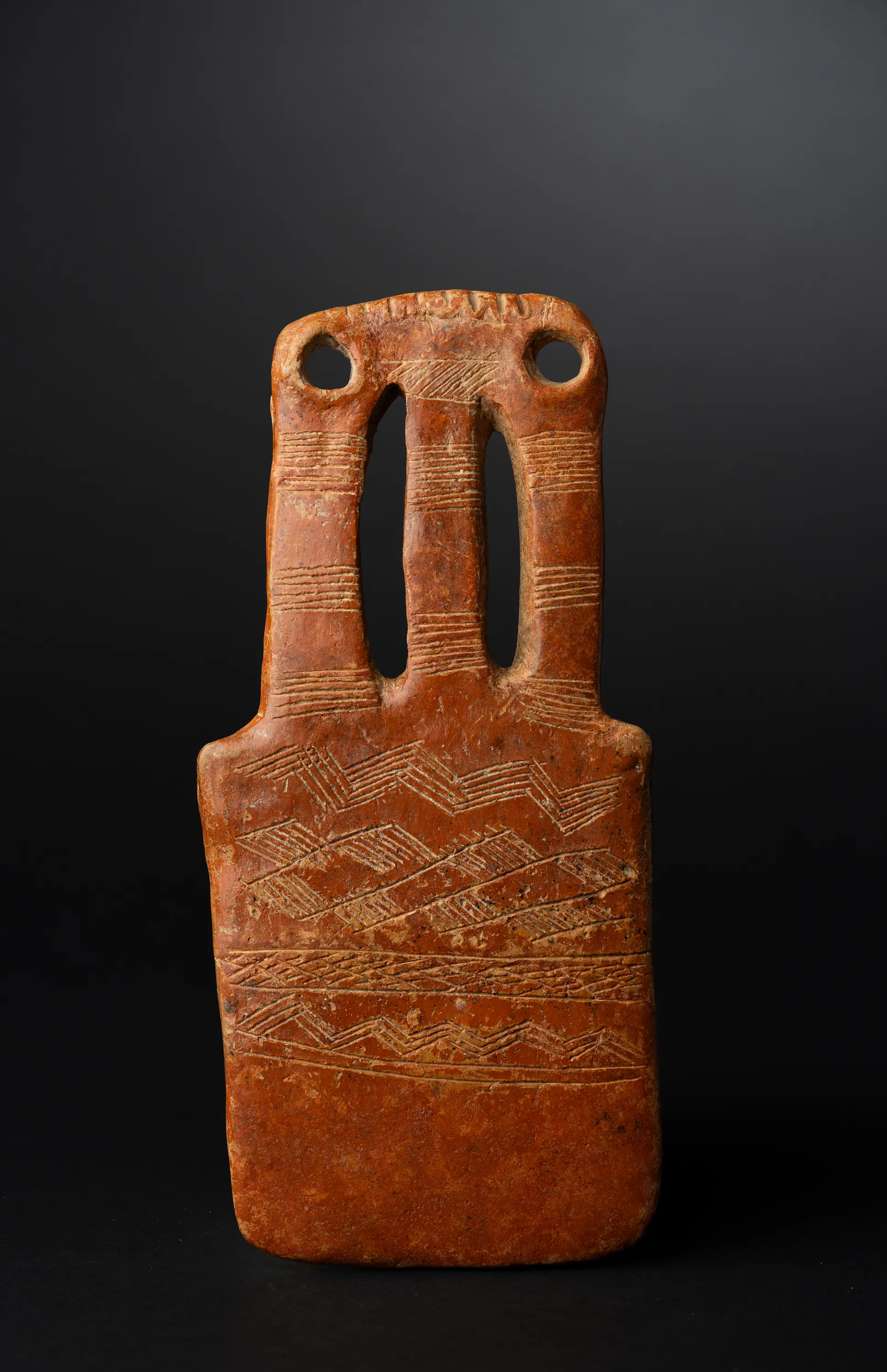
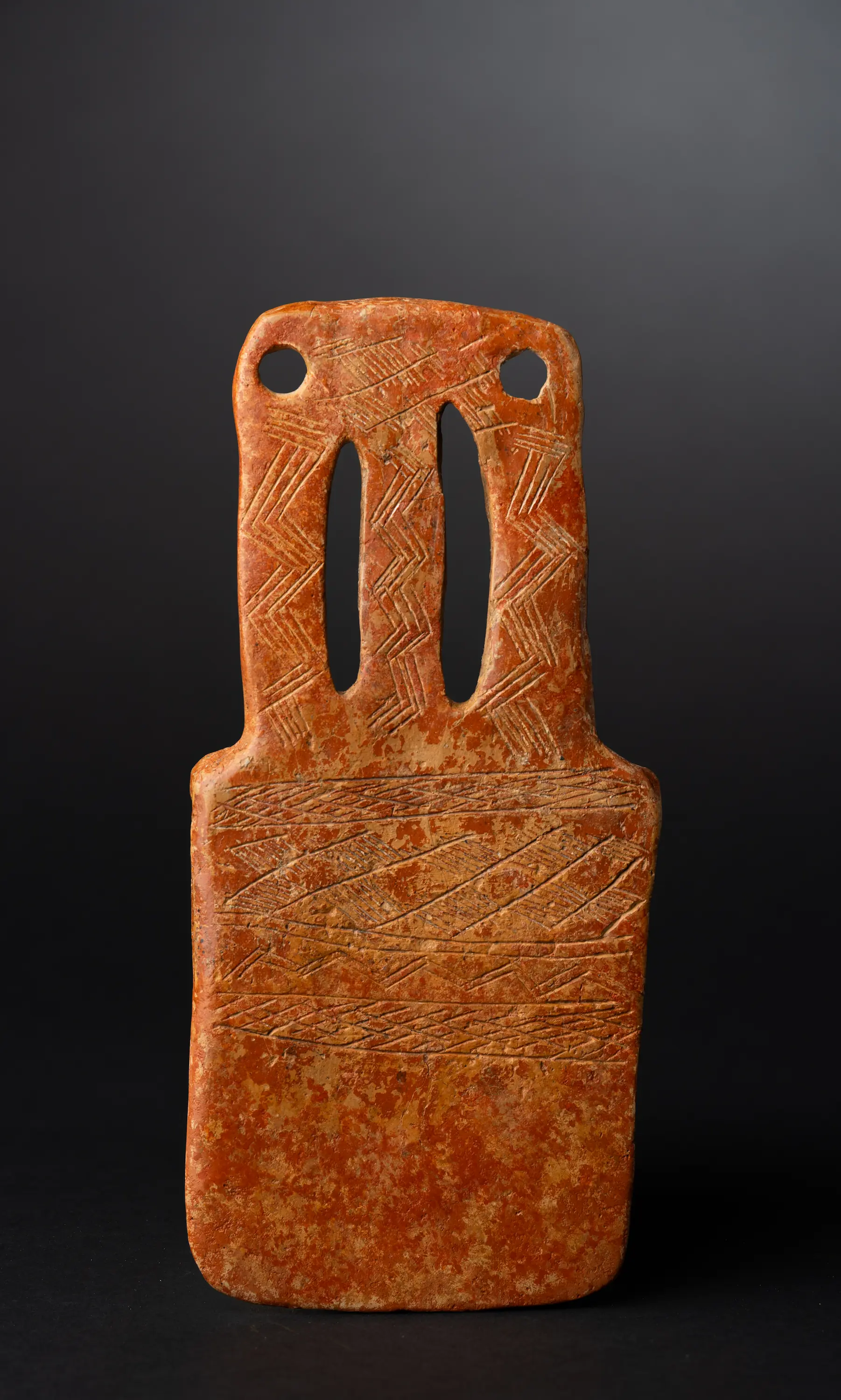
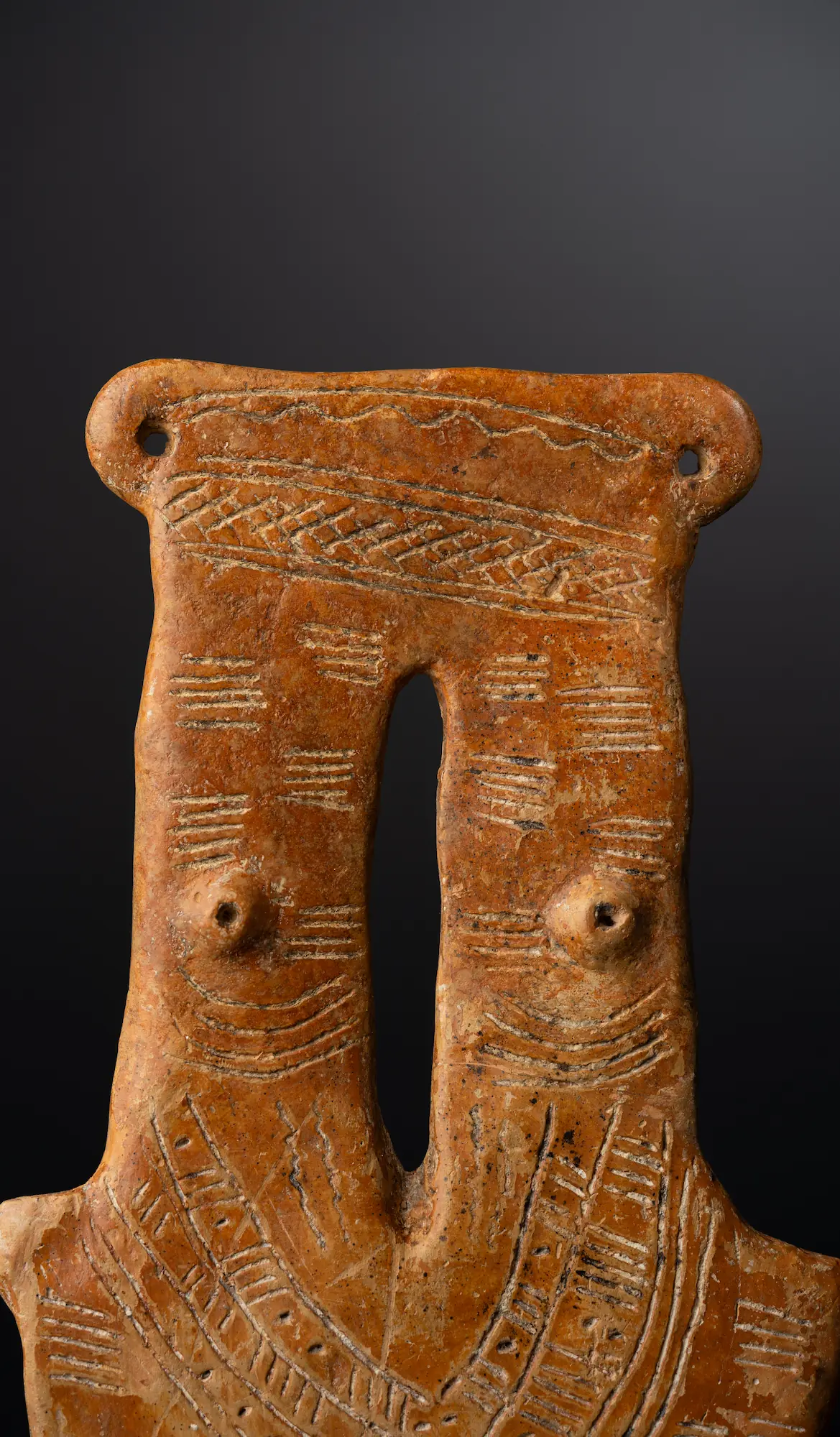
The figure stands twenty-three centimetres high, cut from a single slab of red clay and flat as a paddle. It has no face. Two pierced ears sit at the upper corners, where a head would be, and between them rise three necks side by side, divided by two narrow slots that close at the shoulders. Below, the body carries band after band of incised pattern once filled with white paste: zigzags, chains of hatched lozenges, a field of lattice. It has been published at least five times since 1975, and read in more than one way. In 1984 an archaeologist studied it and decided it did not have three necks at all.
Maria Rosaria Belgiorno read the central element as the only true neck and the two beside it as something else: thick locks of hair, an Egyptian-style coiffure falling to the shoulders on either side of a face that was never carved. Where other "triple" figures show two small heads at the shoulders, she saw a woman holding two children, a swaddled pair set in the kind of cradle-board Cypriot mothers used [3]. When Vassos Karageorghis catalogued the same object for his standard corpus of Cypriot terracottas seven years later, he recorded her reading and refused it. Her interpretation, he wrote, was "difficult to accept" [1].
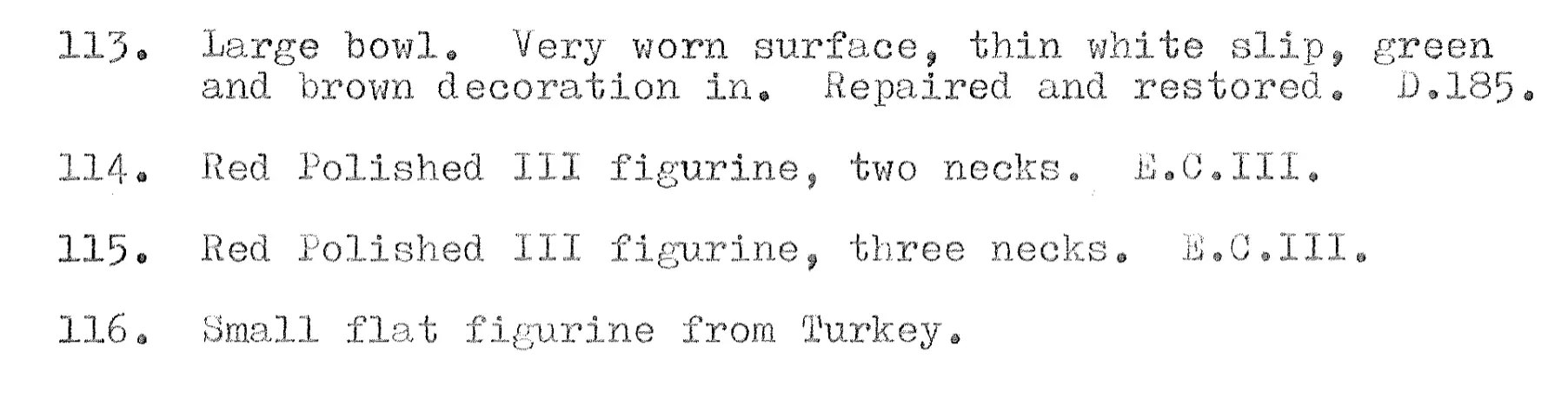
The object that drew the disagreement is one of a small handful of three-necked plank figures known from the whole of Bronze Age Cyprus, and on the published record one of only two or three that survive complete. It spent fifty-three years on loan to the Ashmolean Museum in Oxford, where it stood in a glass case, was copied by art students, and was cited by everyone who has written about the type. Its find-spot is unknown. On the list its owner drew up in August 1972, it appears among the pieces with no recorded find-spot, as number 115. It has now passed to the Drakopoulos collection, with its two-necked companion, number 114 [10].
Cut from a single slab
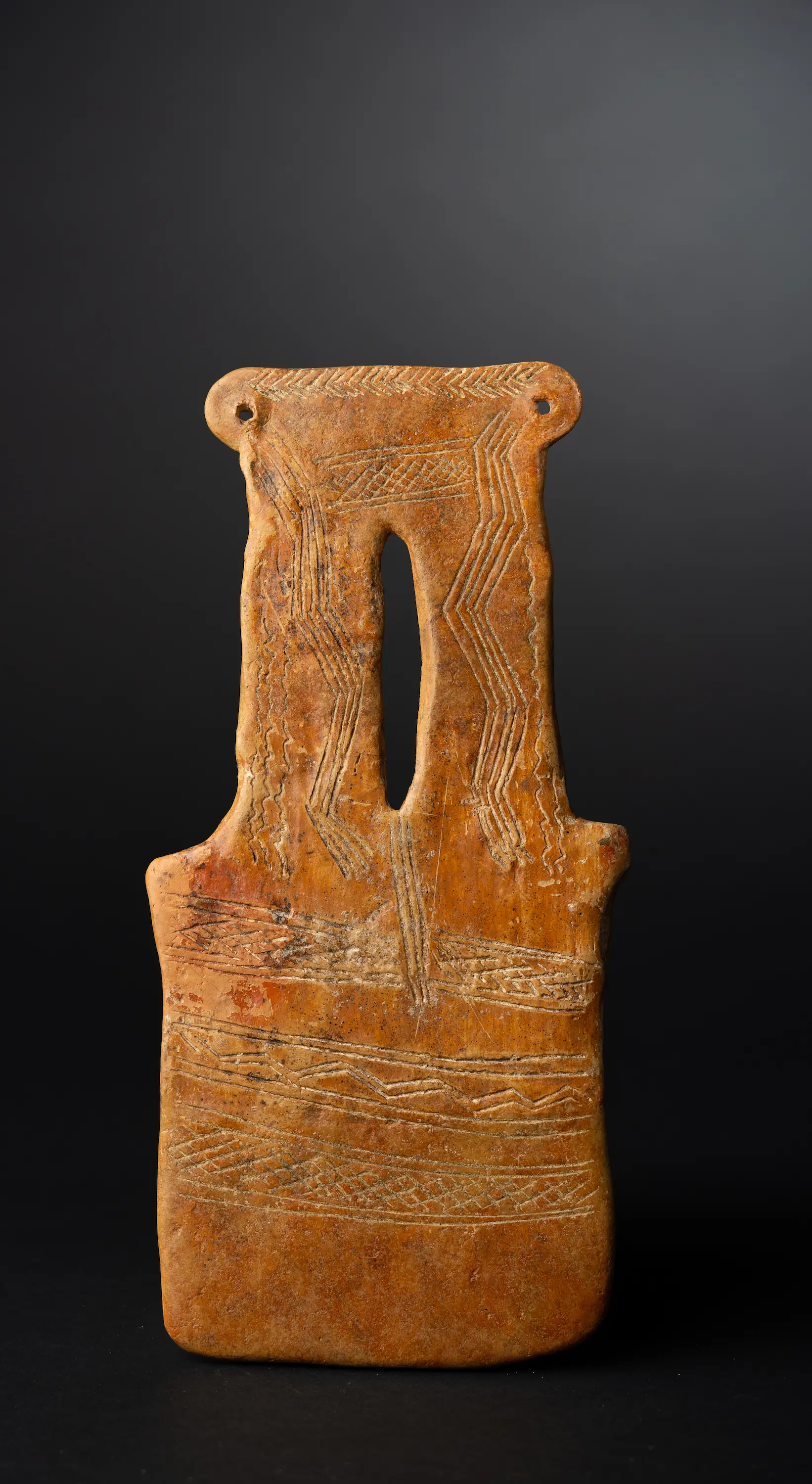
Plank figures are the first free-standing images of the human body made in Cyprus after a gap of roughly a thousand years. The island's Chalcolithic villagers had carved people in blue-green picrolite, cruciform figures small enough to wear; then the human form all but vanishes from the record until, around 2000 BC, potters on the north coast began cutting flat rectangles of clay and giving them shoulders, necks, faces and dress [6][8]. The name fits. Each is cut from a single slab, averages about twenty-two centimetres tall, and is finished on both faces with the lustrous red slip archaeologists call Red Polished ware [6]. Detail is incised into the leather-hard clay and rubbed with white paste, so that a geometry of lines and dots stands out against the red: a headband across the brow, a collar of beaded strands, large pierced ears, lattice and lozenge fields read as the embroidery of a robe [1][6]. On the backs, vertical zigzags run down the nape like falling hair.
They are not common. The fullest statistical study counted seventy-eight free-standing examples; a later, more generous tally reached a little over two hundred across the three and a half centuries the type was made [5][8]. Most come from tombs, and most of those from a single cemetery: Lapithos, on the north coast, has produced at least half of all the figures known [6]. A handful turn up in settlements instead, one of them standing in the doorway of a pottery workshop, which has helped persuade some scholars that planks belonged to the living before they accompanied the dead [6][8].
Two necks, then three
Most planks have one head. A sizeable minority do not. In the standard corpus, twenty-three of the seventy-eight free-standing figures carry more than one neck, close to a third, and the great majority of those have two [5][6]. Three is another matter. Among the forty complete or near-complete figures one analyst examined, there were twenty-nine with a single head, nine with two, and exactly one with three [5]. The figure now in the collection is, on the published record, one of the two or three complete three-necked planks that exist. The two pieces are dated a little apart, the two-necked to Early Cypriot III, around 2000 BC, the three-necked to Middle Cypriot I a century or so later; Knox has argued that the multi-headed planks as a class belong late in the tradition, variants that appear only once the single figures were well established [1][8].
The doubled and trebled figures cluster where the type is densest. Their "main source appears to be Lapithos," wrote Desmond Morris, who thought them "probably the work of one, or a few artists, intent on developing the classic Plank Figure motif in a new and more complex form" [4]. Karageorghis reconstructed the maker's problem in plain terms. A single neck and head sat comfortably on the slab; two did not. To fit two necks the coroplast, the modeller who shaped the clay, had to widen the body, and then faced the question of where to put the faces. He set the ears at the top corners and bridged the two necks across the top, a join that also kept the fragile necks from snapping off. "Once the coroplast had created a figurine with two necks and heads," Karageorghis went on, "he then tried, perhaps unconsciously, to create one with three necks, without having any specific iconographic intention" [1]. On that account the third neck is an escalation, a maker pushing a motif one step further because the clay allowed it, and nothing more.
The companion with two necks and one chest
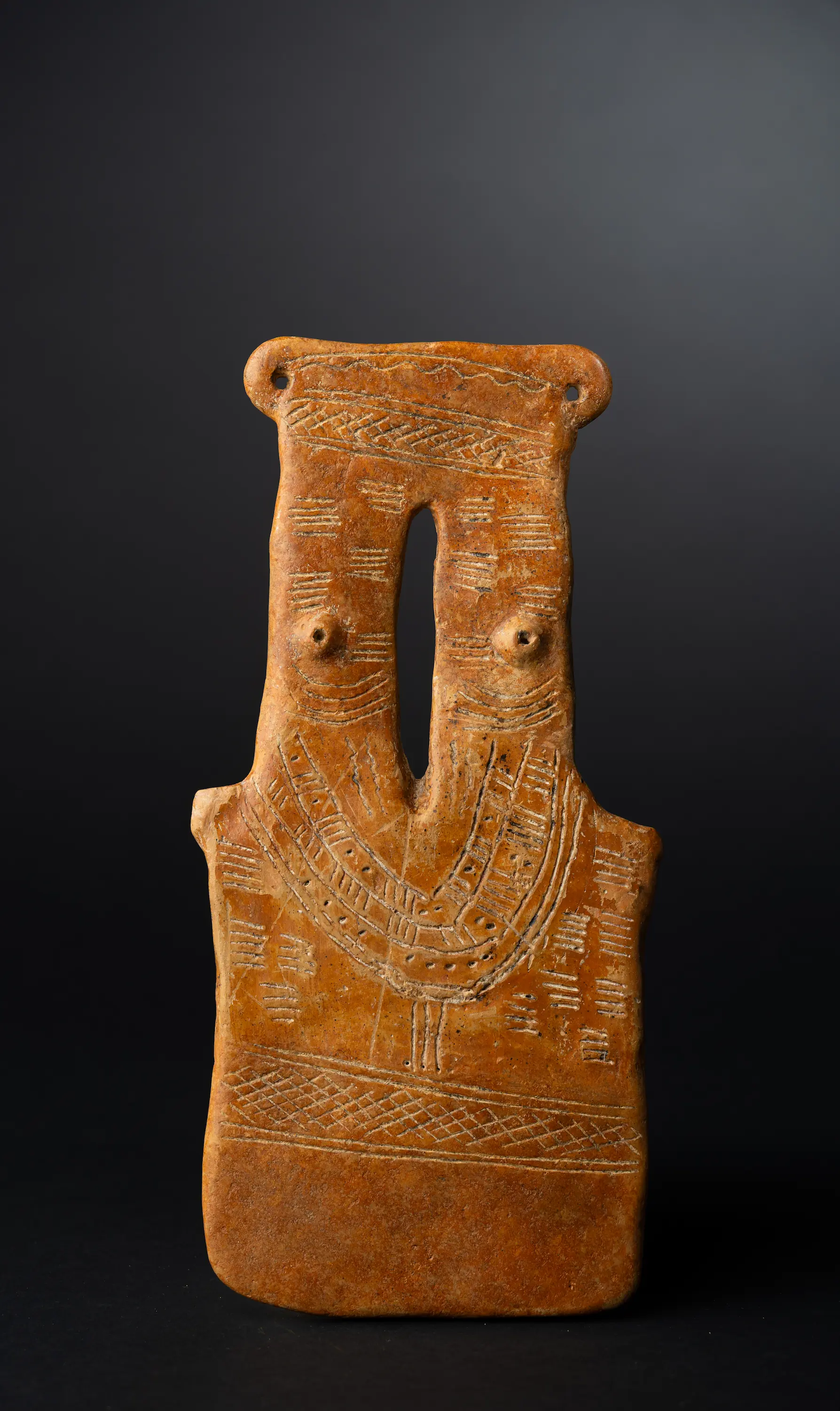
The larger figure, number 114, is easier to read. It has two necks rather than three, bridged at the top where a single nose and pair of eyes once sat across both, common to the two faces [1]. Below the bridge the body widens into angular shoulders, one of them carrying a stub of arm. A deep collar of arched, dotted strands curves from shoulder to shoulder, the necklace seen on two-headed planks from the Lapithos tombs [1][3]. Below it, a breast sits to either side, a small pellet with a puncture for the nipple.
Two necks, two faces, and yet the breasts are not one to a body. As Karageorghis put it, "the coroplast conceived the body as one, with one breast on each side of the chest," so that it is not clear which of the two heads, if either, is meant to be female [1]. The doubling that gives the figure two faces gives it a single torso, and the single torso carries the marks of one woman split between two necks. Whatever the maker intended, the object will not resolve into one person or two.
Twins, a goddess, a married couple, or none of them
This is roughly where interpretation begins, and it has gone in every direction at once. Morris, struck by the way Bronze Age Cypriot potters doubled and trebled everything from spouts to handles, read the multiple heads as sympathetic magic: figures made to bring on twins, or a family of two or three children [4]. Jacqueline Karageorghis, who saw the whole class as the island's earliest images of a great goddess, took the doubled head as the goddess shown two-faced [7]. Vassos Karageorghis thought some of the pairs were couples, a man and a woman sharing one body; the clearest candidate, a hooded double figure from a Lapithos tomb now in Stockholm, Jacqueline Karageorghis read as "a couple in bed," he as something nearer a sacred marriage [1][7]. Belgiorno read that same Stockholm piece as two swaddled infants in a cradle [3]. The object has been a married couple and a pair of babies, depending on who was looking.
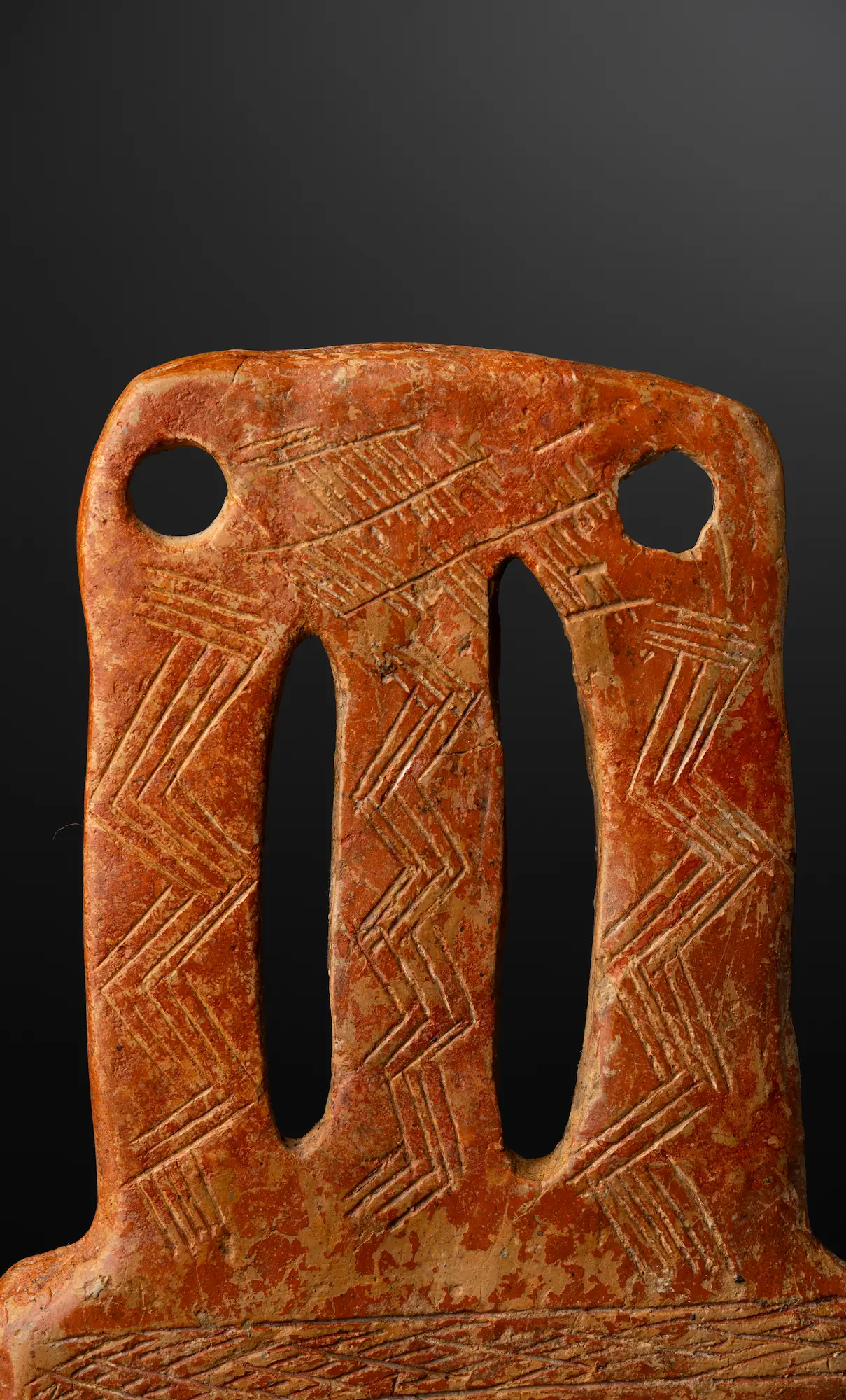
It is against this background that Belgiorno's three-necked reading belongs. Faced with the figure now in the collection, her only example of the type, she refused the "triple idol" altogether: the central element was the neck, the two flanking it were locks of hair, and where small heads appeared on the shoulders of such figures she found her mother with two children again [3]. Karageorghis's flat "difficult to accept" was the standard reference work closing the question [1]. It has not stayed closed, and the type may be built so that it cannot. Talalay and Cullen, in the fullest recent study, argue that the planks were deliberately ambiguous, multivalent symbols whose refusal to settle into man or woman, one or many, made them effective in the charged setting of a funeral. Some single-headed planks, they point out, are decorated on the back as though they were double, which suggests the makers themselves felt the single and the multiple to be close kin [3][6]. The same object has been read as twins, a goddess, a couple, a mother with children, and a symbol built to mean several of these at once. That spread is the evidence that the multiplying of heads was doing symbolic work, rather than counting people.
Stood up, mended, and broken on purpose
Whatever they meant, the planks were handled. Knox, working from the objects rather than their imagery, assembled the case that they were used things and not grave-furniture made for the tomb. Several had been stood upright and "rooted into the ground for sufficient time to cause lasting marks" on the clay. They are the only Cypriot figurine type known to have been mended in antiquity, which means they were worth mending. And a horizontal break across the torso occurs on at least forty-four percent of them, too consistent a place to be accident: Knox reads it as deliberate, the snapping in two of a charged object at the end of its life, a kind of ritual killing [8].
Both figures show restoration, as most surviving planks do, and the catalogue records where [1][2]. On the three-necked figure the right neck and the lower body are modern work, on a piece that stands twenty-three centimetres tall and eleven across. On the two-necked figure the tops of the necks, part of the right neck, and the lower body are made good, on a figure measuring twenty-five and a half by twelve [1]. Whether the original breaks were the deliberate snap Knox describes or the ordinary damage of a collective tomb reused over generations, the figures reached the modern world already broken, as most planks did.
The art master who bought them
The man who recorded no find-spot for the two figures was James Alfred Brew, born in Douglas on the Isle of Man in 1923, an artist and art teacher trained at Manchester and the Slade [10]. He had served in the North Staffordshire Regiment through the war, taught art in a London school for a decade, and then, between 1960 and 1970, taught at British services schools abroad, with postings in Cyprus and Hong Kong [10]. His obituary remembers a man with "a very developed eye for beauty" who filled his Islington house with objects chosen for "elegance, proportion, decoration and interest," and not, it is careful to add, for their monetary value [10]. He collected the way an artist does, by eye, and designed theatrical stage sets and traced Manx family trees for pleasure on the side.
He bought in Cyprus in the 1960s, in the open and from the people who had antiquities to sell. A letter he wrote to the Ashmolean in 1973 describes the trade first-hand. Correcting the find-spot of some medieval bowls, he explains that he had driven out from Nicosia toward Morphou to a village where "the owner, who I think was the mukhtar of the village, used to sell off some of the pots... and is a traffiko in antiquities" [10]. He recommends a circuit of others worth visiting: a man called Loizides at Morphou, the Pierides collection at Larnaca, a collector reached through the Limassol Club, a dealer in the main square of walled Nicosia, the mukhtar of Episkopi [10]. One lamp in his collection is scratched on the base, in his own hand, "Paphos 1965, J.A. Brew" [10]. This was late-colonial Cyprus, where buying what villagers turned up in their fields was ordinary and legal, and the planks left the island, by his family's account, before 1970 and the UNESCO convention that has governed the trade since. Their ancient find-spot was never written down. The attribution to Lapithos is the verdict of style, not of any excavation.
Fifty-three years in Oxford
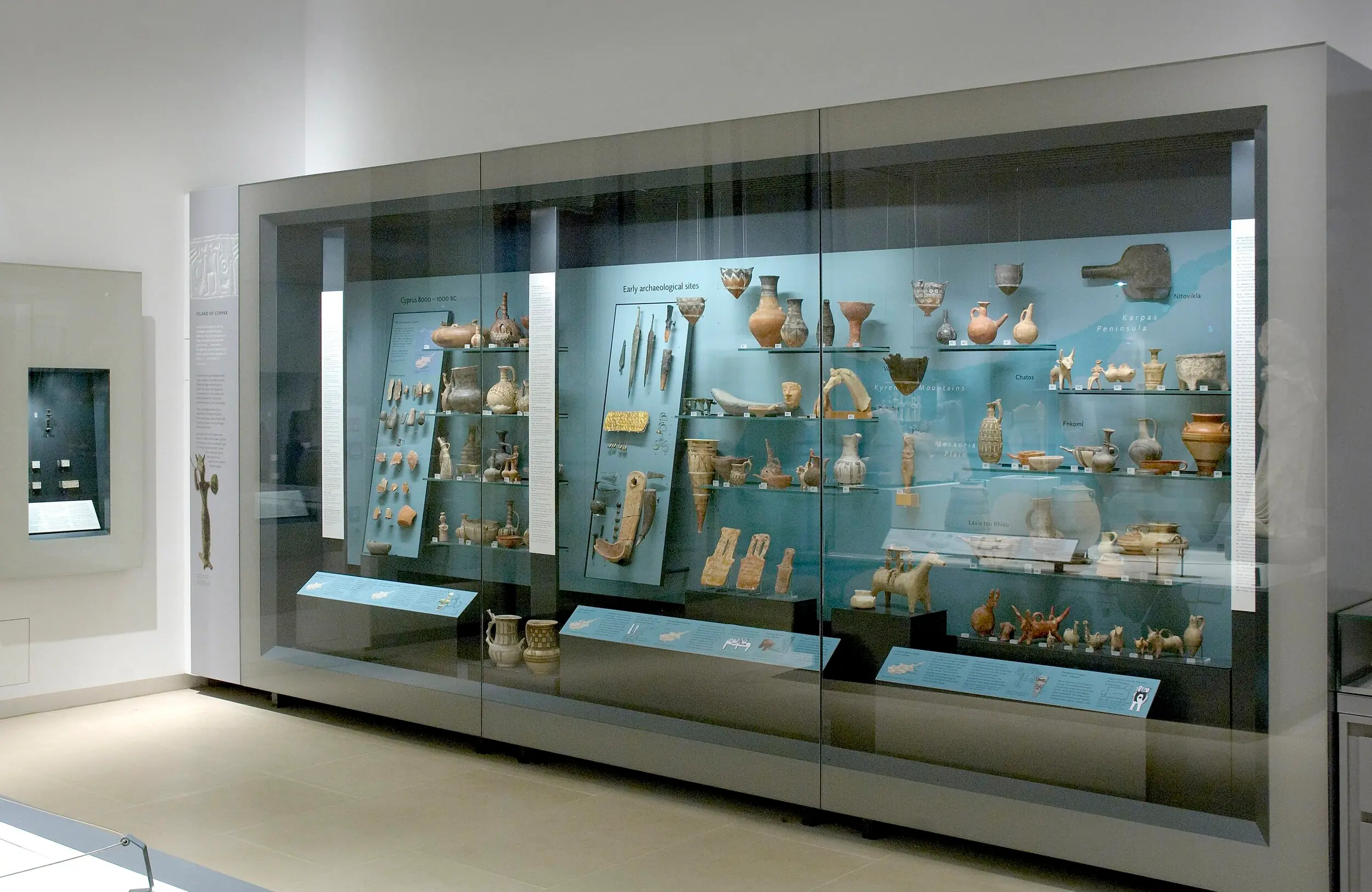
On 30 August 1972 Brew sent his collection, about a hundred and twenty pieces, to the Ashmolean on indefinite loan. The Keeper of Antiquities, R. W. Hamilton, set the terms in writing: the loan was "indefinite" and "revocable," Brew kept ownership, and the museum had "full liberty to publish" [10]. Brew replied that he felt "most honoured that my collection should be housed in such a splendid place as the Ashmolean" [10]. The arrangement held for fifty-three years.
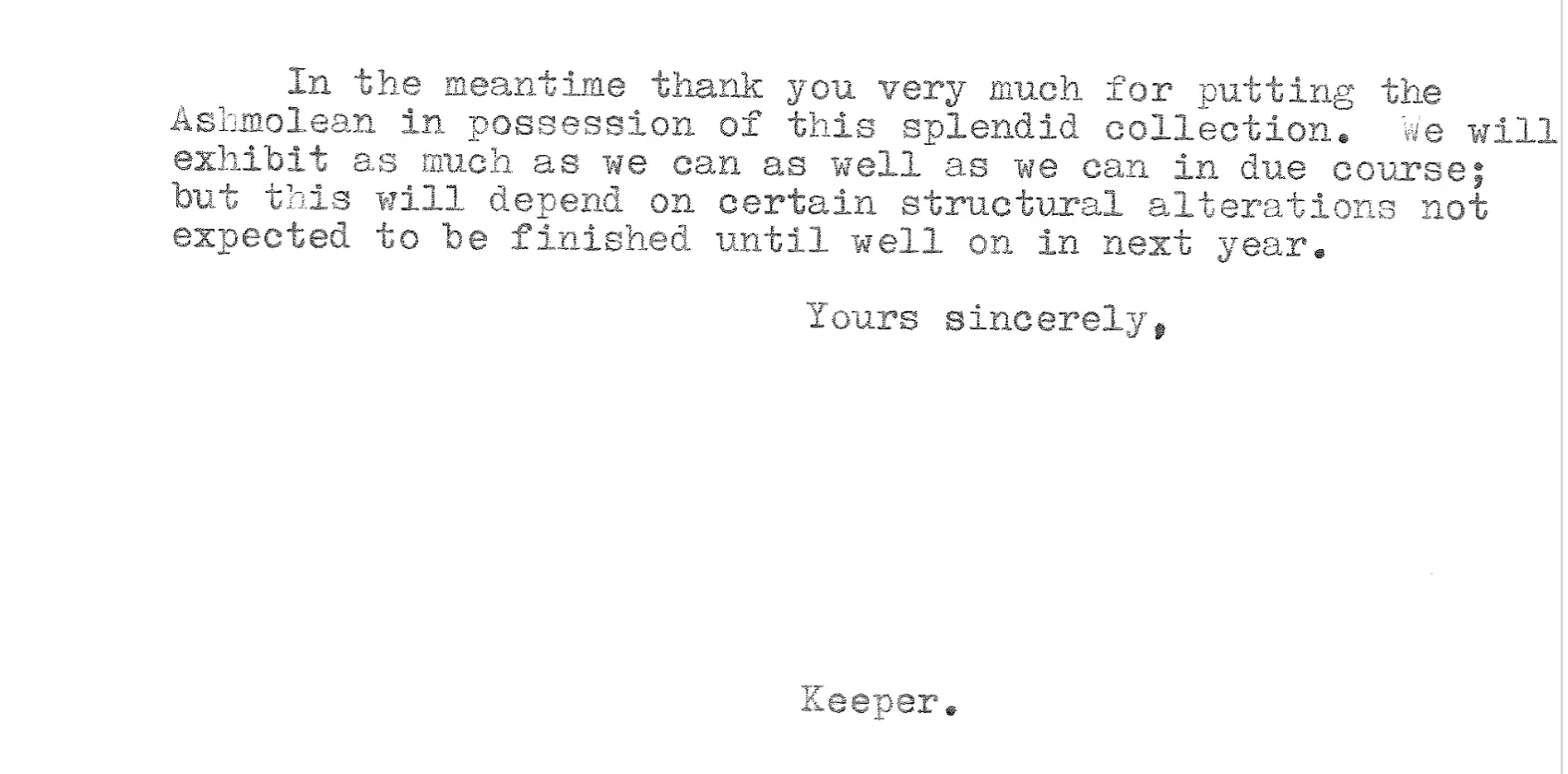
In 2004, by then eighty and unwell, Brew asked for part of the collection back. He wanted to spend his last years among the objects he loved most, and chose around twenty vessels, most of them medieval glazed bowls, to keep beside him. The planks were not among them [10]. He died in 2008, and the pieces he had taken home were sold at Bonhams in London on 29 April 2009, in the antiquities sale; the large Archaic bichrome dish from that auction is now in this collection. The planks stayed in Oxford until the loan was formally closed on 30 September 2025, "on display" to the end, and from there they passed to the Drakopoulos collection [10].
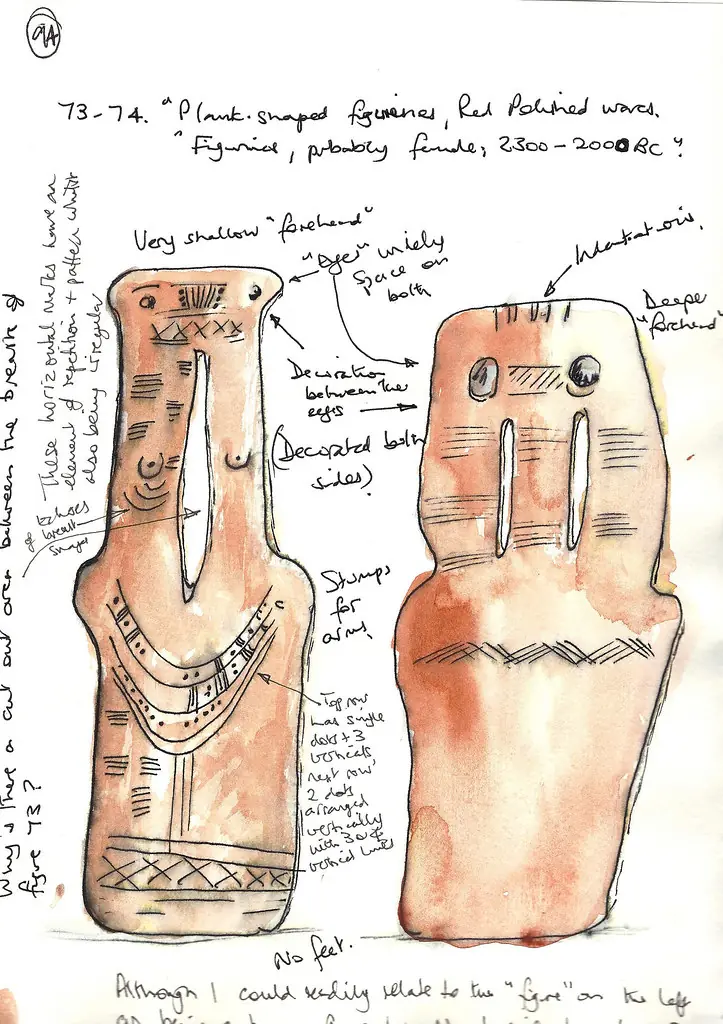
Among the people who looked at them was a ceramics student named Ann Kelcey. She had first been struck by a single plank figure in the British Museum, "a single terracotta 'plank-shaped' figure... from ancient Cyprus," and then found more in the Ashmolean. The simplicity of the form, she wrote, "with the merest hint of gender, and the use of incised marks... were powerful devices that seemed to cross the boundaries of time" [11]. She sat in front of the two Brew figures and painted them in watercolour, copying the gallery label as it then read, "Figurine, probably female, 2300–2000 BC," and noting what she saw: a very shallow forehead, eyes set wide on both, stumps for arms, no feet [11]. Against the two-necked figure, in the margin, she wrote a question. Why is there a cut-out between the breasts?
Her question was a good one, and no catalogue has closed it. The figure has two necks and a single chest, a slot cut where the chest should be whole, and no one has explained any of it.
References
- 1.Karageorghis, V. (1991). The Coroplastic Art of Ancient Cyprus I: Chalcolithic–Late Cypriote I. Nicosia: A.G. Leventis Foundation. Figures here = group Bd.12 (pl. XXXVI:3) and group Bf.2 (pl. XL:2).
- 2.Frankel, D. (1983). Corpus of Cypriote Antiquities 7: Early and Middle Bronze Age Material in the Ashmolean Museum, Oxford (SIMA XX:7). Göteborg: Paul Åström. Nos 151–152, pl. 12.
- 3.Belgiorno, M. R. (1984). Le statuette antropomorfe cipriote dell'età del bronzo (I parte: gli idoli del Bronzo Antico III–Bronzo Medio I), in Studi Ciprioti e Rapporti di Scavo. Rome: CNR, Istituto per gli Studi Micenei ed Egeo-Anatolici. Her 'Tipo H' (fig. 12:2) and 'Tipo N' (fig. 17:2).
- 4.Morris, D. (1985). The Art of Ancient Cyprus, with a Check-list of the Author's Collection. Oxford: Phaidon. Fig. 227.
- 5.a Campo, A. L. (1994). Anthropomorphic Representations in Prehistoric Cyprus: A Formal and Symbolic Analysis of Figurines, c. 3500–1800 BC (SIMA-PB 109). Jonsered: Paul Åström.
- 6.Talalay, L. E., & Cullen, T. (2002). Sexual Ambiguity in Plank Figures from Bronze Age Cyprus, in D. Bolger & N. Serwint (eds.), Engendering Aphrodite: Women and Society in Ancient Cyprus (ASOR Archaeological Reports 7 / CAARI Monographs 3). Boston: ASOR, 181–195.
- 7.Karageorghis, J. (1977). La Grande Déesse de Chypre et son culte. Lyon: Maison de l'Orient.
- 8.Knox, D. (2012). Making Sense of Figurines in Bronze Age Cyprus (PhD thesis, University of Manchester).
- 9.Brown, A. C., & Catling, H. W. (1975). Ancient Cyprus. Oxford: Ashmolean Museum. Fig. I, b-7.
- 10.Ashmolean Museum, Oxford: the J.A. Brew loan (file 129), 1972–2025. Brew's loan list of 29 August 1972; the Keeper's letter of 7 September 1972; Brew's reply of 9 September 1972 and his letter to Ann Brown of 17 February 1973; the curator's letter of 10 March 2004; the 'Long Term Loan In' ledger (ANBRE); with J.A. Brew's obituary (2008).
- 11.Kelcey, A. (c. 2012). Figures I & II, artist's statement and sketchbook studies for the CinBA Live Project exhibition.