
Iron Age Wheel-made White Painted Plates
Three wheel-made plates in the Drakopoulos collection belong to the White Painted ware of the Cypro-Geometric period, c. 1050 to 750 BC, and like their excavated counterparts they carry their main painting on the underside.

Alexis Drakopoulos
April 14, 2024·Discussion · Collection·2 min read


Share


Alexis Drakopoulos is a Greek Cypriot Machine Learning Engineer working in Financial Crimes. He is passionate about Archeology and making it accessible to everyone. About Me.
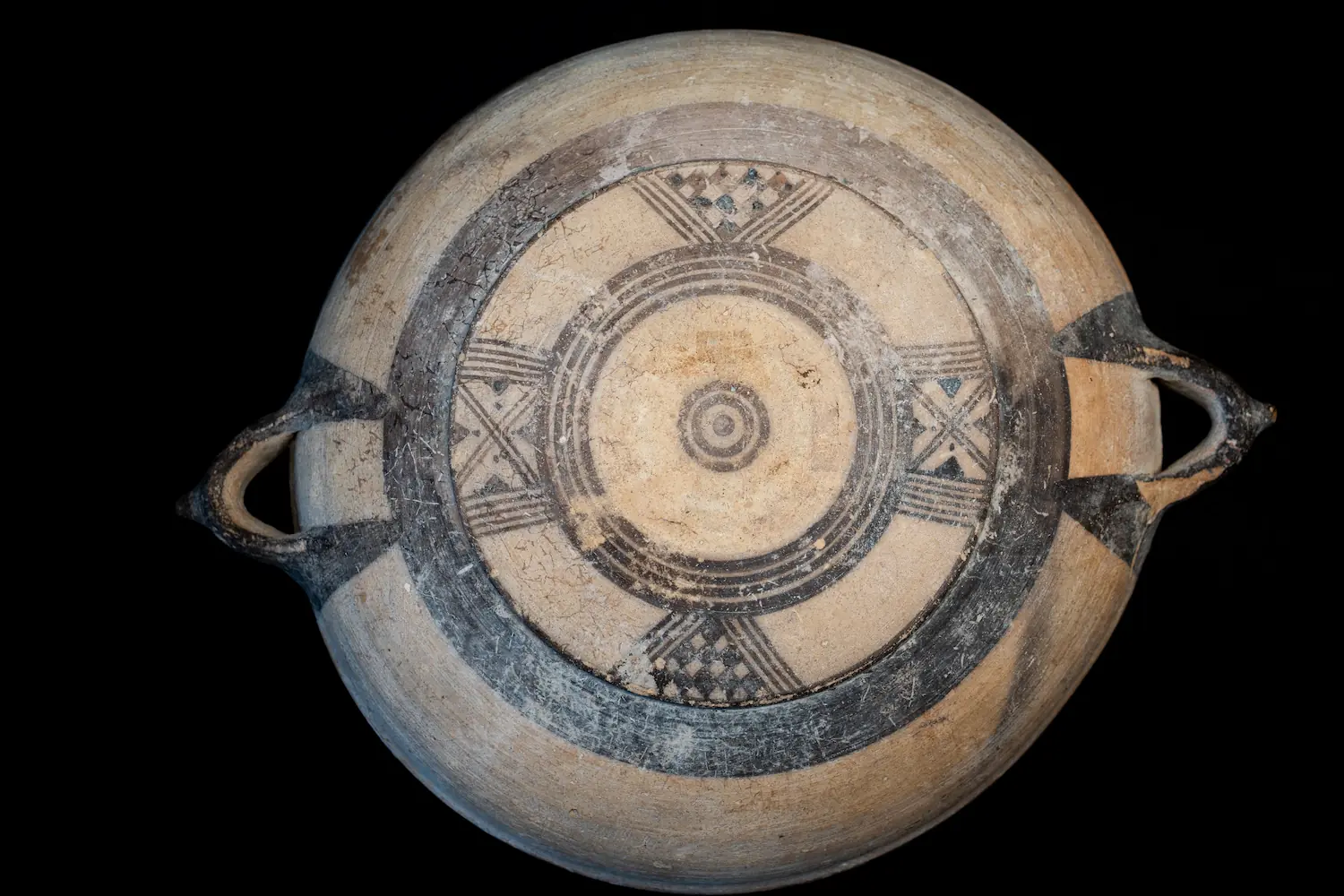
The three plates on this page have sometimes been described as "White Slip," a name that does not fit them. White Slip is a handmade ware of the Late Bronze Age, with a thick white coating and quite different shapes. These plates were thrown on the wheel in the early Iron Age and painted in a single dark matt paint on pale buff clay: they are White Painted ware of the Cypro-Geometric period.
The flat two-handled plate is one of the few Cypriot shapes whose first appearance can be dated. Maria Iacovou showed that it does not occur in Proto-White Painted, the pottery of the 11th-century transition from the Bronze Age. It is "a shape of local inspiration that appeared first in the White Painted, Bichrome and even Black Slip Painted wares of advanced Cypro-Geometric I groups," and "its circulation is indeed limited to the Cypro-Geometric period" [1, p. 202].
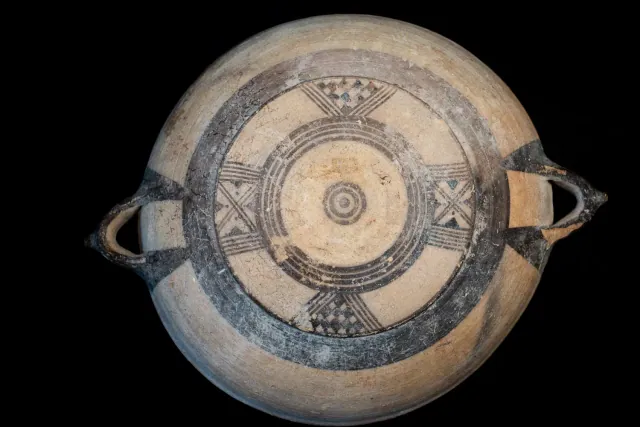
On these plates the main design goes on the underside, and the interior carries little more than a few rings and a dark rim. On the largest, 40 cm across with its handles, four arms of parallel lines cross the base like the spokes of a wheel round a small target of circles, two of them framing chequered triangles. The excavators of recent tombs at Palaepaphos-Skales concluded that "these dishes must have been displayed, when not in use, since their main decoration is confined to the base" [3, Tomb 203]. That remains a hypothesis.
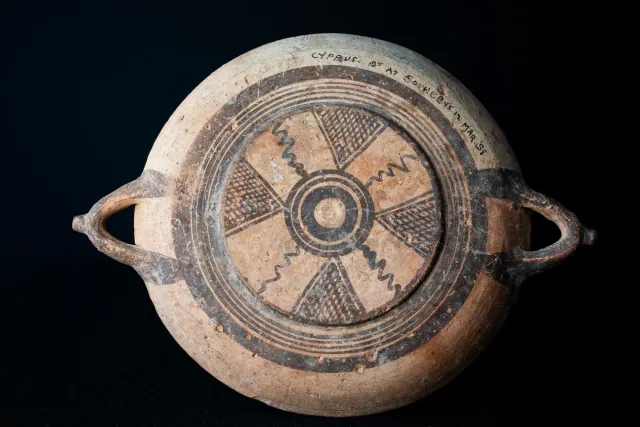
The second plate, 33 cm across, has four framed, cross-hatched triangles radiating from a ring of concentric circles, with four freehand wavy lines between them. The Swedish excavators recorded the same scheme in Lapithos Tomb 408, where a White Painted I plate 34.5 cm across has "four lattice triangles meeting in a circle on base" [2]. Both of these plates are dated c. 1050 to 850 BC.
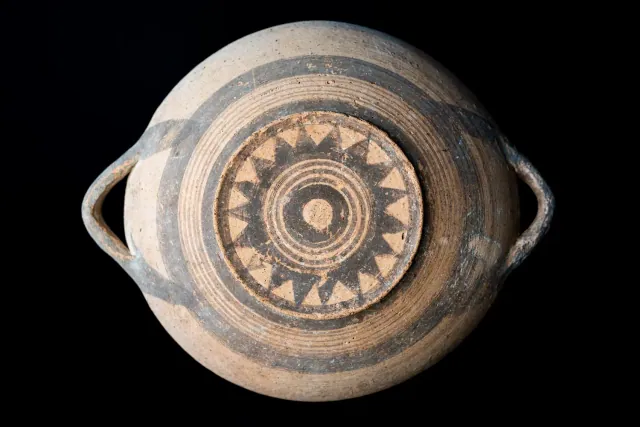
The third and smallest, 25 cm across, has a closed ring of solid triangles pointing outward round a nest of circles, so that the underside reads as a star. Its shape and the weight given to concentric circles suggest a later date, c. 950 to 750 BC, and its closest parallels, in the Hermitage and in Atlanta, are dated by their museums into the Cypro-Archaic.
The plates and their place in the Cypro-Geometric repertoire are covered in Lesson 7 of the pottery course, and the shape itself in the compendium's dish entry.
References
- 1.Iacovou, M. (1991). Proto-White Painted pottery: a classification of the ware. In J. A. Barlow, D. L. Bolger & B. Kling (Eds.), Cypriot Ceramics: Reading the Prehistoric Record. Philadelphia: University Museum, 199–205.
- 2.Gjerstad, E., Lindros, J., Sjöqvist, E. & Westholm, A. (1934). The Swedish Cyprus Expedition I: Finds and Results of the Excavations in Cyprus 1927–1931. Stockholm: Swedish Cyprus Expedition, Lapithos Tomb 408, no. 6.
- 3.Karageorghis, V. & Raptou, E. (2016). Palaepaphos-Skales: Tombs of the Late Cypriote IIIB and Cypro-Geometric Periods (Excavations of 2008 and 2011). Nicosia.