
Unnumbered pageScan 38 of 147
Continued from p. 35
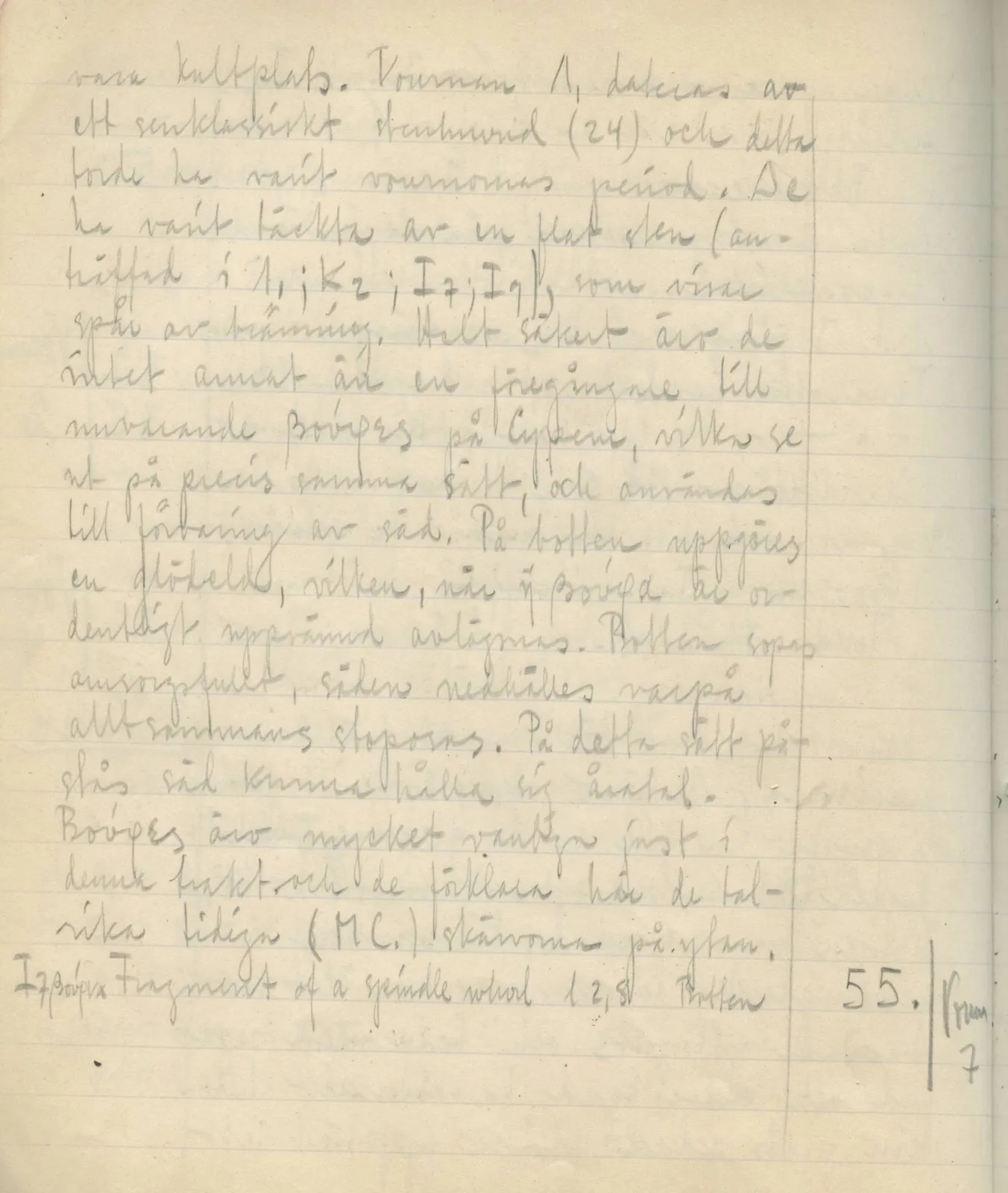
… cult place. The vourna Λ1 is dated by a late Classical stone head (24) and this presumably was the period of the vournas. They had been covered by a flat stone ( found in Λ1; Κ2; Ι7; Ι9), which shows traces of burning. Quite certainly they are nothing other than a forerunner of the present-day βούφες in Cyprus, which look exactly the same, and are used for storing grain. At the bottom a fire is made, which, when ἡ βούφα is or dentally heated through, is removed. The bottom is swept carefully, the grain is poured in, after which the whole is sealed. In this way grain can keep for years. - Βούφες are very common in this district and they explain here the numerous early (M.C.) sherds on the surface.
| Ι7 βούφα Fragment of a spindle whorl l 2,8 Botten | 55. | Vourn |
| 7 |
65 figures hard to readstruck struck outadded written in above” jug ditto, and what it repeatsword reading not certain