
Early Bronze Age · c. 2300–2000 BC
The Double‑Necked Bird Jug
A Red Polished jug from the north coast of Cyprus, built by hand c. 2300–2000 BC for a family tomb. Two necks, two birds, and about 57 centimetres of burnished clay.
Begin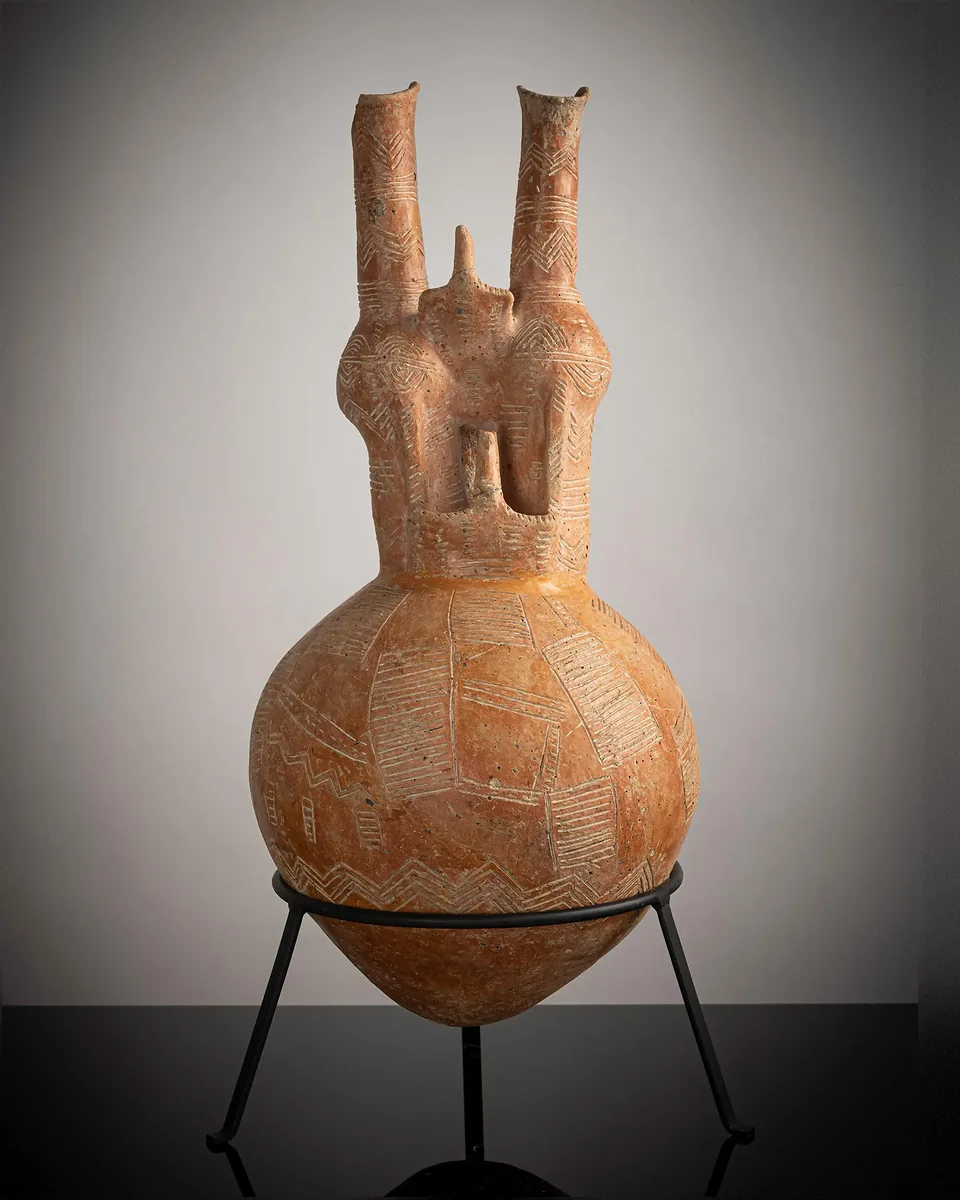
The necks and the birds are the parts of a jug like this added last, and the first to snap off a pot in the ground.
This one was reassembled from about thirty fragments, and both necks and both birds came through. It has no tomb number. Its shape, its finish and its decoration still place it closely: the north coast of Cyprus, the workshops that supplied the cemeteries of Vounous and Lapithos, and the last centuries of the third millennium BC.
Its nearest published relative, dug from a Vounous tomb in 1933 and now in the Louvre, carries one bird. This jug carries two.
- Date
- Early Cypriot II–III, c. 2300–2000 BC
- Ware
- Red Polished; handmade, incised, with modelled birds
- Height
- c. 57 cm
- Condition
- Reassembled from about thirty fragments; both necks and both birds survive
- Find-spot
- Not recorded; attributed to the Vounous–Lapithos workshops on type and style
- Accession
- JUG-BA-024
I · The catalogue entry
Read it the way Dikaios did
In 1931 and 1932 Porphyrios Dikaios, curator of the Cyprus Museum, excavated forty-eight tombs at Vounous and sorted their pottery into types. This shape became his Type II c, one of the “big incised jugs”. He described his type-piece, jug no. 23 from Tomb 46A, in one sentence. Test it against this jug.
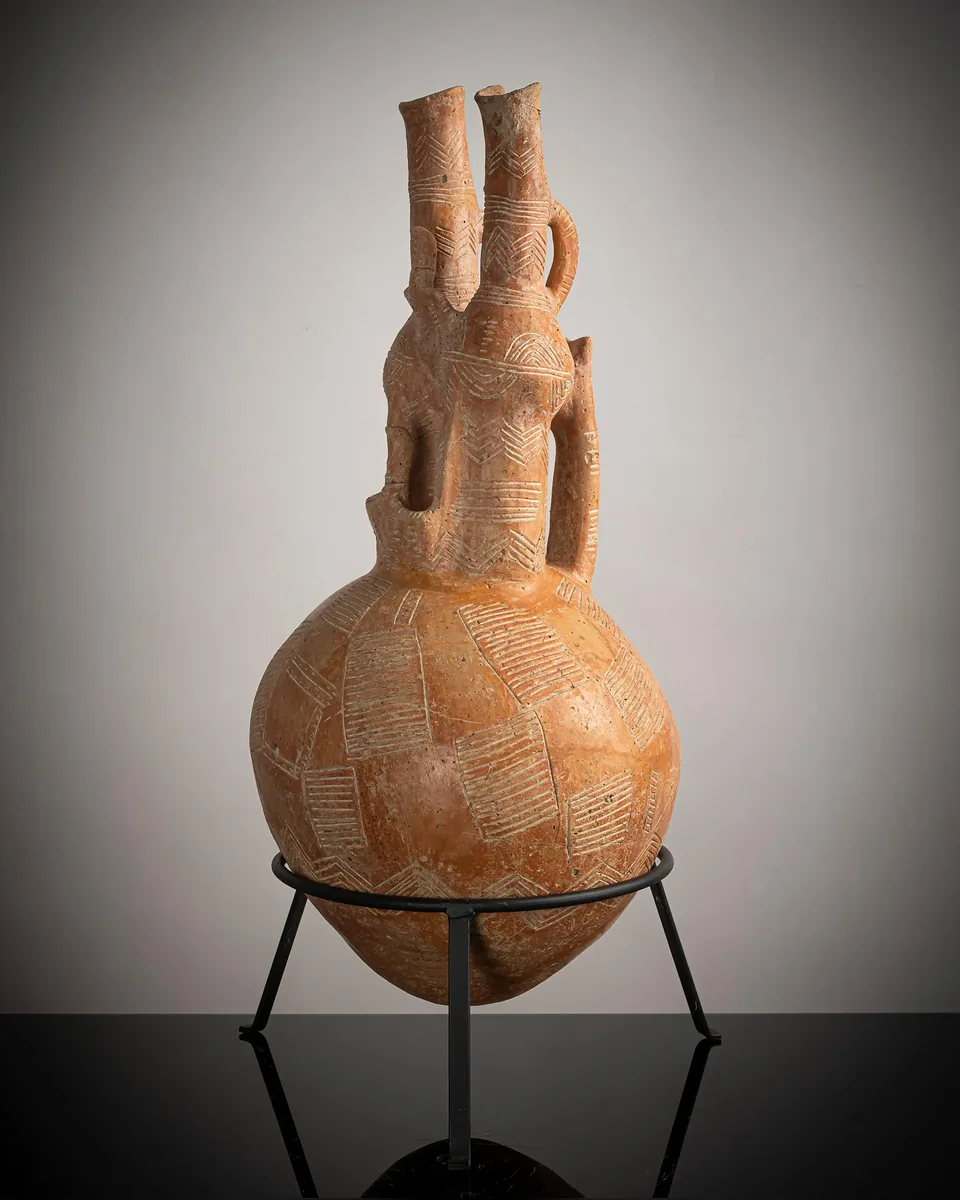
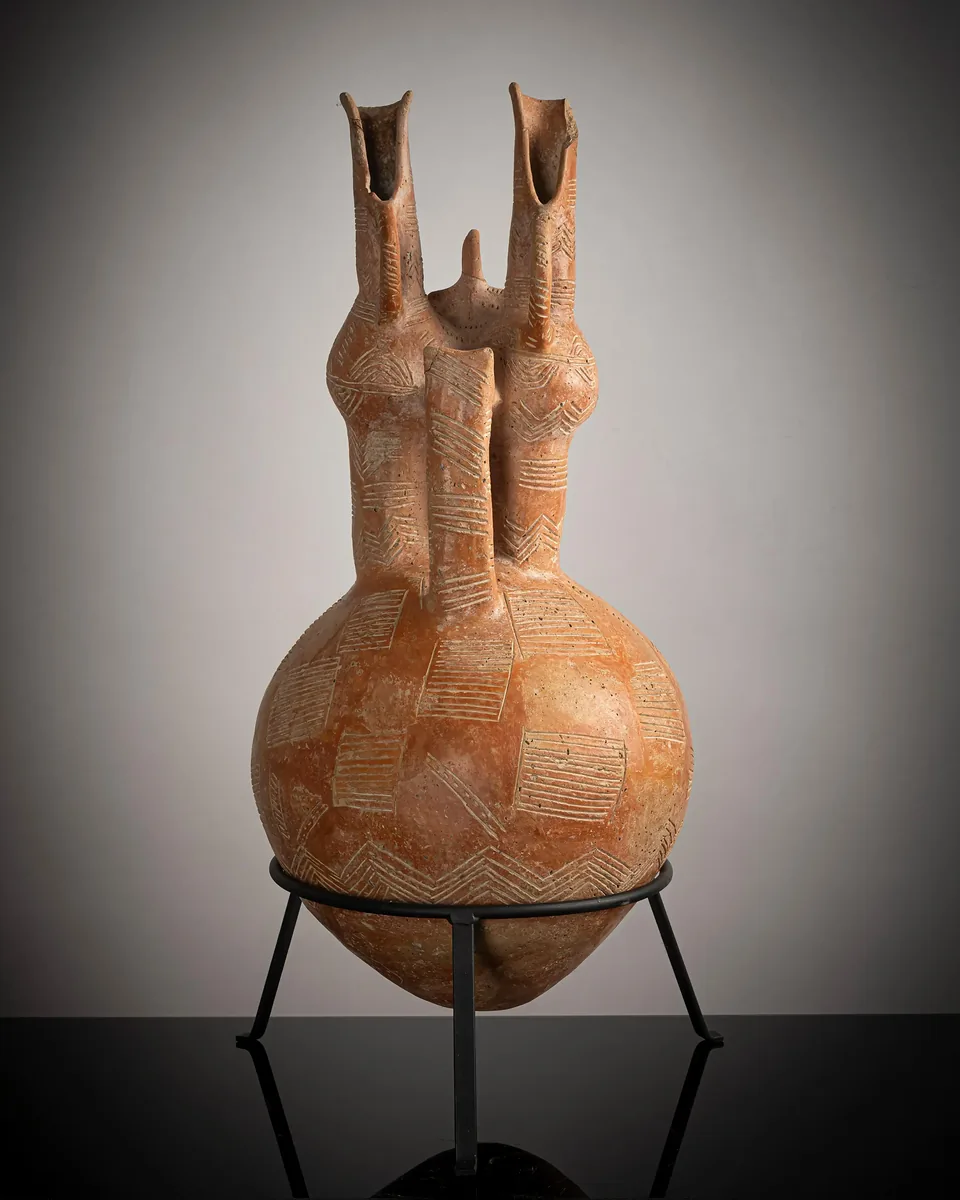
Drag the jug to turn it · tap a point to read it
Choose a phrase of the catalogue entry to find it on this jug. One phrase does not fit.
Dikaios 1940, Tomb 46A, no. 23
“23. ”
II · The tomb
Where a jug like this was left
This jug has no recorded find-spot. Its type-piece has one: the side-chamber of Vounous Tomb 46, which Dikaios found intact. Scroll down into it.
01 · The hill
A cemetery without its village
Vounous means “the hill”. The cemetery lies on the north slopes of a low hillock below the Kyrenia range, about two and a half kilometres from the village of Bellapais, with the ground falling away towards the sea.
Three excavations between 1931 and 1938 opened more than 160 tombs. The village that buried its dead here has never been found, so almost everything known about these people comes from their graves.
02 · The dromos and the door
A passage cut into the rock
Each tomb began as a sloping passage, the dromos, cut down into the white calcareous subsoil the Cypriots call havara. The dromos of Tomb 46 was 3.45 m long, 1.45 m wide and 1 m deep. Most Vounous passages begin with a rough step and then drop steeply to the door.
The doorway was closed with a slab of limestone held in place by small stones packed round its base. At Vounous the doorways usually face north, down the hill towards the sea.
03 · Filled and reopened
Dug out for every death
Between burials the passage was probably filled with earth. Dikaios’s evidence was Tomb 10, which he found cut, sealed with its slab and backfilled, but never used. For each new burial, he argued, the family dug down to the slab again. Large jars found standing in a few passages may have held water for washing the dead, or for libations, so some passages probably stayed open for a while after a burial.
04 · The chamber
A room for the family
Inside was a roughly rounded room. The dead were laid on their backs, in their clothes, head towards the door, usually on the right-hand side as you enter. The pottery was usually massed on the left. The tombs served generation after generation, and when the floor filled, earlier remains were cleared to the sides. Tomb 36 held nine burials.
Cattle were killed and butchered at the cemetery; their bones turn up in roughly a third of the tombs, and some large bowls still held ox bones when they were excavated. The living ate at the funeral, and the dead were given their share.
05 · Tomb 46A
An intact side-chamber
Tomb 46 had a side-chamber opening off its west side, and Dikaios found it intact: an oblong room 3 m long and 1.60 m wide, a few bones in its north-western part, and pottery over almost the whole floor. His catalogue of the chamber lists:
- large bowls4
- small hemispherical bowls26
- jugs7
- juglets5
- bottles2
- amphora1
- cooking pot1
- metal knives2
Five of the jugs carry a snake in relief on the neck. Some of the small bowls stood inside the large ones.
06 · And one more
The bird jug among the large vessels
“Among the large vessels was a double-necked Red Polished incised jug with a bird modelled in the round between the two necks.”
That jug, no. 23, is the type-piece for the jug on this page. Where it is now, we have not been able to establish. The jug on this page has no recorded find-spot at all, but a chamber like this one is where a vessel of its kind was made to stand.
III · The family
One bird, or two
The jug’s two nearest published relatives both come from Vounous. One is in the Louvre; the other is Dikaios’s type-piece, known now from an excavation photograph. Each carries a single bird.
Count the birds. Both relatives carry one. This jug carries two.
This jug
The Louvre jug
Dikaios's type-piece
- This jug
- Drakopoulos Collection, London. No recorded find-spot.
- Two, stacked one above the other between the necks: the lower tied to the necks by struts, the upper at the level of the swellings.
- The Louvre jug
- Musée du Louvre, AO 17526. Vounous Tomb 54, excavated by Claude Schaeffer in 1933.
- One, at the base of the necks, turned outwards, with a flat body and a long vertical neck (Karageorghis XII.15).
- Dikaios's type-piece
- Vounous Tomb 46A, no. 23, excavated 1931–32. Present whereabouts unknown to us.
- One: the ‘upper part of bird between the two necks in front’.
Schematic elevations drawn after photographs; decoration simplified
Birds that grow out of the pot
In 1991 Vassos Karageorghis catalogued the Cypriot vases with bird figures attached. Most of the birds perch, on a shoulder, a handle or a bar between two necks. In three entries, he noted, “the birds are fused to the body of the vase, without any support”. This jug belongs in that small company, though none of the three is its twin.
XII.13A different type
Two jugs built into a single vessel, 26 cm high, with birds on it and a basket handle arching over the top. Cyprus Museum, Nicosia.
XII.14Unlocated
A jug with two birds and a long neck tilted forward, recorded in a private collection in Famagusta. It has not been seen since 1974.
XII.15The nearest relative
The Louvre's double-necked jug from Vounous Tomb 54, with its single bird.
IV · The making
Cut before the fire, filled after
The whole jug was built by hand: the potter’s wheel reached Cyprus only around 1650 BC, centuries later. The birds were modelled separately and pressed on while the clay was leather-hard, firm enough to hold its shape but still soft enough to cut. Every white line is a groove, and studies of Red Polished pottery have worked out the order of the steps.
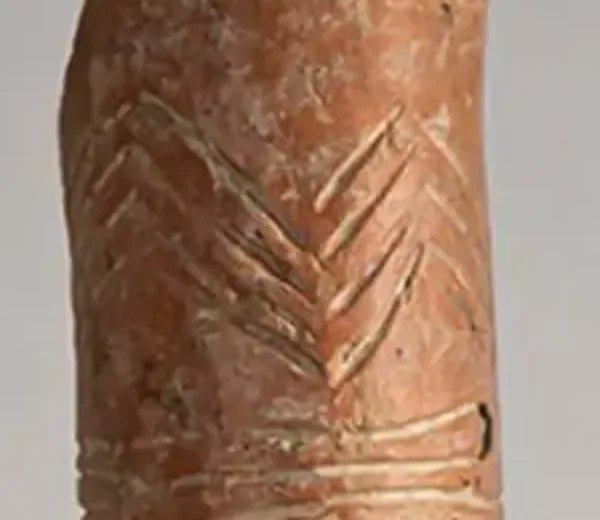
ChevronsStacked up the necks 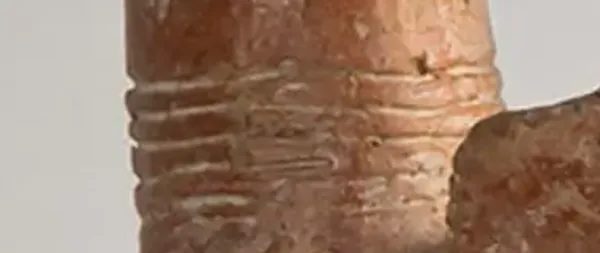
Ring bandsRound the necks 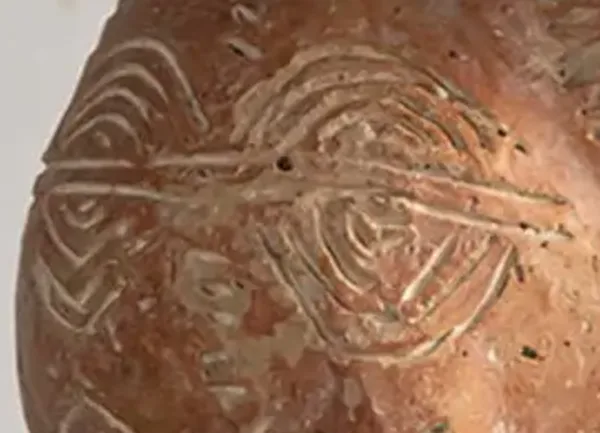
Concentric semicirclesOn the swellings of the necks 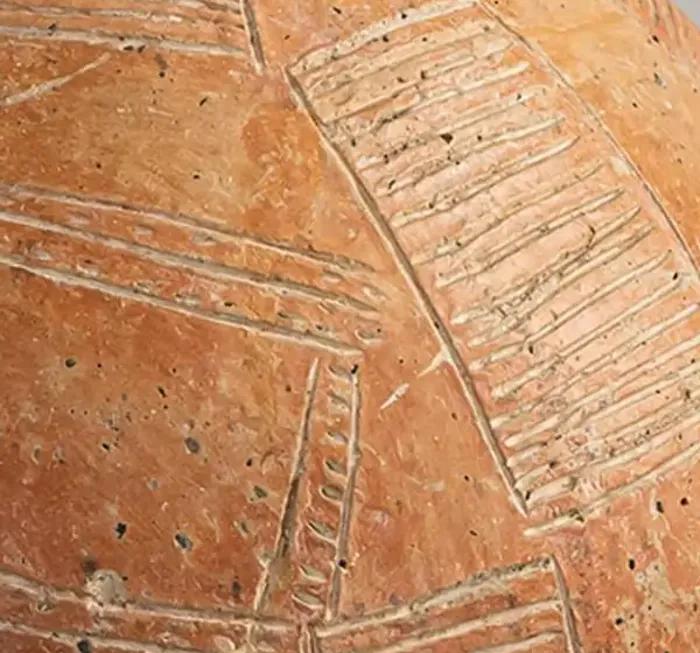
A hatched panelPart of the patchwork on the body 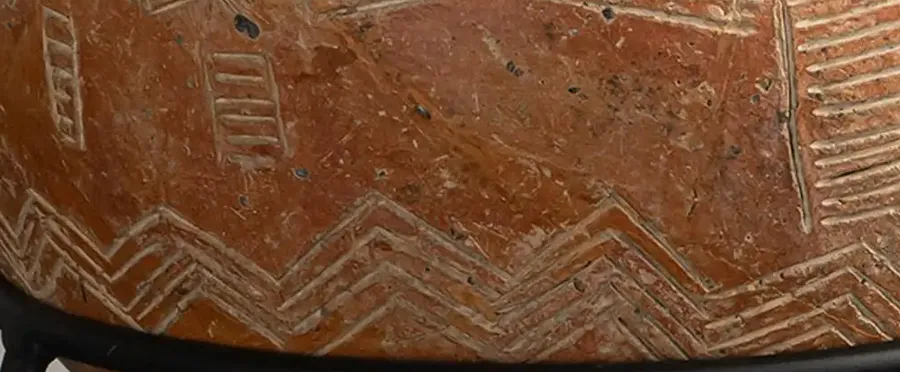
The zigzag bandLow on the body
1 · Incise
The pattern was cut into the leather-hard clay with a single sharp point. The soft, fine clay of the north coast takes a clean line without tearing.
2 · Slip
The pot was coated in slip, a thin wash of iron-rich red clay. On excavated pots the slip can be seen running down into the grooves.
3 · Burnish
While the clay was still leather-hard, the slip was rubbed to a shine with a smooth pebble. Between this jug’s necks the pebble could not reach, and the surface there stays dull.
4 · Fire
The pot was fired, most likely in an open fire or a pit. Analyses put most Red Polished firings at around 750–800 °C. With plenty of air in the fire, the iron in the slip turns red.
5 · Fill
Most specialists put the white paste last, pressed into the grooves after firing and the surface wiped clean: wet paste would have spoiled an unfired, burnished surface. At Alambra, a village in the centre of the island, the fill was chalk, limestone and sometimes burnt bone.
V · The meaning
What were the birds for?
Early Bronze Age potters in Cyprus modelled birds in clay and fixed them to their pots; they did not paint them. The birds perch on the rims of bowls, stand on the shoulders of jugs and rise between the necks of jugs like this one, and almost every one with a known find-spot comes from a tomb. What they meant is argued, and the arguments are not equally strong.
The firmest reading
Dikaios, who dug jugs of this type at Vounous, set the plain birds between the necks apart from his richer pieces: they ‘may be simply of ornamental character’. Karageorghis, cataloguing the whole class in 1991, found ‘no justification’ for a symbolic reading in the prehistoric period. A bird, he wrote, was ‘an easy enough motif to render’.
Why this potter doubled a bird that the jug’s closest relatives carry singly is unexplained.
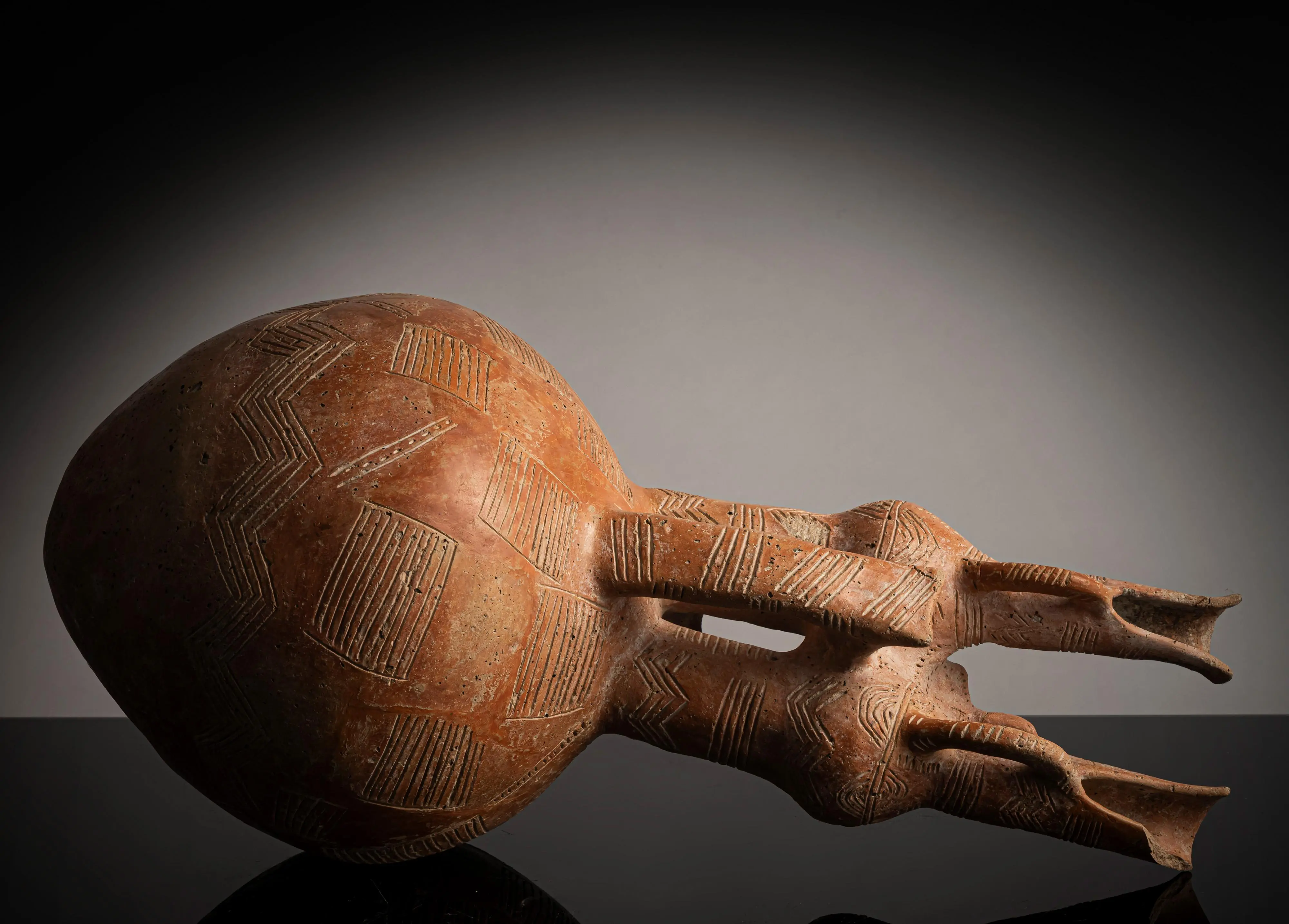
On the Tomb 19 jug the bird bends to drink from a tiny cup. On this one there is no cup. The two birds lean out over nothing.
Principal sources
- P. Dikaios, ‘The Excavations at Vounous-Bellapais in Cyprus, 1931–2’, Archaeologia 88 (1940).
- V. Karageorghis, The Coroplastic Art of Ancient Cyprus I (Nicosia 1991), group XII.
- D. Morris, The Art of Ancient Cyprus (Oxford 1985), pp. 86–88, 221–223.
- D. Frankel and J. M. Webb, pXRF study of prehistoric Bronze Age pottery, Journal of Archaeological Science 39 (2012).
- P. Keswani, Mortuary Ritual and Society in Bronze Age Cyprus (London 2004).
- J. M. Webb and D. Frankel, ‘Social Strategies, Ritual and Cosmology in Early Bronze Age Cyprus’, JMA 23 (2010).
- E. and J. R. Stewart, Vounous 1937–1938 (Lund 1950).
- Musée du Louvre, inv. AO 17526.