
Unnumbered pageScan 54 of 147
Continued from p. 51
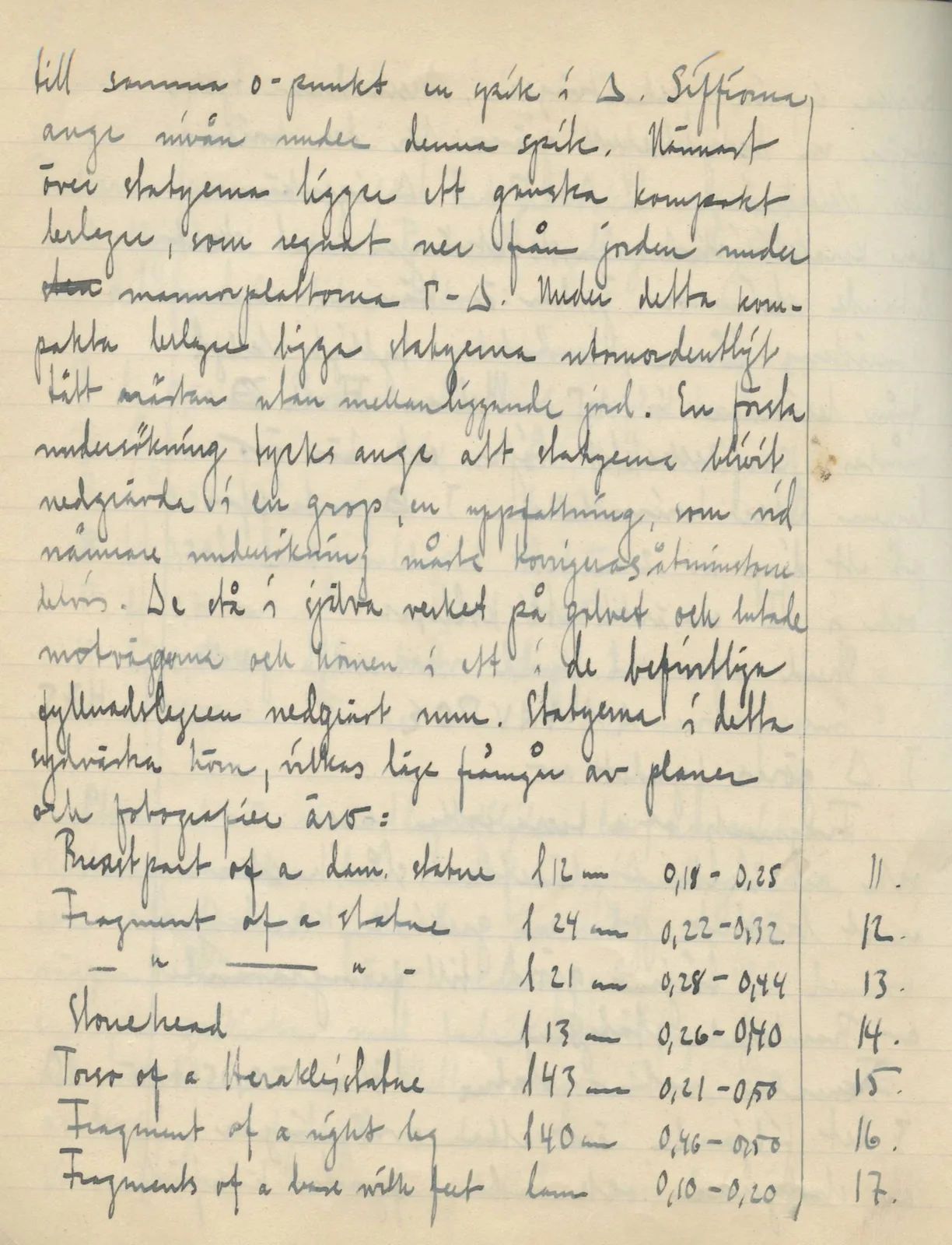
… to the same 0-point a nail in Δ. The figures give the level below this nail. Nearest above the statues lies a fairly compact clay layer, which has rained down from the earth under the marble slabs Γ–Δ. Under this compact clay layer the statues lie extraordinarily densely, almost without intervening earth. A first examination seems to indicate that the statues have been buried in a pit, an impression which, on closer examination must be corrected at least in part. They in fact stand on the floor and leaned against the walls and corners in a room sunk into the existing fill layers. The statues in this southwest corner, whose position is shown by plans and photographs are:
| Breastpart of a dam. statue | l 12 cm | 0,18 – 0,25 | 11. |
| Fragment of a statue | l 24 cm | 0,22 – 0,32 | 12. |
| – ” — ” – Fragment of a statue | l 21 cm | 0,28 – 0,44 | 13. |
| Stonehead | l 13 cm | 0,26 – 0,40 | 14. |
| Torso of a Heracles statue | l 43 cm | 0,21 – 0,50 | 15. |
| Fragment of a right leg | l 40 cm | 0,46 – 0,50 | 16. |
| Fragments of a base with feet | l cm | 0,10 – 0,20 | 17. |
65 figures hard to readstruck struck outadded written in above” jug ditto, and what it repeatsword reading not certain