
Unnumbered pageScan 36 of 147
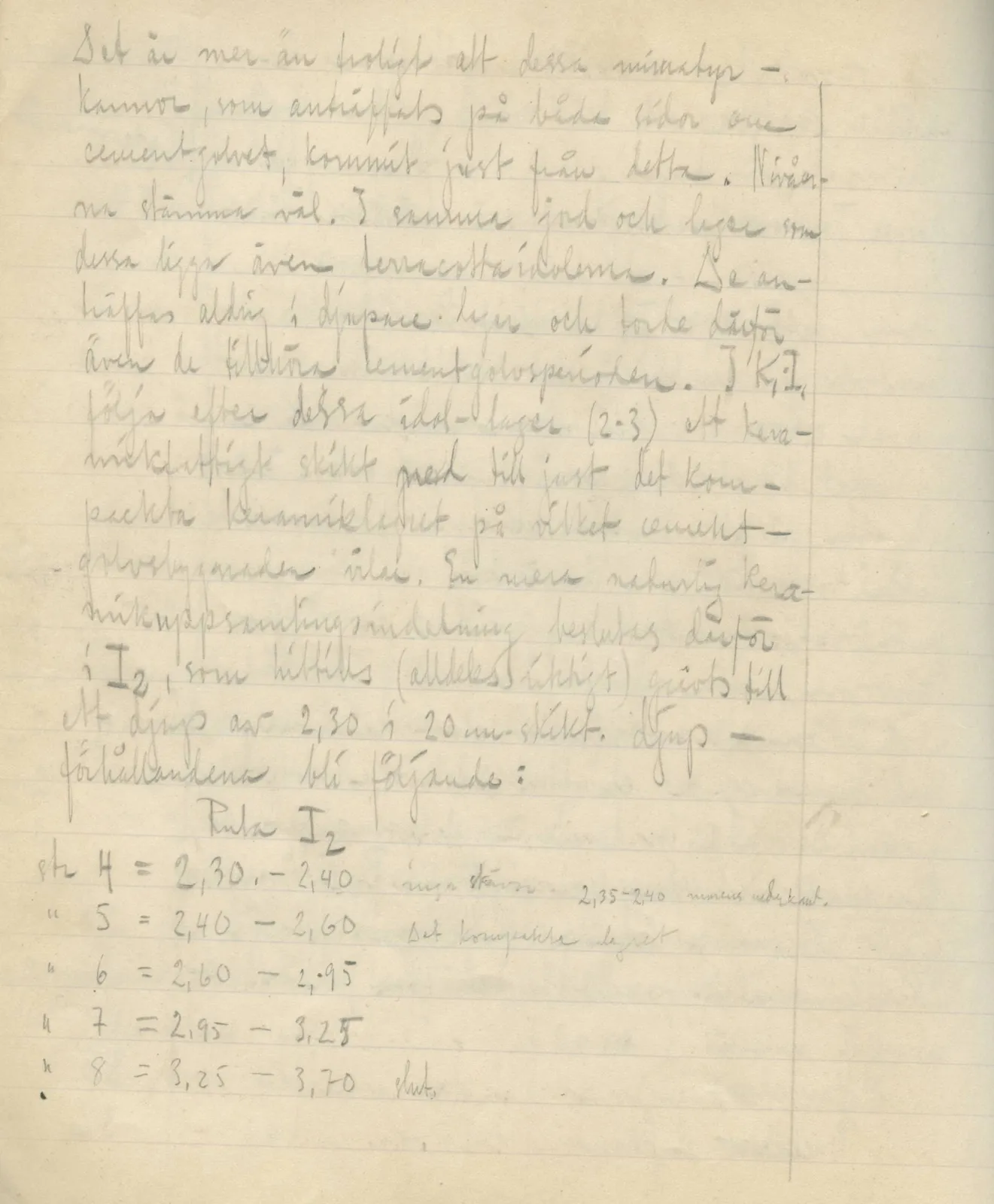
It is more than likely that these miniature - jugs, which were found on both sides of the cement floor, came precisely from this. The levels-agree well. In the same earth and position as these lie also the terracotta idols. They are never found in deeper layers and should therefore also belong to the cement floor period. In K, I, these idol layers (2-3) are followed by a pottery-poor level down to just the compacted pottery layer on which the cement-floor construction rests. A more natural pottery-collection division is therefore decided in I2, which hitherto (quite correctly) was made into 20 cm levels down to a depth of 2,30. The depth conditions will be as follows:
Square I2
| str 4 = 2,30.- 2,40 | no sherds 2,35-2,40 underside of the wall. |
| ” str 5 = 2,40 - 2,60 | The compacted layer |
| " 6 = 2,60 - 2,95 | |
| ” " 7 = 2,95 - 3,25 | |
| " 8 = 3,25 - 3,70 | end. |
65 figures hard to readstruck struck outadded written in above” jug ditto, and what it repeatsword reading not certain