
Page 154Scan 76 of 94
Margin left, pencil: Wall I lies on a thin bedding of red clay
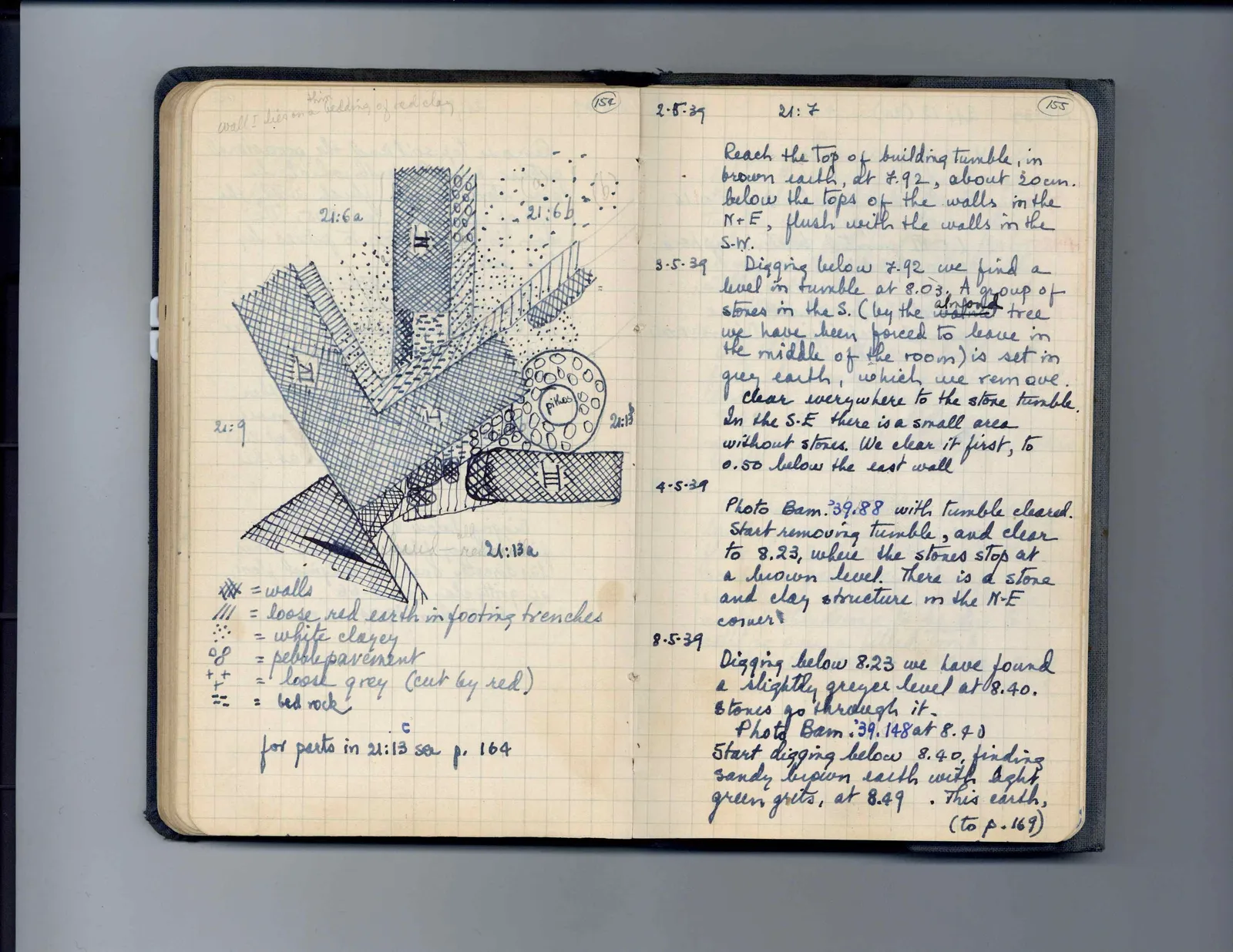
Drawing: plan of walls and features; labels: 21:6a, II, I, 21:6b, pithos, 21:13, III, 21:13a, 21:9
Drawing: legend:
[crosshatch] = walls /// = loose red earth in footing trenches \because = white clayey 0 & 0 \\ 0 & 0 = pebble pavement + + \\ + = loose grey (cut by red) \bar{-} \bar{-} = bed rock
for pots in 21:13 c see p. 164
Right page
| 2.5.39 | 21:7 |
Reach the top of building tumble, in brown earth, at 7.92, about 20 cm. below the tops of the walls in the N-E, flush with the walls in the S-W.
3.5.39 Digging below 7.92 we find a level in tumble at 8.03. A group of stones in the S. (by the walnut almond tree we have been forced to leave in the middle of the room) is set in grey earth, which we remove. Clear everywhere to the stone tumble. In the S-E there is a small area without stones. We clear it first, to 0.50 below the east wall
4.5.39 Photo Bam. '39. 88 with tumble cleared. Start removing tumble, and clear to 8.23, where the stones stop at a brown level. There is a stone and clay structure in the N-E corner.
8.5.39 Digging below 8.23 we have found a slightly greyer level at 8.40. Stones go through it. Photo Bam. '39. 148 at 8.40 Start digging below 8.40, finding sandy brown earth with light green grits, at 8.49. This earth, (to p. 169)
65 figures hard to readstruck struck outadded written in above” jug ditto, and what it repeatsword reading not certain