
Painting·PNT-00079·1785
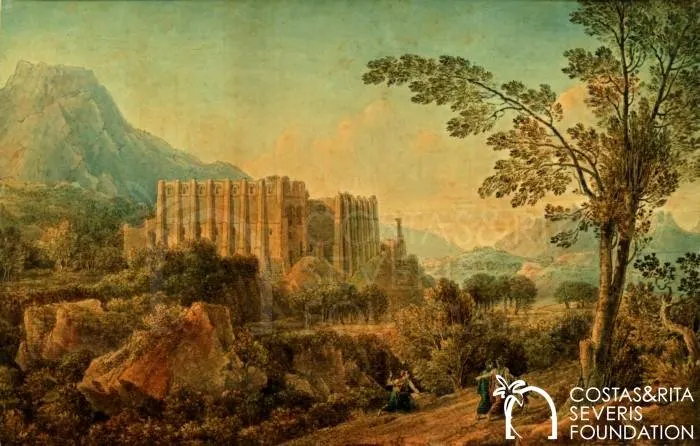
Vue des Ruines du Monastère de Cazzfone, Chypre
English, as on the record
Louis Francois Cassas was sent to the Near East by his patron Ambassador to the Porte Choiseul-Gouffier to produce sketches for his forthcoming book Le Voyage Pittoresque de la Syrie, de la Phoenicie, Palestine et la Basse Egypte. He came to Cyprus in 1785 on his way from Alexandretta to Egypt because of a storm. Six engravings of views of Cyprus are included in Choiseul-Gouffier’s book. Cassas made thirteen illustrations of Cyprus, two of these are still missing and references in the French archives indicate that these were of Amathus. The watercolour is one of three that exist made by Cassas of Cyprus. It is another view of the abbey, also known as Episcopia or the White Abbey, Abbee de la Paix, and Telabaise. Augustinian monks lived there until 1206 when Thierry, Archbishop of Cyprus authorized them to adopt Premonstratensian rule. The abbey flourished up until the end of Venetian rule when its influence declined and the French monks occupying the abbey allowed the buildings to fall into disrepair. Bellapais Abbey was abandoned in 1571 and only a small Christian church within the abbey remained in use. The area surrounding the edifice, being one of the most idyllic places in northern Cyprus, has been rendered faithfully. The lush vegetation envelopes and compliments the focal point of the painting and contributes to its grandeur. There are two women and a child walking up the path. On the left side, they have just passed an elderly man resting against a rock. The central figure, a taller woman looks at the beggar over her shoulder and points at him with an outstretched hand. This representation of the group, its presence and the costumes, is unusual and contrasts with the faithfulness characterising the landscape. No women in eighteenth century Cyprus would be walking in the countryside alone nor dressed in this manner. Women did not go out of their houses unless to the market or church and always accompanied by men. At the time Cypriots wore clothes that were a mixture of Greek and Turkish island costumes. Certainly the beggar is dressed in a Cypriot costume distinguishable by the blue pantaloon (vraka), the gilet and the red cap. But Cassas lived at a time when France was about to take its greatest social change, humanitarian ideas were triumphant and the smell of revolution in the air. The artist was also influenced by the Philhellenic attitudes of his patron Choisel-Gouffier. With all this in mind one may suggest that there is an allegory presented here. The women, wearing the Greek hlamyda could be part of the past history of the island, the abbey to which they are going the glorious past, and the beggar the present. Alternatively, the women may represent the “soul” of the Greek culture, a timeless ideal, which along with the ancient surviving monastery constitute the glory of the land. They are there to inspire their countrymen to rise to the heights of the past. Furthermore, could Cassas through the use of Greek clothing be identifying the inhabitants and the island with the Western world to which it once belonged. The artist has chosen to ignore the present political realities on the island and does not include in the picture any hint of Ottoman rule or presence. The landscape is so totally westernised that it could even be French.
Inscription, as transcribed by CVAR
Inscribed on back: Vue des Ruines du Monastère de Cazzfone, Chypre [View of the Ruins of Cazzfone Monastery, Cyprus]
Corrections and additions
Can you tell us more about this?
If you can identify, date or place this item, or know where else it is recorded, we would like to hear.
Missing from this record
- People shown not identified
We would like to hear about
- What it shows or records
- Its date, place or author
- Where else it is published or held
- A mistake in our description
Tell us if you would like to be thanked by name on the page.
More from Amathus
944 items in the archiveThe site →
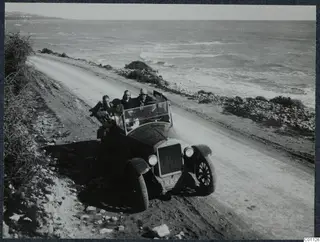 C01126Excursion to Limassol, with a stop at Amathus
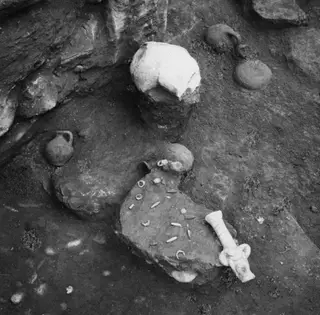 C02284Tomb 11 at Amathus, finds in situ
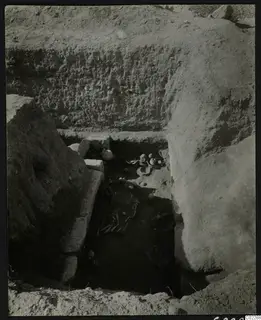 C02288Tomb 11 at Amathus, find in situ
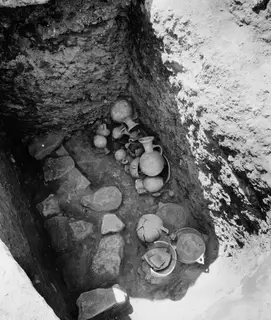 C02289Tomb 19 at Amathus, finds in situ
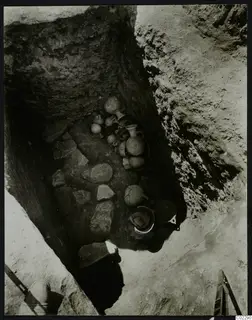 C02290Tomb 19 at Amathus, finds in situ
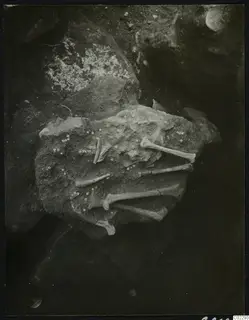 C02293Tomb 21 at Amathus, beads and bones in situ
Photographs: Swedish Cyprus Expedition, Medelhavsmuseet, Stockholm (CC0)