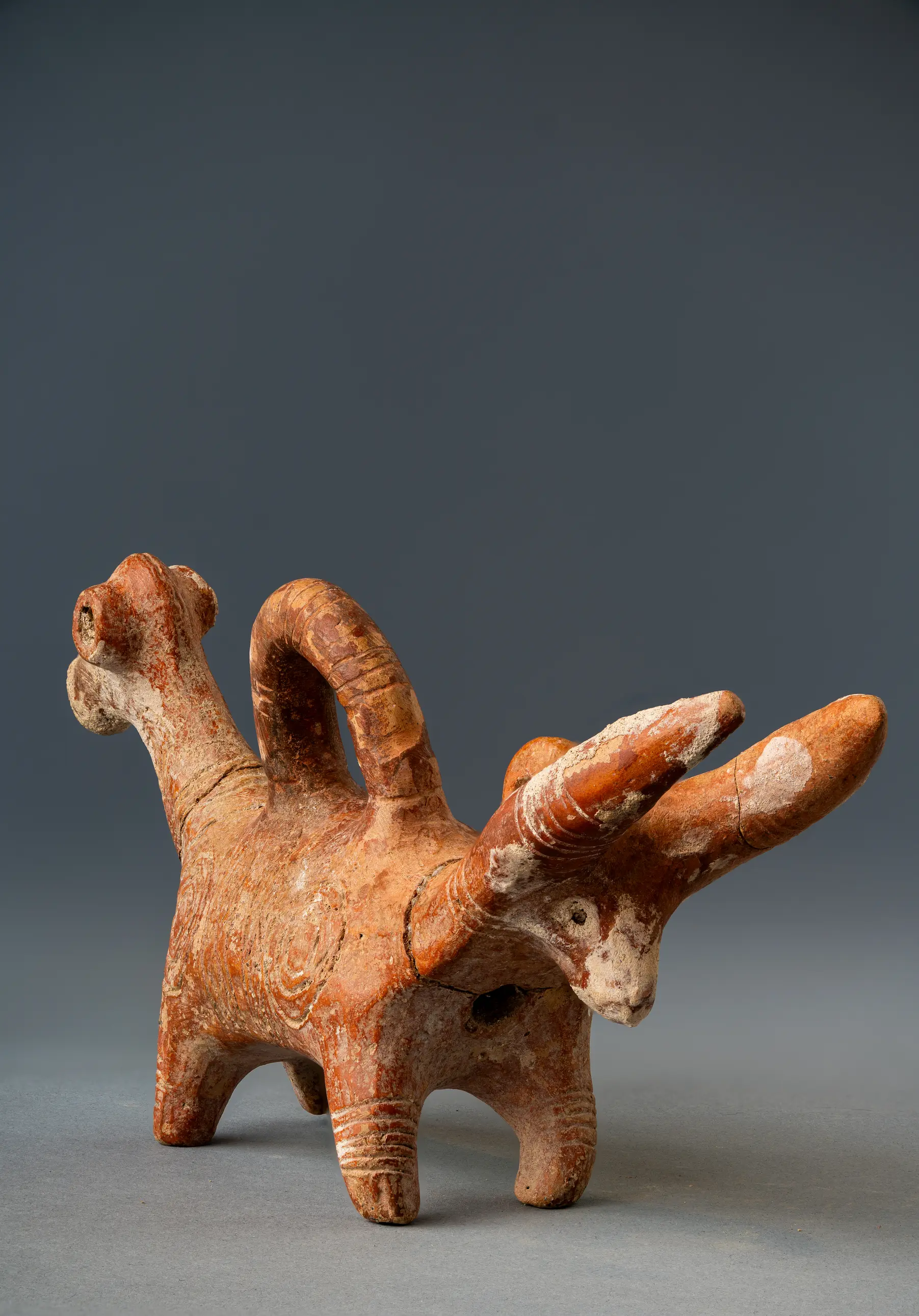
The Chalcolithic Period
Before the bronze — picrolite, pigment, and the first Cypriot image of the body
3900 – 2400 BCLong before the island learned to work copper at scale, it had already learned to make an image of itself. The Chalcolithic — the "copper-stone" age, running roughly from 3900 to 2400 BC — is the long prelude to everything the Bronze Age would become. Copper was known but barely used, hammered cold into the occasional small ornament rather than smelted; the real materials of the age were stone, bone and clay. Across the south and west of the island, at places such as Erimi, Lemba, Kissonerga and Souskiou, people lived in clusters of round, single-roomed houses, farmed and herded, and buried their dead close at hand. It is one of the few prehistoric Cypriot cultures we know from settlements as much as from graves.
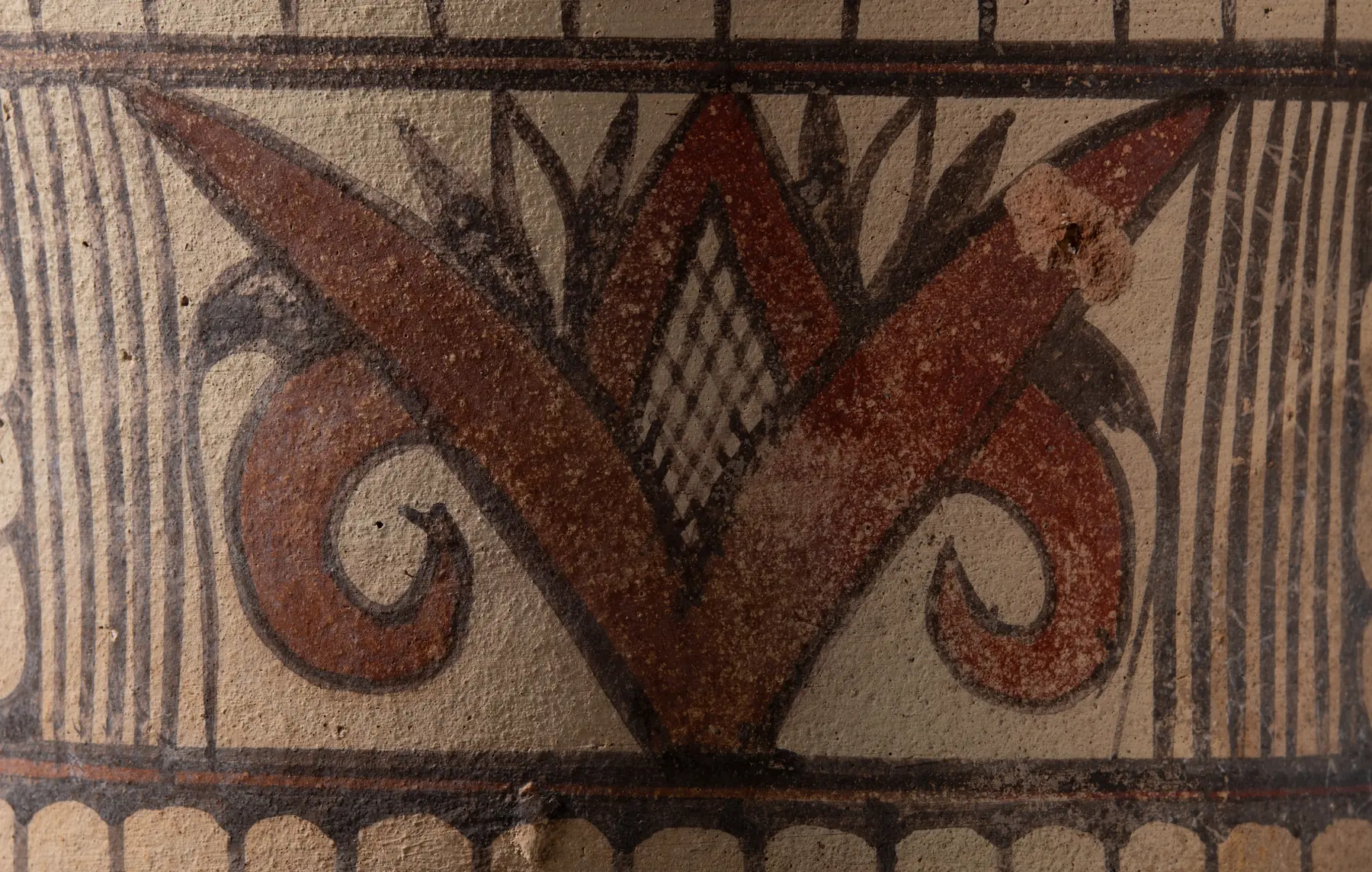
The pottery of the period is Red-on-White ware: pale-slipped vessels painted with red linear ornament, lattices and bands and the occasional spiral, the first sustained painted tradition on the island and a distant ancestor of the painted clay that runs through the rest of this collection. But the form that defines the Chalcolithic, and the reason it matters so much to a collector of Cypriot art, is carved not thrown. From a soft blue-green stone called picrolite, quarried from the bed of the Kouris river, the islanders cut small figures of the human body — most famously the cruciform figurine, a stylised person with arms flung straight out to either side, head tipped back, knees drawn up, pierced to be worn at the throat.
These figures are the first Cypriot images of the body, and they are everywhere bound up with birth and increase. Several show a squatting, birthing posture; one celebrated example wears a smaller cruciform figure as its own pendant, an image of an image hung at the breast. What they meant — goddess, ancestor, amulet, the marking of a life passage — is genuinely unsettled, and the honest posture before them is curiosity rather than conclusion. What is not in doubt is their reach: the cruciform figurine has become a visual shorthand for prehistoric Cyprus itself.
The collection's Chalcolithic holdings are still being assembled, and this section is the place they will come to live. What follows sketches the world these objects came from and singles out the form to watch for — the picrolite cruciform figurine — held here for now as a placeholder until the first pieces are catalogued.
In this section
The First Image of the Body
The Chalcolithic is the moment the human figure enters Cypriot art and does not leave it again. Earlier islanders had carved stone and shaped clay, but it is in these centuries that the body becomes a subject in its own right — small, portable, charged, and made to be worn. The vehicle is picrolite, a soft serpentine stone the colour of shallow sea, smooth to the touch and easy to cut with flint and abrasive, found as water-worn pebbles in the Kouris and its tributaries. Out of it the carvers made the cruciform figurine: a person reduced to a cross, the outstretched arms and the drawn-up legs balancing a tipped-back head, the whole no larger than a thumb and drilled through the neck to hang as a pendant.
Alongside the figures came the painted pottery. Red-on-White ware gave the period a second, gentler signature — pale vessels carrying red lattices, bands and hooked motifs, the linear discipline that would echo, three thousand years later, in the Geometric jars of this collection. Stone and clay together describe a society that had begun to ornament its world and to picture itself within it.
Because the collection's pieces from this era are still being gathered, the gallery that will fill this chapter is held open. In its place stands the object that speaks for the whole period — the cruciform figurine — presented as the masterpiece to come.
The Cruciform Figurine
A thumb-sized person carved from blue-green picrolite, arms flung wide — the image that has come to stand for prehistoric Cyprus itself.
Turn the figurine in 3D to read the outstretched arms, the tipped-back head and the drilled neck by which it was worn.
A Body in Blue-Green Stone
The cruciform figurine is one of the most economical images the ancient Mediterranean produced, and one of the most immediately legible. A human body is reduced to a cross: the arms are thrown straight out to either side, the head tips back on a long neck, and the legs are drawn up and folded so that the figure seems to squat in the air. Most are only a few centimetres tall, smaller than a thumb, and almost all are pierced through the neck so they could be strung and worn against the skin.
The material is the point. Picrolite is a soft, fine-grained serpentine, blue-green to grey-green, that takes a high polish and can be worked with flint blades and an abrasive paste rather than metal tools. The carvers found it as smooth pebbles in the rivers of the south-west and cut their figures directly from the rounded blanks, so that the finished form often still carries the memory of the water-worn stone it came from. The result is an object that is both severe and tender: geometric in its symmetry, intimate in its scale, and made to be held.
The Quarry on the Kouris
Picrolite is not found across the island. Its source is the bed of the Kouris river and its tributaries in the south-west, and the distribution of the figurines fans out from there — which is part of why the cemeteries and settlements of the Souskiou valley, near the Dhiarizos, loom so large in the study of the period. The Souskiou tombs in particular were rich in picrolite, and they are among the few Chalcolithic burial grounds set apart from a settlement, a distinction that has fed decades of argument about status, exchange and belief.
That a single soft stone, gathered from one corner of the island, should carry the period's most charged images is itself telling. The figurines travelled; the stone was sought out and worked into a standard form recognised the length of Cyprus. A responsible catalogue would resist pinning any single example to a named site without a secure excavated context — but it can say with confidence that the form belongs to a real place, and that the blue-green of the stone is the blue-green of the Kouris.
Birth, and the Reading of It
Whatever else they are, these figures are bound up with the body and with birth. A number of cruciform and related figurines are shown in a squatting, knees-apart posture that has been read, widely though not unanimously, as the moment of childbirth; some are explicitly female, others ambiguous or unmarked. The favoured interpretations gather around fertility, safe delivery and the marking of the passages of a life — a figure to be worn through pregnancy, deposited at a death, kept and curated within a household.
None of these readings is secure, and the honest position is that the debate remains open. The figures have been called goddesses, ancestors, amulets, and aids in childbirth; the truth may be that a single object did different work in different hands across its long life. What can be said plainly is that the Chalcolithic Cypriots chose, again and again, to render the human body in this one severe and frontal way, and to wear that image at the throat. The body is the subject; everything else is inference.
A Figure Wearing a Figure
The most famous object of the whole tradition makes the point better than any argument. It is a larger cruciform figurine, found in the Souskiou region and now a touchstone of Cypriot prehistory, which wears around its own neck a smaller cruciform pendant — an image of an image, the form quoting itself. Whatever the figurines meant, here is a Chalcolithic person, or god, or ancestor, shown doing exactly what their living owners did: wearing the cross-shaped body as an ornament and a charm.
That single detail is why the cruciform figurine has become a kind of emblem for the island's deep past, reproduced on coins, stamps and museum logos. It compresses a whole prehistoric sensibility into a few centimetres of river stone: the body made portable, the sacred made wearable, and the unmistakable sense of a people picturing themselves long before they could write.
On Assembling This Section
A note for revision, to be replaced as the collection grows. The collection does not yet hold a catalogued Chalcolithic piece; this entry is a deliberate placeholder for the cruciform picrolite figurine the collector intends this section to be built around, and it is presented as a draft so that nothing here is mistaken for an object already in hand.
[DRAFT, to verify: when the first Chalcolithic pieces are acquired and catalogued, the masterpiece's artifact id, images, dimensions and provenance should be set against the record, and the placeholder language above removed. Any association with a specific site such as Souskiou should be claimed only as far as the documentation allows, distinguishing a secure find-spot from a stylistic attribution and from a market provenance.] What the section is reaching for is plain enough: to begin the journey not with the bronze, but with the stone — and with the first moment a Cypriot hand cut the shape of a person and hung it at the throat.
“The body made portable, the sacred made wearable — a people picturing themselves long before they could write.”